




ODM Kitchenware Supplier: How to Build a Cohesive Private-Label Line
Choosing an ODM kitchenware supplier is different from buying a few off-the-shelf utensils. For private-label buyers, the goal is not only to fill a catalog with knives, graters, scissors, whisks, choppers, oil dispensers, and cutting boards. The goal is to create a kitchenware line that feels consistent in the hand, looks coherent on a shelf, photographs well online, and can be reordered without quality drift.
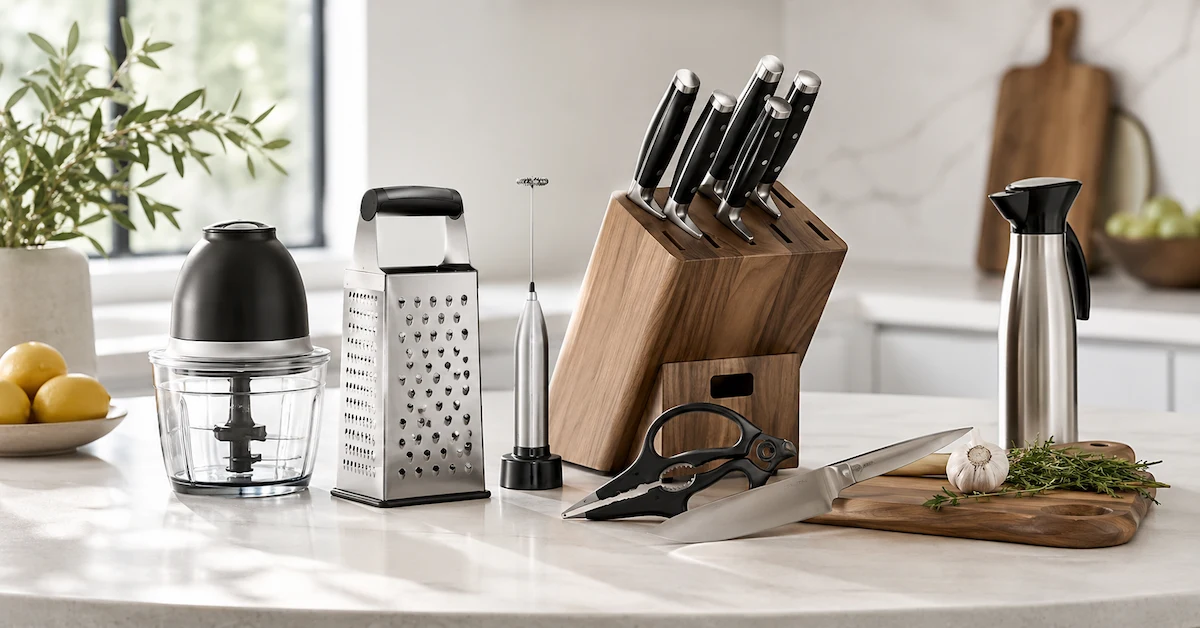
The original product image shows a coordinated kitchenware assortment: a knife block set, handheld food chopper, box grater, whisk, kitchen scissors, knives, an oil dispenser or spray bottle, and a cutting board. The visual language is clear: stainless-looking metal surfaces, black accents, and wood tones. For a retailer, distributor, importer, or e-commerce brand, that kind of assortment can become the foundation for a private-label line. The real sourcing question is whether the supplier can support it reliably.
Key Takeaways
- An ODM kitchenware program should be evaluated as a complete product line, not as separate items only.
- Mixed materials such as metal, plastic, and wood-grain components require extra attention to finish consistency and fit.
- Buyers should ask suppliers clear questions about customization, packaging, samples, inspection standards, and reorder consistency.
- A cohesive assortment can support retail displays, online bundles, starter kits, and category expansion when sourced carefully.
What Makes ODM Kitchenware Sourcing Different?
ODM sourcing usually means the supplier already has product concepts, molds, designs, or coordinated assortments that can be adapted for a buyer’s brand. This is useful when a company wants to launch faster than a fully custom OEM project, but still needs a more distinctive result than generic catalog sourcing.
In kitchenware, this matters because shoppers compare products quickly. If a knife block, grater, chopper, and oil dispenser look unrelated, the brand feels fragmented. A good ODM supplier should help buyers create a common design direction across handle colors, finishes, packaging, and product naming. However, buyers should not assume that a visually coordinated display proves the supplier can manage every product category equally well.
How to Read a Coordinated Kitchenware Assortment
A broad kitchenware set tells buyers a lot about the supplier’s sourcing and development capabilities. Each item introduces a different production concern. A knife block involves stable slots, surface finish, and safe blade storage. Knives require attention to blade finishing, handle assembly, balance, and edge treatment. A grater involves metal forming and user-safe edges. A handheld chopper introduces molded plastic parts, lid fit, and blade assembly. A whisk and kitchen scissors may look simple, but they still need comfortable grip, tension, and repeatable assembly.
The oil dispenser or spray bottle adds another layer: sealing, dispensing performance, and finish alignment. The cutting board brings questions about surface treatment, moisture behavior, and warping risk. In other words, a kitchenware line is not one product. It is a small supply chain packaged as one brand story.
Comparison Checklist for Supplier Evaluation
Before committing to an ODM kitchenware supplier, compare candidates using the same criteria. This helps prevent decisions based only on price or catalog photos.
| Evaluation Area | What to Check | Questions to Ask the Supplier |
|---|---|---|
| Product scope | Which items are available as individual SKUs or bundles | Can the assortment be sold as a set, or are the items quoted separately? |
| Materials | Metal, plastic, wood or wood-grain components, surface finish | What material options are available, and how are they specified in the quote? |
| Customization | Handle color, logo placement, packaging, item mix | Which parts can be customized without new tooling? |
| Sample quality | Fit, finish, edge treatment, grip comfort, packaging accuracy | Will production samples match the approved sample standard? |
| Quality control | Inspection points across mixed product categories | What checks are performed before shipment, and how are defects documented? |
Material and Build Details Buyers Should Review
Several items in the display appear to use stainless-looking metal surfaces, black components, and wood or wood-grain elements. Buyers should avoid making assumptions about grades, coatings, or performance unless these details are confirmed in supplier documentation. Instead, request written material callouts and compare them with physical samples.
For metal items such as knives, graters, scissors, whisks, and oil containers, review surface consistency, burrs, edge safety, and corrosion-related claims carefully. If the product is intended for food contact, ask what documentation the supplier can provide for the destination market, without assuming certification exists.
For plastic components, especially the handheld chopper, inspect clarity, wall thickness, lid fit, odor, impact resistance, and how the blade assembly is secured. For wood or wood-grain pieces, ask about surface treatment, moisture behavior, cleaning instructions, and expected variation in appearance.
Building a Private-Label Line Instead of a Random Bundle
A strong private-label kitchenware line should have a clear structure. Buyers can usually start with a core prep range and expand later. For example, a practical first assortment might include a knife block set, cutting board, grater, whisk, scissors, and chopper. The oil dispenser or spray bottle can become an add-on item or part of a cooking-prep bundle.
When planning the line, consider:
- Use case: Is the line for everyday home cooking, gifting, starter apartments, retail fixtures, or online bundles?
- Price ladder: Which items are entry-level traffic drivers, and which are higher-value sets?
- Packaging format: Will products be boxed individually, bundled, or merchandised together?
- Replacement logic: Can popular items be reordered without forcing buyers to reorder the full set?
- Brand consistency: Do colors, finishes, labels, and photography guidelines match across the line?
Common Mistakes in ODM Kitchenware Buying
One common mistake is over-bundling. A large set can look attractive in a presentation, but it may be expensive to ship, difficult to merchandise, and too broad for the target shopper. A focused assortment often performs better than a crowded one.
Another mistake is judging only the hero item. Buyers may spend most of the evaluation on the knife set while ignoring the chopper lid, scissor tension, grater handle, or oil dispenser seal. Customers notice weak points quickly, and one poor item can reduce confidence in the whole brand.
A third mistake is failing to define the approved standard. If the supplier receives only general comments such as “make it premium” or “keep the black finish consistent,” production teams may interpret the requirement differently. Use approved samples, photos, written specifications, packaging files, and inspection criteria to reduce ambiguity.
Questions to Ask Before Placing an ODM Order
Commercial details should be confirmed directly with the supplier instead of assumed. Before moving from sample review to order planning, buyers should ask:
- What is included in the quoted assortment, and what is optional?
- Which components can be customized through color, logo, packaging, or configuration?
- Are any tooling changes required for the requested private-label version?
- What sample process is used before mass production?
- How are material specifications recorded and controlled during repeat orders?
- What packaging options are available for retail, e-commerce, or wholesale distribution?
- What inspection steps are used for metal parts, plastic parts, wood-based parts, and final packing?
- What are the current lead time, MOQ, payment terms, and shipping options?
Practical FAQ
What is an ODM kitchenware supplier?
An ODM kitchenware supplier provides existing or supplier-developed product designs that buyers can adapt for their own brand. This may include changes to packaging, colors, logos, or assortment structure, depending on the supplier’s capabilities.
Is ODM better than OEM for private-label kitchenware?
ODM is often faster when the buyer can work from existing designs. OEM may be better when the buyer needs a fully custom product. The right choice depends on budget, timeline, tooling needs, and how unique the product must be.
Should buyers source every kitchenware item from one supplier?
Not always. One supplier can simplify coordination, but buyers should confirm whether that supplier can control quality across all categories. If some items are outsourced, ask how the supplier manages specifications and inspections.
What should be checked in kitchenware samples?
Check fit, finish, grip comfort, sharp or rough edges, packaging accuracy, color consistency, lid or seal performance, and whether the samples match the written quotation. For private label, also verify logo placement and packaging artwork.
Final Sourcing Advice
When screening an ODM kitchenware supplier, start with one coherent assortment rather than many unrelated samples. Ask for the item list, material callouts, customization options, packaging choices, and quality control process. Then evaluate whether the supplier can explain the collection as a retail-ready program, not just a group of products. That is where a capable private-label partner becomes easier to identify.
