








When a kitchenware bundle needs to look retail-ready and still make sense for buyers
An ODM kitchenware supplier is often the difference between a generic assortment and a sellable product line. For sourcing managers, the real issue is not whether a kitchen set can be made; it is whether the set feels coherent, meets the right price band, and works across home kitchens, gift channels, and everyday food prep without creating headaches later. A bundle can look attractive in a product photo and still fail when the buyer starts asking about material consistency, packaging, replacement parts, or how the pieces fit together on a crowded counter.
That is why kitchenware sourcing is rarely just about filling a carton. It is about deciding whether the set supports the way customers actually cook: chopping, slicing, grating, whisking, mixing, juicing, and serving. The wrong combination can make the assortment feel padded. The right one gives retail teams a neat story and gives end users tools they will actually keep within arm’s reach.
What this style of kitchenware set is trying to solve
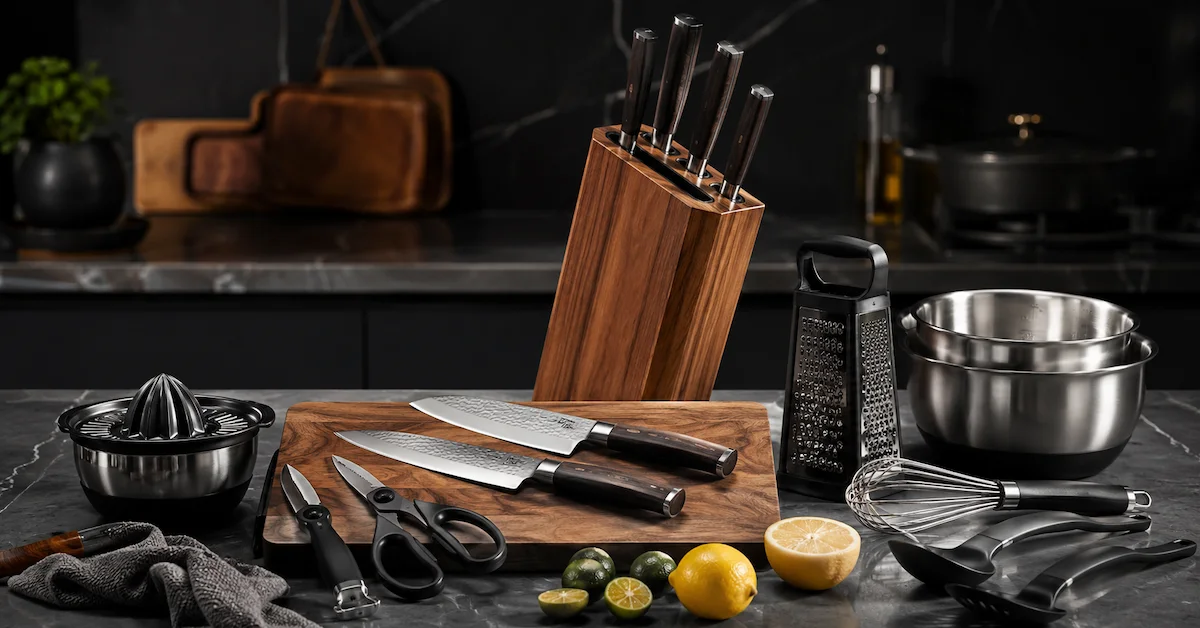
The visible product mix points to a coordinated kitchen utensil set built around everyday prep tasks. There are knives in multiple sizes, a vertical knife block, a rectangular cutting board with rounded corners, a box grater, a handheld citrus juicer, nested stainless-steel mixing bowls, a whisk, tongs, a spatula or turner, a ladle, and kitchen shears. In other words, the set tries to cover the middle ground between basic starter kits and more complete countertop bundles.
That matters because buyers in retail and B2B channels are often looking for a single purchase that solves several jobs at once. A home goods chain may want a giftable set. A hotel or catering buyer may want a practical backup assortment. A private-label brand may want a visually consistent line that can be merchandised as one SKU family or split into subcategories later.
The product styling also tells a story. Dark handles, wood or wood-look accents, stainless steel bowls, and black utensils create a muted, modern appearance. That look tends to work well on shelf and in online listings because it reads as coordinated rather than cluttered. Still, buyers should be careful: attractive visual harmony does not automatically mean the manufacturing details are equally harmonized.
Why sourcing this category is more complicated than it looks
Kitchenware is one of those categories where small details carry a lot of weight. The knife blades may be stainless steel, but blade type, edge retention, and balance can vary widely. The wood elements may be solid wood, bamboo, composite, or wood-look construction. The bowls may be fine for general mixing, yet the surface finish and rim design can change how they pour and stack.
A custom kitchenware supplier needs to make these parts work together in both appearance and production. If the knives are made one way and the wooden block another, the set can end up with mismatched tones or a poor fit. If the handles are too glossy while the bowls are highly reflective, the bundle can look busy instead of premium. These are not abstract design concerns; they show up in buyer feedback, return rates, and shelf appeal.
There is also the operational side. Bundled kitchenware sets must be packaged well enough to survive transit, yet remain easy for the customer to open and store. Knife blocks, cutting boards, and nested bowls can shift in shipping if the internal layout is not thought through. That is the sort of issue a seasoned OEM kitchenware manufacturer should anticipate early, before tooling and packaging are locked.
Quick reference: what each component contributes
Cutting and slicing tools
The knife selection gives the set its core utility. Multiple blade sizes allow basic prep work without forcing the user to reach for separate tools immediately. The vertical slotted block is useful because it keeps blades organized on the countertop and reduces loose storage. From a buyer’s perspective, that also improves perceived value.
Prep surfaces and bowls
The cutting board and nested stainless-steel mixing bowls handle two different parts of the prep flow: one for cutting, one for mixing and holding ingredients. Stainless bowls are especially familiar to kitchen users because they are light, durable in feel, and easy to stack.
Secondary prep tools
The grater, citrus juicer, whisk, tongs, spatula or turner, ladle, and shears cover everyday support tasks. These pieces often make the difference between a “knife set” and a true kitchen bundle. Buyers should pay attention to handle comfort here; these are the parts people hold for longer stretches than they expect.
What to ask an ODM kitchenware supplier before placing an order
When a sourcing team evaluates an ODM kitchenware supplier, the first question should not be “Can you make this?” It should be “Can you make this consistently, and can you document the build in a way our market can support?”
A practical inquiry list usually includes:
Material confirmation for each component, especially blades, handles, bowls, and wood elements
Whether the knives are stamped or forged, if that distinction matters for your positioning
How the wood-look surfaces are created and whether the finish will hold up in use
Packaging format and how each part is protected in transit
Whether the set can be branded as a full bundle or divided into separate SKUs later
What visual customization is possible without changing the underlying structure too much
That last point matters more than some teams expect. A custom kitchenware supplier can often adjust colors, logos, packaging, and surface styling more easily than core geometry or material construction. Buyers who want a faster launch usually do better by customizing the visible features first and leaving deeper engineering changes for a later cycle.
Selection criteria that actually affect sell-through
A kitchenware bundle wins or loses on a few practical tests. The first is coherence. The set should feel like one family, not a stack of unrelated commodity items.
The second is usability. If the included pieces overlap too much, the assortment becomes wasteful. If it is too thin, buyers see it as incomplete. The product shown here leans toward a balanced middle, although the exact final piece count is not visible, so sourcing teams would still want a full specification sheet.
The third is storage. A knife block helps the set sit neatly on a countertop, but only if the rest of the items can be tucked away cleanly. Nested bowls are a good sign. Rounded corners on the cutting board also help with easy handling and fewer sharp visual edges in the package.
The fourth is material contrast. Dark handles and wood tones can look elegant, but they need to be controlled. Too many finishes in one bundle can make the set look like a sample box rather than a retail product.
Common mistakes buyers make in this category
One common mistake is over-specifying the marketing language before confirming the manufacturing details. A set may be described as premium, but if the blade grade, handle composition, or wood structure is not fully agreed, the supplier cannot support that positioning cleanly.
Another mistake is treating every piece as equally important. In reality, the knife block, knives, and bowls do most of the visual work. The whisk or ladle may be smaller items, but they still need a finish that matches the broader set. If those smaller pieces look cheaper, the whole bundle feels downgraded.
A more practical warning: do not assume that a pretty kitchen bundle is automatically dishwasher safe, heat resistant, or suitable for all food-contact expectations. Those claims need to be confirmed. It is better to leave a feature off the sales copy than to discover a mismatch after launch.
How this kind of set fits different channels
For retail, the appeal is obvious. The set photographs well, the color palette is calm, and the components are easy to understand at a glance. That makes it useful for online listings and shelf displays.
For gifting, coordinated kitchenware carries a simple advantage: it looks complete. Buyers often prefer a bundle that seems ready to use rather than a loose collection of tools.
For foodservice or catering, the value is in backup utility. Some operators may not want a decorative set, but they do appreciate organized countertop tools that are easy to identify and replace.
For private label, the set offers a decent platform because the product family already has a defined visual language. That gives room for brand marks, packaging changes, and line extensions without rebuilding everything from scratch.
FAQ for sourcing teams
Is this more suitable for OEM or ODM?
It can suit both, but the visible product presentation leans toward ODM because the assortment already looks designed as a coordinated set. If a brand wants faster market entry, that is useful.
Can the set be sold as one bundle or separate items?
Possibly, but that depends on how the supplier structures the line. Since the exact commercial arrangement is not provided, buyers should confirm whether the items are tied to a single SKU or can be split.
What should be checked first in samples?
Fit, finish, balance, nesting, and the consistency of surface color across wood, metal, and coated parts. Small mismatches become obvious once the items sit together on a table.
What if the buyer wants a more premium look?
Focus on the visible surfaces first: handle finish, block grain appearance, bowl polish, and packaging presentation. Those elements move perception faster than hidden structural changes.
A sensible next step for buyers
If you are shortlisting an ODM kitchenware supplier, start with the components that shape the first impression: knives, block, bowls, and the overall color/material balance. Then ask for a clear component-by-component specification, sample photos, and packaging layout before you discuss branding details. That sequence saves time and prevents a lot of awkward backtracking later.
For teams building a private-label kitchen line, the best move is usually to judge the set as a system, not a pile of parts. When the materials, storage format, and visual style all line up, the assortment becomes easier to sell and easier to support. When they do not, even a large bundle can feel oddly thin.
