




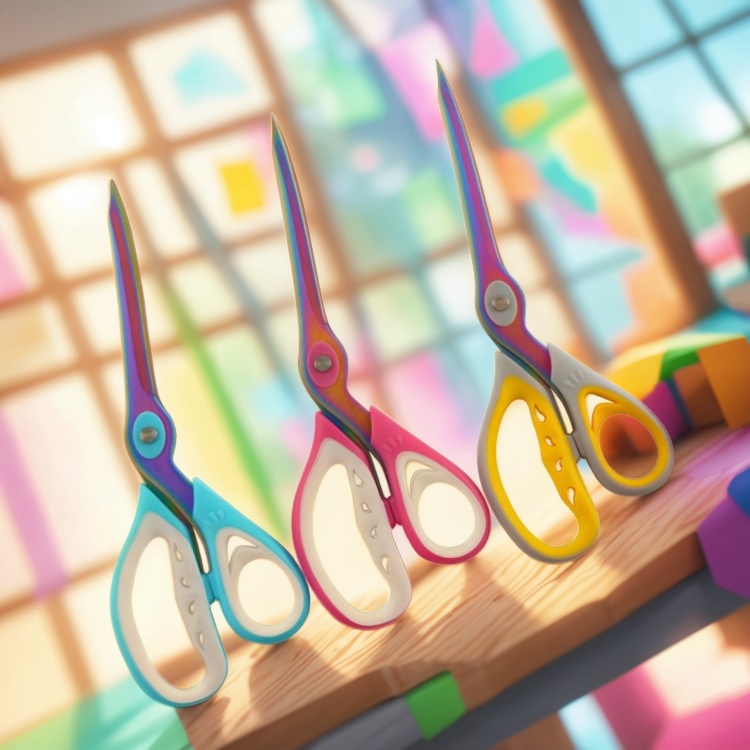
OEM Household Scissors: Custom and Wholesale Options
OEM household scissors are everyday cutting tools supplied under a buyer’s brand, packaging concept, or product line. For retailers, distributors, promotional product companies, and homeware brands, they can be a practical category because scissors are used in homes, schools, offices, craft rooms, and sewing kits. The key sourcing challenge is not simply finding the lowest unit price. Buyers need to compare cutting performance, handle comfort, packaging, consistency, and the supplier’s ability to support custom requirements.

This guide explains how to evaluate OEM and wholesale household scissors without assuming unverified specifications. Use it as a checklist when discussing a new scissors project with a factory, trading company, or sourcing partner.
What OEM Household Scissors Usually Involve
In an OEM arrangement, the buyer typically provides branding direction while the supplier manufactures or sources the scissors according to agreed requirements. Depending on the supplier’s capability, customization may include handle colors, packaging artwork, logo placement, blade finish, assortment packs, and retail display formats. Some products in the household scissors category may feature visual finishes such as a titanium-style or rainbow-tinted blade coating, while some designs may use soft-grip handles in pastel shades. These details should always be confirmed with the supplier through samples and written specifications.
Household scissors can serve different end uses, so buyers should define the intended application before requesting a quote. General-purpose kitchen drawer scissors, craft scissors, school scissors, office scissors, and sewing scissors may look similar but require different expectations for blade sharpness, handle size, tip shape, and packaging warnings.
Why Many Buyers Consider Chinese Factory Scissors
Chinese factory scissors are widely considered by global buyers because the supply base is broad and can support many price points, designs, and packaging formats. However, “made in China” does not automatically mean a product is either high quality or low quality. The outcome depends on the specific factory, materials, tooling, process control, and inspection standards.
When comparing suppliers, ask whether they are the actual manufacturer or a trading company, what parts of the production process are handled in-house, and how they control outsourced steps such as coating, printing, or packaging. A transparent supplier should be able to explain how samples are made, how mass production is checked, and what tolerances are realistic for the design.
Customization Options to Discuss Before Quoting
Clear specifications reduce misunderstandings and help suppliers provide comparable quotations. Instead of asking for “good scissors,” create a short product brief with the intended retail channel, target user, preferred price range, and packaging style.
- Size and shape: Confirm overall length, blade length, handle opening, tip shape, and whether the design is for adult or child use.
- Blade finish: Ask what finishes are available and what each finish is intended to do. Do not assume durability or corrosion performance without test data.
- Handle design: Discuss color, grip feel, left-hand or right-hand use, and comfort for repeated cutting tasks.
- Branding: Confirm where a logo can be placed, whether it is printed, engraved, labeled, or added only to packaging.
- Packaging: Options may include blister cards, paper cards, hang tags, boxed sets, or bulk packaging for institutional channels.
- Assortments: Retailers may request multiple colors, sizes, or set combinations in one carton.
Comparison Checklist for Wholesale Household Scissors
Wholesale buyers should compare suppliers with the same checklist. This prevents a low quote from hiding weaker packaging, unclear inspection terms, or inconsistent finishing.
| Evaluation Area | What to Check | Questions to Ask the Supplier |
|---|---|---|
| Cutting performance | Clean cutting on intended materials such as paper, thread, fabric, or light packaging | What materials are used for sample cutting tests, and can the buyer define the test? |
| Handle comfort | Grip size, edge smoothness, pressure points, and ease of opening | Can handle samples be reviewed before confirming color and tooling? |
| Finish consistency | Blade appearance, coating uniformity, scratches, burrs, and alignment | What visual defects are acceptable or unacceptable in mass production? |
| Packaging | Retail presentation, barcode area, warnings, carton strength, and language needs | Who supplies artwork, and will a pre-production packaging sample be provided? |
| Commercial terms | MOQ, lead time, payment terms, sample charges, and shipping method | Are the quoted terms for stock items, custom colors, or fully customized packaging? |
Quality Checks Before Mass Production
Before approving a wholesale order, request samples that match the expected production version as closely as possible. A photo is not enough for scissors because cutting feel, balance, and handle comfort must be tested by hand. If the product is intended for a particular category, such as craft use or sewing, test it with realistic materials rather than only thin paper.
Buyers should also clarify inspection standards in writing. This may include checking blade alignment, opening and closing smoothness, handle defects, printed logo position, packaging condition, carton labeling, and quantity accuracy. If third-party inspection is required, ask the supplier whether they can support it and at which production stage inspection is recommended.
Wholesale Ordering and Packaging Planning
Wholesale household scissors often compete on shelf presentation as much as the tool itself. Packaging should protect the blades, communicate the intended use, and fit the buyer’s retail or distribution environment. For e-commerce, packaging may need to survive parcel handling. For supermarkets or discount stores, hang-hole strength and barcode readability may be more important. For schools or office suppliers, multipacks and clear product identification can simplify purchasing.
When planning the order, ask the supplier to separate costs for the scissors, customized packaging, inner cartons, master cartons, and any optional display units. This makes it easier to compare quotations and decide where customization provides value.
Key Takeaways
- OEM household scissors should be specified by use case, size, handle design, blade finish, packaging, and branding needs.
- Do not rely only on catalog photos; request samples and test cutting performance with realistic materials.
- For Chinese factory scissors, verify whether the supplier manufactures directly and how quality is controlled.
- Wholesale pricing should be reviewed together with MOQ, lead time, packaging cost, inspection terms, and shipping details.
- Any claims about coating, durability, safety, or compliance should be supported by supplier documentation, not assumed.
Practical FAQ for B2B Buyers
What information should I send when requesting an OEM scissors quote?
Send the target size, intended use, preferred handle color, blade finish, logo requirement, packaging type, estimated order quantity, destination market, and any testing or labeling requirements. A reference photo can help, but written specifications are more reliable.
Can household scissors be customized for private label retail?
Often yes, depending on the supplier. Common private label options include packaging artwork, color selection, logo placement, and assortment planning. Buyers should confirm which options require additional tooling, longer lead time, or higher MOQ.
How do I judge whether a wholesale price is fair?
Compare quotes only when the specifications are the same. A lower price may exclude custom packaging, use a different finish, have a higher defect allowance, or assume a larger order quantity. Ask for a detailed quotation instead of a single unit price.
Should I request a pre-production sample?
Yes. A pre-production sample helps confirm the final handle color, blade appearance, logo position, packaging layout, and cutting feel before mass production begins.
What supplier claims should be verified?
Verify any claims related to material grade, coating performance, corrosion resistance, safety compliance, certifications, and test results. Ask for documents or test reports when those details matter for your market.
