





OEM Household Scissors: Sourcing Guide for Buyers
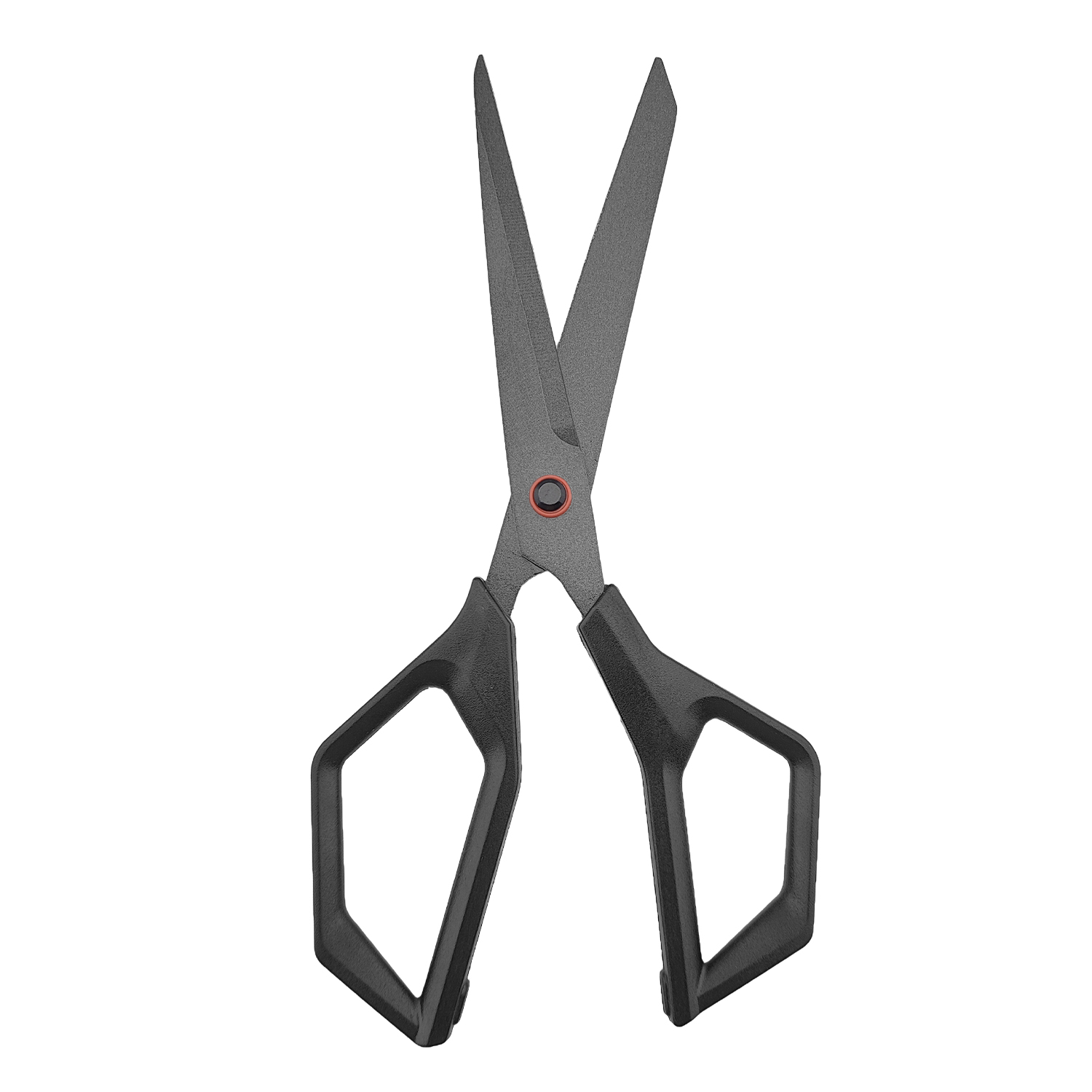
OEM household scissors are a common but important product category for homeware brands, retailers, distributors, promotional buyers, and private-label importers. A pair of scissors may look simple, yet the buying decision involves blade material, cutting feel, handle comfort, packaging, branding, inspection standards, and long-term user expectations. For B2B buyers, the goal is not only to find a product that looks attractive, but also to confirm that the supplier can deliver consistent quality across repeated orders.
The original product description highlights household scissors with stainless steel blades, ergonomic handles, a geometric design, a matte black finish, and a lightweight structure. It also describes their use for everyday tasks such as cutting delicate fabrics and robust cardboard. This guide expands that topic into a practical sourcing framework so buyers can evaluate OEM household scissors more clearly before requesting samples, confirming artwork, or placing an order.
Key Takeaways
- OEM household scissors should be evaluated by cutting performance, handle comfort, appearance, packaging, and supplier consistency.
- Do not rely only on product photos; request samples and test them on realistic household materials.
- Confirm customization options, logo placement, packaging files, inspection criteria, and commercial terms directly with the supplier.
- A clear specification sheet helps reduce misunderstandings between buyers, factories, and quality inspectors.
What OEM Household Scissors Mean for B2B Buyers
OEM, or original equipment manufacturing, usually means a supplier produces goods according to a buyer’s requested design, branding, packaging, or technical requirements. In the household scissors category, OEM work may include logo printing, custom handle colors, packaging design, display cartons, retail labels, barcode placement, or other private-label details. The exact scope depends on what the supplier can offer, so buyers should ask for a clear list of available customization options before developing a final product plan.
Household scissors are used in many everyday situations: opening packages, cutting paper, trimming fabric, preparing craft materials, and handling general home or office tasks. Because the use cases are broad, a sourcing decision should balance durability, safe handling, comfort, price positioning, and retail presentation. A discount store, a supermarket chain, a stationery distributor, and a homeware brand may all need different versions of the same basic product.
For an OEM project, the buyer should define the product’s role first. Is it a budget household tool, a premium-looking kitchen drawer item, a craft-focused scissor, or a promotional giveaway? This positioning affects blade thickness, handle design, packaging cost, quality-control expectations, and the amount of product information needed on the retail pack.
Product Features to Review Before Ordering
The original article mentions stainless steel blades, ergonomic handles, a geometric design, matte black finish, and a lightweight structure. These are useful starting points, but B2B buyers should convert them into verifiable specifications. For example, if the scissors are described as stainless steel, ask the supplier what grade is used and whether it is consistent across production batches. If the handle is described as ergonomic, evaluate whether it fits the hand comfortably during repeated cutting tasks.
When reviewing household scissors, consider the following points:
- Blade performance: Test whether the scissors cut cleanly from the base of the blade to the tip.
- Blade alignment: Check whether the two blades meet evenly without gaps or excessive looseness.
- Handle comfort: Confirm that the handle shape works for the target user group and does not create pressure points.
- Finish quality: Look for scratches, uneven coating, burrs, color variation, or sharp edges around the handle.
- Weight and balance: Lightweight scissors can be convenient, but they should still feel stable during cutting.
- Packaging fit: Make sure the scissors are secured inside the packaging and protected during shipping.
For buyers selling through retail channels, appearance matters because scissors are often purchased quickly from a shelf or online listing. A geometric handle design and matte black finish can help create a modern look, but visual design should not replace practical testing. Comfort and cutting reliability are what customers remember after purchase.
Comparison Checklist for OEM Household Scissors Suppliers
Before choosing a household scissors manufacturer or supplier, compare offers using the same criteria. This makes quotations easier to understand and reduces the risk of selecting a supplier based only on the lowest unit price.
| Evaluation Area | What to Check | Questions to Ask the Supplier |
|---|---|---|
| Blade material | Material type, thickness, hardness target, corrosion resistance expectations | What stainless steel grade is used, and can it be confirmed in the specification sheet? |
| Cutting performance | Paper, fabric, cardboard, packaging film, and other intended materials | What cutting tests are normally performed before shipment? |
| Handle design | Comfort, grip space, surface finish, color consistency, left- or right-hand suitability | Can handle color, finish, or logo position be customized? |
| OEM branding | Logo method, artwork format, retail packaging, barcode, carton marks | What files are required for logo and packaging production? |
| Quality control | Inspection process, defect classification, sample approval, batch consistency | What inspection criteria are used for mass production? |
| Commercial terms | MOQ, lead time, payment terms, shipping terms, sample cost | What are the current MOQ, production lead time, and sample arrangements? |
How to Test Samples Before Mass Production
Sample testing is one of the most important steps in sourcing OEM household scissors. A product photo cannot show how the blades feel, whether the hinge is smooth, or whether the handle remains comfortable after repeated use. Buyers should request samples that match the intended production version as closely as possible, including finish, handle color, and packaging if available.
A practical sample review can include these steps:
- Visual inspection: Check the surface, blade edges, handle finish, logo placement, and packaging condition.
- Opening and closing test: Open and close the scissors repeatedly to feel whether movement is smooth and stable.
- Cutting test: Cut standard copy paper, thicker paper, light fabric, and cardboard if those uses match your market.
- Tip test: Confirm whether the blade tips meet properly and can perform small trimming tasks.
- Comfort review: Use the scissors for several minutes to identify hand fatigue, tight grip areas, or awkward angles.
- Packaging drop review: If retail packaging is included, check whether the product remains fixed after normal handling.
Keep written comments and photos for each sample. If revisions are needed, communicate them in measurable terms. For example, instead of saying the handle should be “better,” specify whether the grip opening is too small, the surface is too slippery, or the edge needs smoothing.
Customization and Packaging Considerations
For OEM household scissors, customization often determines whether the product feels aligned with the buyer’s brand. However, customization should be managed carefully because each change can affect cost, lead time, tooling needs, or inspection requirements. Buyers should confirm what can be customized without new tooling and what requires additional development.
Common customization areas include logo placement, handle color, surface finish, retail card design, blister packaging, paper sleeve, gift box, display box, instruction text, barcode, and outer carton markings. The original article refers to a matte black finish and geometric design, which may suit brands looking for a contemporary appearance. If your target channel has specific shelf-display rules, confirm packaging dimensions and hanging-hole requirements early.
Packaging should protect the scissors, present the product clearly, and provide any necessary user information for the target market. Buyers should ask the supplier what packaging formats are available and whether packaging artwork can be reviewed through digital proofs and pre-production samples. It is also useful to confirm carton packing details, because shipping efficiency and shelf-ready logistics can influence the total landed cost.
Quality Control Points for Household Scissors Orders
Quality control for household scissors should cover both function and appearance. Even small issues can affect customer satisfaction: blades that do not align, handles with burrs, loose pivots, uneven finishes, or packaging damage may lead to returns or negative reviews. A clear inspection plan helps both the buyer and supplier understand what is acceptable.
Buyers can create an inspection checklist covering blade sharpness, blade alignment, opening and closing smoothness, handle condition, logo accuracy, color consistency, product cleanliness, packaging accuracy, barcode readability, and carton marking. If the scissors are intended for a regulated retail market, buyers should ask the supplier what documentation is available and should independently confirm applicable import, labeling, and safety requirements for that market.
It is important not to assume that every supplier follows the same testing procedure. Ask how the factory checks incoming materials, in-process production, and finished goods. Also ask whether a golden sample can be approved and retained as the reference for mass production. For larger orders, buyers may also consider third-party inspection based on agreed acceptance criteria.
Questions to Ask a Household Scissors Manufacturer
Good sourcing depends on clear questions. Before confirming an OEM household scissors order, buyers should request detailed answers rather than broad promises. This helps prevent misunderstandings and makes quotations easier to compare.
- What blade material is used, and how is it described in the product specification?
- Can the scissors be tested on paper, fabric, cardboard, or other materials required by the buyer?
- What handle colors, finishes, and logo methods are available?
- Is the matte black finish shown in the sample available for mass production?
- What packaging options are available for retail, wholesale, or promotional channels?
- What is the current MOQ, sample lead time, and mass-production lead time?
- How are defects classified during inspection?
- Can the supplier provide a pre-production sample for approval?
- What shipping terms and carton packing details can be offered?
These questions do not replace commercial negotiation, but they create a professional foundation for supplier communication. A reliable supplier should be able to respond with specific information or explain what needs to be confirmed before quoting.
Practical FAQ
What makes household scissors suitable for OEM projects?
Household scissors are suitable for OEM projects because they can often be adapted through branding, handle color, packaging, and retail presentation. Buyers should confirm the exact customization scope with the supplier before assuming that all design elements can be changed.
Are stainless steel blades always the best choice?
The original product description mentions stainless steel blades, which are commonly used for household scissors. However, buyers should ask what grade is used and whether the material matches the intended price point, market expectations, and cutting tasks.
How should buyers compare two similar scissors samples?
Use the same cutting materials, the same number of cutting cycles, and the same visual inspection checklist. Compare blade alignment, cutting smoothness, handle comfort, finish quality, packaging, and supplier responsiveness.
What information should be included in an OEM specification sheet?
A specification sheet may include product size, blade material, handle material, color, finish, logo method, packaging type, barcode requirements, carton details, inspection criteria, and approved sample references. Buyers should confirm all final details with the supplier.
Should buyers approve packaging before production?
Yes. Packaging affects retail presentation, shipping protection, barcode scanning, and brand consistency. Buyers should review artwork proofs and, when possible, a physical packaging sample before mass production.
Conclusion
OEM household scissors require more than a quick review of appearance and price. A well-sourced product should cut reliably, feel comfortable, match the brand’s visual direction, and arrive in packaging suitable for the intended sales channel. The stainless steel blades, ergonomic handles, geometric design, matte black finish, and lightweight structure described in the original article provide a useful product direction, but buyers should still verify every important detail through samples, specifications, and supplier communication.
For retailers, distributors, and private-label buyers, the best results come from treating household scissors as a functional tool with clear quality expectations. Define the target user, test samples carefully, document requirements, and ask the supplier direct questions about customization, inspection, packaging, MOQ, lead time, and shipment terms. This approach helps reduce sourcing risk and supports a more consistent OEM household scissors program.
