




An OEM kitchen knife set is one of those products that looks simple from the sales floor and becomes complicated the moment a buyer has to specify it for real. A countertop block with several blades and a pair of scissors can look finished at a glance, but the decisions behind it affect prep speed, safety, shelf appeal, margin, and how often the set comes back with complaints. For restaurants, culinary schools, and retail brands, the right set is not just a bundle of knives; it is a working system that has to hold up in daily food preparation and still make sense as a manufactured product.
The challenge is that buyers often start with appearance and end up discovering the hard parts later: blade mix, handle feel, block stability, packaging, and whether the set can be consistently produced at scale. That is where an OEM kitchen knife set program earns its keep. It gives you room to define the construction, the assortment, and the branding without starting from zero. For a new line, a private label knife set may be the fastest route to market. For an established brand, a custom kitchen knife set can be the better answer when the market wants a specific knife count, a different storage block, or a sharper value story.
What this type of knife set is really solving
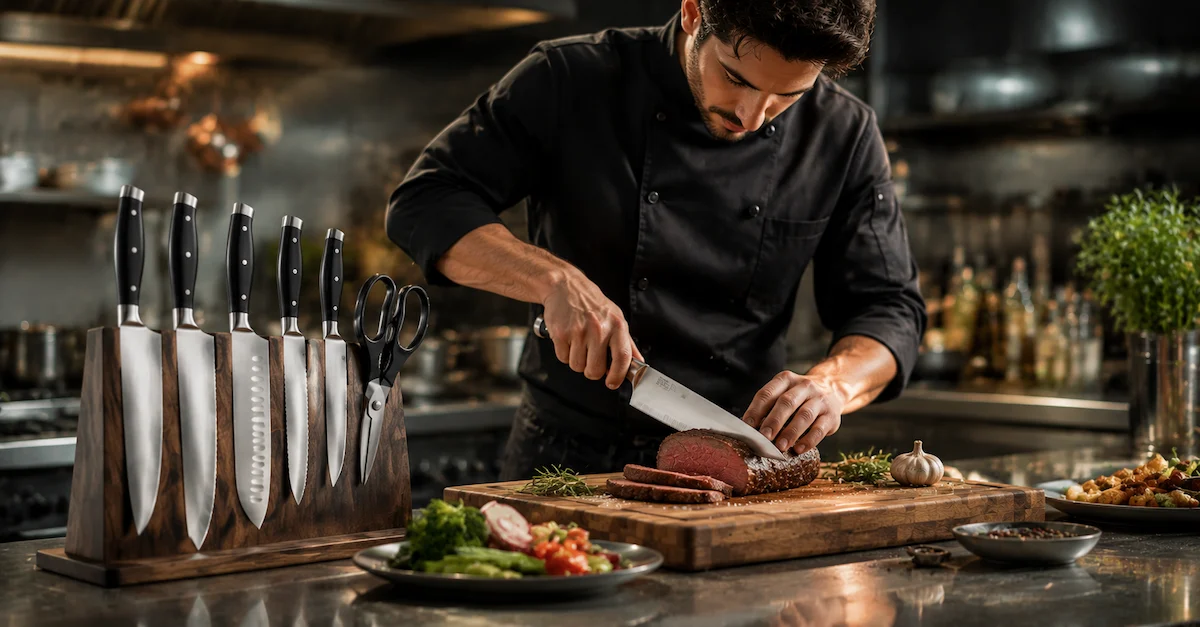
The visible product in this category is straightforward: a wooden knife block holding multiple knives and kitchen scissors, with one knife shown in use on a cutting board in a professional kitchen setting. That presentation matters because it solves three buyer problems at once. First, it keeps the tools organized on the counter. Second, it gives users a broad enough mix of blade shapes for general prep. Third, it signals a complete set rather than a loose assortment of individual pieces.
That last point matters more than it sounds. Buyers in food service and retail do not usually want to source a chef knife, utility knife, slicing knife, and scissors separately if they can avoid it. They want a complete package that is easy to merchandise, easy to explain, and easy for the end user to understand. A knife block also reduces drawer clutter, which is one reason these sets remain popular in both commercial kitchens and home cooking environments.
Key components buyers should evaluate first
The product shown includes at least five knives plus kitchen scissors, with mixed blade lengths and shapes. That assortment suggests a general-purpose prep set rather than a specialist carving or steak program. For sourcing teams, the first question is not “How many pieces are in the box?” It is “Does the knife mix match the actual use case?” A broad chef-style blade is useful for chopping and rocking cuts. Narrower slicing and utility-style blades help with trimming, fruit, vegetables, and lighter prep work. Scissors add another layer of utility, especially in kitchens that handle herbs, packaging, or quick trim jobs.
Blade finish is another practical clue. The visible blades appear metallic and polished, likely stainless steel based on appearance, but exact steel grade should never be assumed unless the supplier documents it. The same caution applies to hardness, edge treatment, and whether the knives are forged, stamped, or built with a full tang. Those details influence weight, balance, and long-term performance, but they are not visible in a photo. A serious buyer should request the specification sheet rather than rely on visuals alone.
The handles in the image appear black, curved, and fitted with visible rivets or pins. That usually points to a durable, functional design aimed at grip comfort and straightforward manufacturing. Whether the handle material is synthetic, composite, or another engineered material is not obvious from appearance. In OEM kitchen knife set programs, handle material choice is not a side note; it affects cost, ergonomics, finishing, and how the product reads in the market. A premium retail line may want a more refined feel, while a food service line may prioritize durability and easy cleaning behavior.
Why the knife block is not just packaging
The dark wood block with angled slots does more than hold the set together. It influences shelf presence, counter stability, and the perceived value of the product. A block set can make a modest knife assortment look complete and ready for sale, which is useful for OEM and ODM kitchen cutlery set manufacturing. It also gives the buyer a defined format for retail photography and product display. For distributors, that matters. Consumers understand a block set immediately; they do not need much explanation.
From a manufacturing perspective, the block is part of the product system. Slot geometry must match the knife profile, or the user experience becomes annoying very quickly. A blade that snags every time it is inserted or removed will create complaints even if the knife itself is acceptable. The block also needs to remain stable on a countertop, especially in professional kitchens where people work fast and often with wet hands. Small details here can decide whether the set feels dependable or merely decorative.
Selection criteria that actually help buyers
When comparing an OEM kitchen knife set, a buyer should focus on a few practical criteria instead of overloading the decision with marketing language.
Start with assortment logic. Does the set cover the core prep tasks your customers care about, or does it include filler pieces? A good general-purpose set usually has a chef knife, a slicing knife or similar long blade, a utility blade, and additional support pieces. Scissors are a useful inclusion, but they should not be used as a substitute for a meaningful knife lineup.
Next, look at consistency. In mass production, the real quality test is repeatability. Can the supplier hold the same blade profile, handle fit, polish level, and block finish from run to run? That matters more than a one-off sample that looks excellent in isolation. Buyers of a private label knife set especially need this discipline, because packaging and branding only work if the product inside stays steady.
Then consider the customer environment. A commercial kitchen may value grip security and quick access. A retail customer may care more about presentation, block color, and the sense that the set belongs on an open countertop. A culinary training program may need a more practical mix, with enough variation to support instruction but not so much that the set becomes confusing. Matching the configuration to the market is usually more profitable than chasing the longest spec sheet.
Common mistakes that create avoidable problems
One frequent mistake is assuming all kitchen knife sets are interchangeable because they look similar in photos. They are not. The blade shapes, handle geometry, block slot layout, and even the included scissors can change how usable the set is. Another error is pushing too hard on price and then discovering that the assortment feels thin or the block does not present well on the shelf. That can hurt sell-through more than a slightly higher unit cost.
Another buyer trap is over-specifying features that the market does not value. It is easy to get stuck on technical details that sound impressive but do not improve the end-user experience. If the product is aimed at restaurants, reliable handling and consistent prep performance usually matter more than ornamental extras. If it is aimed at retail, the visual story and perceived completeness may matter more than a very narrow performance claim. There is no universal formula, and that is exactly why OEM work exists.
One more practical warning: do not assume the visible black handle means a particular material or performance level. That is a common sourcing shortcut, and it can cause friction later if expectations were never documented. Ask for samples, material descriptions, and production drawings where available. It is a dull step, but it saves time.
How to talk to a supplier before you commit
If you are developing an OEM kitchen knife set, start the conversation around use case, not just piece count. Ask what knife mix the supplier recommends for the target channel. Ask how the block is produced and whether the slot layout can be adjusted for different blade sizes. Ask what finishing steps are involved in blade polishing, handle assembly, and block production. Those questions reveal whether the supplier is thinking like a manufacturing partner or just an assembler.
It also helps to discuss branding early. A custom kitchen knife set often lives or dies on packaging, labeling, and how clearly the set tells its story at first glance. If the set is going into retail, the box and insert matter. If it is going into a restaurant supply channel, durability and easy replenishment may matter more. A supplier that understands both contexts is usually easier to work with than one that only talks about appearance.
Quick buyer checklist
Before you move forward, make sure you can answer these questions clearly:
What user is the set for: home cook, restaurant, catering, or training?
Does the knife assortment match that use case?
Is the block stable and sized for the blades you want to include?
Are the blade material, handle material, and assembly details documented?
Can the supplier repeat the same look and build quality across production runs?
Are packaging and branding aligned with your sales channel?
FAQ
Is an OEM kitchen knife set better for new brands?
Often, yes. It allows a new brand to launch with a defined product structure rather than trying to piece together loose components. That said, the spec still has to be disciplined. OEM is not a shortcut around product planning.
What is the advantage of a private label knife set?
It lets a buyer bring a market-ready product to shelf faster with their own branding. For many distributors and retailers, that is the most practical route when the target audience already understands what a block knife set should look like.
Why does the block matter so much?
Because it affects storage, presentation, and daily convenience. A poor block undermines even a decent knife assortment. A well-designed one makes the whole set feel intentional.
Can a custom kitchen knife set be small and still useful?
Yes. A smaller set can work if the pieces are chosen carefully. The point is not quantity for its own sake; it is whether the lineup supports the actual preparation tasks the end user performs most often.
What to do next
If you are sourcing an OEM kitchen knife set, treat the sample as the start of the discussion, not the finish line. Check the blade mix, verify the handle feel, study the block fit, and confirm what is documented versus what is merely visible. The best buying decisions in this category are usually made by people who care about the small functional details, because those details are what the end user notices after the product has been sitting on the counter for a few months.
For brands and buyers planning a launch, the next step is to turn the market goal into a production brief: target user, knife count, block style, branding method, and the level of finish expected in the final set. Once those basics are clear, the sourcing conversation becomes much easier, and the product has a better chance of arriving as something people will actually use rather than just admire for a week.
