




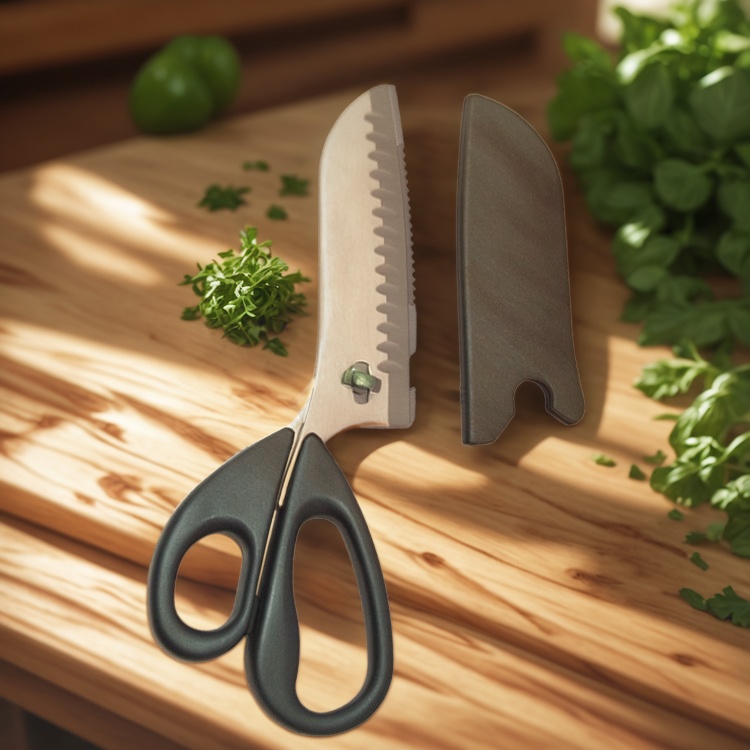
OEM Kitchen Scissors: Essential Culinary Tool
OEM kitchen scissors are a small product category with a large role in food preparation. For home cooks, restaurant teams, and retail buyers, a well-designed pair can reduce prep time, cut packaging, trim herbs, portion poultry, and handle everyday kitchen tasks that are awkward with a standard knife. For wholesale, private label, or OEM programs, the challenge is not only choosing a sharp tool, but choosing a product concept that is safe, practical, easy to clean, and appropriate for the target market.
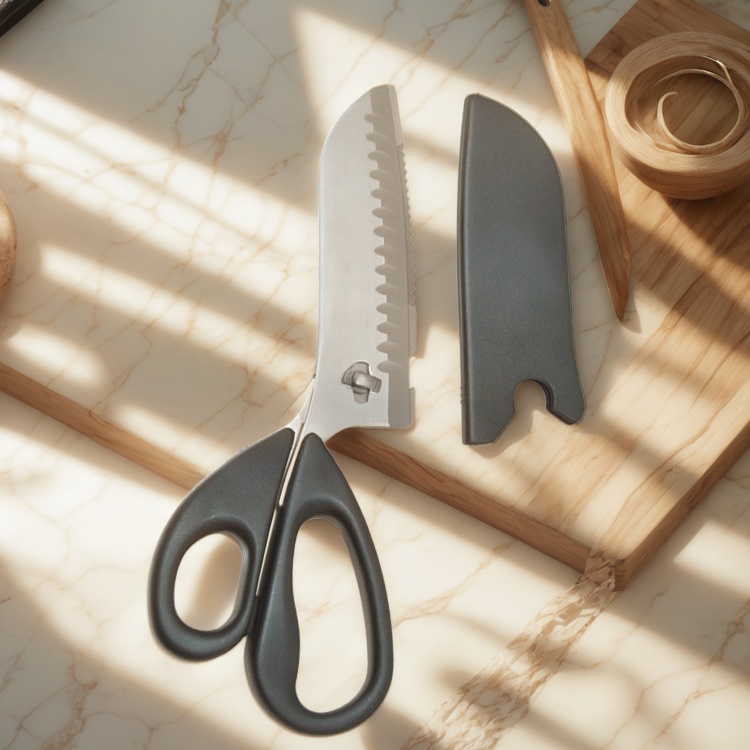
The original product description highlights several useful points: kitchen scissors can be multi-functional, may use sharp serrated stainless steel blades, can have ergonomic handles, may include a protective blade cover, and some designs offer detachable blades for cleaning. Those features are worth evaluating carefully before placing an OEM or wholesale order, because details such as blade geometry, handle comfort, packaging, and cleaning access can strongly affect customer satisfaction.
Key Takeaways
- OEM kitchen scissors should be evaluated as a food-prep tool, not only as a low-cost accessory.
- Useful features may include serrated stainless steel blades, ergonomic handles, a protective cover, and detachable blades, when available.
- Buyers should ask suppliers for exact material, dimensions, packaging, compliance, and quality-control details instead of assuming specifications.
- Multi-functional designs can reduce kitchen clutter, but too many added functions may make the product harder to clean or use.
- Samples should be tested on realistic tasks such as herbs, packaging, poultry trimming, and general meal preparation.
What Makes Kitchen Scissors Different from Regular Scissors?
Kitchen scissors are built for food and food-adjacent tasks. Unlike office scissors, they must cope with moisture, grease, fibers, cartilage, packaging film, and repeated washing. The best design for one market is not always the best design for another. A compact pair may suit small apartment kitchens, while a heavier pair may appeal to users who prepare poultry or meat more often.
Many modern products are positioned as multi-functional kitchen scissors. This can include cutting herbs, trimming vegetables, opening food packaging, cutting meat, or performing knife-like tasks. However, buyers should be cautious with broad claims. If a supplier describes the product as suitable for cutting tough poultry bones, ask what testing was performed, what blade thickness is used, and whether the hinge and handle were designed for that stress.
Core Features to Review Before Sourcing
For OEM kitchen scissors, product selection should begin with functional requirements. Start by defining the primary user: home cooks, gift buyers, supermarkets, restaurant supply channels, or promotional programs. Then review the product against a short list of practical criteria.
- Blade design: Ask whether the blades are straight, serrated, or partly serrated. Serrated stainless steel blades can help grip slippery food, but buyers should confirm the exact material and finish.
- Handle comfort: Ergonomic handles should feel secure when wet and should not create pressure points during repeated cutting.
- Hinge strength: A loose pivot can reduce cutting accuracy, while an overly tight pivot can make the scissors tiring to use.
- Cleaning access: Detachable blades, when offered, can make washing easier. Ask how the mechanism locks and whether users receive clear cleaning instructions.
- Storage safety: A protective blade cover can reduce accidental contact in drawers and can help protect the cutting edge.
Comparison Checklist for OEM Buyers
The table below can help sourcing teams compare samples from different suppliers. It focuses on questions that affect usability, safety, and long-term customer perception.
| Evaluation Area | What to Check | Questions to Ask the Supplier |
|---|---|---|
| Blade material | Stated metal type, finish, corrosion resistance expectations | What is the exact blade material and how is it verified? |
| Cutting performance | Herbs, packaging, meat trimming, vegetables, and other intended tasks | What tasks is this model designed to handle safely? |
| Handle design | Grip comfort, opening size, wet-hand control | Can handle material, color, or texture be customized? |
| Cleaning method | Fixed or detachable blades, crevice access, user instructions | Are the blades detachable, and what cleaning guidance is included? |
| Safety and packaging | Blade cover, retail box, instruction sheet, warning labels | What packaging options are available for private label orders? |
| Quality control | Sharpness consistency, hinge tension, visual defects | What inspection steps are used before shipment? |
Balancing Multi-Function Design and Ease of Use
Additional functions can make kitchen scissors more attractive on a shelf or product page, but they should not compromise the main cutting function. Some designs include knife-like capabilities, bottle-opening features, nut-cracking notches, herb strippers, or other utility details. These can be useful when they are well integrated. They can also create cleaning gaps, add weight, or confuse users if the product has no clear instructions.
For B2B buyers, the best approach is to match functions to the sales channel. A supermarket kitchen tool may need simple messaging and clear safety packaging. A professional kitchen channel may care more about blade strength, hinge durability, and cleanability. A gift set may prioritize appearance, storage, and a protective cover. Before approving tooling or packaging, test whether every promoted function works reliably enough to support the product claim.
Private Label and OEM Questions to Ask
Because the term OEM can cover many arrangements, buyers should clarify the commercial and technical details early. Do not assume minimum order quantity, pricing, lead time, logo method, certifications, or testing standards unless the supplier provides written confirmation. Important questions include:
- Can the supplier provide product drawings or specification sheets before sample approval?
- Which parts are customizable, such as handle color, logo placement, blade cover, packaging, or instruction leaflet?
- What sample process is used, and how are changes recorded between sample rounds?
- Which quality checks are performed for sharpness, assembly, appearance, and packaging?
- What documents are available for the target market, and which claims should not be printed without verification?
For any product that touches food or is marketed for kitchen use, importers and brand owners should also check applicable requirements in their own market. The supplier can provide information, but the buyer is responsible for confirming what is required for the sales region and distribution channel.
Sample Testing Before Placing a Wholesale Order
Sample testing should be practical rather than theoretical. Use the scissors in the way customers are likely to use them. Cut herbs to see whether the blades crush or slice cleanly. Open flexible packaging to check tip control. Trim poultry skin or fat if that is part of the intended use. Wash and dry the product several times, then check for stiffness, trapped food, or visible wear. If there is a blade cover, test whether it stays in place during storage.
It is also useful to involve several testers with different hand sizes. A handle that feels comfortable to one person may be awkward for another. Record feedback in a consistent score sheet so the decision is not based only on first impressions.
Use and Care Guidance for End Users
Clear care instructions can reduce complaints and extend product life. Even strong kitchen scissors should be used within their intended purpose. Users should avoid twisting the blades, forcing cuts through materials the product was not designed for, or storing the tool loose without protection. After contact with meat, poultry, or strong-smelling ingredients, the scissors should be washed promptly and dried thoroughly. If the blades detach, the instruction sheet should explain how to separate and reassemble them safely.
FAQ
Are OEM kitchen scissors the same as kitchen shears?
In many markets the terms overlap. Kitchen shears often suggest a stronger food-prep tool, while kitchen scissors can describe both general and specialized kitchen models.
Should buyers choose detachable blades?
Detachable blades can make cleaning easier, especially after cutting meat or herbs. Buyers should still test the locking mechanism and confirm that instructions are clear.
Can one pair replace a kitchen knife?
Kitchen scissors can handle many cutting tasks, but they should complement knives rather than replace every knife function. Claims should match tested performance.
What should be confirmed before printing private label packaging?
Confirm material, features, care instructions, warnings, country-specific requirements, and any performance claims in writing with the supplier.
How should wholesale buyers compare suppliers?
Compare samples, specifications, quality-control process, packaging options, communication speed, and documentation. Price matters, but poor cutting performance or unclear claims can create higher costs later.
