




Choosing an OEM kitchen scissors manufacturer is a product-definition decision before it is a price decision. The factory must understand what the scissors will cut, who will use them, how the tool will be stored, which market will receive it and how the finished pack will be handled. A clear brief lets a buyer compare like with like. A vague request creates attractive samples that cannot be quoted, tested or repeated with confidence.
Direct answer: send the manufacturer one controlled brief covering the intended task, reference model or drawing, blade and handle direction, required functions, target market, quantity, branding and packaging. Ask for an identified sample, test every claim on that sample, approve the product and pack as one revision, then compare quotations against that same revision. MOQ, tooling, sample timing, production timing, testing and delivery terms should be confirmed for the specific project.
This guide is written for importers, brand owners, wholesalers, supermarket buyers, distributors and e-commerce teams. It follows nine practical steps and then answers common sourcing questions. BONET HOUSEWARE product and service pages are used as examples where they are relevant; a public page is a starting point, not a substitute for a project specification or written commercial confirmation.
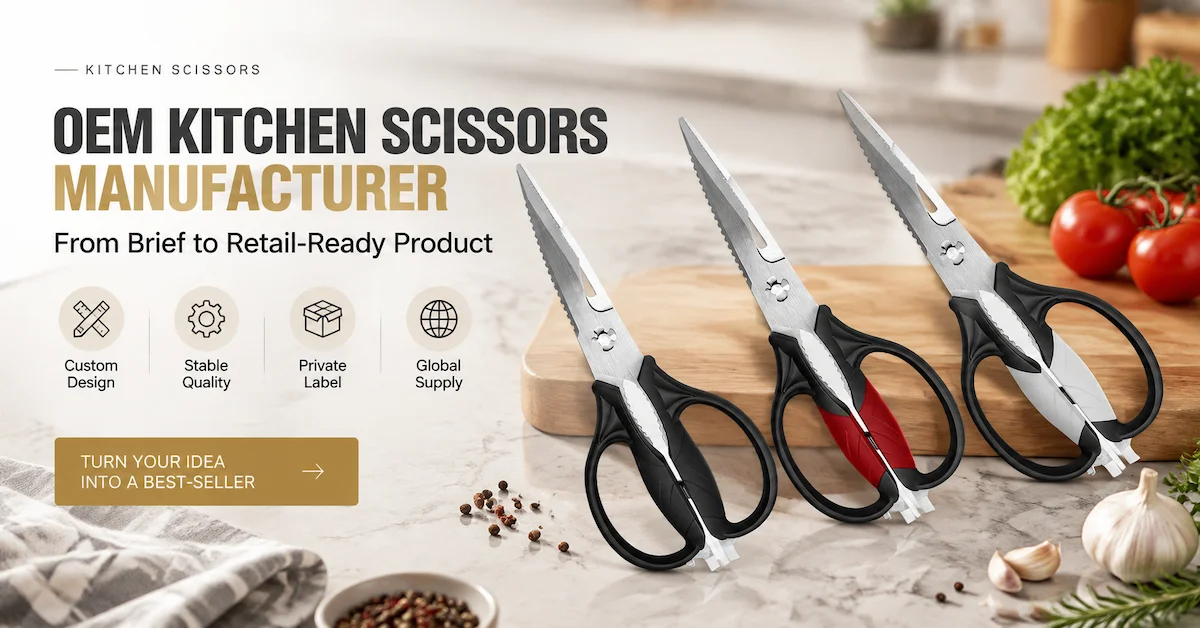
1. Define What OEM Means for This Kitchen Scissors Project
OEM is often used as a single label for several very different requests. One buyer may want a logo on an existing model. Another may want a new handle color and retail card. A third may have a drawing that changes the blade profile, pivot, sheath and storage system. These projects should not enter a factory conversation under the same assumptions. Write down the route before asking for a quote.
For an existing-model program, identify the exact product page, model name, dimensions, materials, accessories and approved appearance. For a modified-model program, separate what stays fixed from what changes. For a drawing-led program, attach the drawing revision and list the features that are performance-critical. If the request is still conceptual, call it development rather than pretending it is a simple repeat order.
A buyer looking for a kitchen scissors manufacturer China should also describe the destination market and sales channel. A supermarket peg pack, a boxed gift set, an e-commerce mailer and a food-service carton can require different product protection, artwork, instructions and carton arrangements. The same scissors may need different pack decisions for each channel.
| OEM route | Typical buyer input | Questions to resolve before sampling |
|---|---|---|
| Existing model | Product page, model reference, quantity and branding idea | Which dimensions, functions, colors and accessories remain unchanged? |
| Modified model | Reference sample plus marked changes | Do the changes affect tooling, assembly, cutting feel or packaging fit? |
| Drawing-led OEM | Dimensioned drawing, material direction and intended use | Which tolerances and tests define acceptance of the first sample? |
| Development project | Concept, target user, market position and rough sketches | What feasibility, structure, sample and packaging decisions are needed? |
The first factory reply is useful evidence. Does it repeat the requirements, identify missing information and distinguish recommendations from commitments? Does it ask about the cutting media, logo surface and pack format? A supplier that asks precise questions is easier to evaluate than one that sends an unexplained unit price.
2. Choose the Right Kitchen Scissors Product Architecture
Kitchen scissors are not one universal shape. A straightforward pair can serve everyday opening and trimming jobs. A multifunction design may add a nut-cracking area, herb-stripping detail, bottle-opening feature or other integrated task. A magnetic-storage design adds a sheath, retention behavior and a storage surface to the product story. The right choice depends on the user and channel, not on the longest feature list.
BONET's public product pages provide useful SKU-level examples. S52034 is presented as an 8-inch kitchen scissors model with 420 stainless steel and PP. SKI090 is presented as a 9-inch multifunction model with 420 stainless steel and PP. SKI022 is shown as a 9-inch multi-purpose model with 420 stainless steel and PP plus TPR. G2011 is shown as a magnetic kitchen scissors model measuring 21.8 x 8.6 x 2 cm, with 420 stainless steel and PP. These descriptions apply to the named products; they should not be generalized to every item in a category.
| Product direction | Relevant BONET product page | Buyer decision | Evidence to request |
|---|---|---|---|
| General-purpose kitchen scissors | S52034 kitchen scissors | Prioritize everyday cutting, grip and simple storage | Model identity, cutting result, pivot feel and packed sample |
| Multifunction kitchen scissors | SKI090 multifunction scissors | Name each task instead of saying only "12-in-1" | Function matrix, test media and packaging wording |
| Multi-purpose kitchen shears | SKI022 multi-purpose shears | Review handle construction, feature access and cleaning | Approved appearance, function checks and care statement |
| Magnetic storage model | G2011 magnetic scissors | Define sheath, surface, retention and removal experience | Storage test, cover fit, protection and retail presentation |
A buyer comparing a multifunction kitchen scissors manufacturer should request a row for every requested function. The row should state the action, the intended material, the pass observation and the claim that may appear on the pack. This protects the brand from a feature promise that the sample cannot repeat.
For a magnetic kitchen scissors manufacturer, describe the mounting surface and orientation. A magnetic sheath that holds on one specified surface is a different promise from "sticks anywhere." The product page can inspire the concept, but the production-intent sample determines the claim.
3. Specify the Blade, Pivot and Handle as One System
A blade can be sharp and still feel wrong if the pivot is loose, the alignment changes through the stroke or the handle transfers force poorly. Review these parts together. Record the blade profile, length, thickness direction, edge form, finish and any serration. Then observe how the two blades meet, how much resistance the pivot creates and whether the handle remains comfortable during the intended task.
Material wording needs the same discipline. When speaking with a stainless steel kitchen scissors manufacturer, ask which grade is proposed for the exact model and how it is documented. The grade is only one input. The buyer should also discuss geometry, heat-treatment direction where relevant, finish, edge preparation, corrosion review and the agreed cutting result. Keep any report tied to the same SKU and revision.
Blade specification questions
Describe the cutting media that represent the intended use. Paper, herbs, food packaging and poultry skin create different observations. Define alignment, surface appearance, burrs, edge continuity and the point at which the blade should be rejected. If a sheath or protective cover is included, inspect the fit with the real production-intent blade and check for exposed points or contact with the edge.
Pivot specification questions
Record the opening and closing feel, side play, fastener appearance and alignment through a full stroke. If the construction is detachable, explain how the halves separate, how they reconnect and which surfaces become accessible for cleaning. Do not publish a care claim until the actual construction and target market have been reviewed.
Handle specification questions
Handle review includes molding quality, flash, seams, ring dimensions, insert fit, color reference, logo location and the connection between plastic and metal. A color change may affect the molding route or packaging artwork. A soft-touch insert may affect cleaning, grip and cost. Keep every option in the controlled revision instead of describing it only in an email.
| Component | Specification evidence | Sample observation | Repeat-order record |
|---|---|---|---|
| Blade | Profile, dimensions, material direction, finish and edge description | Alignment, edge condition, surface and agreed cutting result | Approved sample ID, revision and inspection method |
| Pivot | Fastener type, assembly direction and any separation method | Resistance, play, smoothness and blade alignment | Approved reference feel or measurable range |
| Handle | Construction, color reference, material and logo location | Grip, molding, fit, comfort and appearance | Color standard, artwork and controlled sample |
| Accessories | Sheath, magnet, insert, label or other included parts | Fit, retention, completeness and safe presentation | Bill of materials and pack-content checklist |
Have a reference model or drawing?
Send an OEM Kitchen Scissors Brief4. Verify the Factory Process and Quality Checkpoints
A factory tour or process page matters when it helps the buyer understand where quality is created. BONET's public manufacturing description lists stages including stamping, straight adjustment, heat treatment, rough grinding, water grinding, polishing, injection molding, ultrasonic cleaning, setting and assembly, quality checks, final cleaning and packing. Not every SKU uses every listed stage. Ask which stages apply to the chosen model and what is checked before the next stage begins.
Early checks are important because final inspection cannot repair every upstream problem. A blade blank that is out of shape, an inconsistent surface or a handle component with molding variation can become harder to correct after assembly. For each applicable stage, identify the input, the checkpoint, the owner of the check and the disposition of a failed piece. Keep the answer specific to the model rather than requesting a generic quality slogan.
| Process area | Buyer question | Evidence for the project |
|---|---|---|
| Stamping and straight adjustment | How are blade profile and flatness controlled for this SKU? | Drawing reference, in-process check or recorded sample |
| Heat treatment | What requirement is connected to the selected material and process? | Agreed specification and available process record |
| Grinding and polishing | Where are geometry, edge condition and surface appearance checked? | Visual standard, work reference and inspection result |
| Injection molding | How are color, molding appearance and metal-to-handle fit reviewed? | Color reference, approved sample and defect criteria |
| Assembly and quality checks | How are pivot movement, alignment and function verified? | Item-level checklist and approved reference |
| Cleaning and packing | How are appearance, protection, labels and contents confirmed? | Packed sample, artwork revision and carton record |
The ISO 9001:2015 certificate for Yangjiang Master Scissor & Knife Manufacture Co., Ltd. states the scope as production and sale of scissors. That wording should remain exactly scoped. An ISO quality-management certificate can inform a supplier review, but it does not by itself prove that a particular OEM sample cuts a particular material, fits a package or meets a buyer's market requirements.
A sourcing team searching for a kitchen scissors factory China can use process questions to compare factories. Look for traceability from the brief to the sample, from the sample to the inspection method and from the inspection method to the packed product. The quality conversation becomes useful when it names the item being purchased.
5. Build a Sample Plan That a Buyer Can Repeat
Sampling is the moment when a concept becomes inspectable. Give every sample a simple ID and record the received date, model, revision, components and packaging. Photograph the full product and close views of the blade, pivot, handle, logo and protective parts. If the sample changes, issue a new revision or a marked change list. Do not let a later email silently replace the original reference.
Use test media that represent the intended task and describe the preparation. Record the full stroke, material movement, edge behavior and any visible damage. For multifunction models, test each named function. For magnetic models, test the exact sheath and surface configuration. For a retail pack, check retention, point protection, removal, labels, barcode placement and carton fit.
| Sample gate | Practical review | Record to keep | Reason to stop |
|---|---|---|---|
| Identity | Model, revision, dimensions, components and pack contents | Sample ID, photos and received date | Sample cannot be tied to the current brief |
| Cutting | Agreed media, full stroke, edge behavior and material movement | Method, result and visible damage | Result is inconsistent or outside intended use |
| Pivot | Opening, closing, resistance, play, fastener and alignment | Observation and approved reference feel | Movement changes, binds or allows separation |
| Handle and assembly | Grip, molding, fit, color, logo and attached components | Defect notes and approved appearance | Comfort, fit or assembly misses the brief |
| Cleaning review | Accessible surfaces and proposed care statement | Method reviewed for actual construction | Care claim is unsupported or key areas are inaccessible |
| Packaging | Retention, point protection, removal, labels, barcode and carton fit | Approved artwork and packed sample photos | Product moves, is exposed or pack information is incomplete |
Approval should name the sample ID and the accepted specification, artwork and packaging revisions. If one issue remains conditional, say what must be shown again and who owns the next decision. "Looks good" is not a production instruction. A short, dated approval record is much more valuable than a long chain of informal comments.
6. Coordinate Private Label Branding with the Product
Private label succeeds when the product and brand system are approved together. A logo can be printed, laser engraved or applied by another agreed method, but the final result depends on the surface, curvature, texture, color and available area. A digital mockup cannot answer all of those questions. Put the logo position, size, orientation, colors and method into the sample review.
BONET's OEM/ODM page describes support for production by drawing or sample, brand OEM, material and color customization, logo printing and laser engraving, export packaging, quality inspection support and packaging customization. It also describes concept development, structural optimization, material recommendation, feasibility assessment and mass-production support. These are service capabilities described on the public page; feasibility, setup, cost, MOQ and timing still require confirmation for the selected model.
For private label kitchen scissors, keep the logo artwork, packaging dieline, barcode information and product specification in one RFQ record. Identify the file owner and the approved use. Use revision numbers rather than overwriting artwork. Ask how obsolete files are controlled when the design is updated.
A custom kitchen scissors manufacturer should help separate a branding change from a structural change. A printed logo, new color, altered grip, revised blade profile and newly developed sheath each create different feasibility questions. State the customization level in the brief so the sample route, tooling discussion and quotation assumptions remain clear.
Logo review checklist
- Approved artwork file, color reference and language version.
- Application method, position, scale, orientation and acceptable variation.
- Surface condition after molding, polishing or other finishing.
- Physical sample approval under normal retail lighting.
- Artwork revision linked to the product and packaging revisions.
7. Treat Custom Packaging as a Product Requirement
Packaging protects a cutting tool, explains the use case and carries the brand promise. It also changes the quotation. A sleeve, blister-style pack, color box, gift box, tray, insert and e-commerce mailer involve different materials, assembly work and transport assumptions. Put the real scissors into the proposed pack and test the pack as it will be displayed, lifted, opened and shipped.
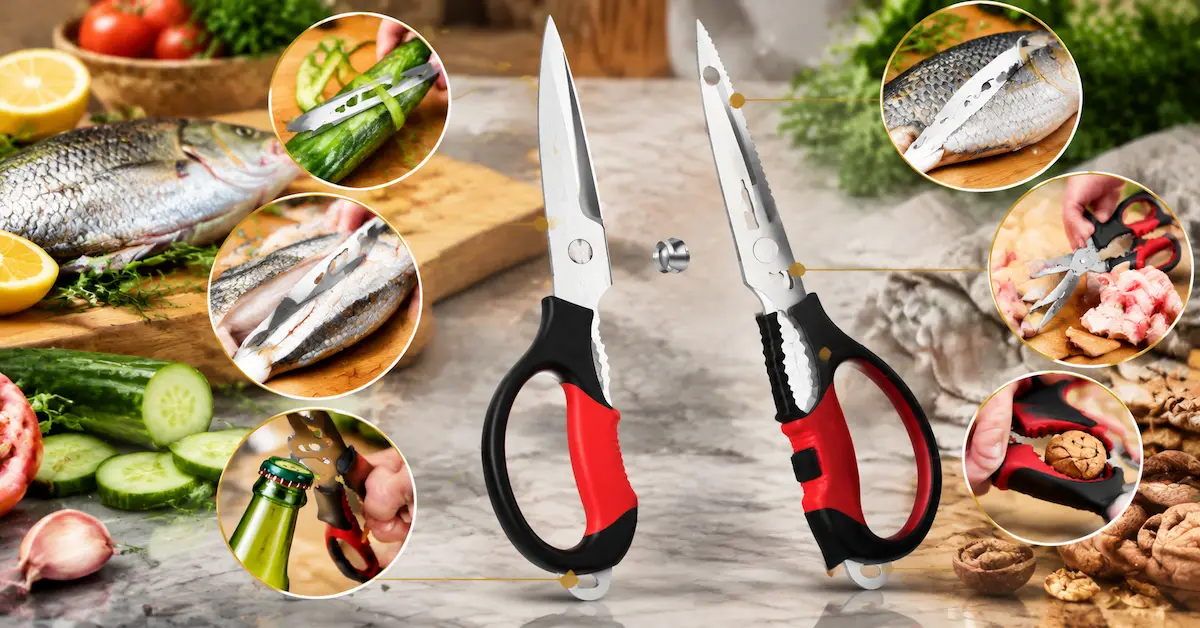
Artwork review should cover the product name, intended-use wording, care information, warnings where required, barcode, origin and other destination-market information. The responsible buyer or qualified adviser should confirm legal requirements. A manufacturer can provide product and production information, but it should not be asked to guess every obligation in every market.
When packaging carries a multifunction or magnetic claim, connect the wording to the sample test. A small diagram can help the shopper understand the feature, but it must match the actual construction. Avoid broad claims such as "works on every surface" unless the project has evidence that supports that exact language.
| Packaging item | Buyer decision | Confirmation to request |
|---|---|---|
| Individual pack | Format, display face, opening experience and protection | Packed sample and approved dieline |
| Product retention | Position, movement, point and blade protection | Shake, lift and removal observation |
| Brand information | Logo, product name, care, warnings and barcode | Artwork revision and market review |
| Outer carton | Pack quantity, orientation, labels and handling | Carton specification and pack-out record |
Need a logo, retail card or export pack reviewed with the sample?
Request a Private Label Packaging Review8. Compare OEM Quotations on the Same Assumptions
A search for kitchen scissors wholesale China can produce several numbers that are not actually comparable. One offer may cover a bare product, another a printed retail pack and another a different quantity or delivery term. Rebuild all offers against the same product, branding, packaging and logistics assumptions before deciding.
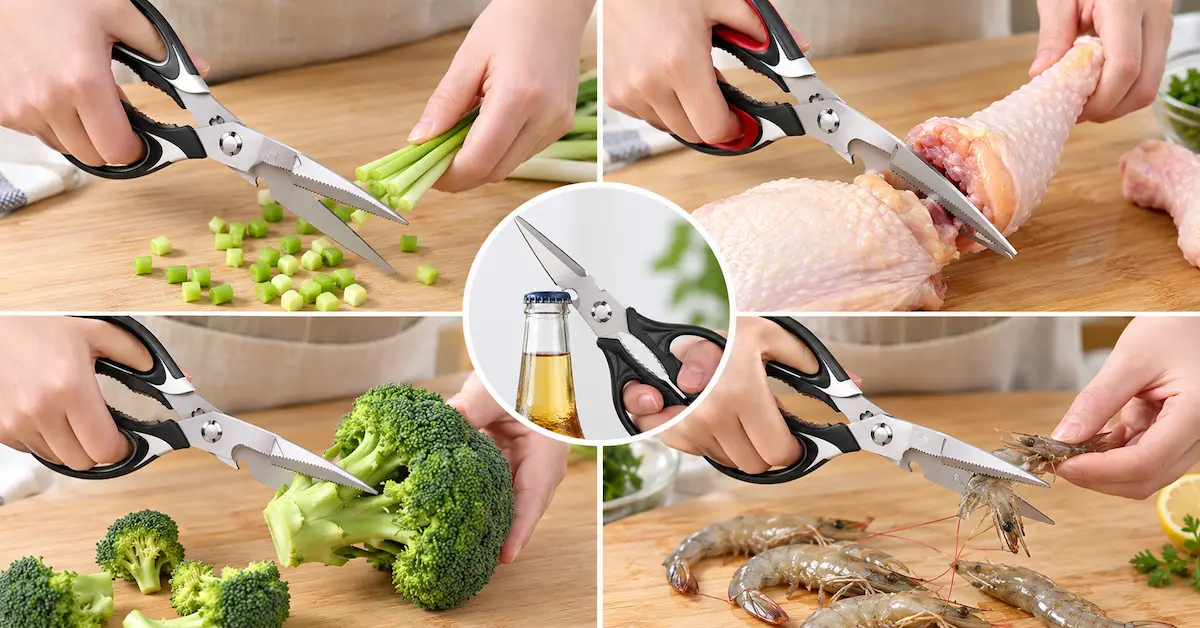
Record currency, validity period and trade or delivery term. Separate confirmed values from allowances, exclusions and provisional items. Ask how a handle color, logo method, packaging structure, quantity or delivery destination changes the offer. Keep the answer in writing and link it to the revision that was priced.
| Quotation line | What to normalize | Question to ask |
|---|---|---|
| Product | Model, revision, material, finish, handle, functions and accessories | Does the price point to the same approved construction? |
| Branding | Logo method, location, colors, setup and artwork revision | Which branding costs are included or separate? |
| Packaging | Individual pack, insert, labels, barcode, carton and pack quantity | Is the offer based on the approved packed sample? |
| Development | Sample, prototype, tooling, artwork changes and extra rounds | Which charges are one-time, refundable or recurring? |
| Quality and documents | Inspection basis, tests and project documents | What evidence is included and what needs separate arrangement? |
| Delivery | Quantity, timing, destination and commercial term | What assumptions sit outside the unit price? |
MOQ, unit price, tooling, sample timing and production lead time should not be presented as universal BONET numbers. They can change with model, material, customization, packaging, quantity and factory schedule. Request the project-specific values after the brief is complete, then reopen the quotation if the revision changes.
9. Protect the Repeat Order and the Buyer Relationship
The first order is only one part of a private-label program. The second order tests whether the system can reproduce the same product without relying on memory. Create an item master containing model, revision, dimensions, materials, finish, color standards, logo artwork, packaging dieline, barcode, pack contents, carton arrangement and approved sample ID.
Use a change record with two lists: what changes and what stays exactly as approved. Give each changed file a new revision number. Beside it, record any effect on tooling, materials, appearance, pack fit, quotation, testing, sampling or timing. Name the version it replaces. This makes an apparently small change visible to both the buyer and the factory.
When an issue appears after delivery, describe the observed condition without guessing the cause. Include a whole-product photo, a close view, scale where useful and any batch or quantity information available. Then request containment, cause review, corrective action and verification appropriate to the issue. A precise record is more useful than a general statement that "quality is not stable."
Manufacturer scorecard
| Evaluation area | Evidence to request | Decision question |
|---|---|---|
| OEM fit | Relevant models, process explanation and item-level answers | Does the supplier understand this construction and task? |
| Specification discipline | Brief, drawing, sample ID and revision log | Can each quoted feature be traced to a controlled reference? |
| Sample quality | Cutting result, pivot behavior, assembly, appearance and pack | Does the physical sample meet the agreed method? |
| Manufacturing control | Applicable process stages, checkpoints and reaction plan | Are key risks checked before final inspection? |
| Commercial clarity | Included, excluded, provisional and separate cost lines | Can offers be compared on the same assumptions? |
| Communication | Decision recap, ownership and open-question status | Will changes remain visible across teams? |
| Repeat-order readiness | Item master, retained sample and obsolete-file control | Can the approved product be reproduced without memory? |
BONET HOUSEWARE publicly presents kitchen scissors alongside kitchen knives, kitchen tools, cutting boards, gadgets and OEM/ODM support. That breadth may help a buyer plan a wider range, but the decision for a scissors project should still rest on item-level evidence: an approved sample, a controlled specification, an agreed pack and a project-specific quotation.
OEM Kitchen Scissors Manufacturer FAQ
What should I send with my first OEM inquiry?
Send the intended tasks, target user, destination market, sales channel, reference model or drawing, dimensions, material direction, handle and function requirements, logo artwork, packaging idea, estimated quantity, requested timing and required documents. Mark each item as fixed, preferred or open. Include photographs where they remove ambiguity.
Can a kitchen scissors factory China supplier make a custom handle?
A custom handle may mean a color change, a new insert, a modified grip, a new mold or a substantially new structure. Ask the factory to classify the request and confirm feasibility, tooling, sample requirements, MOQ, cost and timing for the selected design. Do not assume that a custom color has the same commercial impact as a new mold.
Who should consider a private-label kitchen scissors program?
Private label is suitable for a brand, retailer or distributor that wants an owned presentation while using an agreed existing or developed product. The product, logo, packaging and market wording should be approved as one system. A simple logo on an existing model and a new product with a bespoke gift box are different projects.
What is the best stainless steel for kitchen scissors?
There is no single material answer without the task and construction. Compare the exact grade, geometry, heat-treatment direction where relevant, finish, edge preparation, pivot and cutting result. BONET publicly lists 420 stainless steel for the named example SKI090, SKI022, G2011 and S52034 pages; that information applies to those identified models and should be confirmed for any new OEM version.
How should multifunction claims be tested?
Write one test row per function. Identify the material or action, the preparation, the observation and the wording that may appear in the pack. If the tool includes an opener, nut-cracking area, herb stripper or other detail, test that detail on the intended media. Do not let a broad feature count replace an item-level test.
How should magnetic kitchen scissors be evaluated?
Define the sheath or magnet, target surface, storage orientation, retention observation, removal action, cover fit and packaged presentation. Test the production-intent sample on the specified surface. Keep the consumer claim no broader than the documented result.
What does ISO 9001 tell a buyer?
It informs the review of a quality-management system. The certificate cited for Yangjiang Master Scissor & Knife Manufacture Co., Ltd. is scoped to the production and sale of scissors. It does not replace the approved sample, item specification, function test, packaging review or destination-market assessment.
How do I protect a new logo or drawing?
Identify ownership and permitted use in the commercial agreement, share controlled files through the agreed business channel and use revision numbers. Name the people who may handle the files and ask how obsolete artwork is controlled. Have counsel review the relevant contract language for the jurisdictions involved.
RFQ Checklist for an OEM Kitchen Scissors Manufacturer
- The intended tasks, target user, destination market and sales channel are stated.
- The model, drawing or physical reference is clearly identified.
- Blade, pivot, handle, sheath, magnet and other accessories are described separately.
- Material claims are tied to the exact SKU, sample and evidence.
- Every multifunction feature has a corresponding sample check.
- The logo artwork, color, position, application method and revision are controlled.
- The individual pack, labels, barcode, protective parts and outer carton are included.
- The sample is approved with product, artwork and packaging revisions.
- Applicable process stages and quality checkpoints are understood.
- MOQ, price, tooling, sample timing, production timing and delivery assumptions are confirmed for the project.
- Required tests and documents are matched to the product and destination market.
- A repeat-order item master preserves the final approved version.
The strongest OEM kitchen scissors programs are built from ordinary details that people can inspect. Define the job, select the right architecture, connect blade, pivot and handle, review the applicable factory stages, test the real sample, approve the real pack and compare quotations against one revision. That discipline gives a brand a product that can be explained to shoppers, checked by a quality team and reordered with fewer surprises.
To begin a project with BONET HOUSEWARE, provide the selected model or reference, intended tasks, target market, estimated quantity, material direction, logo files, packaging idea and requested timing. The team can then review whether an existing OEM route, a private-label modification or a broader development route fits the brief and confirm the commercial details for that specific project.
Ready to compare an OEM kitchen scissors project on one clear brief?
Send Your Kitchen Scissors RFQ