




OEM Kitchen Shears: Practical Sourcing Guide for Multi-Functional Scissors
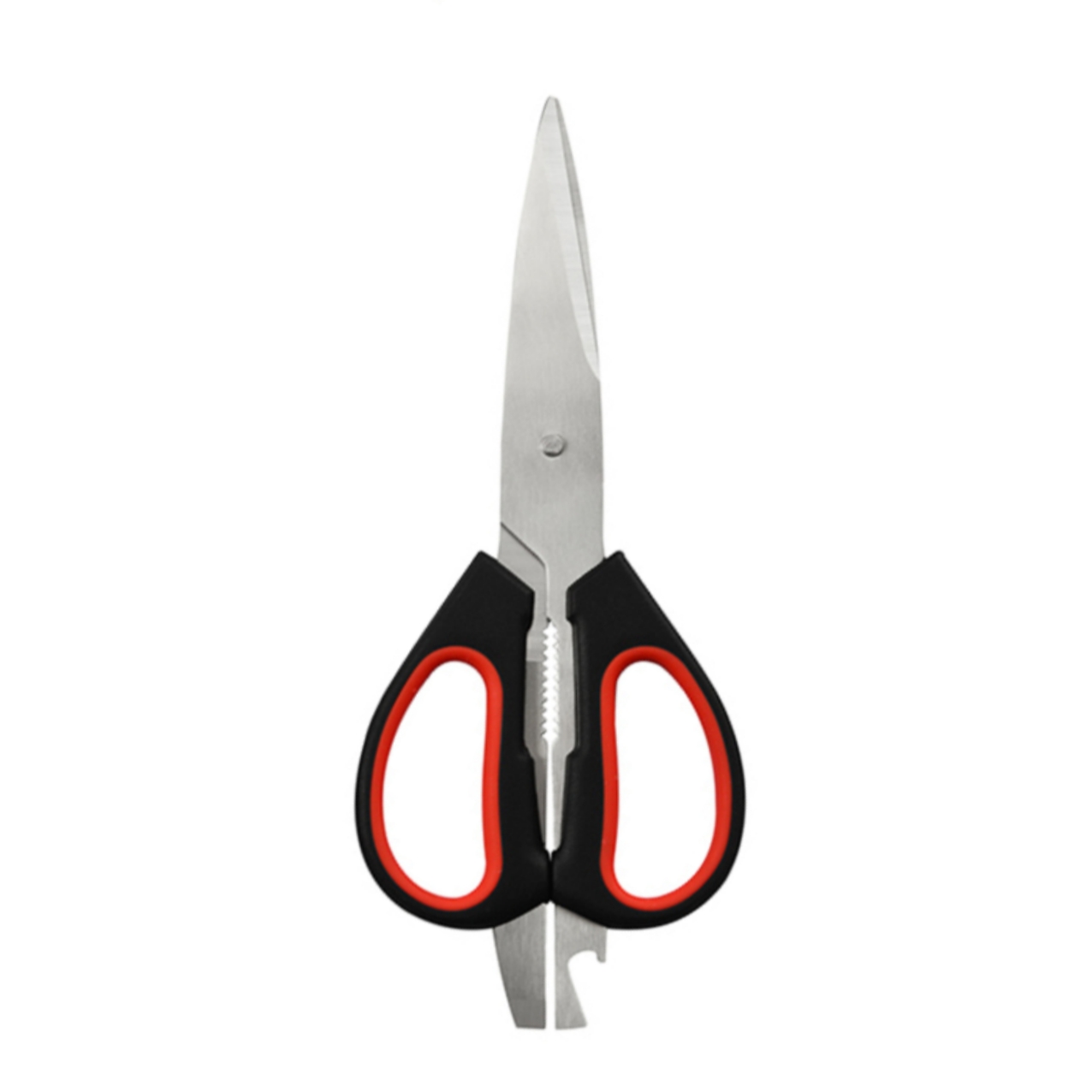
OEM kitchen shears are a useful product category for importers, houseware brands, promotional product buyers, and kitchenware distributors because they combine everyday cutting tasks with optional multi-tool functions. The original article introduced a multi-functional kitchen scissors concept with features such as stainless steel blades, rubberized grips, a bottle opener, nutcracker, herb stripper, serrated edge, fish scaler, vegetable peeler, and a black-and-red appearance. For B2B buyers, the key question is not only whether the product looks versatile, but whether the design, materials, packaging, and quality controls fit the target market.

This guide rewrites the topic from a sourcing perspective. It explains how to evaluate OEM kitchen shears, what to confirm with a kitchen scissors factory, and how to reduce risk before placing a wholesale or private-label order.
Key Takeaways
- OEM kitchen shears should be evaluated by cutting performance, handle comfort, safety, cleanability, packaging, and consistency across production.
- Multi-functional features can add value, but only if they are practical, durable, and clearly explained to end users.
- Do not assume blade grade, compliance status, MOQ, pricing, or test results; ask the supplier for written confirmation and supporting documents.
- Samples are essential before bulk purchasing, especially when custom colors, logos, packaging, or tool integrations are requested.
What OEM Kitchen Shears Usually Need to Do
Kitchen shears are expected to handle a wide range of routine tasks: trimming herbs, cutting food packaging, portioning soft foods, and assisting with meal preparation. A multi-functional version may also include add-ons such as a bottle opener, nutcracker, herb stripper, serrated section, fish scaler, or peeler. These features can be attractive for retail shelves and online listings, but buyers should consider whether each function is genuinely useful for the intended customer.
For example, a simple pair of kitchen scissors may work well for a supermarket value line, while a multi-tool model may suit outdoor cooking, barbecue accessories, gift sets, or a premium private-label range. The right choice depends on retail positioning, buyer expectations, and packaging space for instructions.
Feature Checklist for Multi-Functional Kitchen Scissors
When comparing OEM kitchen shears, use a structured checklist rather than relying only on product photos. A pair of shears can look strong but still perform poorly if the blades are misaligned, the handle is uncomfortable, or the extra features are hard to use.
| Selection Point | What to Check | Questions to Ask the Supplier |
|---|---|---|
| Blade performance | Sharpness, alignment, cutting feel, edge retention during sample use | What blade material is used, and can it be confirmed in writing? |
| Handle comfort | Grip shape, non-slip feel, suitability for left or right hand use | Can the handle color or surface texture be customized? |
| Multi-tool features | Bottle opener, nutcracker, herb stripper, fish scaler, peeler, or serrated edge | Which functions are standard and which require custom tooling? |
| Cleaning and hygiene | Crevices, food traps, detachable or fixed construction | What care instructions should be printed on packaging? |
| Packaging | Retail card, box, blister, instructions, barcode space | Can private-label packaging artwork be supported? |
| Quality consistency | Sample-to-bulk match, visual finish, screw tightness, opening smoothness | What inspection process is used before shipment? |
Custom Kitchen Shears Manufacturing: What Can Be Customized?
OEM and custom kitchen shears may involve several levels of customization. Basic customization often includes logo placement, handle color, printed packaging, and user instructions. More complex projects may involve changes to handle shape, blade profile, tool functions, or product sets. Before requesting extensive changes, buyers should ask whether new tooling is required, how long sampling takes, and what costs or minimum order quantities may apply.
It is also important to define the target price point early. A buyer sourcing a promotional item may prioritize cost control and simple packaging. A retail brand may focus on tactile handle quality, cleaner finishing, and stronger shelf presentation. A distributor serving professional kitchens may place more emphasis on cutting reliability and easy cleaning. Clear positioning helps a supplier recommend a realistic design.
How to Evaluate a Kitchen Scissors Factory
A kitchen scissors factory should be assessed on communication, product understanding, sampling support, and quality documentation. Buyers should avoid assuming that every supplier can meet the same standard simply because the product photos look similar. Ask for current product options, available customization methods, packaging formats, and sample lead times.
Commercial and compliance details should be verified directly. If your market requires specific food-contact documentation, chemical testing, labeling, or packaging rules, ask the supplier what documents are available and whether third-party testing can be arranged. Do not rely on general statements such as “high quality” or “export standard” without written evidence. For large orders, consider pre-shipment inspection criteria covering blade alignment, appearance, function testing, quantity, packaging, and carton marks.
Sample Testing Before Wholesale Orders
Samples should be tested in realistic conditions. A buyer can create a simple internal test plan using common kitchen tasks and repeated handling. The goal is not to perform laboratory testing, but to identify obvious usability issues before committing to production.
- Cut herbs, thin packaging, thicker plastic packaging, and soft food items to assess cutting feel.
- Open and close the shears repeatedly to check hinge smoothness and hand fatigue.
- Try each extra function, such as bottle opener, nutcracker, herb stripper, or fish scaler, if included.
- Wash and dry the sample according to proposed care instructions, then inspect for residue traps or surface changes.
- Review packaging clarity, warning statements, and whether the functions are easy for consumers to understand.
Buyers should record sample feedback with photos or short videos and send precise comments to the supplier. Clear feedback, such as “handle edge feels sharp near the thumb” or “herb stripper hole needs clearer instruction,” is more useful than broad comments like “improve quality.”
Balancing Functionality, Cost, and User Experience
Multi-functional kitchen scissors can be appealing because one product can replace several small tools. However, more functions do not always mean a better product. Each added feature may increase complexity, affect comfort, or require more instruction. For many markets, the best OEM kitchen shears are not the ones with the longest feature list, but the ones with a sensible combination of sharp cutting, secure grip, easy cleaning, and reliable packaging.
If the product is intended for online retail, consider how the functions will be shown in images and bullet points. If it is for offline retail, ensure the packaging communicates the main benefits quickly. If it is for gift or promotional use, logo visibility and perceived value may matter more than advanced functions.
Practical FAQ for OEM Kitchen Shears Buyers
What information should I provide when asking for a quotation?
Provide target quantity, destination market, desired functions, logo requirements, packaging type, target price range if available, and any compliance or documentation needs. This helps the supplier respond accurately.
Can I request a custom handle color or logo?
Many OEM projects include color and logo customization, but availability depends on the supplier’s process and order quantity. Ask whether the logo is printed, engraved, or applied another way, and request a pre-production sample.
Should I choose a simple shear or an 8-in-1 style design?
Choose based on customer need. A simple design may be easier to clean and explain, while an 8-in-1 style design can work well for retail listings, gift sets, and buyers who value compact multi-tools.
How can I confirm material and compliance claims?
Ask the supplier to state the material in writing and provide relevant documents or arrange third-party testing if required for your market. Avoid making product claims until they are verified.
What should be checked before shipment?
Common checks include quantity, packaging, logo accuracy, blade alignment, opening and closing action, appearance, function testing, carton labels, and whether bulk goods match the approved sample.
Final Sourcing Advice
OEM kitchen shears are a strong category when the product design matches the buyer’s channel and customer expectations. Start with clear requirements, compare samples carefully, and ask direct questions about materials, customization, packaging, inspection, and documentation. A practical sourcing process will help buyers choose multi-functional kitchen scissors that are useful, understandable, and suitable for their market.
