




An OEM kitchen utensils manufacturer produces goods against an agreed buyer specification, drawing or approved reference. In practice, its responsibilities need to be divided into three areas: what the product must be, how production will be controlled, and how the finished goods will be released. A sales promise that a utensil can be customized is the beginning of that conversation, not the completion of it.
For an international buyer, the technical definition includes the working-end shape, thickness or flexibility, handle dimensions, component materials, joining method, finish, acceptable appearance and approved claims. The operational definition includes approved tooling or fixtures, material identification, sample revisions, quality checks and packing instructions. The commercial definition includes variation-specific MOQ, project charges, ownership rights, lead-time milestones and delivery terms. The three definitions must describe the same product.
OEM differs from ordinary catalog purchasing because the buyer has usually requested a specific version. It can also differ from private labeling: placing a logo on an unchanged stock shape does not automatically create a new engineering specification or an exclusive design. ODM development can involve more supplier-led concept and structure work, but it still requires documented approval, intellectual-property arrangements and change authority.
Direct answer: A trustworthy OEM manufacturing program has a single current product definition and a written rule that no material, component, process, supplier, function, label or packaging substitution takes effect without the agreed review and approval. The rule must be proportionate to risk; it should protect the functional requirements rather than create paperwork for every inconsequential adjustment.
BONET HOUSEWARE CO., LTD publicly describes OEM production from drawings or samples, color and material customization, logo marking, packaging support and production inspection. Its official OEM/ODM service page also describes six collaboration phases, from requirements and sampling through quotation, production, inspection and delivery. These published capabilities are useful when preparing an inquiry. They do not establish product-specific MOQ, test results or a guaranteed procedure for a particular order; those details belong in the buyer's quotation and manufacturing agreement.
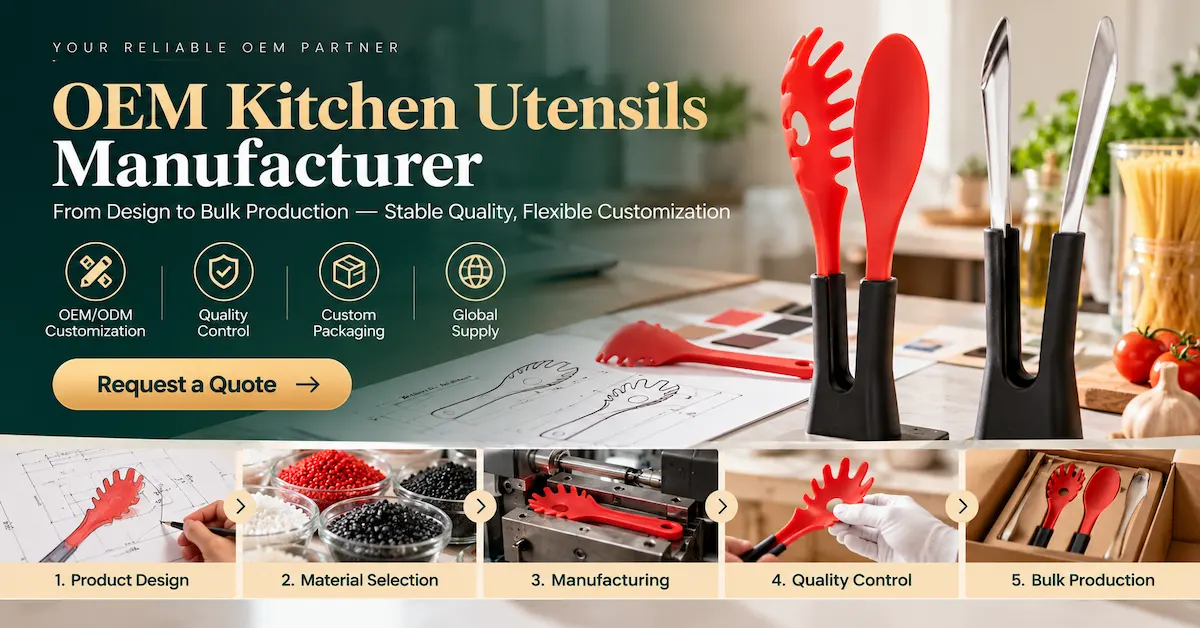
Why Do Approved Kitchen Utensil Samples Change Before Bulk Shipment?
A strong-looking sample may still leave important questions unanswered. It might have been hand-finished, built from readily available components, shown in a temporary color, packed without the final insert, or made with materials that differ from the supply route planned for volume production. None of those circumstances is automatically misconduct. They become an order problem when the differences were not identified and accepted.
Production can drift when the supplier switches a resin grade, changes pigment, substitutes a metal insert, shifts to another molding tool, adjusts a joint, updates the logo file or changes a carton because the original is unavailable. Even a seemingly helpful substitution can affect surface feel, strength, cleaning, appearance, food-contact documentation or barcode accuracy. The commercial price may remain the same while the product delivered to consumers changes.
Consider an illustrative example: a brand approves a flexible scraper and a matching serving spoon. The next sample uses a different core stiffness to improve manufacturing yield. That change could alter how the scraper bends or how the spoon carries food. Rather than deciding that the new version is “equivalent” from a photo, the teams should document the affected components, run the agreed tests and authorize or reject the revision. This hypothetical example is a general sourcing scenario, not a claim about BONET's actual output.
A useful procurement question is therefore: Which changes require notification before they occur, and who has the authority to accept them? Ask this before the first purchase order, when the answer can still shape the specification and quote. A process that identifies proposed changes early is better than an inspection program that discovers them only when cartons are ready to ship.
Real BONET References: Why Product Titles Are Not Complete Specifications
BONET's official kitchen utensil catalog includes silicone-related tools and mixed-material multifunctional products. Four published models demonstrate a common sourcing issue: marketing descriptions, visible photographs and component-material fields do not always describe the same level of detail. Before commissioning an OEM variation, establish which material applies to which component and which performance claims can be independently supported.
| Verified reference | Published dimensions | Listed materials | OEM question to resolve |
|---|---|---|---|
| U101 Utensil Collection | 26.4 × 5.5 × 6 cm | 420 stainless steel; nylon | Specify individual tool contents and identify material by component before approving a set variation. |
| U103 Multifunction Tool | 27.5 × 8 × 4 cm | 420 stainless steel; nylon | Confirm whether the proposed design uses silicone, nylon or another material at each working surface. |
| G2009 Silicone Spoon | 27 × 6.5 × 1.5 cm | Carbon steel; silicone | Clarify the position and protection of the listed carbon steel component. |
| G2008 Silicone Spatula | 20 × 3 × 1 cm | Carbon steel; silicone | Confirm material construction, working-edge function and acceptable variations. |
| G2007 Silicone Utensil | 27.5 × 6.5 × 1.5 cm | Carbon steel; silicone | Confirm which dimensions and materials control the finished OEM version. |
Source: the linked BONET product pages. Dimensions and material labels are catalog facts; the suggested OEM questions and control methods are independent buyer recommendations. No listed model is represented here as a confirmed 304 stainless steel utensil, and these product references are not automatically available in every custom color or packaging program.
The U103 page describes a silicone-related multifunctional concept while its parameter field lists nylon as the plastic material. An importer should not choose which description to trust by preference. Request a current component drawing, confirmed bill of materials and actual sample. Similarly, the carbon-steel field on G2007–G2009 should not be silently rewritten as a stainless-steel core. This is exactly the kind of discrepancy a controlled OEM specification is designed to close.
Compare Real Product References Before Designing an OEM Variant
Use BONET's published models as starting points, then ask the team which exact dimensions, materials, colors, logo methods and packaging options can be quoted for your market.
The Seven Records Every OEM Production-Release File Should Contain
A useful production-release file does not need to be a large manual. It needs seven current records that can be retrieved when the supplier prepares production, an inspector checks a shipment, or the buyer issues a repeat purchase order. The following is a recommended buyer-side method, not a statement that BONET uses this exact internal document set.
| Controlled record | Minimum contents | What it prevents |
|---|---|---|
| 01. SKU master and drawing | Product name, stable ID, geometry, tolerances, revision and approved exceptions. | Confusing similar-looking designs or earlier samples. |
| 02. Component BOM | Material and part callouts, variants, color references and authorized component sources where needed. | Unreviewed substitutions and incorrect material claims. |
| 03. Approved reference samples | Sample ID, stage, date, comparison points, sign-off and location of retained samples. | Disagreement over what the buyer actually approved. |
| 04. Test and inspection plan | Critical characteristics, methods, sample plan, limits and actions after a failed check. | “Looks good” replacing reproducible acceptance rules. |
| 05. Artwork and retail pack | Logo, barcode, instructions, claims, piece count, insert, carton and each artwork revision. | Correct product placed in the wrong brand or pack. |
| 06. Commercial order annex | MOQ by variation, quantity, cost scope, delivery milestones, Incoterms and approved tooling terms. | Quotation assumptions changing silently after deposit. |
| 07. Change and release log | Proposed changes, impact review, retest, approvers, decisions and affected production lots. | Unapproved changes passing from prototype into shipments. |
Assign one owner to the entire release file and one named approver for each decision category. Engineering or product development should approve function and materials; the brand team should approve visual identity and the pack; procurement should approve price and schedule; the appropriate compliance owner should approve market claims. A small company may use fewer people, but the responsibilities should still be distinguishable.
Use explicit file names such as “SKU-105_Assembly_RevC,” not “new-final-last-version.” A repeat-order request should cite the revision and sample ID rather than say “same quality as before.” If the files contradict one another, resolve the conflict in writing and specify which record controls before releasing the first commercial batch. The goal is a single product identity at every handoff.
How to Approve a Golden Sample Without Approving the Wrong Product
Buyers often refer to the approved “golden sample” as if one physical object could settle every requirement. It cannot. A sample can demonstrate scale, shape, color and tactile feel, but its identity, production method and limitations must be recorded. A pre-production sample made by temporary tooling is not automatically evidence that the final production line can reproduce all of its characteristics.
Start by stating why each sample was supplied. A concept sample may close the head shape; a material sample may answer flexibility or grip questions; a marked sample may approve logo size; and a fully packed sample may approve the retail presentation. Only the appropriate production-intent sample should authorize bulk manufacturing, and it should be supported by written specifications, relevant tests and the agreed inspection plan.
At the final sample review, compare the sample to the current drawing and BOM. Record the critical characteristics, intended cooking task, acceptable finish and any small, explicitly accepted deviations. Test the item with representative cookware or serving conditions, but separate practical demonstrations from formal evidence required for product claims. Retain the signed sample and identifier, and ensure the supplier retains the same controlled reference.
If the factory reports a difference between the approved sample and the production route—such as a revised core, changed hinge or different molding tool—do not solve it with an informal “looks fine” message. Ask for a written change notice, the reason and impact, any revised drawings, and the tests needed to determine whether the new condition is acceptable. When a change affects function or compliance, buyers may need new independent evidence before authorizing it.

Map Silicone, Metal, Nylon and Other Components in One BOM
A bill of materials is more than a list of raw-material names. It connects every relevant piece of the utensil to the approved product, including coatings, pigments, inserts, adhesives and accessories where applicable. For each food-contact component, identify the formulation or grade, authorized supplier or approval basis where required, intended use, supporting documentation and approved alternatives. The degree of traceability should reflect the product and market risk.
The distinction matters particularly for mixed-material designs. A silicone spoon may contain an internal metal component; a nylon utensil can be presented visually alongside stainless-steel pieces; and a two-part utensil can have a joint whose function depends on both materials. Replacing a metal alloy, colorant, polymer grade or joining method can affect weight, feel, durability, corrosion behavior, heat exposure or regulatory review.
For BONET's published U101 and U103 references, the site identifies 420 stainless steel and nylon in the parameter fields. The purchasing team should map each material to its respective component before reproducing claims such as “all stainless steel” or “all silicone.” For G2007, G2008 and G2009, the listed combination is carbon steel and silicone. That information should trigger a construction question, not an unsupported assumption about a concealed core.
Use an alternative-component field only when there is a defined approval route. The purchasing team can authorize a pre-evaluated equivalent if validated under the planned conditions; it should not approve unrestricted substitutions merely because two suppliers use the same broad material name. Define whether a change needs notification, document review, sample comparison, formal retest or refusal. A risk-based approach keeps the program manageable while protecting important characteristics.
Buyer check: If the sample drawing identifies a silicone head and a carbon-steel component, ask what portion of the article contacts food, how the metal is covered or protected, and which formulation and finished-article test evidence support the intended use. Do not treat “food grade,” “BPA free,” “dishwasher safe” or a heat rating as a verified promise without product-specific evidence.
Match the OEM Manufacturing Controls to the Actual Utensil
It is common to see manufacturing websites list stamping, molding, grinding, polishing, assembly, cleaning and inspection. The correct workflow, however, depends on the product. A nylon kitchen tool, reinforced silicone spoon and stainless-steel cutting utensil do not use identical equipment or controls. Ask for a process map for the quoted SKU, not a generic factory flowchart.
BONET's official manufacturing overview describes metal stamping, straight adjustment, heat treatment, grinding, polishing, injection molding, cleaning, assembly, quality inspection and packing. Several of those operations are expressly relevant to knives and scissors; they should not be attributed indiscriminately to all silicone and nylon kitchen utensils. For an OEM kitchen utensils order, request the applicable operations and clarify what is produced, purchased or subcontracted.
At incoming inspection, verify material and component identity. During setup, check the correct tool revision and approved color or finish reference. At the first article, measure the characteristics that matter most. During the run, monitor the operation for known sources of variation: flash, dimension drift, loose joints, rough edges, color differences or incorrect assemblies. At final inspection, compare goods with the agreed sample and acceptance plan. At packing, confirm the correct SKU, piece count, carton identification and retail artwork.
Photographs are useful supplementary records, but they cannot replace measurements and identified samples where those are necessary. A supplier's promise that every stage is “strictly controlled” becomes meaningful when the buyer can see what is checked, at which stage, to what criterion, and what happens when a result fails.
Build a Change-Request System That Prevents Quiet Substitutions
Most of the practical value in this article lies here: the change-request process begins after a production-intent sample has been approved, not only after a defect is found. A supplier may propose a change to reduce scrap, replace a scarce material, shorten a lead time or make assembly easier. Some changes improve the product. Others can undermine an agreed function or retail claim. Buyers need a reliable way to tell the difference before goods are made.
What must be included in a proposed Engineering Change Notice?
Require a stable change number, affected SKU and revision, the original and proposed conditions, reason for the request, material or drawing differences, inventory already produced, timing, test impact, packaging impact and cost or schedule effects. The supplier should identify the proposed effective lot and state whether old and new versions would be mixed. The buyer should then record a decision: approve, approve with conditions, ask for more evidence or reject.
Ask for side-by-side documentation. If the change concerns a handle shape, provide revised drawings and functional samples. If it concerns a silicone compound or pigment, identify the revised formulation and obtain the relevant evidence for intended food contact and heat/cleaning claims. If it concerns a cardboard sleeve, review the barcode, label content, fit and transport protection. An apparent cosmetic adjustment can still affect assembly, packaging or applicable claims.
| Change example | Risk to review | Suggested buyer response |
|---|---|---|
| Change silicone formulation or colorant | Food-contact status, appearance, heat and flexibility claims | Review composition evidence, new sample and relevant tests before approval. |
| Change metal insert or alloy | Stiffness, corrosion, joining and documented materials | Compare specifications, construction and performance before release. |
| Move production to new tooling | Dimensions, finish and repeatability | Request first-article comparison and an updated process record. |
| Change logo application | Brand accuracy, permanence, surface condition | Approve the method and physical marked reference. |
| Replace retail packaging | Fit, product protection, wording, barcode and carton volume | Approve a fully packed sample and revised artwork files. |
| Change component subcontractor | Material, geometry, documentation, process stability | Review qualification evidence and determine necessary checks. |
Define a simple rule: no change enters the production route solely because it appears cheaper, faster or visually similar. Approval rights can be delegated for genuinely low-risk changes, but the delegation should itself be documented. This protects the supplier as well as the buyer: once a change is authorized, both parties know which revision, cost and inspection requirements apply.
Illustrative decision example: a revised handle material
Suppose the approved version uses a named nylon grade and the supplier proposes an alternative. The material price might be lower, but the buyer still needs to review the intended temperature exposure, component strength, appearance, cleaning instructions and evidence supporting any retail claim. A reasonable response would be to hold affected production until the revised BOM, comparison samples and agreed evaluation are reviewed. If accepted, update the part number or revision and identify the first production lot using it. This is a hypothetical method, not an assertion that BONET made such a change.
Verify Food-Contact and Performance Claims by Finished Article
Food-contact compliance cannot be established by a general phrase such as “food-grade material.” For utensils destined for different markets, buyers should identify which components contact food, which food types and temperature/duration conditions are foreseeable, and which rules or authorizations apply. A qualified compliance adviser or laboratory should review the finished article and the planned label claims. The same document packet may not cover every color, design or material revision.
In the United States, the Food and Drug Administration explains that the regulatory status of food-contact materials depends on the components and the intended conditions of use; certain Food Contact Notifications are manufacturer- and use-specific. In the European Union, Regulation (EC) No 1935/2004 provides a general food-contact framework and Regulation (EC) No 2023/2006 addresses good manufacturing practice. Additional Union or national measures may apply to specific materials. Mentioning these regulations does not establish that any BONET SKU has been certified or tested against them.
Set up a claims-to-evidence table for each OEM variation. A “dishwasher safe” claim may require a defined repeated-cleaning evaluation on the whole assembled tool; “heat resistant” should state the relevant conditions and duration; “stainless steel” should identify the grade and actual components; and “BPA free” must be supported where the claim is relevant. Mark statements still awaiting proof as proposed claims, not approved marketing copy.
If a supplier changes a pigment, resin, surface treatment, bonding material or food-contact part, reassess whether the earlier report still covers the new configuration. Management-system certification, social audit material or a report for a different SKU cannot replace product-specific evidence. Collect supporting documents before printing the final retail pack; correcting a claim after packaging is produced can be more expensive than delaying the first approval.
Reference points for independent verification: U.S. FDA, “Determining the Regulatory Status of Components of a Food Contact Material”; European Commission, “Food Contact Materials”; Regulations (EC) No 1935/2004 and No 2023/2006. This article does not make a legal determination for any product. The manufacturer, importer and qualified advisers must review the intended article and destination market.
Choose Functional Tests That Match Each Utensil's Intended Use
Some OEM purchasers ask a supplier to “test the quality” without stating what good performance means. That phrase is hard to reproduce. Instead, choose a few critical-to-quality characteristics for each product, define a practical test method and agree on acceptable results. The test should match how the tool is expected to be used, not a dramatic demonstration that does not reflect normal service.
For a spatula, examine the working-edge profile, flex under an agreed condition, handle attachment and intended cookware contact. For a spoon, consider head shape, representative load, handle stiffness and ease of cleaning. For a two-in-one utensil, verify each function independently and evaluate any locking, opening or alignment feature. For sets, every SKU needs its own applicable checks and the finished set needs packing verification.
| Tool type | Performance questions | Potential inspection evidence |
|---|---|---|
| Silicone spatula | Does the edge contact the intended surface evenly? Does flex remain consistent? | Defined scraping trial, geometry measurement, reference sample. |
| Cooking or serving spoon | Can it lift the intended food load without unacceptable bending or joint movement? | Agreed load/deflection procedure and assembly check. |
| Multifunction tool or tongs | Do both functions work? Are moving parts stable and appropriately cleanable? | Functional cycling and the specified assembly test. |
| Mixed-material utensil | Does the working-end material remain sound under the stated cooking and cleaning conditions? | Material identification and relevant product-specific testing. |
| Retail utensil set | Are all advertised pieces present, correct, protected and consistent with the pack? | Final component BOM and completed pack audit. |
Every measurement needs units, a method and a decision rule. This article deliberately does not invent specific load limits, heat thresholds, life-cycle counts, chemical migration values or acceptance tolerances for BONET products. Those values depend on engineering, validation, applicable standards and the approved buyer brief. If the supplier proposes values, request the basis and identify which values are contractual acceptance limits.
Inspect at First Article, In-Process, Final Product and Packout
A robust inspection program does not rely on a single final carton check. Different errors become visible at different times. Wrong material identity may be detectable when components arrive; an incorrect mold or color at setup; assembly looseness during the run; a missing accessory at packing. Distributing inspection where failures originate usually makes correction easier than discovering everything at the end.
First-article verification. Compare the first approved production-intent parts with the drawing, BOM and sample. Record relevant dimensions, finishes, assembly fit and identification. If tooling or material changed, review the approved notice before running the remaining quantity. Do not mistake first-article approval for proof that the entire batch will remain stable.
In-process verification. Confirm the supplier has defined what operators monitor, at which frequency and with which tools. The correct checks depend on the product: size and appearance for molded parts, joint fit for assemblies, geometry and finish for metal components, or functional operation for multifunction tools. Ask how out-of-control production is contained and whether previously made units are checked after a failure.
Final product verification. Compare selected finished articles with the documented requirements and agreed sample. Use the inspection plan specified in the contract, including how defects are classified, how sample size is determined and whether the goods can be released. AQL-based sampling can be considered where appropriate, but it is not a general guarantee that an uninspected unit is defect-free. Critical safety concerns deserve separate rules rather than acceptance solely through average lot results.
Packout verification. Confirm the ordered SKU and color, logo, warnings, instructions, barcode, piece count, retail pack and export carton. Retain a fully packed master reference. The quality team should be able to trace a finished carton to its lot and the authorized product revision. When an error is found, specify the containment, correction, reinspection and responsibility for any delay.
Before You Approve the Bulk Order
Ask BONET how your particular utensil would be sampled, inspected, packed and identified. A project-specific answer is more meaningful than a universal “100% quality” statement.
Protect Color, Logo, Packaging and SKU Identity Across Revisions
A utensil that performs perfectly can still be commercially unacceptable when the wrong logo or packaging appears on the shipment. Brand teams often work with artwork files while product engineers work with drawings. Procurement may approve a price before either file is closed. An OEM release process connects those separate decisions to the same SKU and revision.
Identify color through an agreed reference on the actual material when feasible. Screen colors, digital proofs and color names are not always sufficient for comparing molded silicone, nylon and printed packaging. A controlled physical reference makes disputes easier to resolve. Also approve the marking method on the assembled item; laser engraving, printing and molded marks may differ in appearance, cost, process requirements and suitability for particular surfaces.
The retail artwork file should include the exact product designation, approved claims, care instructions, barcode and any destination-market labeling requirements. Ask the supplier to check that it fits the actual retail pack, insert and assembled tool. Use the same version information on the packing list, master carton and receiving documents wherever appropriate. A carton label must not point to a discontinued configuration merely because the external dimensions are unchanged.
BONET publishes support for custom colors, logo printing, laser engraving, retail cartons, gift boxes and barcode labels. These are service categories; they do not mean every method is feasible for every model. Confirm tooling or print setup, MOQ by color and packaging, proof costs, artwork revision limits and the sign-off sequence before the buyer prints a catalog or makes a sales claim.
Compare OEM Quotations Without Losing the Approved Scope
Once the product definition is stable, the price should identify exactly what the supplier is selling. A low unit quote based on a stock color with generic packaging is not directly comparable to a quote that includes a new handle configuration, marked product, printed box and agreed inspection. Ask every supplier to answer the same RFQ and disclose assumptions or exclusions. A price difference that cannot be explained may reflect a difference in the product.
Separate recurring unit costs from nonrecurring costs such as design work, sample preparation, tool or fixture development and initial testing. Request the MOQ for each SKU, material or color variant, logo route and printed package; one order-wide quantity can conceal component-specific minimums. Ask whether a different color requires a new production setup or an additional evidence review. For a first order, compare a narrower launch assortment against a complex multi-color range before committing inventory.
Document the trade term and named place and compare offers on a consistent basis. Use a current logistics estimate to assess freight, destination charges and applicable duty or taxes. Avoid treating Incoterms as a substitute for import regulation or local tax advice. Clarify when lead time starts: receipt of deposit, material availability, approved sample, final artwork or signed production-release file.
Illustrative cost comparison, not a BONET quote: assume one supplier offers a packed OEM utensil at $2.40 plus $600 in one-time charges for 1,000 units, while a second offers $2.60 with $150 in setup charges for the same agreed quality and pack. Excluding freight and other costs, the resulting order costs would be $3,000 and $2,750. At that quantity, the supplier with the higher recurring unit price has the lower first-order total. Reorder economics could differ after one-time charges are recovered. This demonstrates why buyers should compare the entire stated scope, not make assumptions from headline unit prices.
Budget for the possibility that a technically necessary change resets an approval milestone or incurs testing costs. A clear written change procedure helps determine whether the supplier, buyer or another party authorized the change and who bears its consequences. It will not remove all disputes, but it makes discussions about price, testing and delivery evidence-based.
Adapt the OEM Control Plan to Your Sales Channel
Kitchenware importers are not one audience. A supermarket buyer needs clear barcodes, shelf-ready packaging, dependable replenishment and stable product claims. An e-commerce brand is often more sensitive to parcel damage, listing accuracy and customer return reasons. A cookware brand needs consistency with the recommended cookware and cleaning method. A hospitality distributor may prioritize more frequent use, replacement parts and specific washing routines. The product specification should explain the intended channel instead of trying to satisfy every use case with one vague promise.
For an online kitchen utensil program, obtain final photos from the approved production version or label the images as visual concepts. Confirm that variations shown in product listings match what the customer will receive. Packaging protection and accessory inclusion deserve a dedicated test or review plan. A difference between listing and delivered goods can generate returns even when the actual utensil meets the factory's dimensional criteria.
For retail chain purchasing, decide how many SKUs the launch will contain, how variants are identified at carton and case level, and how the first order can be replenished without unexpected changes to shade, finish or packaging. If a buyer requires country-specific labels or instructions, include them in the approved artwork, not in an untracked email sent after production starts.
For professional or intensive-use environments, do not promote a household tool as a commercial-performance product without task-specific testing and a suitable care plan. A manufacturer's general category competence is not evidence of suitability for every customer application. Present your intended use honestly and ask for validation before claiming superior durability, safety or compliance.
Protect the Second and Third Purchase Orders with a Reorder Baseline
Many sourcing problems arise after the first shipment succeeds. The original engineer changes roles, the packaging team replaces a file, a resin or pigment becomes scarce, or a vendor proposes a new tool. Someone writes “repeat exactly,” but the meaning of “exactly” has become uncertain. A reorder should reference the same approved product master and require a new review of any proposed deviations.
Maintain a compact reorder baseline: SKU and version, approved material/component list, golden sample identification, pack artwork and barcode revision, critical test limits, current supplier or subcontractor qualifications where required, and the change log. Include known issues from the previous receiving inspection and their corrective actions. The baseline should travel with the purchase order instead of being stored only in the memory of one person.
Ask the supplier to declare whether any inputs, tooling, facility, processes or packaging sources have changed since the last accepted lot. A “no change” declaration is helpful only when tied to a defined list. If there has been a change, evaluate whether the earlier approval and evidence remain applicable. The inspection plan can be revised as risk changes, but weakening it solely because two earlier shipments passed is not a substitute for understanding process stability.
Track issues as actionable data: not just “three unhappy customers,” but the product ID, shipment lot, symptom, possible cause, investigation outcome and action. If an issue requires a material or design correction, create a new controlled revision and ensure old stock is properly separated. This is how OEM sourcing becomes a repeatable supply arrangement rather than a chain of one-off orders.
How to Evaluate an OEM Kitchen Utensils Manufacturer Beyond Unit Price
When comparing an OEM kitchen utensils manufacturer, ask for evidence that addresses the selected product rather than relying on a broad factory brochure. A manufacturer with attractive samples may still be unsuitable if it cannot explain the current bill of materials, material traceability, approval authority or correct way to handle changes. Conversely, the most useful partner is often the supplier that identifies feasibility limits and asks detailed questions before issuing a confident quote.
Use a supplier scorecard to make the comparison transparent. The following weighting is an illustrative buyer method, not BONET's internal rating system or an industry certification rule. Adapt it to your product and purchasing risk. Certain requirements, such as applicable product safety and legal compliance, should be mandatory pass/fail conditions rather than weighted benefits that can be traded against price.
| Comparison dimension | Illustrative weighting | Strong evidence |
|---|---|---|
| Product and material transparency | 25% | Current drawing, component map, BOM and identified product-specific limitations. |
| Sample and change approval | 20% | Traceable samples, named approvers, documented substitution process. |
| Process and inspection control | 20% | Relevant process map, first-article plan and clear action for defects. |
| Commercial and MOQ clarity | 15% | Comparable price basis, variation-level minimums and explicit extra charges. |
| Packaging and brand accuracy | 10% | Approved physical pack, artwork/version control, lot and carton identity. |
| Communication and reorder planning | 10% | Named contacts, clear milestones and repeat-order change declaration. |
During a discussion with BONET or any other manufacturer, ask who reviews engineering details, who authorizes changes, how differences are reported, and which records can be provided for the relevant SKU. Ask for a simple explanation of where custom materials are procured and how their identity is checked. The goal is to learn whether the supplier can manage your specific first order and subsequent repeats.
A Copy-Ready RFQ for OEM Kitchen Utensils with Change-Control Requirements
Use this template to get a project-specific response rather than a generic product catalog. Not every field must be finalized before contacting the supplier; identify unknowns as “supplier proposal requested.” The important step is to make differences visible so a preliminary offer does not turn unspoken assumptions into production commitments.
Project and buyer: We are evaluating an OEM kitchen utensils manufacturer for [brand, importing company, destination market and sales channel]. Please confirm the best manufacturing route for our proposed [product or collection].
Product reference: Our starting design is [drawing / sample / photograph / BONET model link]. State which aspects are to be reproduced, which may be modified and which remain to be developed. Please identify the relevant current model and any production limitations.
Intended use: Cooking task, food contact, cookware surface, anticipated temperature/duration conditions, cleaning method and consumer instructions. Please flag any proposed claims requiring validation.
Technical specification: Overall dimensions, working-end geometry, critical tolerances, material and component grades, construction, finish, color and required function. Please provide a proposed BOM that identifies each component and any necessary supporting evidence.
Branding and packaging: Logo and placement, artwork version, product name, barcode, warnings, care instructions, set composition, individual or retail packaging, master-carton data and destination language requirements.
Commercial plan: First-order quantity by SKU and color, expected reorder program, target landed-cost position, requested Incoterms rule and named place, required shipment milestone, and any tooling ownership or exclusivity questions.
Sampling request: Please distinguish stock, modified, functional and production-intent samples. Quote sample charges, estimated review milestones and any tooling required. Identify which documents and tests would support bulk-order release.
Quality request: Proposed critical-to-quality checks, first-article evidence, relevant in-process checks, final inspection/packout plan, traceability and corrective-action route. Please identify what will be measured and how deviations will be handled.
Change-control request: Please confirm that changes to materials, pigments, inserts, tooling, manufacturing site, component sources, marking or packaging will be disclosed and reviewed before use where relevant to the approved specification. Describe the proposed Engineering Change Notice and lot-identification process.
Quotation request: Itemize recurring unit costs, MOQ by variation, one-time development charges, sample/test/packaging expenses, lead-time assumptions, payment and trade terms, validity, inclusions and exclusions.
Send the brief with a few representative files, not an uncontrolled folder of conflicting sketches. Mark which drawing or sample is the current version. Ask the supplier to respond with three columns: confirmed, alternative proposed, and information needed from buyer. This structure encourages a productive technical discussion and makes the next decision easy.
Ready to Discuss a Traceable OEM Utensil Program?
BONET HOUSEWARE lists production by drawing or sample, product material and color customization, sampling and packaging support. Share your proposed model, market, volumes and approval requirements to request a realistic project review.
Frequently Asked Questions About OEM Kitchen Utensil Manufacturing
1. What should I look for in an OEM kitchen utensils manufacturer?
Look for a supplier that can connect a product drawing or sample to a controlled BOM, manufacturing process, inspection criteria and retail pack. Ask who owns the current specification and who can approve a change. Product photos, a broad catalog and a low initial price are useful starting points, but they are not substitutes for sample identity, production evidence or a clear supply agreement.
2. How is an OEM kitchen utensil different from a private-label product?
Private labeling commonly involves placing a brand identity or retail pack on an existing design. OEM work normally refers to manufacture against a buyer-defined specification, which may involve changes to components, geometry or production. The terms overlap commercially, so the contract should define the actual development work, tooling, intellectual-property permissions and approval deliverables rather than depend on the label alone.
3. Can BONET manufacture kitchen utensils from our drawing or reference sample?
BONET's OEM/ODM page publicly lists production by drawing or sample and related customization support. Whether a particular design, material or quantity is feasible requires a project review. Supply the intended use, technical files, target market and forecast volumes, then request confirmation of tooling, sample scope, MOQ, test requirements and commercial conditions before assuming production can proceed.
4. What is the minimum order quantity for OEM kitchen utensils?
There is no reliable universal MOQ across all utensils. The minimum may depend on resin or metal procurement, color and marking setup, tool usage, packaging print quantities and scheduling. Ask for MOQ by product, color, component and retail packaging. A total quantity across several SKUs may not satisfy each component-level minimum unless the supplier explicitly accepts the combination.
5. Does an approved prototype mean the bulk order is ready?
Not automatically. Confirm whether the sample represents the intended material, tooling, assembly route, branding and final pack. Record deviations from the production design and close them before release. Some projects require a production-intent first article, revised test evidence or a packed pre-production sample. Approval must state precisely which conditions were accepted.
6. Can the manufacturer substitute a silicone or metal grade without telling us?
Substitution rights should be addressed explicitly in the purchase agreement. For characteristics that influence function, food-contact evidence, labeling or customer acceptance, use a written change request and approval decision before the new material enters production. The buyer can define validated alternatives in advance, but broad names such as “silicone” or “stainless steel” alone should not authorize unrestricted replacements.
7. What quality checks matter most for OEM spatulas and cooking spoons?
Check the actual product use, working-end geometry, component material identity, assembly stability, finish and approved cleaning or temperature conditions. Select functional checks for the task and make acceptance criteria measurable when possible. For a mixed-material product, do not infer the core material from a marketing photo. Ensure the final packaged article also matches the approved model and claims.
8. Can we use the same food-contact report for every color and design?
Do not assume coverage. Different colorants, formulations or construction changes may affect the scope of existing evidence. A qualified compliance adviser or laboratory should evaluate the formulation, finished article, intended food contact and destination rules. Link supporting documents to the specific revision. General “food-grade” claims and management-system certificates do not establish every finished-product authorization or performance claim.
9. Who should own the tooling and product design?
Tooling and design rights are commercial and legal decisions, not automatic consequences of using OEM or ODM terminology. Specify which files and molds belong to each party, who pays for development and maintenance, whether the tooling can be moved, how it may be used and what happens if the relationship ends. Obtain appropriate legal review when exclusivity, intellectual property or cross-border enforcement matters.
10. How do we check the first commercial batch?
Review first-article evidence, relevant in-process monitoring, final-product inspection and packout checks. Define the SKU revision, sample method, critical defects, acceptable criteria and nonconformance procedure before production. Inspect the final boxed product as well as the individual utensil. Any proposed deviation should be identified and approved before shipment rather than explained after the goods arrive.
11. How can buyers prevent changes on repeat OEM orders?
Reference a controlled product-release file on every purchase order. Keep the approved BOM, drawing, sample ID, artwork, inspection rules and change history. Ask the supplier for a declaration of relevant changes since the previously accepted lot. When a change is proposed, identify which earlier approvals and tests still apply and which must be repeated before starting the new run.
12. What should I send BONET to receive a useful OEM quotation?
Send the product reference or drawing, intended market, task, construction and branding priorities, packaging format, quantities by variation and requested delivery point. Identify which details are mandatory and which can be proposed by the supplier. Ask for a written feasibility response, sample route, BOM clarification, price and MOQ breakdown, approval responsibilities and lead-time assumptions through BONET's contact page.
Conclusion
A strong OEM kitchen utensils manufacturer relationship is built on an approved product definition, not only a good-looking sample. Buyers should lock the material and component BOM, keep samples and artwork traceable, define product-specific quality checks and require written review of changes that could affect function, claims, price or repeatability.
BONET HOUSEWARE provides genuine utensil product references, published OEM/ODM services and a route for discussing project specifications. Send a concise brief, identify the open technical decisions and request a documented proposal before committing to bulk production.
