




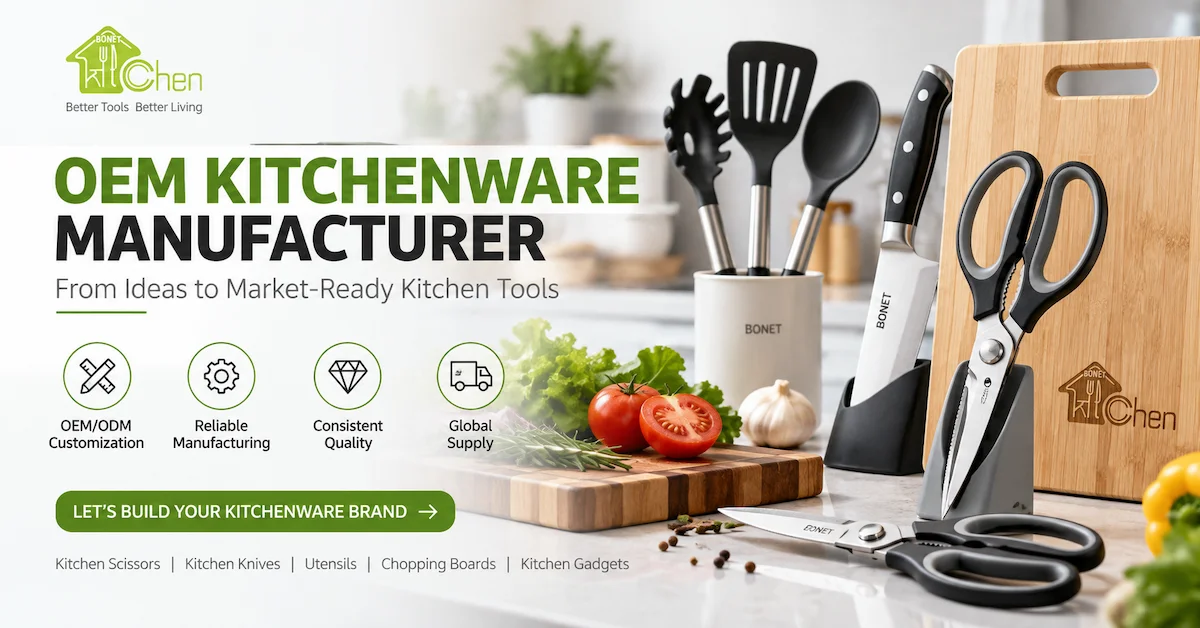
To choose an OEM kitchenware manufacturer, compare suppliers against the same product specification, order quantity, packaging scope and approval requirements. Ask each supplier to separate the product price from tooling, sampling, testing and delivery charges. A lower quotation is only useful when it buys the same configuration and leaves no essential work unpriced. For a first retail range, start with the customer task: cutting food, peeling vegetables or stirring during cooking. Then decide which features deserve customization and which can remain standard. This guide focuses on kitchen scissors and related hand tools, rather than treating every product used in a kitchen as the same sourcing project. BONET HOUSEWARE CO., LTD. is based in Yangjiang, Guangdong, China. Its kitchenware product catalog includes scissors, kitchen knives, utensils, chopping boards and multifunctional tools. Use those categories to build a shortlist, then request a quotation for a defined configuration rather than an unspecified “kitchenware collection.”
Start With the Retail Range, Not the Factory’s Entire Catalog
A brand owner launching a coordinated collection, an importer adding a category and a supermarket buyer replacing an existing item need different quotation briefs. Name the sales channel and intended user before discussing decoration. For a supermarket project, specify the proposed display format and pack contents. For an online range, define the individual saleable unit and the package that will reach the customer. For a distributor, identify which items must be available separately for replenishment. Consider an illustrative collection containing scissors, a peeler and a cooking utensil: matching colors may be desirable, but each item still needs its own specification and quantity. This is a planning example, not a confirmed BONET set or mixed-order offer. For a single personal purchase or an immediate stock requirement, ask about available products instead of starting a custom-development project.
OEM, ODM or Private Label: Define What Actually Changes
For an OEM project, give the manufacturer a buyer-approved design, specification or sample to work from. For an ODM project, identify the development work you need the supplier to undertake, such as resolving an unfinished concept or changing the structure. For private-label customization of an existing model, state whether the changes stop at branding and packaging or also affect the product. BONET’s OEM and ODM services cover production from drawings or samples, customization and product development. Use that discussion to define the work, not merely choose a service label. Ask the OEM kitchenware manufacturer to quote the existing-model option separately from any redesigned version. Confirm the arrangements for design files, tooling, modifications and permitted use in writing; a quotation for a mold should not leave those responsibilities unstated.
Build One Specification Sheet That Every Supplier Can Price
Your request for quotation, or RFQ, should make it possible to compare offers without guessing what has been included. Separate requirements that are fixed from preferences that can be discussed. A target appearance can be negotiable; the product’s intended task should not disappear during a cost revision. Use the following specification checklist as a starting point, not as a list of capabilities already confirmed for every BONET model.
| Specification field | Information to put in the RFQ | What to clarify in the quotation |
|---|---|---|
| Product identity | Category, model reference and drawing revision | Exact model and version being priced |
| Intended use | Food-preparation task, user and usage environment | Suitability questions requiring a sample or test |
| Dimensions | Required measurements, units and agreed tolerances | Whether dimensions describe the tool, sheath or complete pack |
| Materials | Material requirement for each relevant component | Metal, handle, soft grip, coating and accessory specifications |
| Functional details | Cutting, peeling, detachable parts or storage requirements | Which features and accessories are included |
| Branding | Artwork, location, size and requested method | Setup charge, sample approval and decoration limitations |
| Order breakdown | Quantity per model, color and packaging version | Minimums and price tiers for each configuration |
| Retail packaging | Saleable contents, protection, labels and pack dimensions | Included packaging versus optional upgrades |
| Quality approval | Sample reference, checks and acceptance criteria | Inspection scope, reports and release responsibility |
| Delivery scope | Required delivery point and target arrival date | Included charges, exclusions and scheduling assumptions |
Specify Materials by Component, Not by a Single Marketing Label
Ask for a component-level material list. On scissors, identify the blade material separately from the handle, pivot and sheath. On a silicone utensil, ask about both the outer material and any internal support. On a peeler, distinguish the cutting element from the body and any removable parts. Record the required finish and cleaning conditions alongside those materials. Do not approve “food-safe,” “dishwasher-safe” or a temperature claim on packaging without asking what evidence supports the particular product and use conditions. Where the intended market requires specialist review, agree the assessment with your testing or compliance partner before approving the final claims. The purchasing task is to connect each requirement with evidence, not to select the longest list of material names.
Model Comparison: What Three Kitchen-Scissors Listings Tell a Buyer
An OEM kitchenware manufacturer’s catalog becomes more useful when models are compared in the same columns. The examples below use BONET’s published product details. Dimensions and materials are catalog information, not independently measured results; the review questions are suggested procurement checks.
| BONET model | Listed dimensions | Listed metal | Listed polymer materials | Published design direction | Question to resolve before quoting |
|---|---|---|---|---|---|
| G2004 multifunction kitchen scissors | 19 × 9.5 × 1 cm | 420 stainless steel | PP | Detachable blades and integrated functions | Which functions, components and packaging are included in this offer? |
| G2003 cooking shears | 24 × 7.5 × 1.5 cm | 420 stainless steel | PP + TPR | Detachable blades and magnetic sheath | Does the quoted configuration include the sheath and the specified handle materials? |
| G2011 magnetic kitchen scissors | 21.8 × 8.6 × 2 cm | 420 stainless steel | PP | Magnetic sheath and multifunction features | What storage surfaces, included parts and package dimensions must be confirmed? |
Do not rank these models by cutting performance or price from the material labels alone. Request samples for the same intended tasks, confirm how the listed dimensions were measured, and compare the complete retail configuration. In particular, make any storage-compatibility statement specific to the reviewed sample. A feature shown on a product page should be explicitly included in the order specification before you build packaging or photography around it.
How to Compare OEM Kitchenware Manufacturer Quotes
Ask an OEM kitchenware manufacturer for an itemized offer showing the product configuration, decoration, packaging, one-time development charges and any separately priced services. Put all offers on the same currency, quantity and delivery basis. Write down what “one unit” contains: an individual tool, a tool with a sheath, or a complete retail set. For your internal comparison, add the quoted costs needed to reach the same agreed delivery point, then divide by the same number of saleable units. Keep one-time charges visible rather than hiding them in an assumed future order volume. Mark unquoted freight, testing, inspection or other required work as pending, not zero. Also request a repeat-order price basis: which setup charges would disappear, and which specifications must remain unchanged? This produces two useful views—first-order commitment and repeat-order purchasing—without pretending they are identical.
Ask Whether the MOQ Applies to the Model, Color or Package
The minimum order quantity, or MOQ, needs a written scope. Ask whether it applies per product, per color, per branded version or per packaging design. Then ask whether different items can be combined and which minimums would still apply separately. For the illustrative scissors–peeler–utensil range, a single collection name does not establish a shared minimum. BONET’s OEM service page leaves MOQ to quotation-stage confirmation rather than specifying a universal minimum. When assessing an OEM kitchenware manufacturer, request two clearly separated options: the configuration you prefer and a simpler alternative using fewer changes. Do not accept a lower minimum without checking what changed in the product, pack or price.
Check Workmanship Through the Processes Relevant to Your Product
BONET’s manufacturing process overview presents stamping, straight adjustment, heat treatment, grinding, polishing, injection molding, cleaning, assembly, quality checks and packaging. Treat this as a starting point for product-specific questions, not a statement that every tool follows every operation. For scissors, ask how blade alignment, opening and closing, assembly and exposed edges will be checked. For a molded handle, request agreed appearance and fit criteria. For a detachable tool, include removal and reassembly in sample review. Ask which operations take place at the proposed production site and which involve another party. The quotation should identify responsibility for the finished product even where several processes or suppliers contribute to it.
Approve the Product and Packaging as One Retail Item
BONET describes a six-stage workflow covering requirements, sample development, quote confirmation, production, inspection and delivery. Within those stages, make the approval status of each item explicit. Keep the reference model, prototype and approved production sample distinguishable. An unfinished sample may help assess shape without approving its final material, color or finish. Put the packaged sample on the desk alongside the product specification. Check the included parts, protective arrangement, artwork, barcode information and instructions together. Record unresolved points before giving approval. For a fuller workflow, refer to BONET’s product-brief-to-production guide. Your sign-off should identify a specific sample and revision, rather than rely on an email that says only “looks good.”
Review Quality Evidence Without Treating Every Document as Equivalent
Ask the OEM kitchenware manufacturer for an inspection plan that names the checks, acceptance criteria, recording method and person authorized to release the order. Review material identification, dimensions, function, assembly, appearance and packaging as separate subjects. During certification review, record the document type, issuing body, legal company name, site, scope and relevant dates. Keep management-system certificates, social-audit reports and product test reports in separate parts of the supplier file. Ask what each document demonstrates for this order and what it does not cover. Where an audit includes findings, request follow-up evidence rather than assuming the summary proves closure. BONET’s kitchenware quality-control guide provides a related discussion of inspection and release. Agree how nonconforming products will be reported, contained and reviewed before shipment.
Turn Lead Time Into a Schedule With Named Starting Conditions
Request separate estimates for development, tooling where applicable, sample revisions, material preparation, production, inspection and delivery. Ask when each clock starts: receipt of artwork, approval of the sample, confirmation of materials or another agreed event. Keep factory completion, shipment departure and arrival at your warehouse as distinct dates. Ask the supplier to confirm available capacity for the proposed product and quantity rather than infer it from a company-wide annual output figure. For a coordinated range, check whether all items and packaging will be ready together and whether partial delivery is acceptable. A useful schedule also states what happens when a design change or failed inspection requires additional work. BONET’s published process treats lead time as a quotation-stage confirmation, not a fixed promise for every order.
Watch for Quotation Changes That Quietly Change the Product
Review each price revision against the specification, not just the previous total. Has a sheath become optional? Has the grip material changed? Does the offer now cover a plain box instead of printed retail packaging? Is the quoted quantity based on a forecast rather than the purchase you are ready to place? These are comparison questions, not allegations about a supplier. Require changes to be listed and approved. Apply the same discipline to repeat orders: retain the model reference, material list, approved sample, artwork and packaging revision. Ask for written notice before substitutions. The practical value of an OEM kitchenware manufacturer is easier to assess when the proposal shows exactly what will be supplied, what remains open and what would trigger a new approval.
Send an RFQ That Leaves Fewer Assumptions
A useful opening message is: “We are sourcing a branded kitchen-tool range for the attached market and sales channel. Please quote each model and color separately, using the quantities, product requirements and packaging brief provided. Identify tooling and sampling charges, minimum order conditions, estimated milestones, inspection scope and exclusions. Show any lower-cost alternative separately rather than substituting it into the requested specification.” Attach the references needed to support that message, and name the person who will approve changes.
Frequently Asked Questions
1. What does an OEM kitchenware manufacturer need to quote accurately?
Provide the intended use, target market, product reference or drawing, component requirements, quantity by version, branding, packaging and delivery point. Mark anything undecided. Ask the supplier to list assumptions and exclusions so an initial estimate is not mistaken for a fully confirmed production offer.
2. Can BONET work from a drawing or sample?
BONET lists drawing- and sample-based production in its OEM services, alongside ODM development support. Submit the reference with the required changes and end-use conditions. Ask for feasibility, development scope and sample arrangements before treating the concept as ready for production.
3. Is private labeling the same as developing a new kitchen tool?
Not necessarily. Define whether the project uses an existing model with branding changes or requires different dimensions, components or functions. Request separate quotations when comparing those routes. The service label alone does not tell you what engineering or approval work is included.
4. What is BONET’s MOQ for custom kitchenware?
BONET’s OEM service page does not state one MOQ for every model. Request the minimum for your selected product, color, branding and packaging. Confirm whether a mixed-product order is possible and whether any component or packaging minimum remains separate.
5. How much does OEM kitchenware cost?
Request a quote for a defined product and order breakdown. Compare recurring product and packaging charges separately from tooling, samples and other project-specific costs. Without that scope, a broad price range would not tell you what your retail-ready order actually includes.
6. Can logo, color and packaging be customized?
BONET lists logo printing, laser engraving, color options and retail-packaging support among its customization services. Confirm the method available for the selected product, its location and appearance, the sample requirement and any effect on minimum quantity or scheduling.
7. Can different kitchen tools be ordered as one collection?
Request a collection proposal with each item listed separately. Confirm the model, quantity, color, packaging and delivery timing for every item. Do not assume that coordinating the order creates a single shared MOQ, identical lead times or a standard ready-made set.
8. Which product claims should be checked before packaging approval?
Identify every intended claim about food contact, cleaning, heat, corrosion resistance or performance. Ask for evidence tied to the product and conditions concerned, and confirm the review needed for the destination market. Leave unsupported claims off the final artwork.
9. What should a kitchenware sample review cover?
Compare the sample with the agreed specification, including dimensions, materials, function, fit, finish, included accessories and packaging. Record observations and unresolved points. A sample can be approved for one purpose, such as shape review, without approving it for mass production.
10. What should be reconfirmed before a repeat order?
Reconfirm the approved product and packaging revisions, material availability, quantity, price and schedule. Ask whether any component, process or production arrangement has changed. Do not let “same as last order” replace the version references needed to identify what must remain the same.
Conclusion
Choosing an OEM kitchenware manufacturer is a comparison of defined commitments, not just unit prices. Start with the retail task, specify the product by component, compare complete quotations and approve the packaged sample against clear criteria. Keep MOQ, production timing and quality evidence tied to the actual order. To discuss a BONET project, send your kitchenware RFQ with the target market, candidate models, quantities, customization requirements and packaging brief. Ask for a proposal that separates confirmed details from decisions still requiring your approval.
