




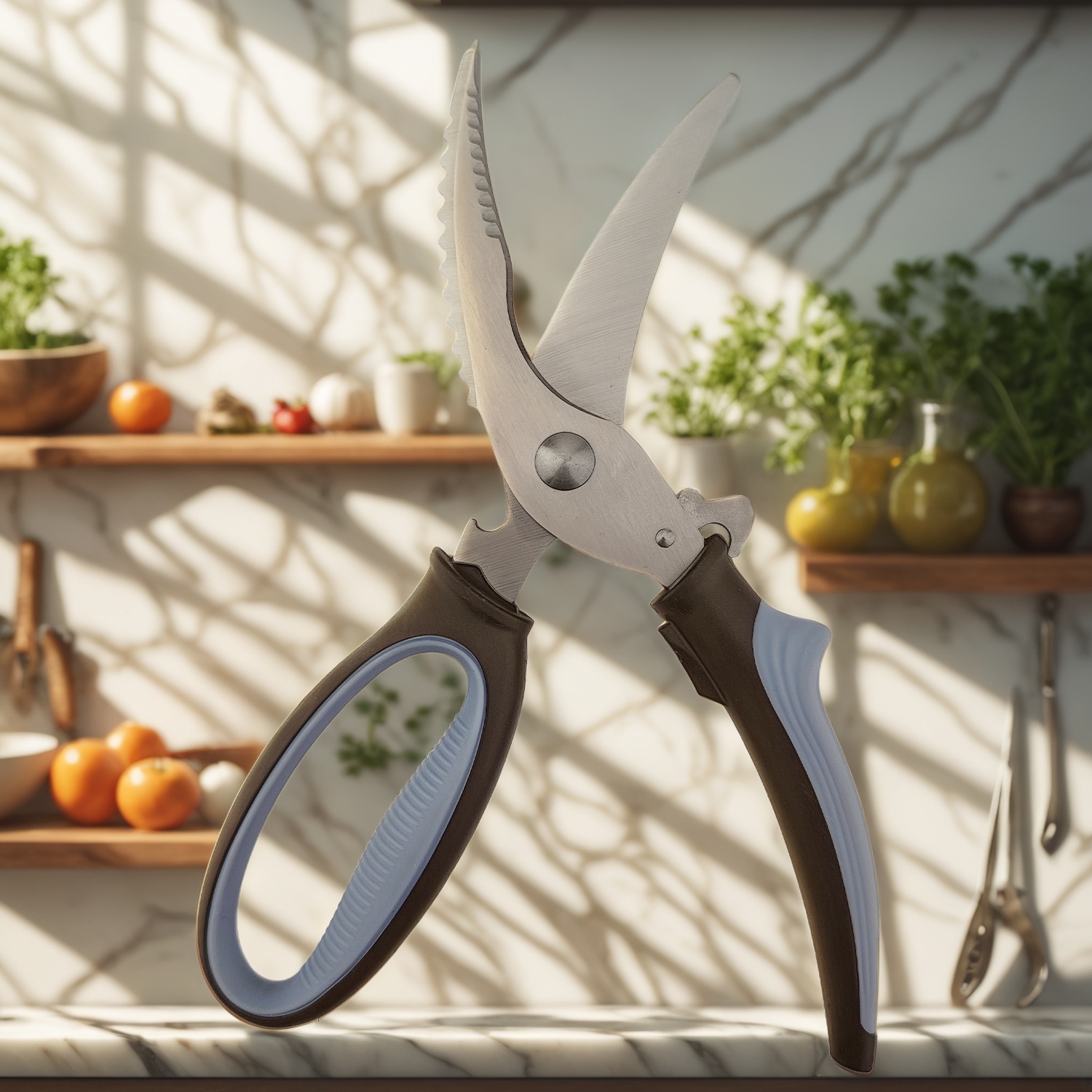
OEM Poultry Scissors: Quality Manufacturer Overview
For kitchenware brands, importers, and wholesale buyers, OEM poultry scissors are more than a simple cutting tool. They are a product category where comfort, blade performance, safety, packaging, and repeatable factory quality all affect customer satisfaction. A poultry shear that feels solid in a sample but varies in mass production can create complaints, returns, and brand risk. That is why supplier evaluation should go beyond a product photo or a low quotation.

The original product focus is clear: poultry scissors for kitchen use, with attention to stainless steel blades, ergonomic handling, and possible multifunctional details such as serrated sections, fish-scaling edges, nutcracker areas, or bottle-opener functions. This guide explains how to turn those ideas into a structured sourcing process so buyers can compare factories with fewer assumptions.
Key Takeaways
- Evaluate OEM poultry scissors by performance, comfort, consistency, and service support, not price alone.
- Ask suppliers to confirm material, blade hardness, finishing, packaging, and inspection methods in writing.
- Request pre-production and production samples before approving a larger order.
- Check whether multifunctional features are useful, safe, and consistently made.
- Keep commercial details such as MOQ, lead time, customization cost, and testing documents as supplier questions unless they are formally confirmed.
Understanding the OEM Poultry Scissors Search Intent
Most buyers searching for OEM poultry scissors are not only looking for a finished product. They are looking for a manufacturing partner that can support a private-label or customized kitchenware line. That may include handle colors, logo placement, packaging layout, retail display requirements, barcode labeling, or product instructions. The buyer needs to know whether a factory can deliver consistent quality while also adapting the product to a brand brief.
Poultry scissors are often used for tasks that demand strength and control, such as cutting poultry joints, trimming meat, or handling slippery ingredients. For this reason, product design should be reviewed from both a mechanical and user-experience perspective. A sharp-looking blade is not enough. The hinge, handle geometry, surface finish, grip security, cleaning method, and edge retention all influence the final customer experience.
What to Review in Blade and Material Quality
The source article refers to high-quality stainless steel as an important feature. For sourcing, the next step is to ask the manufacturer to identify the specific steel type used, the heat-treatment process, and the target hardness range. Do not assume a material grade from marketing language. Ask for written confirmation, and if compliance or food-contact documentation is required in your sales market, request the relevant documents directly from the supplier.
Blade design also matters. Poultry scissors may have straight, curved, serrated, or partly serrated cutting areas. Serration can help grip slippery skin or meat, while a smooth edge may be easier to sharpen or clean depending on construction. Buyers should test the blades on realistic use cases instead of relying only on visual inspection. A sample review should include cutting performance, blade alignment, opening and closing smoothness, and whether the pivot remains stable after repeated use.
Ergonomics and Safety for Real Kitchen Use
The original article highlights ergonomic handles and a secure grip. In practice, ergonomics should be tested by different hand sizes and both quick and repeated cutting motions. A handle that looks modern may still create pressure points, especially when cutting through tougher food. Ask whether the handle material, texture, and shape can be customized, and request samples in the exact handle style being quoted.
Safety should be reviewed before approving any OEM design. The scissors should open and close predictably, with no sharp burrs on the handle, pivot, spine, or secondary tool areas. If the design includes a locking mechanism, ask how it is tested and whether it remains reliable after repeated use. If the shears are detachable for cleaning, confirm how easily they separate and whether the assembly feels secure during cutting.
Multifunctional Features: Useful or Overcomplicated?
Some kitchen scissors include added functions such as a fish scaler, nutcracker, bottle opener, or serrated gripping section. These features can create retail appeal, but they should not weaken the core cutting function. For an OEM buyer, the question is not simply how many functions can be added. The better question is whether each function is clear, safe, durable, and relevant to the target customer.
If your brand sells to home cooks, multifunctional features may be helpful when they are easy to understand and explain on packaging. If your channel serves professional kitchens or culinary retailers, performance, cleaning, and durability may matter more than extra functions. Ask the supplier to provide drawings or samples showing the exact feature layout, and test whether those features interfere with grip comfort or cleaning.
Supplier Evaluation Checklist
| Evaluation Area | What to Check | Questions to Ask the Supplier |
|---|---|---|
| Blade performance | Sharpness, alignment, cutting control, edge finish | What steel type, hardness target, and sharpening process are used? |
| Handle design | Grip security, comfort, pressure points, wet-hand control | Can handle color, material, or texture be customized? |
| Pivot and structure | Smooth movement, stability, looseness after repeated use | How is pivot strength or durability checked during production? |
| Multifunctional parts | Scaler, nutcracker, bottle opener, serration, if included | Are these features standard or optional, and how are they inspected? |
| Packaging | Retail card, box, insert, instructions, barcode needs | What packaging formats are available, and who provides artwork files? |
| Order control | Samples, inspection, defect handling, lead time | What are the MOQ, sample cost, production timeline, and QC process? |
How to Manage OEM Customization
OEM customization can include logo printing or engraving, handle color, packaging artwork, instruction inserts, and sometimes changes to shape or functions. Each customization option can affect cost, tooling, production timing, and quality control. Before requesting a final quote, prepare a clear specification sheet. Include product dimensions if available, preferred functions, packaging type, logo placement, target market, and any mandatory labeling requirements.
Buyers should also clarify ownership of molds, artwork, and packaging files. If the supplier creates custom tooling, ask who owns it, how it is stored, and whether it can be used for other customers. If you need exclusivity for a particular design, discuss that early and obtain written terms. Avoid assuming exclusivity from a general OEM conversation.
Sample Approval and Quality Control
A strong sourcing process usually includes several sample stages. First, request an available reference sample to judge the factory's current workmanship. Next, request a customized sample if the handle, logo, or packaging will change. Finally, request a pre-production sample before mass production begins. The approved sample should become the reference for inspection.
For quality control, define acceptable and unacceptable conditions. Examples may include blade misalignment, loose pivots, rough edges, handle color deviation, weak logo printing, damaged packaging, or inconsistent opening force. If you use third-party inspection, share the inspection criteria with the supplier before production. This reduces disputes and helps the factory understand your expectations.
Practical FAQ
What should I ask before choosing an OEM poultry scissors supplier?
Ask about material, blade treatment, handle options, customization methods, sample availability, MOQ, lead time, packaging support, inspection process, and required documentation for your market.
Can I assume all stainless steel poultry scissors have the same quality?
No. Stainless steel can vary by grade, hardness, finishing, and heat treatment. Ask the supplier to confirm the exact material and provide supporting information when needed.
Are multifunctional poultry scissors better for wholesale programs?
They can be, but only if the added functions are useful and do not reduce comfort, cleaning convenience, or cutting performance. Test samples before selecting a multifunctional design.
How many samples should a buyer review?
At minimum, review a reference sample and a final approved sample that matches the quoted product. For customized orders, a pre-production sample is also strongly recommended.
What details should be confirmed in writing?
Confirm product specification, material claims, packaging, logo method, MOQ, pricing terms, lead time, inspection standard, defect handling, and any compliance documents required for your sales region.
Final Sourcing Advice
Choosing a factory for kitchen scissors is a balance of product performance, communication, and production control. A suitable OEM partner should be able to answer detailed questions, provide relevant samples, explain quality checks, and support the level of customization your brand needs. Instead of relying on broad claims, build your sourcing decision around verified specifications, hands-on testing, and written agreements. That approach gives your poultry scissors program a stronger foundation for wholesale, retail, or private-label sales.
