




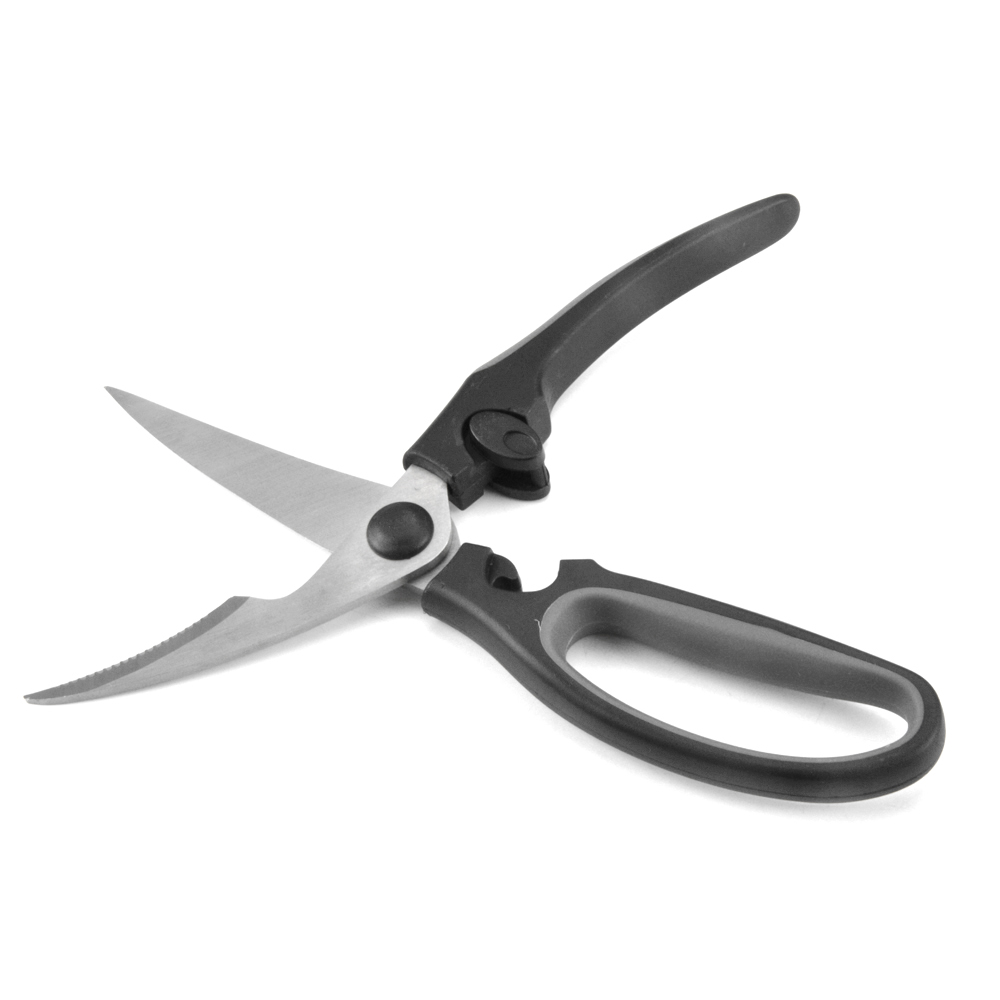
OEM Poultry Scissors: Multi-Functional Kitchen Shears Sourcing Guide
OEM poultry scissors are a practical category for kitchenware brands, wholesalers, importers, and promotional product buyers because they solve several common food-preparation tasks with one compact tool. Unlike standard office-style scissors, poultry shears are intended for kitchen use: cutting poultry, trimming herbs, handling slippery food surfaces, and performing small utility jobs around meal preparation.

For B2B buyers, the goal is not simply to find a sharp pair of scissors. The more important task is to confirm whether the design, materials, cleaning method, safety details, packaging, and supplier communication match your target market. The original product description highlights stainless steel blades, a micro-serrated edge, an ergonomic non-slip handle, a bottle opener, a nutcracker, a safety lock, a disassembly function for cleaning, and a blade notch for small chicken bones or flower stems. These are useful features, but buyers should still verify specifications, test samples, and ask clear commercial questions before placing an OEM order.
What Makes Poultry Scissors Different from General Kitchen Scissors?
Poultry scissors are built for tougher kitchen cutting tasks than ordinary household scissors. When cutting poultry, the blade must grip skin, joints, and small bones without sliding. The micro-serrated edge mentioned in the source material is relevant here because serrations can help the blade hold slippery food surfaces more securely during cutting.
Multi-functional kitchen shears also need to balance strength with control. A pair that feels too heavy may be tiring in repeated use, while a pair that feels too light may not inspire confidence for poultry preparation. For retail programs, buyers should evaluate how the scissors feel in different hand sizes, whether the handle shape supports a firm grip, and whether the locking mechanism is easy to operate without feeling loose.
Core Features to Evaluate Before OEM Sourcing
When comparing OEM poultry scissors, focus on features that affect daily performance and customer satisfaction. The original article identifies several practical elements: stainless steel blades, a micro-serrated edge, non-slip ergonomic handles, a bottle opener, a nutcracker, a safety lock, and a disassembly design for cleaning.
- Blade performance: Ask what stainless steel is used, how the blade is sharpened, and whether the supplier can provide sample cutting tests for poultry, herbs, fish skin, and packaging.
- Grip comfort: Check whether the handle material remains stable when wet and whether left-handed or universal use matters for your market.
- Cleaning access: If the shears can be disassembled, confirm how the mechanism works and whether it remains secure after repeated use.
- Safety storage: Test the smart lock or closing latch to ensure it holds the blades closed during storage and transport.
- Added utility: Bottle opener, nutcracker, and bone-notch functions can be useful, but they should not weaken the handle or make cleaning difficult.
Comparison Checklist for Buyers
The table below can help sourcing teams compare poultry scissors samples from different suppliers. It is also useful for creating an internal evaluation sheet before confirming an OEM kitchen shears order.
| Evaluation Point | What to Check | Questions to Ask the Supplier |
|---|---|---|
| Blade material | Stainless steel type, finish, sharpness, corrosion resistance expectations | What material grade is used, and can it be documented? |
| Cutting edge | Micro-serrated edge, smoothness, gripping ability on slippery food | Can you provide samples for cutting poultry skin and herbs? |
| Handle design | Non-slip feel, ergonomic shape, comfort during repeated cutting | What handle material options are available for OEM orders? |
| Safety lock | Blade closure security, ease of opening, durability after repeated locking | How is the lock tested during production inspection? |
| Cleaning design | Disassembly method, food-trap areas, ease of reassembly | Are care instructions included or customizable? |
| Multi-tool functions | Bottle opener, nutcracker, blade notch, real-world usability | Can these functions be modified or removed for a custom version? |
| Packaging | Retail box, blister card, insert card, barcode area, shipping protection | What packaging formats and artwork requirements do you support? |
OEM Customization and Branding Considerations
OEM buyers often need more than a standard product. They may require a private-label logo, a specific handle color, multilingual packaging, a custom user manual, or a retail-ready presentation. Before discussing price, clarify which parts of the scissors can be customized and which changes require tooling, testing, or longer lead time.
Logo placement is another detail worth confirming early. A logo may be applied to the blade, handle, packaging, or instruction insert, depending on the design and supplier capability. Buyers should request artwork templates, file format requirements, color limitations, and pre-production samples before approving mass production. If your sales channel has packaging rules, barcode requirements, warning label needs, or country-specific language requirements, provide them at the quotation stage rather than after production begins.
Quality Control Questions for a Kitchen Shears Factory
A kitchen shears factory should be able to explain how it controls blade sharpness, handle assembly, locking function, surface finish, and packaging. Avoid relying only on catalog photos. Ask for physical samples and check several pieces, not just one hand-selected sample. If you are sourcing for retail or wholesale distribution, confirm how the supplier handles in-process inspection and final inspection.
- Request a sample that matches the proposed production material, handle color, and packaging.
- Test cutting performance on relevant foods and non-food items that consumers may realistically use in a kitchen.
- Open and close the safety lock repeatedly to check stability.
- Disassemble and reassemble the shears if that feature is included.
- Wash and dry the sample according to the supplier's recommended care instructions.
- Review the packaging for sharp-edge protection during transport.
Buyers should also ask whether any third-party testing, compliance documentation, or market-specific declarations are available. Do not assume a product meets your destination market's requirements unless the supplier provides appropriate documentation and you verify it against your own compliance process.
Use and Care Guidance for End Customers
Although this is an OEM sourcing topic, end-user experience still matters. A good product page or retail insert should explain how to use and care for poultry scissors safely. Customers should cut on a stable surface, keep fingers clear of the blade path, and close the lock before storing the shears. If the scissors are designed to come apart for cleaning, the instructions should clearly show how to separate and reconnect the blades.
Because poultry can carry food-safety risks, cleaning instructions are important. Buyers should ask the supplier for recommended washing guidance and confirm whether the final product is suitable for dishwasher use before making that claim. If dishwasher suitability is not documented, describe hand washing and thorough drying instead. Clear care language helps reduce misuse, complaints, and avoidable returns.
Key Takeaways
- OEM poultry scissors should be evaluated for cutting control, safety, cleaning access, and real kitchen usability.
- The original feature set includes stainless steel blades, a micro-serrated edge, non-slip ergonomic handles, a safety lock, disassembly for cleaning, and added bottle opener and nutcracker functions.
- B2B buyers should verify material details, packaging options, logo methods, testing documents, and inspection procedures before ordering.
- Sample testing is essential because photos and catalog descriptions cannot prove grip comfort, blade performance, or lock durability.
FAQ: OEM Poultry Scissors Sourcing
What should I ask first when contacting a poultry scissors supplier?
Start with material details, available handle options, logo methods, packaging choices, sample availability, lead time, and whether documentation is available for your target market.
Are micro-serrated blades better for poultry scissors?
Micro-serrated edges can help grip slippery poultry skin, fish skin, or herbs while cutting. Buyers should still test samples to confirm the edge suits their intended users.
Can multi-functional kitchen shears replace all other kitchen tools?
No. Bottle opener, nutcracker, and notch functions can add convenience, but poultry scissors should be judged mainly on safe, controlled cutting and easy cleaning.
Should OEM buyers request pre-production samples?
Yes. A pre-production sample helps confirm material, color, logo placement, packaging, lock function, and assembly before mass production begins.
What information should be included in retail packaging?
Useful packaging may include product name, safe-use guidance, cleaning instructions, supplier or brand information, barcode area, and any legally required market-specific labeling verified by the buyer.
