





OEM Scissors Manufacturer: Kitchen Sourcing Guide
For houseware brands, importers, and wholesale buyers, kitchen scissors are a small product with a surprisingly large impact on customer satisfaction. A pair that cuts cleanly, feels stable in the hand, and cleans easily can become a repeat-purchase category. A poorly specified product, however, can create complaints about dull blades, loose rivets, uncomfortable handles, or difficult cleaning. Choosing the right OEM scissors manufacturer is therefore not only about unit cost; it is about product definition, quality control, and clear communication before production begins.
Key Takeaways
- Define the intended kitchen tasks before discussing materials, handle design, or packaging.
- Ask suppliers to confirm blade material, hardness targets, finishing, and corrosion-resistance expectations instead of assuming specifications.
- Review ergonomics, rivet stability, cleaning access, and multifunction features with real samples.
- Use a written quality checklist for pre-production samples and shipment inspection.
- For OEM projects, clarify branding, packaging artwork, lead time, MOQ, spare parts, and after-sales handling early.
What Buyers Should Clarify Before Sourcing
The phrase professional kitchen scissors can mean different things to different buyers. Some buyers need a simple food-preparation scissor for herbs and packaging. Others want a heavier kitchen shear suitable for tasks such as cutting poultry, shellfish, or thicker food packaging. Before contacting a Chinese scissors factory or OEM supplier, prepare a short product brief that explains the target user, sales channel, price band, and expected tasks.
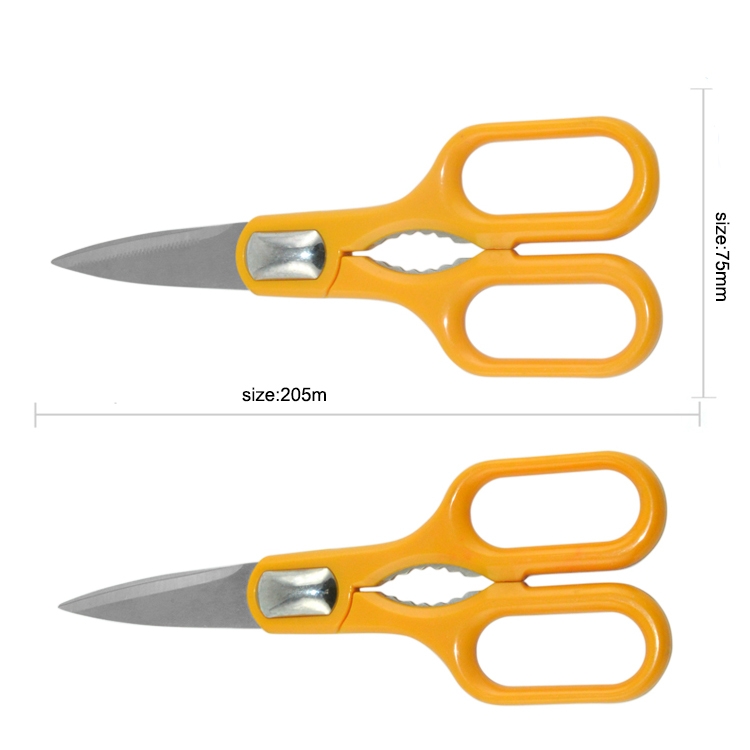
Useful details include preferred blade length, handle color, retail packaging format, barcode requirements, cleaning instructions, and whether the product should include multifunction details. The original product description mentions high-grade stainless steel blades, a polished metal rivet, large-loop ergonomic handles, a bright yellow color, and a serrated notch that can work as a bottle opener or cracker for nuts and shellfish. If these features are important for your program, put them in the specification sheet and ask the supplier to confirm how they will be produced and checked.
Blade, Rivet, and Cutting Performance
The blade is the main reason a customer keeps or returns a pair of kitchen scissors. Stainless steel is commonly chosen for kitchen cutting tools because it can support sharp edges and routine kitchen cleaning, but buyers should not rely on a general material description alone. Ask the manufacturer what stainless steel grade is proposed, what hardness range is targeted, and whether the blade is sharpened by machine, hand finishing, or a combined process. If the supplier cannot provide technical detail, request samples from the intended production process and test them with realistic kitchen materials.
The rivet or pivot area also deserves attention. The original article highlights a polished metal rivet for smooth, controlled cutting motion. In sourcing terms, buyers should check whether the pivot feels stable without being too tight. A loose pivot can reduce cutting accuracy, while an overly tight pivot can make the scissors tiring to use. During sample review, open and close the scissors repeatedly, cut different materials, and inspect whether blade alignment remains consistent.
Ergonomics and Multifunction Design
Kitchen scissors are often used with wet hands, oily food packaging, or quick prep tasks, so handle comfort matters. Large handle loops can accommodate more hand sizes and may reduce fatigue during repeated cutting. Buyers should ask for handle dimensions, material options, surface texture, and color-matching possibilities. A bright color, such as the yellow mentioned in the source article, can help users locate the tool quickly in a busy drawer, but color should be confirmed through physical color samples rather than screen images.
Multifunction features can add value when they are genuinely useful. A notch with a serrated edge between the handles may be used as a bottle opener or a cracker for nuts and shellfish, depending on the final construction. However, added features should not weaken the handle, complicate cleaning, or create uncomfortable pressure points. During evaluation, ask several people to hold the sample and perform typical motions. Good OEM development balances convenience with safety, durability, and easy maintenance.
Comparison and Supplier Checklist
When comparing suppliers, avoid judging only by the first quotation. A lower price may reflect different materials, thinner components, simpler packaging, or fewer inspection steps. The table below can help purchasing teams organize supplier discussions and sample reviews.
| Checkpoint | What to Ask the Supplier | Why It Matters |
|---|---|---|
| Blade material | What stainless steel grade and hardness range are proposed? | Supports sharpness, durability, and corrosion expectations. |
| Cutting test | What materials are used for factory cutting checks? | Shows whether testing reflects real kitchen use. |
| Pivot construction | How is rivet tightness controlled during production? | Affects smooth motion and blade alignment. |
| Handle design | Can loop size, color, and grip texture be adjusted? | Impacts comfort and brand differentiation. |
| Cleaning access | Are there gaps, seams, or areas that trap food residue? | Important for kitchen hygiene and user satisfaction. |
| Packaging | What retail, bulk, or private-label packaging options are available? | Controls shelf presentation and logistics efficiency. |
| Quality control | What inspections are performed before shipment? | Reduces the risk of inconsistent goods. |
OEM Branding, Packaging, and Order Details
For private-label or OEM projects, commercial details should be discussed after the product specification is clear. Ask the supplier which branding methods are available, such as logo placement on the handle, blade, card, box, or instruction insert. Do not assume that every logo method is suitable for every material or order quantity. Request artwork templates and confirm who is responsible for final print approval.
Packaging can be as important as the product in retail channels. A hanging card may suit supermarkets and houseware stores, while a color box may work better for gifting or e-commerce. For online sales, ask whether packaging can protect the scissors during parcel shipping and whether the product requires a blade cover or additional internal fixing. Buyers should also ask about MOQ, sample lead time, production lead time, carton dimensions, gross weight, payment terms, and how nonconforming goods are handled. These details should be written into the purchase agreement rather than left to informal messages.
Sample Testing Before Placing an Order
Samples are not only for appearance approval. Build a practical test routine that reflects how end users will use the scissors. Cut herbs, paperboard food packaging, plastic pouches, and other intended materials. If the product is marketed for tougher kitchen tasks, test those tasks carefully and safely. Wash and dry the sample several times, then inspect the blade, pivot, handle, and any multifunction notch. Check whether the scissors still open smoothly and whether the cutting edge remains aligned.
It is also helpful to compare at least two or three samples from different suppliers. Ask each supplier to label the sample with the material, finishing process, packaging proposal, and quoted version. This prevents confusion later when the approved sample must be matched during production.
Practical FAQ
What should I send to an OEM scissors manufacturer first?
Send a product brief with target market, expected kitchen tasks, blade and handle preferences, color, packaging style, branding needs, estimated order quantity, and any reference samples or photos.
Can I assume all stainless steel kitchen scissors perform the same?
No. Performance depends on steel grade, heat treatment, blade geometry, sharpening, pivot quality, and production control. Ask the supplier to confirm these details and test samples yourself.
How do I evaluate comfort before bulk production?
Check handle loop size, grip feel, opening width, weight balance, and pressure points. Ask several users with different hand sizes to try the sample during repeated cutting tasks.
What quality issues should importers watch for?
Common issues include dull blades, uneven sharpening, loose rivets, poor blade alignment, rough edges, color mismatch, weak packaging, and inconsistent logo printing.
Should multifunction kitchen scissors be selected for every range?
Not always. Multifunction features are useful only when they are comfortable, durable, and easy to clean. For some channels, a simpler design with reliable cutting performance may be the better choice.
Final Sourcing Advice
A reliable OEM scissors project begins with a precise specification and a disciplined sample review. Focus on blade performance, pivot stability, handle comfort, cleaning, and packaging before negotiating final terms. By asking clear questions and documenting approved details, buyers can work more effectively with a kitchen scissors supplier and reduce avoidable quality problems in bulk orders.
