









OEM Stationery Scissors: Practical Sourcing Guide for Office and Craft Buyers
OEM stationery scissors are simple products, but they are not simple to source well. A buyer may be looking for desk scissors for office supply shelves, a student stationery set, a craft-oriented cutting tool, or a coordinated giftable pack that includes both scissors and a utility knife. In each case, the product has to feel comfortable, cut consistently, look suitable for the target retail channel, and arrive in packaging that supports the intended price point.
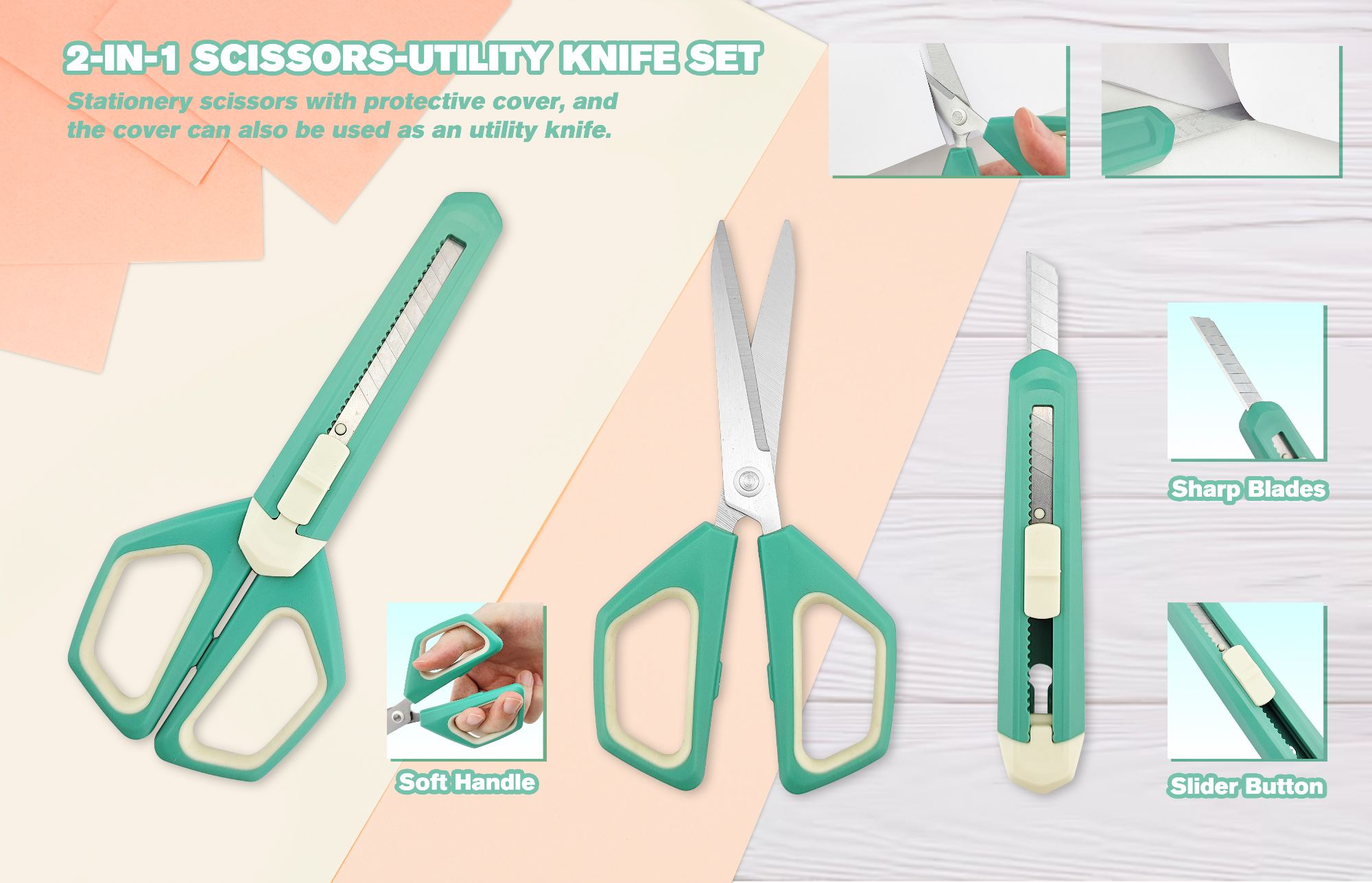
The original product example is a turquoise and ivory cutting duo set featuring a pair of multi-functional scissors and a matching utility knife. The scissors use a modern geometric handle design with a soft inner grip, and the blades are described as stainless steel. The utility knife has a matching turquoise casing, an adjustable blade slider, and a safety lock. Those explicit details make the set a useful reference point for buyers comparing OEM stationery scissors for wholesale, private label, or promotional programs.
Key Takeaways
- For OEM stationery scissors, comfort, cutting performance, safety, and packaging are as important as color and appearance.
- A scissors-and-utility-knife set can serve office, school, craft, and light packaging tasks, but buyers should confirm the exact intended use with the supplier.
- Do not assume blade grade, compliance status, MOQ, production capacity, or test results unless the supplier provides documentation.
- Request pre-production samples and compare them against agreed specifications before approving bulk production.
- Ask clear questions about customization options, packaging structure, replacement parts, quality control steps, and carton protection.
What Makes This Stationery Cutting Set Relevant for OEM Buyers?
The turquoise cutting duo set stands out because it combines two commonly purchased desk tools: scissors for paper, light cardstock, mail, and craft work, plus a utility knife for packages and cardboard. For a retailer or distributor, a matched set can be easier to position than a single pair of scissors because it covers a wider range of everyday cutting tasks.
The color scheme is also important. Turquoise and ivory give the product a distinct desk accessory look without relying on complicated decoration. For OEM sourcing, this raises useful questions: can the supplier match brand colors, provide multiple colorways, print or mold a logo, or adjust packaging artwork? These options should be discussed early because color matching and packaging changes can affect sampling time, order planning, and final approval.
Buyers should also think about the audience. Office supply buyers may prioritize consistent cutting, safe handling, and practical packaging. Craft retailers may care more about precision and hand comfort. School and student channels may focus on safe design, age suitability, and clear labeling. Promotional buyers may need reliable branding areas and compact packaging. The same basic product can work in several channels, but the specification should be aligned with the actual end user.
Scissors Design: Comfort, Control, and Cutting Performance
The original article highlights an ergonomic handle with a soft inner grip. This is a useful product feature because scissors are handled repeatedly, and discomfort becomes noticeable during longer cutting tasks. A handle should allow natural finger placement, stable control, and easy opening and closing. If the scissors are intended for craft or office use, buyers should test them with common materials rather than judging by appearance alone.
Cutting performance should be checked across realistic use cases. For this product, the original description mentions clean cutting on paper and light cardstock. Buyers should not extend that claim to thicker plastics, fabric, heavy board, or industrial materials unless the supplier specifically confirms the application and provides samples for testing. A practical sample review can include straight cuts, curved cuts, repeated cuts, tip accuracy, and whether the blades catch or separate during use.
The blades are described as stainless steel, which is a useful baseline detail. However, the exact stainless steel grade is not provided in the source. If material grade matters for the sales channel, buyers should ask the supplier to specify it in writing and provide supporting documentation if available. They should also confirm blade thickness, blade finish, edge sharpness expectations, and whether protective oil, covers, or corrosion-prevention measures are used during shipping.
Utility Knife Features to Confirm Before Ordering
The matching utility knife adds practical value to the set. According to the original description, it has an adjustable blade controlled by a slider and a safety lock that helps keep the blade secure when not in use. Those details matter because utility knives introduce different safety and durability concerns from scissors.
When evaluating an OEM utility knife, buyers should test whether the slider moves smoothly without being loose, whether the blade holds position during use, and whether the safety lock is easy to understand. The knife should also be checked for edge protection in packaging. If replacement blades are included or sold separately, the buyer should confirm blade size, compatibility, and how replacement information will be communicated to users.
The original article notes that the utility knife is suitable for opening packages and cutting cardboard. That is a reasonable everyday use case, but buyers should avoid positioning it for heavy-duty construction or industrial cutting unless the supplier has designed and tested it for that purpose. Product instructions and packaging language should be clear so customers understand appropriate use.
Comparison Checklist for OEM Stationery Scissors Sets
A structured comparison helps buyers move beyond product photos. The table below can be used when reviewing this cutting duo set against other OEM stationery scissors suppliers.
| Evaluation Area | What to Check | Questions to Ask the Supplier |
|---|---|---|
| Scissors handle | Shape, grip comfort, finger space, opening and closing feel | Can the handle color, grip material, or logo area be customized? |
| Scissors blades | Cutting smoothness on paper and light cardstock, tip alignment, edge consistency | What stainless steel grade is used, and can it be documented? |
| Utility knife | Slider movement, blade stability, safety lock function, casing strength | Are replacement blades available, and what blade size is compatible? |
| Safety and labeling | Warnings, age guidance if applicable, blade protection, instructions | What labeling is recommended for the target market? |
| Packaging | Retail display format, protection in transit, barcode area, branding space | Can the supplier support private label packaging artwork and samples? |
| Quality control | Pre-shipment inspection, visual defects, cutting tests, carton checks | What inspection steps are performed before shipment? |
Packaging and Branding Considerations for Wholesale Programs
Packaging is a major part of OEM stationery scissors sourcing. A cutting tool set may be sold in a blister card, paper card, window box, sleeve, or other retail-ready format. The best option depends on channel requirements. A hangable retail pack may suit stationery stores, while compact boxed packaging may work better for online sales or promotional distribution.
Buyers should consider whether the package protects both the scissors and utility knife from movement during shipping. Blade tips and cutting edges should not damage packaging or become exposed. If the product is shipped through e-commerce channels, drop and vibration risks may be different from store distribution. Ask the supplier what packaging has been used for similar products, but do not assume test performance unless results are provided.
For private label orders, artwork approval should be managed carefully. Confirm print colors, logo placement, barcode space, warning text, product name, country-of-origin marking if required, and any market-specific labeling needs. If the supplier cannot advise on legal requirements for the destination market, the buyer should consult an appropriate compliance professional before finalizing packaging.
Supplier Questions Before Placing an OEM Order
Before committing to a wholesale or OEM stationery scissors order, buyers should prepare a supplier questionnaire. Clear questions reduce misunderstandings and make quotations easier to compare.
- What parts of the scissors and utility knife can be customized: color, logo, handle design, packaging, or set configuration?
- What material is used for the blades, handles, soft grip, and utility knife casing?
- Can the supplier provide samples that match the proposed production materials and colors?
- What is the expected sample lead time and production lead time for the requested configuration?
- What is the MOQ for standard colors and for customized colors or packaging?
- What quality control checks are performed for blade alignment, cutting performance, slider function, and packaging?
- Are product instructions, warnings, and packaging text customizable for the destination market?
- How are the scissors and utility knife packed inside cartons to prevent damage in transit?
These questions do not imply that any specific supplier has a particular MOQ, capacity, certification, or inspection system. They are practical points buyers should clarify during sourcing.
How to Evaluate Samples Before Bulk Production
Sample review should be more than a visual check. Start by comparing the sample against the quotation and artwork file. Confirm color, handle shape, blade finish, utility knife casing, packaging layout, and any branding details. Then perform functional checks with realistic materials such as standard office paper, envelopes, light cardstock, shipping tape, and cardboard.
For the scissors, test multiple cuts and note comfort, resistance, blade alignment, and whether the tips cut cleanly. For the utility knife, test the slider, lock, blade exposure, and stability during package opening. If several people will evaluate the product, gather feedback from users with different hand sizes. This is especially helpful for stationery tools because comfort is subjective.
After sample approval, document the approved version with photos, measurements if relevant, packaging files, and written specifications. This approved sample should become the reference for production inspection. Any later change in material, color, blade finish, or packaging should be confirmed before mass production starts.
FAQ: OEM Stationery Scissors and Cutting Tool Sets
What is the advantage of sourcing a scissors and utility knife set instead of scissors alone?
A set can cover more everyday cutting tasks, including paper, light cardstock, package opening, and cardboard cutting. It may also create a stronger retail presentation when the two tools share the same color and design language.
Can OEM stationery scissors be customized with private label branding?
Customization may be possible, but the exact options depend on the supplier. Buyers should ask about logo placement, handle color, packaging artwork, color matching, and whether customized samples can be produced before bulk ordering.
What materials should buyers confirm?
Buyers should confirm blade material, handle material, grip material, utility knife casing material, blade type, and packaging materials. The source article states that the scissors have stainless steel blades, but it does not specify the grade.
How should buyers test stationery scissors samples?
Test comfort, opening and closing action, straight and curved cuts, tip precision, and repeated cutting on intended materials. For this type of product, paper and light cardstock are relevant sample test materials based on the original description.
What should be checked on the utility knife?
Check slider smoothness, blade stability, safety lock function, casing feel, packaging protection, and blade replacement details if replacement blades are part of the program.
Should buyers request compliance documents?
If the product is sold in a market with specific safety, labeling, or material requirements, buyers should ask the supplier what documents are available and seek professional compliance guidance where needed. Do not assume compliance without documentation.
Final Thoughts
OEM stationery scissors should be selected with the same care as any other branded product. The turquoise scissors and utility knife set offers a practical example of a coordinated office cutting solution with a soft-grip scissors handle, stainless steel blades, a matching utility knife, an adjustable slider, and a safety lock. For buyers, the next step is not simply choosing a color; it is confirming specifications, testing samples, reviewing packaging, and asking the supplier the right questions. A disciplined sourcing process helps create a product that is useful, consistent, and appropriate for its intended retail or wholesale channel.
