




OEM Stationery Scissors: The Amber Scissors Series
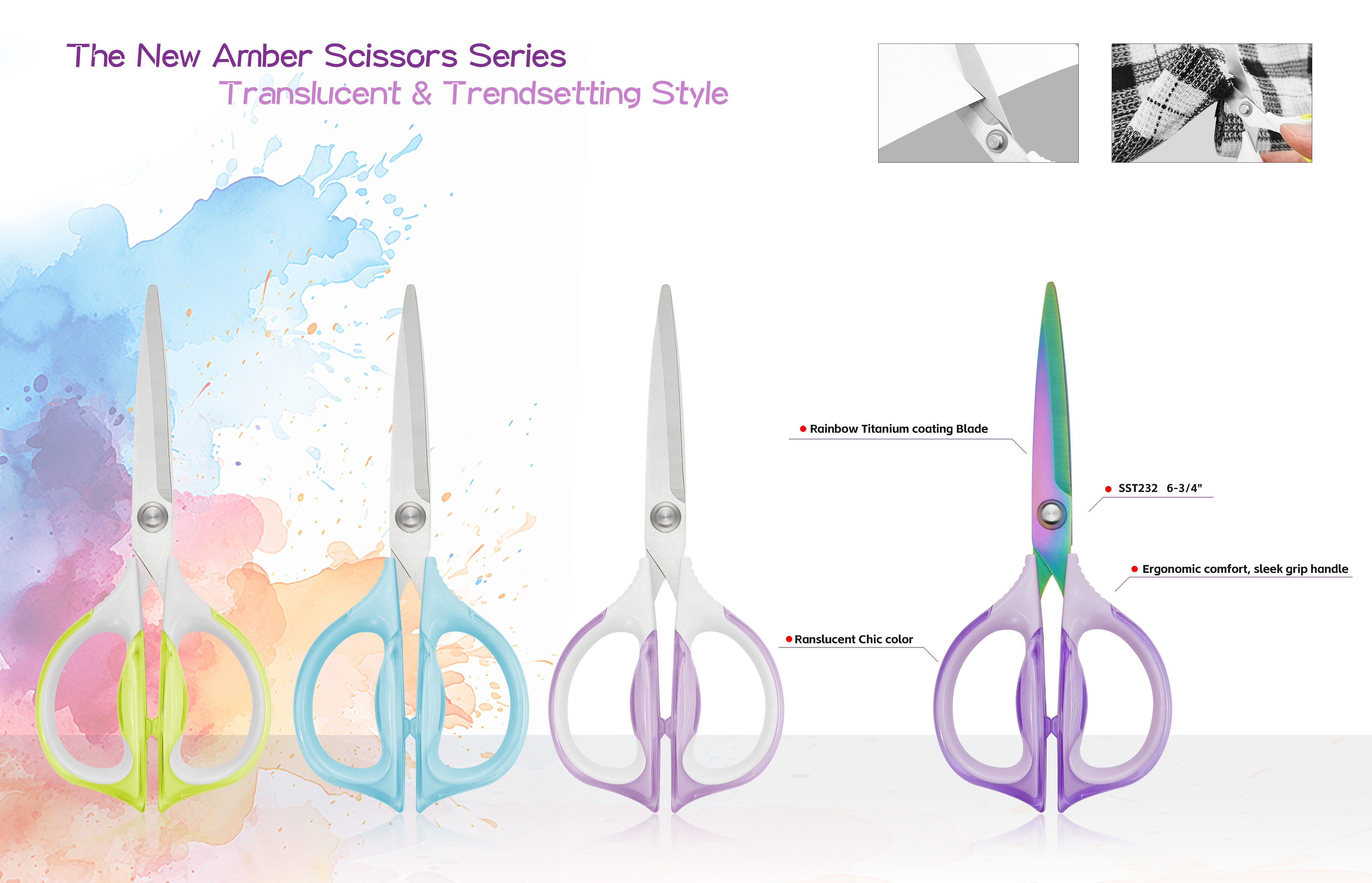
For importers, stationery brands, craft retailers and promotional product buyers, OEM stationery scissors are a small item with a large impact on customer experience. A pair of scissors may be used daily for paper cutting, gift wrapping, school projects, office work or light craft tasks, so sourcing decisions should consider comfort, visual appeal, packaging, quality consistency and supplier communication.
The Amber Scissors Series provides a useful example for building an OEM evaluation checklist. The original product information highlights a rainbow titanium coating blade, ergonomic handle design, translucent color options in lime, aqua and lavender, and an SST232 size of 6-3/4 inches. These details help buyers compare whether the product fits a retail stationery line, craft assortment, back-to-school program or private-label range.
Key Takeaways
- Confirm which product details are fixed and which can be customized for OEM or private-label orders.
- Evaluate scissors by cutting feel, handle comfort, finishing consistency, packaging suitability and shipment reliability.
- Do not rely only on appearance; request samples and ask how the supplier checks sharpness, alignment and surface finish.
- For the Amber Scissors Series, explicit features include a rainbow titanium coating blade, ergonomic handle, translucent shades and 6-3/4 inch SST232 size.
What Makes OEM Stationery Scissors Different?
OEM stationery scissors are sourced not only as finished tools but also as products that may need to match a buyer's brand positioning. A retailer may want a modern color palette for craft customers, while an office supplier may focus on comfortable daily use and repeatable quality. A distributor may need carton labeling, barcode placement, multilingual packaging or a consistent assortment across several markets.
Because these details affect cost, lead time and customer satisfaction, buyers should treat scissors sourcing as a structured project. Instead of asking only for the lowest unit price, prepare a specification sheet that covers size, blade finish, handle color, packaging format, logo requirements and any market-specific documentation the supplier may need to provide or confirm.
Amber Scissors Series Features to Evaluate
The Amber Scissors Series is presented with a rainbow titanium coating blade. This finish gives the blade a distinctive appearance and may help the product stand out in retail displays. However, buyers should ask the supplier what performance or durability expectations are associated with the coating, how the finish is inspected and whether color variation between production batches is acceptable.
The series is also described with an ergonomic handle that is intended to be comfortable and reduce strain during continuous tasks. For B2B buyers, this should be verified through sample testing. Ask several users to cut paper, thin card and common packaging materials for a short period, then record comments on grip comfort, finger opening size, control and any pressure points.
The available translucent shades of lime, aqua and lavender can support a craft or school stationery range. The stated SST232 size is 6-3/4 inches, which is a versatile length for general use. If your range includes children's scissors, heavy-duty office scissors or fabric scissors, confirm whether those are separate models rather than assuming one stationery model covers every use case.
Comparison Checklist for Buyers
| Evaluation Area | What to Check | Questions to Ask the Supplier |
|---|---|---|
| Blade finish | Visual consistency, edge alignment and coating appearance | How is the rainbow titanium coating inspected before packing? |
| Cutting performance | Smooth cutting on intended materials without snagging | What cutting tests are used for stationery scissors samples and bulk goods? |
| Handle comfort | Grip shape, finger space and control during repeated cutting | Can the handle color or material appearance be adjusted for OEM orders? |
| Size and assortment | Whether 6-3/4 inches fits the target user and shelf plan | Is SST232 the only size offered in this style, or are related sizes available? |
| Packaging | Retail card, blister, bulk pack or private-label presentation | What artwork files, barcode rules and packing details are required? |
| Quality control | Batch consistency, defect handling and pre-shipment inspection options | What inspection standards and acceptable defect criteria can be agreed in writing? |
How to Work With a Stationery Scissors Factory
When contacting a stationery scissors factory or supplier, provide clear commercial and technical context. Share the target sales channel, expected user, packaging preference and destination market. If the product is for a brand program, include color references, logo placement ideas and any packaging language requirements. Clear information helps the supplier respond with practical options rather than generic quotations.
Buyers should also separate confirmed product facts from open questions. For this series, the source mentions the rainbow titanium coating blade, ergonomic handle, translucent lime, aqua and lavender options, and 6-3/4 inch SST232 size. Other commercial details, such as MOQ, production lead time, customization limits, available packaging, quality documentation and price tiers, should be requested directly from the supplier and confirmed in writing before ordering.
Sample Testing Before Wholesale Orders
Samples are essential for OEM stationery scissors because small differences in blade alignment, pivot tension or handle shape can change the cutting experience. Test the scissors with the same materials your customers are likely to use. For a craft retail range, include copy paper, cardstock, wrapping paper and adhesive-backed sheets if relevant. For office use, test labels, envelopes and standard packaging materials.
- Check the first impression: color, surface finish, handle molding and packaging appearance.
- Open and close the scissors repeatedly to assess pivot smoothness and noise.
- Cut from the base to the tip of the blade to check consistency across the full length.
- Ask left- and right-handed users to comment if your market includes both user groups.
- Record defects with photos so the supplier can respond with clear corrective actions.
Private Label and Packaging Considerations
For private-label stationery scissors, packaging can be as important as the tool itself. The Amber Scissors Series has visual appeal because of its blade finish and translucent handle colors, so packaging should show the product clearly while protecting the blade and handle during shipment. Buyers should ask whether retail cards, hanging holes, safety covers, barcode labels or master carton markings can be aligned with their distribution requirements.
Artwork approval should be handled carefully. Confirm print dimensions, color references, warning text, country-of-origin marking requirements and barcode readability before mass production. If your market has specific product safety or labeling rules, ask the supplier what information they can provide and verify compliance responsibilities with your own internal or external advisor.
FAQ
What is the main use of the Amber Scissors Series?
Based on the available information, the Amber Scissors Series is positioned as stationery scissors suitable for office, school, craft and general paper-cutting tasks. Buyers should test samples against their exact use case before placing a wholesale order.
Can OEM buyers customize the Amber Scissors Series?
The article source discusses OEM stationery scissors but does not list specific customization options. Buyers should ask the supplier whether logo printing, handle colors, packaging, barcode labels or carton marks can be customized.
What size is mentioned for this series?
The explicit size mentioned is SST232 6-3/4 inches. If your assortment needs different sizes, request the supplier's current model list and confirm whether related sizes are available.
How should buyers verify quality before ordering?
Request samples, test cutting performance, inspect blade finish and handle comfort, then agree on written quality criteria for bulk production. If needed, arrange pre-shipment inspection based on your acceptance standards.
What commercial details should be confirmed with the supplier?
Ask about MOQ, lead time, packaging choices, customization limits, sample policy, payment terms, inspection process and shipment packing. These details are not provided in the original article and should not be assumed.
Final Sourcing Advice
OEM stationery scissors are best sourced through clear specifications, sample testing and written quality expectations. The Amber Scissors Series offers a defined starting point with its rainbow titanium coating blade, ergonomic handle, translucent color choices and 6-3/4 inch SST232 size. For wholesale or private-label programs, use those facts as the base specification, then confirm customization, packaging, inspection and commercial terms directly with the supplier before committing to production.
