




Why outdoor cooking buyers need a better supplier than “just a kitchen goods vendor”
If you are sourcing from an outdoor cooking tools supplier, you are not simply buying spoons, tongs, and bowls. You are buying equipment that has to work around heat, grease, weather, transport, and the impatience of end users who want dinner to happen without fuss. That is a different job from supplying indoor utensils, and it is why many buying mistakes start with the wrong comparison set.
For engineers, sourcing managers, and product teams, the real question is rarely “Are these tools available?” It is more often “Will they hold up in a grill environment, pack neatly, clean easily, and cover the use case without adding unnecessary cost?” The right answer depends on the format of the set, the materials, the handle design, and the way the assortment supports actual outdoor meal prep. A decent-looking utensil on a catalog page can fail quickly once it meets charcoal, glare, and a busy cook with greasy hands.
What an outdoor cooking set is really expected to do
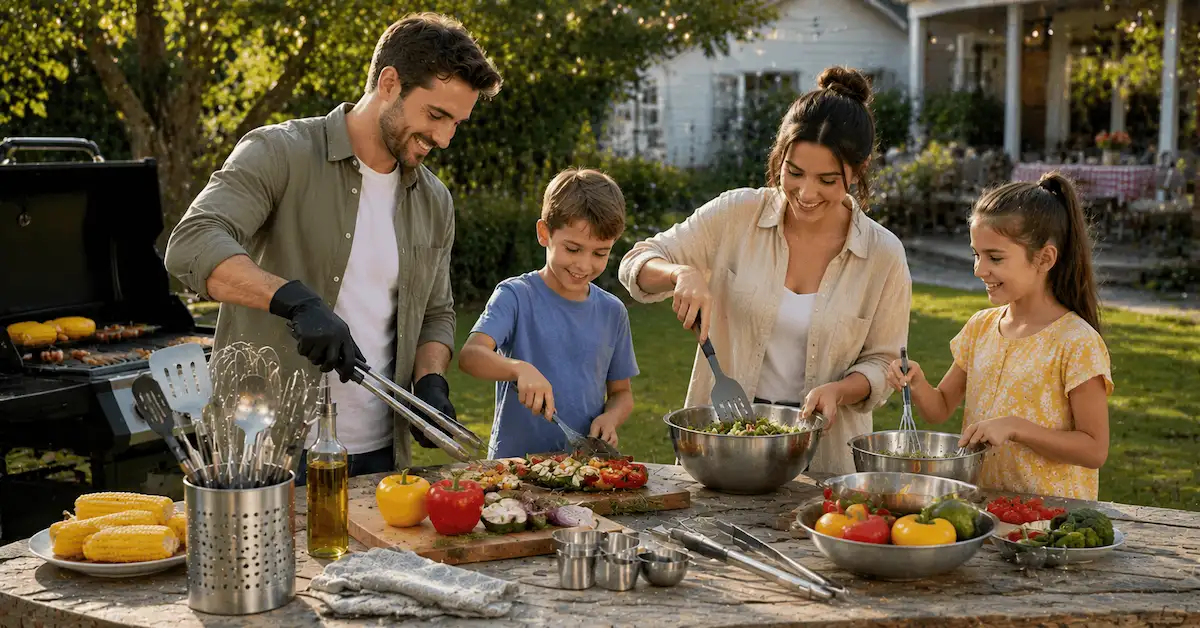
The backyard grilling scene in the supplied product information gives a useful picture. The setup includes stainless-steel grilling utensils, metal mixing bowls, measuring cups, a utensil holder, a bottle of oil, and serving or prep dishes. In other words, this is not a single-purpose barbecue fork. It is a small outdoor kitchen system built around prep, cooking, and serving.
That matters because buyers often split these items into separate sourcing categories. A grill tool supplier, a cookware supplier, and a serving ware vendor may all be involved. Yet the end user usually thinks in one workflow: season the food, prep ingredients, turn them on the grill, and carry them to the table. If the assortment is badly organized, the consumer experiences friction even if each component is decent on its own.
Key product features to evaluate before placing an order
The visible assortment points to several practical requirements that are worth checking early. The long-handled grilling tools are sized for use over an open grill, which suggests heat exposure and reach are central design concerns. The spatula heads appear flat and slotted, which is useful for turning burgers and vegetables while letting grease drain. The mixing bowls have the curved, familiar shape that works for salad, marinades, or side dishes. Measuring cups and a bottle of oil support ingredient control, not just cooking.
Those are small details, but they shape buyer satisfaction. A set that looks rich in photos but lacks a stable bowl, a proper turner, or enough prep pieces may disappoint families or casual hosts who want one bundle to cover the whole cookout. On the other hand, overly elaborate kits can create clutter and raise cost without adding much value.
Material choices that usually make sense
Based on the supplied product data, brushed or polished stainless steel appears to be the main material for the tools and bowls. That is a sensible choice for outdoor cooking because it offers a clean look, resists staining better than many low-cost alternatives, and is familiar to users who want simple maintenance. Black heat-resistant handles or gloves on some tools also fit the category, since grip and heat protection matter around grills.
Still, buyers should avoid assuming more than they can verify. Exact steel grade, coating, and heat resistance were not provided, so those should be confirmed with the supplier rather than inferred from appearance. A tool can look premium in a rendering and still feel flimsy in hand. For commercial sourcing, that distinction matters.
Portable outdoor kitchen equipment versus loose accessories
Many teams start by asking whether they should buy portable outdoor kitchen equipment as a bundled set or source each item separately. The answer depends on distribution channel and target user. For retail, a compact assortment often sells better because it simplifies the purchase decision. For hospitality, event catering, or private-label programs, a mix-and-match approach may allow better control over margin and packaging.
Bundled sets are strongest when the products naturally work together: tongs, spatulas, bowls, cups, and a holder for storage. Loose accessories make more sense when the buyer already has a base system and only needs to replenish a few high-wear items. There is no universal rule here, but there is a warning worth repeating: if the assortment includes unnecessary pieces, the perceived value can rise while actual utility falls. Sourcing should stay anchored to use, not shelf filler.
How a camping cookware supplier differs from a barbecue-focused vendor
A camping cookware supplier is not always the best match for backyard grilling, even though the categories overlap. Camping cookware often emphasizes compact nesting, low weight, and multi-use formats for transport. Backyard outdoor cooking, especially family grilling, tends to reward sturdiness, ease of handling, and a more generous tabletop layout.
The supplied product image leans toward family grilling rather than backcountry cooking. That means the buyer should prioritize stable mixing bowls, long-handled tools, and a tidy prep-and-serve arrangement. If the target customer is a camper, portability becomes more important. If the target customer is a suburban grill owner, comfort and presentation may matter more. This is one of those sourcing choices that sounds minor until the returns data comes back.
Selection criteria that help reduce procurement mistakes
There are a few filters worth using before you move a supplier forward.
First, check the breadth of the assortment. Does the supplier cover the whole outdoor workflow, or only the glamorous part near the fire? In the supplied example, the presence of bowls, measuring cups, and serving dishes suggests broader coverage than a basic tongs-and-spatula bundle.
Second, inspect handle design and length. Long handles are not a cosmetic feature. They reduce exposure to heat and make grill turning more comfortable. If the handles are too short or the grip is awkward, the user experience degrades quickly.
Third, look at storage behavior. A cylindrical utensil holder or canister can be a practical touch for countertop organization, but only if it is stable and sized correctly. Poor storage design turns into countertop clutter, and that is exactly what many buyers are trying to avoid.
Fourth, ask how the set will be packed for shipping and retail display. Metal tools and bowls can scratch one another, and mixed-material sets can rattle badly if they are not protected properly. This is a common quality issue that is easy to miss in product photos.
Common mistakes when sourcing outdoor cooking sets
One frequent mistake is treating all stainless-looking products as equivalent. They are not. The finish, thickness, and assembly quality can vary widely. Another is overestimating how much the consumer wants. Some buyers assume more pieces automatically mean a better offer, but customers usually care about relevance first. A tidy, practical bundle often outsells a bloated one.
Another pitfall is ignoring the boundary between prep and cooking. A set can have excellent grill tools and still fail because the bowls are too shallow, the measuring cups feel flimsy, or the serving pieces are awkward. Since the product information here shows meal-prep tools alongside barbecue utensils, the assortment should be judged as a system, not item by item alone.
Finally, do not skip the basics: cleaning expectations, storage footprint, and how the set will be used by someone with wet or greasy hands. Those are not glamorous specifications, but they are the reasons users keep or discard outdoor kitchen gear.
What buyers should ask an outdoor cooking tools supplier
Useful supplier questions are practical, not theatrical. Ask which items are included in the assortment and whether the set is sold as one package or a family of components. Ask what parts are stainless steel, which ones have heat-resistant handles, and whether the utensil holder is metal or plastic. Ask for pack-out details, because a bundle that looks organized in a studio image may be a headache in carton form.
If you are comparing suppliers across categories, ask whether they can support related product lines such as portable outdoor kitchen equipment or companion items for casual grilling. A good vendor should be able to speak clearly about how the assortment is used, not just how it is photographed.
Practical buyer advice for retail and private label teams
For retail programs, the best-performing outdoor cooking set is usually the one that tells a clear story fast. Family grilling, meal prep, and easy serving are understandable benefits. For private label, you want a supplier who can maintain consistency across tools, bowls, and accessories, because mixed quality inside one box is hard to defend at the shelf.
Also consider how the set lands with the end user. A homeowner preparing burgers and vegetables wants quick access, easy turning tools, and enough bowls to keep raw and cooked food separate. If the bundle supports that flow, it earns its place. If it does not, no amount of polished presentation will save it.
FAQ: quick answers for sourcing teams
Is stainless steel the right default material?
Often, yes. It is widely accepted for outdoor cooking tools and bowls, but the exact performance depends on construction, finish, and handle design. Confirm the details rather than assuming all stainless products behave the same way.
Should a set include prep items, or only grill tools?
If the target use is family grilling or backyard entertaining, prep items add real value. Bowls, measuring cups, and serving dishes make the bundle more useful and more self-contained.
Is a camping-oriented supplier enough for backyard products?
Not always. Camping cookware supplier lines may optimize for compactness, while backyard buyers may care more about comfort, presentation, and larger tabletop workflows.
A sensible next step
If you are evaluating an outdoor cooking tools supplier, start with the workflow rather than the SKU list. Map how the user prepares, cooks, and serves food outdoors, then check whether the supplier’s assortment matches that path. The product data here suggests a well-rounded backyard cooking set with stainless-steel tools, bowls, measuring cups, and a storage piece, which is a strong starting point for family-oriented outdoor use.
From there, verify the parts you cannot see in a photo: material grade, handle construction, pack-out, and whether the assortment can be adapted for your channel. That is usually where a good-looking sample turns into a reliable program—or doesn’t.
