




Why buyers look for an outdoor cooking tools supplier in the first place
When a sourcing team starts comparing options for an outdoor cooking tools supplier, the real issue is rarely just price. It is usually about whether the set will hold up in the field, ship cleanly in a retail pack, and make sense for the way campers, RV users, or BBQ customers actually cook. A camp kitchen is a rough environment: heat, ash, uneven surfaces, cramped storage, and a habit of losing one useful tool right before dinner. That is why the wrong kit becomes dead inventory fast.
For product teams, the decision is also broader than a single utensil. Outdoor cooking equipment has to balance portability, durability, and presentable merchandising. The same buyer may need a compact set for a retail shelf, a bundle for ecommerce, or a private-label package for a seasonal promotion. In that sense, choosing an outdoor cooking equipment supplier is a packaging and assortment decision as much as a manufacturing one.
What this kind of cooking set usually needs to do
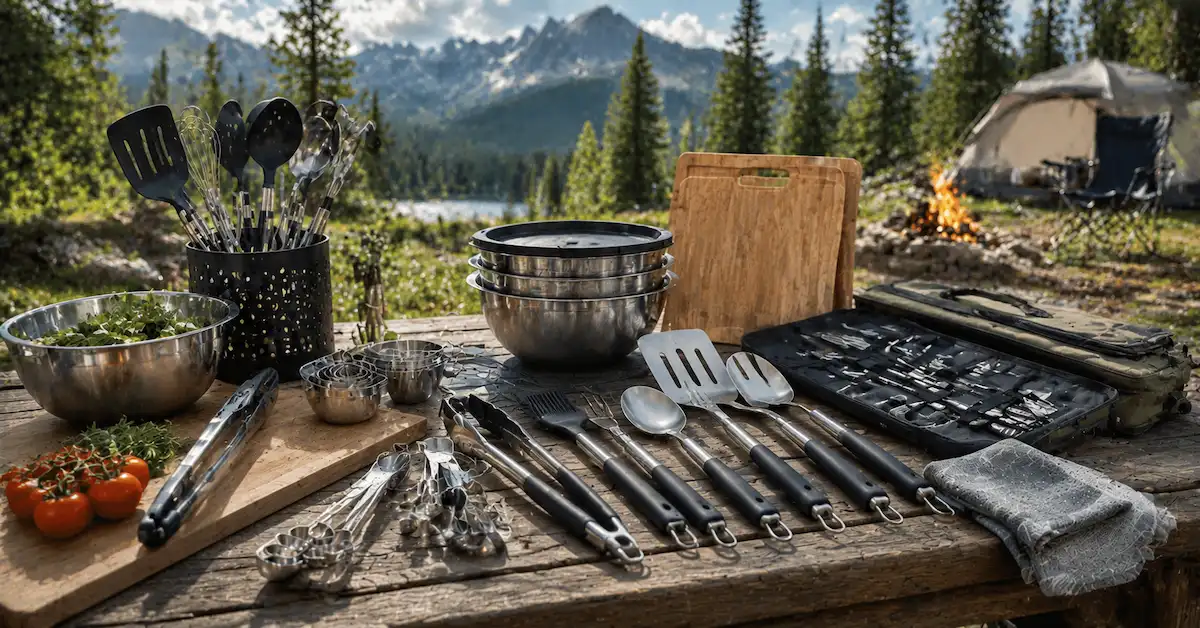
The visible product category here is a multi-piece outdoor cooking tools and camping kitchenware set. Based on the product layout, it appears to combine long-handled utensils, nested metal bowls, a wooden cutting board, small cups, and a zippered carry case. That is a useful mix because it covers several jobs at once: prep, stirring, serving, mixing, and grill-side handling.
Long-handled spatulas, spoons, tongs, ladles, skimmers, and fork-like tools are not decorative extras. They help keep hands away from heat sources and make it easier to work over a grill or campfire cookware. Nested bowls reduce the space penalty, which matters in RV cabinets and campsite totes. A fitted carry case adds real value because outdoor users dislike loose tools rolling around in storage bins.
The practical takeaway is simple: if the bundle looks good but does not reduce friction at the campsite, it will not sell through as well as a cleaner, more useful set.
Quick buyer reference: what to compare across suppliers
Before placing an order, buyers usually need a short list of points that separate a decent supplier from a risky one.
1. Assortment logic
Does the kit include tools people actually use together? A set with a useful spread of spatulas, spoons, tongs, bowls, and a board is easier to position than a random mix of accessories.
2. Portability
A zippered carrying case is not just a convenience feature. For camping cooking tools wholesale programs, portability often decides whether the product is perceived as premium or merely bulky.
3. Material behavior
The visible tools appear to be metal, likely stainless steel or polished steel, with darker handles. That is the right general direction for heat-adjacent use, though buyers should still confirm the exact build, handle material, and finishing method before assuming performance.
4. Storage efficiency
Stackable bowls and hanging-loop handles are small details, but they matter. Good camping kits solve storage problems instead of creating them.
5. Retail presentation
If the set is intended for shelf sale, the case, visible organization, and overall visual coherence matter almost as much as function. Outdoor products are bought with the eyes first.
How the visible product design supports outdoor use
This product layout suggests a kit made for real campsite routines rather than one-off grilling. The long utensil handles imply distance from flame or hot cookware. Flat spatula heads, rounded spoon heads, and slotted or perforated tools cover different food-handling tasks. That means the user can move from flipping to stirring to draining without switching into kitchen gear from home.
The nested stainless-looking bowls are also a smart inclusion. Outdoor cooks need containers for mixing marinades, holding chopped ingredients, serving salads, or keeping ingredients separate before cooking. A wooden cutting board with a handle adds another layer of usefulness, especially when counter space is limited. The small measuring cups or condiment cups appear suited to prep or sauce service, which is the kind of detail that helps a kit feel complete rather than minimal.
One small caution: kits that look comprehensive in a staged photo can still arrive with awkward fit, weak stitching in the case, or handles that do not feel balanced. Buyers should ask to confirm assembly quality and packaging layout, not just the item count.
What manufacturing details matter most to sourcing teams
For this category, the manufacturing conversation usually centers on a few practical points.
Metal utensils and bowls typically depend on forming, finishing, and consistent edge treatment. Sharp edges are a bad sign in a consumer outdoor product. Surface finish also matters because it affects appearance, cleaning ease, and the feel in hand. The image suggests polished or brushed metal with dark handles, but the exact grade is not visible and should not be assumed.
Handle construction is another detail worth checking. Buyers should ask whether the grips are molded, coated, or assembled from multiple materials. Outdoor products see heat, moisture, and repeated packing, so handle durability can become the weak link.
The fabric case is just as important as the metal parts. A sewn textile carrier needs strong seams, smooth zipper action, and enough structure to keep the tools organized. In retail bundles, the case often carries the perceived value of the whole set.
The wooden board should be assessed for finish, surface smoothness, and edge quality. Even in a camping context, buyers expect it to be practical and easy to wipe down.
Common mistakes when choosing a supplier
One mistake is over-ordering novelty and under-ordering utility. A kit can look impressive in photos and still fail because the tools are too short, too flimsy, or too awkwardly packed.
Another mistake is ignoring the storage system. Outdoor cooking equipment supplier catalogs often show the tools themselves prominently, but the case and internal layout determine how the product behaves after purchase. If the set is annoying to repack, users stop using it.
A third issue is assuming all metal utensils are equal. That is not true. Forming quality, finish consistency, and handle attachment can vary enough to affect both safety and customer perception.
Finally, some buyers forget the channel. A kit for camping cooking tools wholesale may need to be priced and bundled differently from a premium barbecue accessory set. Retail customers may tolerate a lighter tool assortment if the display and case feel polished; commercial buyers may care more about ruggedness and replaceability.
How to evaluate an outdoor cooking tools supplier
A serious supplier should be able to discuss the product in functional terms, not just with pretty images. Ask for details on material composition, handle construction, textile specs for the case, and packaging options. If the supplier offers multiple configurations, that is often a good sign because it shows they understand different market positions.
It also helps to ask how the set is intended to be used. A supplier who understands campsite cooking, RV storage, and grilling habits will usually propose a cleaner bundle than one selling generic kitchen accessories under an outdoor label.
If you are building a private-label line, ask for flexibility in case branding, insert cards, and outer packaging. These are not afterthoughts. For seasonal outdoor goods, the package often does as much selling as the contents.
FAQ for sourcing and product teams
Is this kind of set only for camping?
No. It can also fit backyard grilling, picnic prep, RV cooking, and hospitality bundles. The key is whether the assortment feels portable and heat-aware.
Why are long handles so common?
They help create distance from heat sources and make grill-side handling easier. That is both a comfort feature and a practical safety choice.
Are nested bowls worth including?
Usually yes, if the product is meant to feel complete. They add prep and serving utility without taking much extra storage space.
What should buyers verify before placing a bulk order?
Confirm material details, finish consistency, case construction, packaging layout, and whether the full set matches the intended use case. Small mismatches can create big returns later.
What a good next step looks like
If your team is comparing an outdoor cooking tools supplier for a seasonal program, start with the product story, not just the unit cost. Ask whether the bundle solves a campsite storage problem, supports food prep, and presents well in a retail or ecommerce setting. Then check the manufacturing details that affect real-world use: metal finish, handle build, textile case quality, and the logic of the assortment.
A useful supplier should be able to show how the kit holds together as a system. That is the difference between a loose pile of utensils and a product line that buyers can trust to work outside, where conditions are never as neat as the catalog photo.
