




Why buyers look for an outdoor cooking tools supplier in the first place
An outdoor cooking tools supplier is rarely just a place to buy tongs and spatulas. For most buyers, the real task is to assemble a dependable set of grilling accessories that can survive heat, grease, handling abuse, and constant washing without turning brittle or awkward after a few weekends. That matters whether the end user is a homeowner building a patio kitchen, a caterer outfitting event gear, or a retailer trying to stock a practical barbecue line.
The buying problem is simple enough on paper: outdoor cooking needs tools that stay comfortable in the hand, hold up near flame, and make food handling less clumsy. In practice, the choices are messier. Some tools look good on a display card but feel flimsy at the grill. Some sets are broad but poorly coordinated. Others cover the basics yet miss the small details that make outdoor cooking smoother, like a long enough handle, a decent grip, or nesting bowls that do not waste drawer space.
That is why sourcing from the right bbq tools supplier or grilling accessories supplier is more than a price decision. It is a durability decision, a usability decision, and, for commercial buyers, a reputation decision.
What a usable outdoor grilling set should actually include
The product layout commonly associated with outdoor barbecue kits is more practical than decorative. A coordinated setup often includes long-handled utensils, a few prep bowls, a cutting board, a storage caddy, and cleaning accessories. When the set is built well, each item earns its place.
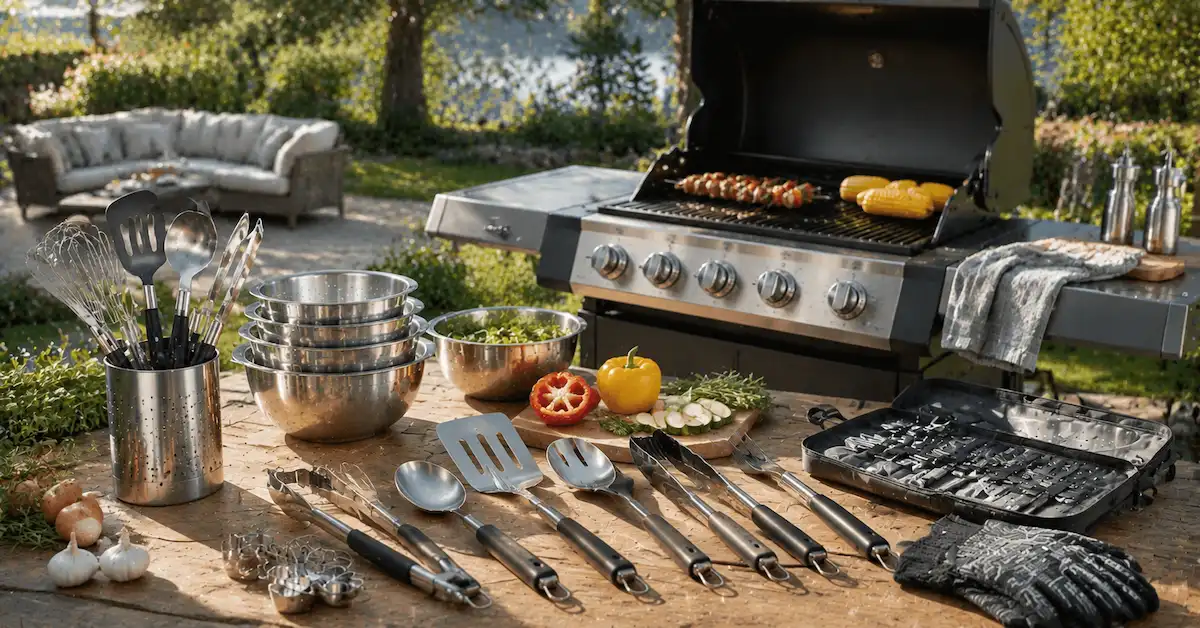
In the image context here, the visible assortment centers on a gas barbecue grill with a hood, side shelves, and control knobs, surrounded by stainless steel tools and food prep items. That kind of arrangement reflects how outdoor cooking really works: prep, cook, serve, and clean happen in one tight zone.
A useful selection usually includes:
Heat-handling tools
Spatulas, slotted spatulas, tongs, grilling forks, and spoons are the backbone of the kit. Long handles are not just a comfort feature; they help maintain distance from the heat source and reduce hand fatigue during a long cook. Flat spatula heads with slots are especially useful because they let grease drain and make lifting burgers, fish, or vegetables a little cleaner.
Prep and mixing items
Nested stainless steel bowls are one of those modest details buyers appreciate after the fact. They save storage space, stack cleanly, and work for marinades, sauces, chopped vegetables, and seasonings. If a supplier can offer coordinated bowl sizes with rolled rims and stable nesting, that is a quiet advantage for both retail and commercial packaging.
Serving and maintenance accessories
A storage container or caddy matters more than it sounds. Tools left loose on a patio table tend to disappear, bend, or get dirty between uses. A dedicated tray, case, or organizer makes a set feel more complete. The same applies to grill-cleaning accessories. Buyers often underestimate maintenance until they have to clean a grate after repeated use.
Materials that make sense for outdoor use
Most practical outdoor kitchen buyers are not chasing novelty. They want materials that tolerate repeated heat exposure, resist corrosion reasonably well, and clean easily. Stainless steel appears frequently in this category for a reason: it fits the job. It is common for utensil bodies, bowls, and some grill surfaces because it balances appearance and function.
Polished stainless steel can look sharp in a showroom, while brushed finishes tend to hide fingerprints and small scratches better. That may sound minor, but for buyers who stock or stage product displays, finish quality affects perceived value quickly.
Handles are the other half of the equation. Black handles made from silicone, rubber, or coated metal can improve grip and make the tools easier to manage around a hot grill. Buyers should still be cautious here. A comfortable-looking handle is not the same as a durable one, and a heat-resistant-looking glove is not something to assume performs to a particular rating unless the supplier states it clearly.
For sourcing teams, this is where asking for material specifics pays off. If a supplier says “stainless steel,” that still leaves room for meaningful variation in grade, finish, and forming quality. The safest approach is to request the exact material description and product construction details rather than guessing from appearance alone.
How manufacturing choices affect the buyer experience
Outdoor cooking tools are often manufactured through stamping, forming, polishing, and handle assembly. That does not mean every supplier will make them the same way, but those processes help explain why some products feel crisp and balanced while others feel bent out of shape right out of the package.
Stamped utensil heads tend to offer clean edges and repeatable shapes. Formed bowls stack neatly and maintain useful rigidity. Polishing improves the look, but it also matters for ease of cleaning. A well-finished edge reduces the chance of snagging towels, gloves, or packaging.
This is especially relevant for commercial buyers. A restaurant or catering team does not want a tool set that looks coordinated for a month and then starts showing bend marks, loose handles, or rough spots. The first impression is the sale; the second impression is repeat purchase.
Choosing between a bbq tools supplier and a grilling accessories supplier
The terms overlap, but not perfectly. A bbq tools supplier may focus more narrowly on cooking implements directly used at the grill: spatulas, tongs, forks, basting tools, and cleaning implements. A grilling accessories supplier may cover a broader mix, including prep bowls, caddies, gloves, seasoning mills, and storage items.
That distinction matters if you are building a category program. If the goal is a compact set for one-season retail turnover, a tight bbq tool range may be enough. If the goal is a more complete outdoor kitchen offering, a broader grilling accessories lineup can support higher basket value and better merchandising.
For many buyers, the best supplier is one that can combine both: a coherent tool line plus supporting accessories that make the set feel intentionally designed rather than assembled from leftovers.
Common mistakes buyers make with outdoor cooking tools
The most common mistake is overvaluing appearance. A polished utensil set can photograph well, but appearance alone will not tell you whether the handles are secure, whether the edges are comfortable, or whether the set works in a real outdoor cooking workflow.
Another frequent issue is ignoring storage. Outdoor kitchens are often space-constrained. Nested bowls, hanging loops, and a compact caddy are not luxuries; they are part of daily usability. If a supplier cannot explain how the set stores, the set may be more cumbersome than it looks.
A third mistake is assuming one product mix fits all buyers. A homeowner may value a complete presentation set, while a restaurant buyer may care more about replaceability and ruggedness. A retailer may need packaging that communicates use clearly at a glance. These are different purchasing problems, even when the tools look similar.
Finally, buyers sometimes skip the maintenance question. If grill-cleaning tools are included, they should be easy to rinse and store. A good outdoor set should make aftercare less annoying, not more.
Practical questions to ask before placing an order
Before committing to an outdoor cooking tools supplier, ask direct questions. Not every one of them needs a formal test report, but the answers should be clear.
What materials are used for the utensil bodies, handles, and bowls?
How are the handles attached, and do they feel secure under regular use?
Which items are included in the set, and how are they packaged for retail or bulk shipment?
Are the bowls truly nestable, and does the storage system keep tools organized?
Are there options for coordinated finishes or mixed sets depending on market needs?
For commercial accounts, it is also sensible to ask about consistency from batch to batch. Even a good product can become a sourcing headache if the finish, feel, or assembly quality drifts too much.
What end users care about most
End users usually care less about technical language than sourcing teams do. They want tools that feel stable in the hand, do not get too close to the flame, and are easy to wash when the meal is done. They also appreciate sets that look organized on a patio table.
That is why the visible combination of a grill, utensils, bowls, and prep items works so well in outdoor cooking. It mirrors the actual sequence of use. Prepare ingredients. Cook on the grill. Turn, lift, and serve. Clean up. Store.
When a supplier understands that sequence, the products tend to make more sense as a group. The customer may not say “this set has good manufacturing logic,” but they will notice that it feels easy to live with.
A small buying warning
Do not assume that every metal-looking tool is equally suited to high-heat use, or that every set in a coordinated display is equally well made inside. Photos can show layout, finish, and general composition. They cannot prove alloy grade, handle performance, or long-term durability. Buyers should treat the image as a useful clue, not a specification sheet.
Who benefits most from buying in coordinated sets
Coordinated sets make the most sense for retailers, hospitality buyers, gift programs, and homeowners setting up an outdoor entertainment area. They are also useful when a buyer wants to present a complete grilling solution instead of a scattered assortment of loose items.
For restaurants and caterers, the appeal is often operational. Multiple bowls, repeatable tools, and an organized caddy can reduce table clutter during service. For retail, the value is simpler: the display reads clearly, and the customer can imagine the whole cooking workflow.
Next step for sourcing teams
If you are evaluating an outdoor cooking tools supplier, start with the basics: tool list, materials, finish, storage format, and packaging. Then compare how the supplier supports real outdoor use rather than just how the set photographs.
A good supplier should be able to explain the role of each piece in the set, from the long-handled spatula to the nested bowls and cleaning accessories. If that explanation feels vague, keep looking. Outdoor cooking buyers usually find out the hard way when the details were not there from the start.
If you are building a BBQ category, consider whether you need a focused bbq tools supplier or a broader grilling accessories supplier. The right answer depends on your market, but the best-fit partner will make the outdoor cooking setup feel complete, durable, and easy to sell.
