




Popular Scissors in China: A Practical B2B Sourcing Guide
Scissors remain a high-volume everyday product for offices, schools, craft kits, sewing rooms, packaging stations, and retail stationery shelves. For buyers searching for popular scissors in China, the challenge is not simply finding a low unit price. The better goal is to match design, cutting performance, packaging, and supplier reliability to the sales channel you serve.
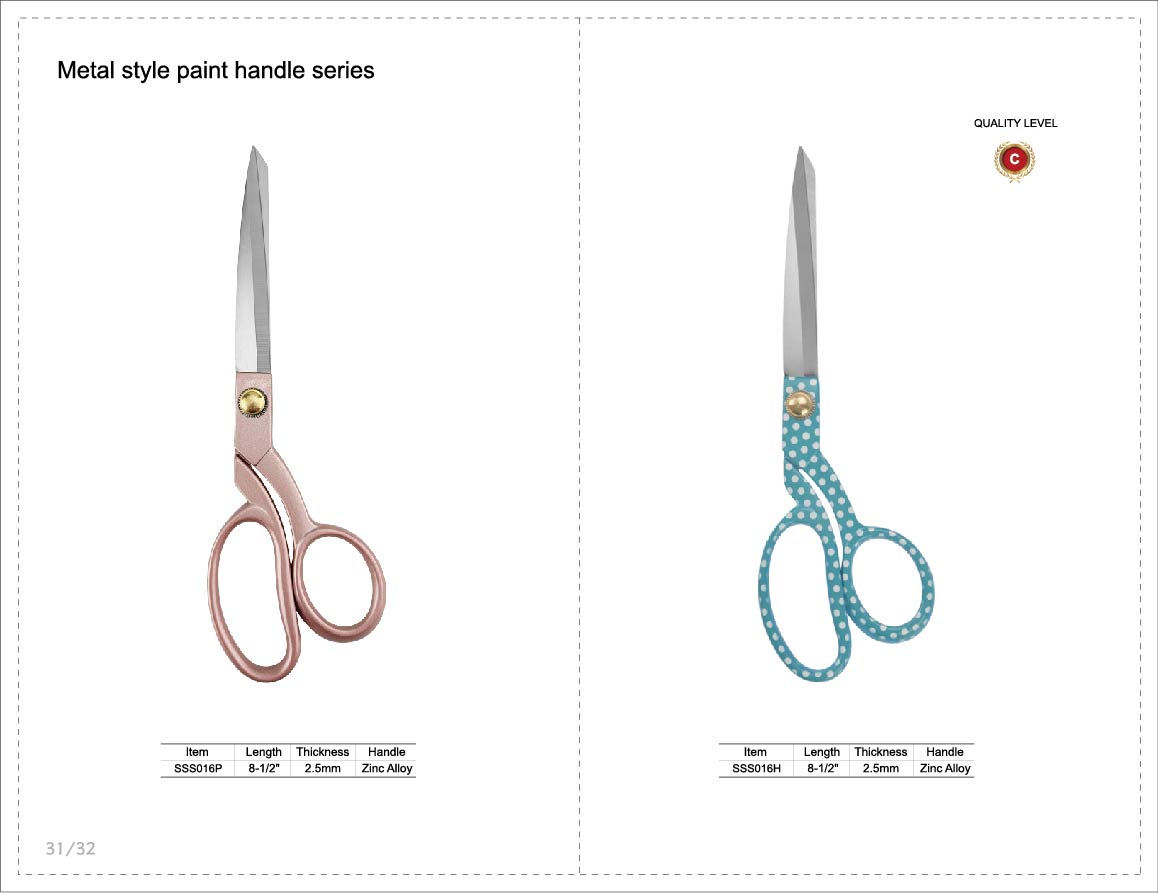
The original product information highlights a Metal Style Paint Handle Series with decorative handle finishes, including a rose gold SSS016P model and a turquoise handle with white polka dots on the SSS016H model. It also notes zinc alloy handle construction, an 8-1/2 inch size, and 2.5 mm blade thickness for the SSS016P model. Those details show why many buyers look beyond basic utility scissors and consider products that can also stand out on a retail shelf.
Key Takeaways
- Popular scissors in China often compete on a mix of cutting comfort, appearance, packaging, and price positioning.
- Decorative painted handles can help differentiate retail, craft, and promotional assortments, but buyers should verify coating durability through samples.
- For wholesale or OEM programs, ask suppliers about materials, blade finish, sample lead time, packing options, and quality inspection procedures.
- Do not rely only on photos. Test real samples on paper, card, fabric scraps, film, or other materials relevant to your customers.
Why Scissors from China Attract Wholesale Buyers
China has a broad houseware, stationery, and hand-tool supply base, which gives buyers access to many scissor styles: office scissors, craft scissors, kitchen scissors, dressmaking scissors, student scissors, and promotional gift sets. This variety is useful for importers and distributors that need several price levels or handle designs within one category.
Another reason buyers search for scissors wholesale China is assortment flexibility. A retailer may need colorful scissors for back-to-school shelves, while a craft brand may prefer a more refined metallic handle finish. A corporate gift supplier may care more about packaging and branding options. The right supplier discussion should therefore start with the intended use, target market, and acceptable quality level, not just the lowest quotation.
Product Design: Function First, Appearance Second
Attractive scissors can perform well, but visual appeal should not replace functional checks. For the Metal Style Paint Handle Series mentioned in the source article, the rose gold SSS016P and turquoise polka-dot SSS016H designs suggest a product direction aimed at users who want tools that look more distinctive than plain plastic-handle scissors. That can be useful for craft retailers, office supply assortments, boutique stationery stores, and online giftable tool collections.
When reviewing decorative scissors, buyers should ask for close-up photos and physical samples. Check whether the handle edges feel smooth, whether the painted surface has even coverage, and whether the handle shape is comfortable for the expected hand size. If the product will be used frequently, comfort and balance are especially important. A scissor that looks good online but feels heavy, slippery, or sharp at the handle edge may lead to returns or poor reviews.
Supplier Questions Before Placing a Wholesale Order
For B2B sourcing, clear questions reduce misunderstandings. Avoid assuming a supplier can meet your packaging, branding, or testing expectations unless those details are confirmed in writing. Useful questions include:
- What materials are used for the handle, blade, pivot, and surface finish?
- Are the model size, blade thickness, and handle color consistent across production batches?
- Can you provide pre-production samples for approval before mass production?
- What packaging formats are available: bulk pack, blister card, paper card, hanging card, or custom box?
- What logo or private label options are available, and where can branding be applied?
- What quality checks are performed before shipment?
- How should buyers handle inspection, defect reporting, and replacement terms?
These questions are especially important for OEM scissors sourcing, where small design changes can affect cost, lead time, packaging dimensions, and final user experience.
Comparison Checklist for Evaluating Popular Scissors
| Evaluation Point | What to Check | Why It Matters |
|---|---|---|
| Cutting performance | Test paper, card, thread, or other target materials | Confirms the product matches real customer use |
| Handle comfort | Check grip shape, finger opening, weight, and edge smoothness | Reduces fatigue and improves repeat-use satisfaction |
| Surface finish | Inspect paint coverage, scratches, chips, and color consistency | Important for decorative and retail-display products |
| Blade alignment | Open and close repeatedly; look for wobble or rubbing | Affects cut quality and perceived durability |
| Packaging | Review barcode area, hanging hole, warnings, and carton strength | Supports retail, e-commerce, and warehouse handling |
| Supplier communication | Confirm samples, order terms, inspection process, and after-sales handling | Helps prevent delays and specification disputes |
How to Position Decorative Scissors in Your Assortment
Decorative scissors are often best positioned where design has commercial value. A rose gold finish, for example, may suit adult stationery, office desk accessories, craft collections, or giftable tool sets. A turquoise handle with white polka dots may work well for colorful school, hobby, or creative workspace themes. The key is to choose styles that match the buying habits of your market rather than adding colors randomly.
For retail buyers, consider building a small range: one practical neutral option, one premium-looking metallic option, and one colorful design. For e-commerce sellers, strong product photos and accurate size details are essential. For distributors, confirm whether the supplier can keep colorways consistent across repeat orders, because inconsistent shades can create problems when replenishing stock.
Sample Testing and Quality Control Tips
Before confirming a large order, request samples from the actual production route whenever possible. Test several pieces, not only one perfect showroom sample. Open and close the scissors multiple times to feel the pivot action. Cut from the base of the blade to the tip to see whether the blades meet cleanly. Check whether the handle finish marks easily during normal handling.
If the scissors will be sold to schools, offices, craft users, or promotional channels, define your own inspection checklist in advance. You may want to check carton labeling, product count, packaging condition, handle color, blade cleanliness, and basic cutting ability. If you require any market-specific safety, labeling, or compliance documentation, ask the supplier what documents are available and verify whether they fit your destination market. Do not assume compliance from general product descriptions alone.
FAQ: Buying Popular Scissors in China
What makes a scissor style popular for wholesale buyers?
Popularity usually comes from a balance of price, comfort, reliable cutting, attractive appearance, and packaging that suits the sales channel. A distinctive handle design can help, but performance still matters.
Can decorative handle scissors be used for professional work?
It depends on the blade design, comfort, balance, and intended material. Buyers should test samples against the tasks their customers perform instead of relying only on appearance.
What should I ask a China scissors supplier before ordering?
Ask about materials, model dimensions, sample approval, packaging, branding options, inspection methods, order terms, and how defects or shipment issues are handled.
Is OEM customization available for scissors?
Many suppliers may offer some form of customization, but details vary. Buyers should ask about logo placement, handle colors, packaging artwork, sample costs, production lead time, and any minimum order requirements.
How can I reduce risk when sourcing scissors wholesale?
Start with samples, document specifications clearly, confirm packaging requirements, use pre-shipment inspection when appropriate, and keep approved samples for comparison with mass production.
