




Quick answer: A successful private label cutting board project starts with a verified base product, then controls five decisions: the intended use and material, the approved logo method, the consumer packaging and claims, the signed-off production sample, and the inspection standard for repeat orders. The fastest-looking branding option is not always the lowest-risk route. Your supplier must know exactly which product revision is being branded, what the label promises, and how the finished retail unit will be checked.
This guide is written for kitchenware importers, retail product managers, online brands, supermarket buyers, and sourcing teams. It uses BONET HOUSEWARE's publicly listed polypropylene (PP) board as a factual reference while distinguishing confirmed supplier services from features, documentation, and price terms that require project-by-project verification.
Request a Private Label Quote → See the Cutting Board CategoryWhat Is a Private Label Cutting Board, and How Is It Different from OEM or ODM?
A private label cutting board is a cutting or preparation board sold under the buyer's own brand identity. It may use an established supplier product as the base and add approved branding, retail packaging, labels, instructions, or a coordinated color presentation. Private label describes the commercial brand ownership and presentation model; it does not automatically mean a wholly new product design or exclusive manufacturing rights.
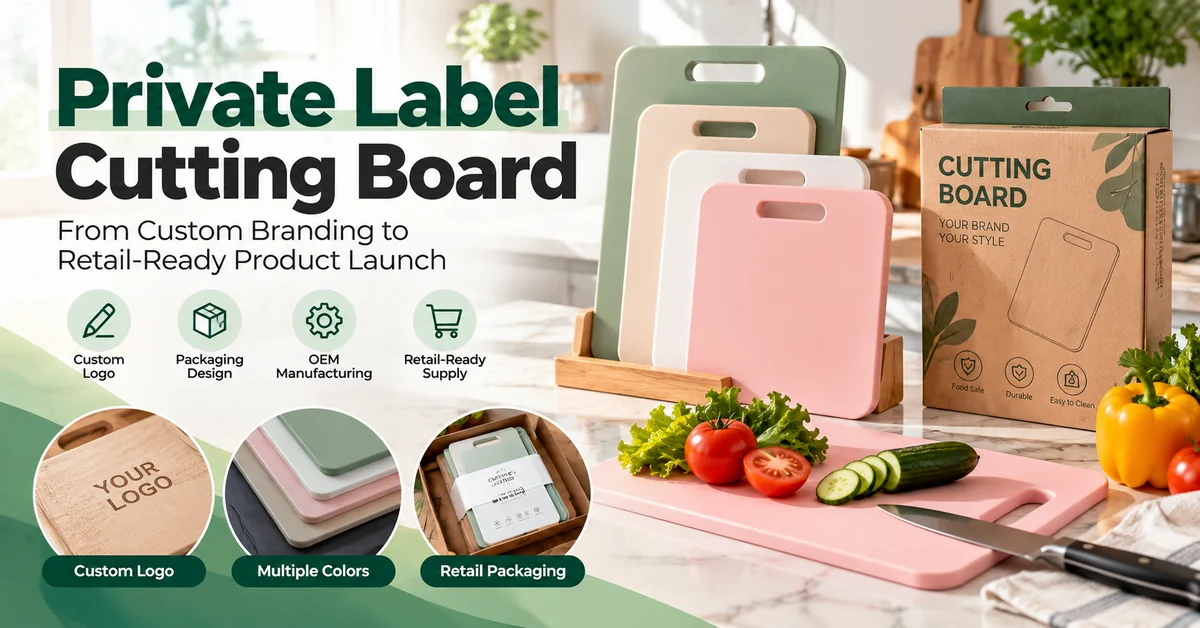
For a first launch, using an existing platform can reduce design uncertainty. The buyer can concentrate on positioning, packaging, brand consistency, channel requirements, and sample approval. However, this route still needs technical documentation: attaching a new sleeve to an unverified board does not resolve material, quality, or market compliance questions.
OEM usually starts with a buyer-controlled specification, drawing, or sample that the manufacturer is asked to reproduce. ODM asks the manufacturer to contribute product development, structural recommendations, feasibility work, or new design concepts. The same project can combine these approaches: an existing PP board may be privately labeled, while a different thickness or new molded geometry may require OEM/ODM evaluation.
| Route | Typical Starting Point | Primary Approval | Commercial Question |
|---|---|---|---|
| Private label | An existing product with brand and pack needs | Logo execution, artwork, pack, approved base version | What branding is feasible without changing the product? |
| OEM | Buyer-owned drawings or finished specification | Dimensions, materials, tolerances, approved sample | Can production repeat the buyer's approved version? |
| ODM | Market opportunity, functional concept, design brief | Development milestones, tooling, final product file | Who decides and owns each design element? |
This distinction prevents a common error in quotation discussions: a buyer requests a private-label price but expects an entirely new board profile, integrated non-slip feet, exclusive color formulation, and a unique pack. Each alteration can change tooling, testing, sampling, lead time, or minimum economical order size. Identify these changes before requesting a final production quote.
Which B2B Buyers Benefit Most from a Branded Cutting Board Program?
The strongest prospects are businesses that own a brand or a repeated retail relationship. They are not simply looking for a low-priced board. They must deliver a recognizable product, meet channel requirements, and handle questions after purchase. Different channels should therefore receive different buying briefs.
Kitchenware and lifestyle brands
These buyers need a coherent look across categories. Board color, surface finish, care language, and sleeve design should work alongside kitchen scissors, knives, utensils, and other tools. Their major risk is inconsistent branding between products supplied by different factories or at different times. A controlled palette and clear brand guide matter as much as the logo itself.
Supermarkets, retail chains, and import distributors
Retail buyers often work backward from shelf dimensions, planned price points, barcode rules, assortment reviews, and carton handling. They need repeatable labeling and delivery packaging. A compelling product photo is insufficient if the hang tag covers essential product information, the barcode scans poorly, or the board occupies an unsuitable shelf footprint.
E-commerce brands and marketplace sellers
Online sellers need accurate size and material information, photographic consistency, and packaging that survives their fulfillment route. They should approve real product photographs of the final branded sample and plan customer-service instructions for cleaning and maintenance. Listing copy must not imply unsupported features such as universal dishwasher compatibility or antibacterial protection.
Gift, promotional, and hospitality sourcing teams
Gift buyers may value visual presentation, coordinated bundles, and a memorable unboxing experience. Hospitality buyers tend to prioritize practical handling, cleaning, and product replacement. Neither audience should be given a generic consumer product claim without confirming the intended use. A serving-oriented board and a heavy-duty cutting surface may require very different construction and evidence.
Less suitable buyers: customers expecting a one-piece consumer purchase; businesses demanding an unverified specialty material or size as immediate stock; and users needing a professional sanitation certification that has not been documented for the exact item. It is better to clarify these limits early than to write marketing copy the product cannot support.
Start with BONET's Publicly Listed PP Cutting Board, Not an Imaginary Catalog
BONET HOUSEWARE, based in Yangjiang, China, publishes a PP Plastic Cutting Board for Kitchen Prep & Serving in its Chopping Board category. The public listing describes polypropylene and a compact reference size of 24.8 × 14.8 × 0.8 cm for ordinary household kitchen preparation and appropriate serving applications. This is a useful factual reference for initial sampling and branding discussions.
The listing is not a universal promise that all colors, custom thicknesses, food-contact certificates, direct-logo techniques, or printed packaging formats are immediately available for this board. Those questions should be answered in a quote and supported by the relevant sample or documentation.
| Specification Field | Publicly Supported Starting Point | Private-Label Approval Needed |
|---|---|---|
| Product | PP Plastic Cutting Board for Kitchen Prep & Serving | Exact production SKU and revision |
| Material | PP (polypropylene) | Resin, additives/colorants, intended-contact evidence |
| Reference size | 24.8 × 14.8 × 0.8 cm | Measurement points, agreed tolerances and weight |
| Use | Household prep and suitable serving uses | Final care instructions and consumer claims |
| Logo / color | Company describes branding and color customization services | Technique, placement, feasibility, color sample |
| Packaging / quantity | Company describes custom packaging options | Unit pack, MOQ, price breaks, carton data, schedule |
| Certificates / test reports | No board-specific evidence confirmed in public listing | Applicable reports for the actual formulation and market |
For a brand launch, ask BONET for the current physical sample, an updated specification, available customization paths, and a packaging discussion. If your brief calls for bamboo, wood, HDPE, or a new board geometry, label it as a requested development option. BONET's broader OEM/ODM material list does not by itself verify a corresponding cutting-board production model.
Build the Product Brief Before You Design the Logo
The first deliverable should be a one-page product brief agreed by merchandising, sourcing, design, and quality teams. It converts the marketing idea into measurable decisions. Without it, the designer may place a logo where a handhold, anti-slip feature, cutting area, or packaging seam later creates a conflict.
Start with the end user's task. Is this a compact board for fruit and light food preparation, a family prep board, a bread-serving accessory, or a coordinated kitchen gift? Define the likely storage location, retail price positioning, packaging space, and expected user care. Then write down the dimensional and material requirements that must be confirmed by a sample, not by a mood board.
A practical nine-field brand brief
- Channel: supermarket, branded website, marketplace, kitchenware distributor, hospitality or gifting.
- Primary task: the specific cutting or serving activities the product should support.
- Approved board: supplier reference, revision, material construction and intended dimensions.
- Consumer promise: two or three benefits backed by observable features or documentation.
- Brand system: logo files, color codes, typography rules, tone of voice and artwork ownership.
- Marking: whether the brand appears on the product, the packaging, or both.
- Pack requirement: selling unit, barcode, language, care instruction and shipping route.
- Quality and evidence: tests, checks, tolerances, artwork criteria and required documents.
- Commercial target: estimated first quantity, target cost range, destination and approval date.
For online channels, supplement the brief with proposed listing images, dimensions and scale references. For supermarkets, add planogram dimensions and required barcode format. For promotional programs, state presentation requirements and how many different customer logos or gift boxes must be processed. These inputs reduce late-stage design corrections and avoid comparing incompatible quotations.
Material, Thickness and Design: What Makes a Board Fit Your Brand?
Material choice shapes the retail positioning, surface feel, weight, potential marking methods, cleaning instructions and cost. A brand should not select a material simply because competitors use it. Choose a construction that fits the intended function and is backed by an exact supplier specification.
PP plastic: a practical reference for everyday lines
Polypropylene boards can fit accessible household kitchenware ranges where convenient handling and a compact format matter. But the label PP alone does not prove a fixed temperature limit, dishwasher compatibility, stain resistance, or food-contact compliance. Resin grade, colorants, processing and intended conditions must be checked for the finished article. Compare actual samples for flatness, edge quality, surface feel, weight and cleaning instructions.
Bamboo and wood: consider construction, not just appearance
Natural-looking boards may help a presentation or gift-oriented collection, but material identity matters. For an offered bamboo or wood product, buyers should establish species or material description, whether it is solid or laminated, adhesive and coating information where relevant, finish method, and care limits. Surface color in a product photograph cannot validate construction. These are supplier-evaluation criteria, not claims that BONET currently lists every such board as a stock item.
HDPE and other alternatives
Other plastic formulations or constructions may be relevant to a custom brief. However, a different polymer, board profile, thickness or anti-slip element can affect design feasibility, materials testing, tooling, and pack dimensions. Ask whether the product exists as a documented model and obtain a separate sample and quotation. Never copy the claims of the PP reference onto an unverified alternative.
Design details also influence usability. Check whether a hanging hole reduces the useful cutting area; whether the edge radius feels appropriate; whether the underside remains stable on a clean, level surface; and whether an embossed texture interferes with food handling or cleaning. If a customer asks for grooves, feet or reversible faces, have the supplier assess tooling and cleaning implications instead of promising them automatically.
Custom Logo Cutting Boards: Select a Marking Method That Fits the Material
Branding can be the defining visual feature of a private label cutting board, but it should not compromise the working surface or create unsupported safety assumptions. The practical objective is a repeatable, legible brand identity that survives the expected handling and cleaning conditions. A proof on a computer screen is not enough to establish that a marking method is appropriate for the actual board.
| Branding Option | Potential Role | Approval Risk | Buyer Action |
|---|---|---|---|
| Branded paper sleeve / belly band | Private-label presentation without directly marking the board | Fit, scuffing, obscured product information | Approve wrapped physical sample and print proof |
| Printed hang tag or retail box | Brand story, barcode, instructions and gift appeal | Print accuracy, carton cost, attachment method | Approve artwork, barcode and transit pack |
| Direct printing on product | Permanent-looking visual identity when technically suitable | Ink compatibility, wear, location, food-contact implications | Confirm method on exact material and test as required |
| Engraving / laser marking | Potential option for certain compatible constructions | Thermal effects, surface quality, cleanability, material suitability | Request feasibility review and approved marked sample |
| Molded or embossed logo | Integrated identity on an approved molded design | Tooling cost, cleanability, exact location and definition | Confirm tooling feasibility, cost and approval ownership |
These are method categories for evaluation, not a statement that every method is offered on BONET's published PP board. BONET's OEM/ODM service broadly mentions logo printing and laser engraving, but the suitable technique depends on the actual material, surface and project. If a requested method could introduce unwanted grooves, residues, coating issues or wear, packaging-only branding may be the more sensible starting option.
In the artwork brief, specify the exact vector logo, maximum width, position measured from a defined edge, orientation, approved color, exclusion zones and whether a registered trademark symbol is part of the supplied artwork. Have the product manager approve the logo on a real sample in natural light and after reasonable handling. The most important question is not, “Can you put our logo on it?” but, “Can this approved marking be repeated without affecting intended use or misleading customers?”
Retail Packaging, Barcode Placement and Artwork Approval
Retail-ready packaging has two jobs: communicate a credible product promise and protect the saleable unit through distribution. A beautiful sleeve that hides material information, a gift box that raises parcel shipping costs, or a barcode that cannot be scanned can turn a promising product into a difficult retail launch.
What to include on a packaging specification
The packaging file should show the dieline or reference dimensions, print area, bleed and safe zones, brand colors, product description, size, material, use and care instructions, applicable origin or importer information, barcode identifier, legal or mandatory notices, and language version as required for the market. Assign a revision number to the artwork and identify who approves product claims. If you use an EAN/UPC/GTIN, verify its authorized ownership or assignment and the retailer's scan requirements.
Ask the supplier to make a mockup around the actual board. If the strap, sleeve or tag sits on a rounded edge, it may slide in transport. If the brand logo is placed beneath a product photograph, it may disappear on a crowded shelf. If the back label covers the care instructions, customers may wash the board incorrectly and then blame the product.
Packaging by sales channel
- Supermarkets: test shelf footprint, display orientation, barcode position, pack robustness and the readability of material and care information.
- Marketplace fulfillment: evaluate packed dimensions, parcel protection, scuff resistance and whether photos accurately show what customers receive.
- Poisonous goods: consider coordinated design, presentation value and protection against corner damage, while keeping claims accurate.
- Wholesale cartons: document units per master carton, carton dimensions, gross weight, markings and any required inner packs.
Require three distinct approvals: digital artwork proof (copy, layout and brand), physical packed sample (fit and appearance), and shipping-carton confirmation (protection and logistics). A digital sign-off alone cannot confirm that a paper sleeve will remain secure on the real product after stacking and handling.
For a coordinated assortment, buyers may combine the board with compatible items selected from BONET's kitchen knife category or kitchen utensils. Such bundles remain design concepts until each component, pack, safety instruction and commercial term has been confirmed.
Food-Contact Evidence and Marketing Claims: Protect Your Brand Before Printing
Any product marketed for preparing or serving food can raise food-contact and consumer-information obligations in its destination market. A private-label owner should build evidence requirements into the project before approving packaging text, not after printing thousands of sleeves. A declaration on raw resin alone may not establish suitability of the finished article with all additives, colorants or applied markings.
For the European Union, relevant frameworks include Regulation (EC) No 1935/2004 and, for plastic articles within scope, Commission Regulation (EU) No 10/2011, as amended, together with applicable good-manufacturing-practice requirements. A buyer should review the product-specific declaration and supporting evidence for the actual materials and intended contact conditions. For the United States, identify the applicable FDA food-contact provisions for the formulation and intended use. Certain polypropylene compositions may be assessed against requirements such as 21 CFR §177.1520; the presence of the word “polypropylene” in a quote is not evidence that every ingredient or finished article complies.
These are regulatory reference points for buyer due diligence, not claims that BONET's published board holds any particular approval. Rules vary by jurisdiction and evolve. Have the responsible importer or qualified specialist confirm the requirements in force for the actual destination, and request documentation that identifies the tested product, test conditions, issuing party, date and scope.
Claims that require particular care
- “Food safe” or “food grade”: define the intended food-contact conditions and verify product-specific evidence instead of using a generic badge.
- “Dishwasher safe”: confirm the approved cleaning instructions and an appropriate basis for the claim on the finished board.
- “Antibacterial” or “antimicrobial”: avoid unless legally and technically substantiated; this is not an inherent universal property of a cutting board.
- “Eco-friendly,” “recyclable,” or “sustainable”: determine exactly what is meant, where it applies, and whether the claim is substantiated and permitted in the target market.
- “BPA-free,” “non-toxic,” and numerical heat limits: do not infer these from a polymer abbreviation; assess applicable evidence and whether such statements are relevant and precise.
Build a claims register with four fields: proposed phrase, evidence owner, supporting document, and approval status. Any claim without an approved evidentiary basis should be revised or removed. This reduces the chance that a sales page, printed pack and customer-service script tell conflicting stories about the same product.
The Five Approval Gates That Make a Private-Label Launch Repeatable
A retail-ready project needs controlled handoffs. Commercial teams may approve a product photo while designers are still revising copy, or procurement may place an order before quality has accepted the final packaging. An approval-gate system makes these disagreements visible before they create scrap, delays, or costly rework.
| Gate | Required Output | Decision Owner | Do Not Proceed If... |
|---|---|---|---|
| 1. Product brief | Defined use, material, board size, channel and target range | Product / sourcing | The product is only a mood-board image |
| 2. Technical sample | Reference sample and approved technical file | Product / QA | Material or dimensions remain uncertain |
| 3. Branded proof | Logo sample, artwork, claims and barcode approved | Brand / regulatory / retail | Claims lack review or marking is unverified |
| 4. Production release | Signed golden sample, final PO and inspection criteria | Procurement / QA | Supplier and buyer reference different revisions |
| 5. Shipment release | Agreed inspection results and carton / documentation review | QA / logistics | Corrective actions or documentation remain open |
Keep a golden sample that represents the approved sellable product, not merely an early unbranded shape. The sample should correspond to a written specification, artwork revision, packaging pack-out, and date of approval. Where appropriate, retain both an unpacked sample for functional checks and a fully packed sample for labeling, shelf presentation and transport checks.
A sample should be examined under realistic handling conditions: put it on a level counter, check for rocking, feel the edges, review any handhold, measure key features, evaluate visual consistency, and compare it with the consumer claims. For a printed sleeve, remove and refit it; check whether information remains legible and the paper rubs against the board. Approving more than one unit can help identify variation that a single carefully selected sample might conceal.
Quality Control: Measure the Board, the Brand and the Packed Unit
Quality for a branded board is broader than whether the cutting surface looks acceptable. Retail customers judge how the item feels, how its dimensions match the listing, how the graphics align, whether packaging arrives undamaged, and whether care instructions make sense. Your quality plan should include all of these checkpoints.
A three-layer inspection structure
Layer 1 — Board: material and agreed appearance, dimensions and thickness, flatness, edge finish, surface defects, odor if relevant, color consistency, functional features and the approved physical revision. Use agreed measurement methods and tolerances rather than subjective descriptions like “perfect shape.”
Layer 2 — Branding: logo orientation, position, legibility, print/mark uniformity, correct version, color reference and any agreed performance check for the chosen marking method. A logo may be neatly printed but still wrong if it belongs to an obsolete artwork file.
Layer 3 — Retail and transport pack: correct SKU, barcode readability, care text, legal copy, label position, count per pack, carton markings, protective materials, physical damage and correct quantities. Confirm whether inspection occurs before or after the final packaging stage and what evidence will be provided.
| Inspection Item | Proposed Method | Specification Needed |
|---|---|---|
| Dimensions and thickness | Measurement at agreed points | Approved drawing and tolerances |
| Surface and edges | Visual and tactile review | Defect reference samples and acceptance rules |
| Flatness / stability | Check on agreed flat reference surface | Test conditions and allowable variation |
| Logo | Compare with artwork and marked sample | Location, color, appearance, revision |
| Retail pack | Print and physical package check | Final dieline, barcode, claim register |
| Master carton | Pack count, marking, transit protection | Approved carton plan and shipping conditions |
A sampling scheme such as an AQL-based inspection may be useful where appropriate, but the chosen standard, sample size, defect classes and rejection criteria must be agreed for the order. There is no universal defect tolerance that can be inferred from a supplier website. Likewise, a factory quality-system statement should not replace product-specific evidence or an inspection report.
Ask about material traceability and whether a significant change in resin, additives, marking process, packaging supplier, or tooling triggers reapproval. A well-controlled product is one where a customer complaint can be traced to a defined production and artwork revision, not a vague batch of “the same board.”
MOQ, Tooling, Customization Cost and Quote Comparison
A final quote should identify what the buyer is actually purchasing. Unit price alone can conceal differences in resin or board weight, logo method, printed sleeve, master carton, inspection, setup charges, and trade terms. This is especially important when a team compares a standard item with a revised private-label version.
Ask separately about standard-product MOQ, MOQ with private-label packaging, custom-color MOQ, and MOQ for a new geometry or mold. These may differ materially because printing and materials suppliers often have their own batch economics. BONET's public pages do not establish a universal MOQ or fixed price for the listed PP board, so the quantities and schedules must be quoted rather than guessed.
Cost components to identify
- Base board and selected material specification, including any custom color or component changes.
- Logo artwork handling, marking setup, print screens, proofing, plates or tooling when applicable.
- Individual packaging, barcode labels, care leaflet, gift box and master carton.
- Sample and courier charges, requested testing, independent inspections and document review.
- Quantity tiers, order-split charges and any unused custom printed materials.
- Agreed Incoterms rule and named place, payment milestones and expected schedule.
A useful way to compare offers is to calculate the estimated landed cost per saleable retail unit. Include the costs actually borne by the buyer, not expenses already included in the supplier's Incoterms-based offer. Account for inspection, shipping, duty where applicable, brokerage, channel handling, and expected loss. Avoid double-counting damage both as an allowance and as a reduction in saleable-unit yield.
Illustrative commercial logic, not a supplier quotation: imagine a customized packaging method increases production cost by a small amount but reduces transit scuffs and customer repacking. The more expensive unit may generate a lower overall cost to serve. Alternatively, an elaborate gift box may lift perceived value but raise parcel and storage costs enough to erode margin. Buyers should use actual prices, carton measurements, and channel data to choose between these outcomes.
To control risk, ask for at least two comparable quotes when feasible: one using the published/reference board with an approved label package, and another using the additional proposed customization. This makes it clear whether a feature generates enough retail value to justify its extra setup and complexity.
How to Work with BONET on an OEM or Private Label Cutting Board
BONET's OEM/ODM service page states that it supports kitchen tools, cutting boards, knives, scissors and related housewares. The service descriptions cover production by drawing or sample, materials and colors, logo support, packaging development, sample review, manufacturing management and quality inspection. Its six-step collaboration process is a useful foundation for a practical project plan.
- Requirement communication: provide the target market, customer type, desired board, estimated quantity, preferred packaging, branding file and evidence requirements. Identify any non-negotiable retail dates without assuming feasibility.
- Design and sampling: request a real board sample and, where agreed, a branded/packed prototype. Resolve product dimensions, logo technique, care wording and pack design together.
- Quotation and confirmation: review the exact scope, sample changes, price, MOQ, tooling/setup, delivery term, documentation responsibility and project schedule.
- Mass production: release production only against a shared specification and approved artwork revision. Request notification and approval of changes affecting form, material or claims.
- Quality inspection: review the agreed checks for the board, marking, packaging and cartons. Define how nonconformities will be addressed.
- Packaging and delivery: reconcile retail unit quantities, carton details, shipping marks and dispatch documentation before goods move.
The company's broader materials list includes plastic, wood, bamboo, silicone and others, but the feasible finished-board configuration must be confirmed per project. Statements about manufacturing scale or corporate certifications should also be supported by up-to-date documentation when they are material to the buyer's approval. A general company quality claim should not be copied into the product label as a board-specific certification.
For buyers considering a coordinated product line, browse BONET's full kitchenware assortment and present the possible bundle in a single brief. A combined assortment may be attractive, but each item still requires its own approved specification and safe packaging.
Ready to evaluate your private-label concept?
Send BONET your preferred board reference, target market, logo file, unit packaging idea and trial quantity. Ask the team to mark which options are standard, which require development, and which need further feasibility confirmation.
Talk to BONET About Your Brand → View OEM/ODM ServicesFrom Approved Sample to Retail Launch: Keep Every Customer Touchpoint Consistent
Even when product and packaging approvals are complete, a private-label launch can fail because the website, retail packaging, instructions and delivered unit describe different products. Before publication, the brand team should compare the final packed sample directly against the online listing and retailer product-data sheet.
Check the product title, dimensions, weight if stated, main material, colors, photography, included accessories, care instructions, warnings where applicable and claims. Photograph the final approved unit, not a concept model with unapproved features. Keep SKU naming consistent between the carton label, invoice, inventory system, warehouse scan, web page and customer-service records.
Treat the first order as a controlled market test
During an initial production run, collect customer feedback on size expectation, surface feel, ease of cleaning, presentation quality, shipping damage and the accuracy of product images. Track returns by reason rather than rolling every complaint into a generic defect percentage. A customer who expected a large family board but received a compact one may reveal a listing problem, while a rough edge may reveal a product-quality problem.
Use those findings before expanding colors or ordering a larger volume. If the first SKU is selling well, keep its approved artwork and product file under revision control. A supplier's “equivalent” material, newly printed care claim, or slight profile change may still require buyer sign-off, especially when product-related documentation depends on the previous formulation.
Build a launch-ready document pack
A reusable document pack might contain the signed product brief, supplier specification, photos of the golden sample, logo vector, approved print files, barcode record, evidence/claims register, agreed inspection checklist, carton specification, commercial quote, purchase order and change history. Not every file needs to be public. The goal is to make the next order less dependent on individual employees remembering earlier conversations.
This approach also supports SEO and generative-search content quality. A public product page can accurately describe verified features, while educational articles can answer buyer questions without inventing certifications, numeric tolerances or case-study results. Consistent brand, product, and supplier information helps buyers and information systems understand what is actually offered.
Seven Common Private-Label Mistakes—and How to Prevent Them
- Approving artwork before the board: the logo safe area or sleeve dimensions can shift after the product is confirmed. Lock the technical sample first.
- Assuming a catalog photo is a specification: request measurements, materials, current revision and physical samples. A photograph cannot prove resin grade or thickness tolerance.
- Requesting direct engraving without material review: an attractive mark on one sample may alter surface properties or fail practical cleaning. Confirm feasibility and any necessary tests.
- Using unsupported claims: food-contact, dishwasher, antibacterial or eco statements can become regulatory and trust risks. Maintain an evidence register.
- Comparing quotes with different packaging: one price may include printed sleeves and cartons while another excludes them. Standardize the comparison sheet.
- Approving digital packaging only: a sleeve can slip, scuff or cover important information on the real object. Require physical pack approval.
- Forgetting revision control: later batches can use different color, marking or artwork if the approved version is not attached to the purchase order.
The common theme is governance. Brand launch problems often arise at the boundary between design, sourcing, regulatory review, production and logistics. A defined approval owner and documented reference version can prevent a small misunderstanding from becoming a shipment-level problem.
Private Label Cutting Board RFQ: What to Send for an Actionable Quote
A useful request for quotation allows the supplier to separate an existing product from custom development. Copy the following headings into your internal brief, fill in the fields you know, and mark open questions clearly. An incomplete but honest brief is more useful than a confident list of unverified assumptions.
Project: Private-label cutting board / branded kitchenware range
Buyer and channel: Company, distributor/retailer/e-commerce, destination market
Product reference: BONET published PP board (24.8 × 14.8 × 0.8 cm) or attached alternative brief
Intended use: Household prep, serving, gifting or other defined function
Changes requested: Logo / color / geometry / material / surface / accessories; mark each as required or optional
Artwork: Vector logo, color references, packaging files, language and barcode requirements
Quantity: Proposed first order, forecast range, desired number of variants
Quality and documentation: Destination-market requirements, expected tests, acceptance criteria, sample approvals
Commercial details: Target cost range if available, requested Incoterms rule and named place, planned arrival window
Supplier response requested: Standard/custom option split, sample and tooling charges, MOQ by variant, quote validity, proposed schedule, packaging cost, document availability
When requesting a quotation, avoid asking for an unsupported guarantee such as “all international certificates included.” Identify the countries and intended uses instead. Ask whether compliance evidence applies to the exact formulation and final board, not a similar material. If your team needs an exclusive design or customer-owned tooling, specify the requested intellectual-property and change-control terms for review.
For next steps, compare the published chopping board reference against your brand brief, review the OEM/ODM workflow, and send your material, logo, packaging, order-volume and destination details via BONET's contact page.
Submit Your Private Label RFQ → Browse Related KitchenwareFrequently Asked Questions About Private Label Cutting Boards
1. What is the minimum order quantity for a private label cutting board?
The appropriate MOQ depends on whether the supplier uses an existing board, produces a custom color, prepares printed retail packaging or develops new tooling. BONET does not publish a single verified MOQ for every cutting-board configuration. Request separate quantity thresholds for standard stock, branding-only and structural customization.
2. Can BONET print or engrave my logo directly on a PP cutting board?
BONET publicly lists general logo printing and laser-engraving services for kitchenware, but the suitable technique for its PP board has not been established here. Send the exact logo and placement request, then ask which methods are compatible with the board and require a finished sample before authorizing production.
3. Can I begin with packaging-only branding instead of a custom mold?
That can be a practical private-label route if an approved existing product meets your requirements. Ask whether a custom sleeve, hang tag or box can be produced at your planned quantity and confirm printing, fit, barcode placement and pack protection. Packaging-only branding is still subject to finished-product and market requirements.
4. Which cutting-board material is best for my own brand?
Choose according to intended use, consumer care expectations, market position and verified supplier capability. BONET publicly lists a PP board reference. Other material options such as wood, bamboo or HDPE should be discussed as individual product or development requests; do not assume all are current finished-board stock models.
5. What documents should I request for EU or US food-contact sales?
Identify the actual finished material, intended conditions, destination and responsible importer. Depending on scope, EU buyers may need declarations and supporting information relevant to Framework Regulation (EC) No 1935/2004 and Regulation (EU) No 10/2011, as amended. US buyers should assess applicable FDA provisions for the actual formulation. Request traceable documents rather than accepting generic “food-grade” marketing language.
6. How do I approve the correct private-label packaging design?
First approve the product's real dimensions and intended claims. Then review a digital artwork proof for text, color, barcode and legal content, followed by a physical packed sample for fit, display and handling. Record the final artwork revision and its approved date in the purchase order.
7. What should a golden sample include?
It should represent the approved board version and, where applicable, the actual logo execution and saleable packaging. Link it to a specification file, approved artwork, labeling instructions and inspection criteria. An early undecorated development sample is not an adequate substitute for a final branded sample.
8. What makes a branded cutting board retail-ready?
The approved board must match its intended use, display accurate material and size information, have appropriate consumer instructions and substantiated claims, carry the required barcode/markings and be protected by suitable packaging. Retail readiness also requires reliable carton data and consistent product files for the destination channel.
9. How can an importer reduce quality issues on repeat orders?
Maintain the golden sample and revision-controlled product, logo and packaging files. Inspect against measurable criteria; require supplier notification of material, tooling or artwork changes; and review actual returns and customer complaints before reordering. Do not rely on an informal instruction to “make it the same as last time.”
10. How should I ask BONET for a private-label cutting-board quote?
Use the BONET contact page and provide the reference board or drawing, target market, intended use, preferred materials, logo artwork, packaging, proposed quantity, documentation needs and requested delivery basis. Ask the supplier to identify standard options, feasible customizations and open technical questions before quoting final terms.
Conclusion
Launching a successful private label cutting board is a connected product, branding, quality and retail project—not a logo-placement task. The most dependable route is to start with a verified base board, establish its material and intended use, approve a feasible marking or packaging solution, substantiate market-facing claims, and preserve a golden sample with controlled artwork and inspection files. That creates clearer supplier communication and a better foundation for repeatable retail sales.
BONET HOUSEWARE publicly lists a compact PP cutting board and describes OEM/ODM services for product development, materials, color, branding, samples, packaging and manufacturing coordination. Brand owners and B2B buyers can use those capabilities as the starting point for a project-specific evaluation. Review the current cutting-board category, explore BONET's OEM/ODM services, and request a tailored quotation with your board reference, logo files, packaging plan, order quantity, and destination market.
Start Your Private Label Project → View the Reference Board