




What Should a Private Label Kitchenware Manufacturer Deliver?
Choose a private label kitchenware manufacturer by checking whether it can reproduce an approved branded product, not simply add a logo to a sample. For your first range, define the kitchen tasks, select suitable models, approve decoration and packaging, and agree how each item will be reordered. Keep the product specification, sales presentation and production order connected. This guide focuses on handheld kitchen tools for brand owners, importers and retail buyers. BONET HOUSEWARE CO., LTD., based in Yangjiang, Guangdong, provides the catalog examples used below; its website covers kitchen scissors, knives, utensils, boards and multifunctional tools.
Start With the Selling Channel and Intended User
For a supermarket collection, put display format, pack identification and separate replenishment into the brief. For an ecommerce range, define the exact contents customers will receive and the parcel configuration. For a gift collection, review the assembled set as well as the individual tools. These are different buying tasks even when they use the same base model. This article addresses household kitchen-tool projects, not a claim that the examples meet heavy-duty commercial-use requirements. A buyer seeking a few unmodified items for immediate use should ask about available stock rather than begin a custom range-development project.
Build the Range Around Distinct Kitchen Tasks
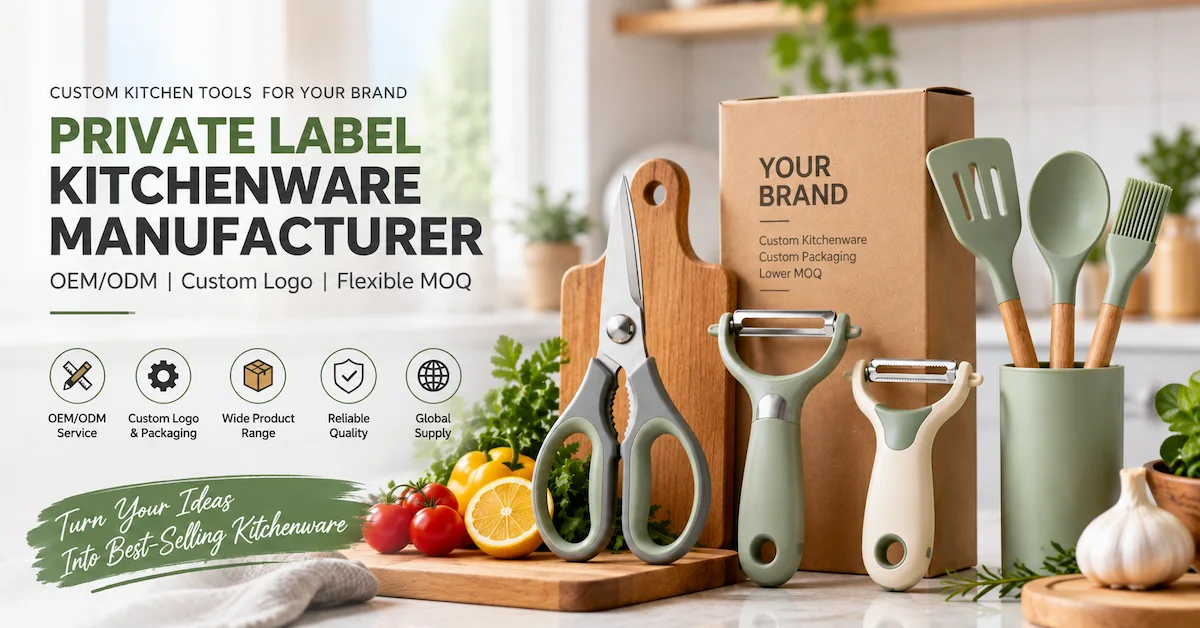
Give each proposed product a reason to be in the collection. A useful starting exercise is to pair food cutting with vegetable preparation and stirring or serving, then check whether the same customer needs all three. Do not choose an item only because its photographed color matches another. Review the BONET kitchenware catalog as a source of candidate models, not a ready-approved bundle. The three examples below illustrate a possible everyday kitchen range; combined ordering, coordinated colors and shared packaging remain matters for quotation and sampling.
Published Specifications: Three BONET Product Examples
The following dimensions and materials are published catalog fields, not independent measurements or test results. Use them to identify the model you want reviewed, then request a component-level specification for the version being quoted.
| Model and product reference | Published dimensions | Listed metal material | Other listed material |
|---|---|---|---|
| G2003 kitchen scissors | 24 × 7.5 × 1.5 cm | 420 stainless steel | PP + TPR |
| M054 three-in-one vegetable peeler | L: 18 × 10.8 × 2.5 cm; M: 15.1 × 9.2 × 2 cm; S: 13 × 6 × 2 cm | 420 stainless steel | PP |
| G2009 silicone spoon | 27 × 6.5 × 1.5 cm | Carbon steel | Silicone |
For M054, confirm how the L, M and S entries relate to the supplied components or variants and how many pieces belong in each retail pack. For G2009, ask where the listed metal is used rather than assuming the whole item is silicone. Do not copy a product dimension into a packaging specification without measuring the actual packed sample.
Model Comparison: What Each Item Contributes
This comparison proposes a role for each model within a collection; it is not a ranking of performance or a statement that the products are interchangeable. The published features provide a starting point, while the final column identifies the sample checks needed before building a brand claim around them.
| Model | Proposed collection role | Published feature to evaluate | Buyer decision before launch |
|---|---|---|---|
| G2003 | Main cutting tool | Detachable blades and magnetic sheath | Confirm included parts, reassembly, storage-surface compatibility and sheath fit |
| M054 | Vegetable-preparation companion | Straight, serrated and julienne functions described | Confirm blade-to-component mapping, pack contents and the foods used for demonstrations |
| G2009 | Stirring and serving companion | Silicone spoon construction | Confirm component structure, intended temperature conditions and cleaning instructions |
A private label kitchenware manufacturer should be asked to review these items together as well as separately. Put the samples beside one another and examine handle proportions, branding space, storage needs and packaging dimensions. A coordinated collection need not have identical construction, but each difference should be intentional and understandable to the customer.
Decide What “Private Label” Means for Your Project
For this project brief, distinguish selling under your brand from changing the product design. One route keeps a catalog model and changes its decoration or packaging; another changes dimensions, materials or functions. BONET’s OEM and ODM services list drawing- and sample-based production, color customization, logo printing, laser engraving and packaging support. Confirm the available combination for each selected model rather than assume every option applies to the entire catalog.
Approve Logo and Color on Physical Samples
Specify the artwork, position, orientation and dimensions of the logo. Request a decorated sample showing the proposed method on the actual product surface. Review it in the orientation in which the customer will hold or store the tool. For a coordinated color, compare the relevant plastic, grip, silicone and packaging samples together under agreed viewing conditions. Keep a physical approved reference; a screen image should not be the sole acceptance standard. Ask how appearance and decoration durability will be checked before agreeing to any related marketing claim.
Separate Branding From New Product Development
A different handle shape or detachable mechanism belongs in the design brief, not only in the artwork instructions. Describe the problem the change must solve and ask for feasibility, tooling, sampling and verification requirements. Also clarify whether the base design remains available to other buyers and what exclusivity, if any, is being proposed. A branded carton does not answer that commercial question. Record the agreed arrangements for custom drawings, tooling and design use before committing to development.
Control MOQ and Cost by Saleable Version
Ask the private label kitchenware manufacturer to state what each minimum order quantity, or MOQ, applies to: the product model, molded color, decoration, retail package or another component. Request quantities per version as well as the collection total. BONET’s published process places MOQ confirmation at the quotation stage and does not provide one universal minimum for every product. Treat any preliminary MOQ as conditional until the configuration is defined.
Count the Versions Before Negotiating the Total
A stock-keeping unit, or SKU, identifies a separately managed saleable item. Build a proposed SKU list containing the model, color, contents and packaging version. Then ask which versions can share purchasing or production arrangements and which cannot. Do not assume that buying several categories together removes the minimum attached to an individual color or printed pack.
Worked Example: Three Tools Can Become Twelve Versions
Suppose a brand offers three tools in two colors, each available in two retail-pack formats. If every combination is sold separately, the plan contains 3 × 2 × 2 = 12 saleable versions. A one-color, one-pack launch would contain three. That arithmetic does not prove the smaller plan will sell better or meet a supplier’s MOQ; it shows how many combinations require decisions and records. Use it to compare launch complexity before committing cash. This is an illustrative planning scenario, not a confirmed BONET offer.
Compare the First-Order Commitment With the Reorder Cost
Request separate lines for products, decoration, packaging, sampling, tooling and any agreed testing or inspection. Identify which charges recur and which belong only to development. When reviewing a cost reduction, mark the exact change: fewer colors, a different pack or an altered product. Protect the features that justify the item’s place in the range. An optional decorative insert can be discussed independently from blade protection or the function customers are buying.
Connect the Specification to Manufacturing and Quality Checks
Give the private label kitchenware manufacturer an approval file for each model. Include dimensions, component materials, finish, assembly, accessories, intended use, branding and package contents. Identify fixed requirements and negotiable preferences. Where information is missing, assign a confirmation task rather than fill the blank with an attractive claim. One collection can share a visual identity while needing different functional checks for scissors, peelers and utensils.
Ask About the Relevant Workmanship
BONET’s manufacturing overview presents processes including stamping, heat treatment, grinding, polishing, injection molding, cleaning, assembly and inspection. Use that overview to request the route relevant to your selected product. For scissors, discuss blade alignment, opening and closing, reassembly and sheath fit. For molded components, agree appearance, fit and finish criteria. Ask where the work will be performed and who controls any externally supplied components; do not assume every product follows every process shown on a general factory page.
Match Every Claim to the Right Evidence
Keep management-system certificates, social-audit records and product test reports separate in the supplier review. Check the named company, production site, scope and relevant dates. For a proposed food-contact, heat-resistance or cleaning claim, request evidence covering the product, materials and use conditions concerned. Do not use a certificate for one activity as approval for an unrelated product claim. Include these checks in the discussion alongside the kitchenware quality-control guide, and have destination-market requirements reviewed before releasing packaging.
Approve the Product, Branding and Retail Pack Separately
A sample approval should answer a specific question. Record the sample reference, date, revision, decision and any unresolved differences. The same physical sample may answer several questions, but keep those decisions identifiable. BONET’s published collaboration process includes sampling, quotation confirmation, production, inspection and delivery; build your approval points into that project schedule.
Use Three Approval Decisions
Ask the private label kitchenware manufacturer to distinguish functional approval from appearance approval and final packed-product approval. The following structure is a suggested buyer control, not a claim that every project requires exactly three shipments of samples.
Functional Sample
Evaluate the tool against its intended tasks. Use agreed foods or test materials, document assembly and cleaning observations, and record what still differs from the proposed production version. Approving a shape should not silently approve an unconfirmed material or performance claim.
Branded Sample
Review color, logo placement, finish and decoration on the product. Compare all items in the range together. Identify the reference that production and inspection teams will use, and record accepted variation rather than relying on a general instruction to “match the brand.”
Packed Retail Sample
Check the tool, accessories, protection, printed information and instructions as one saleable unit. Compare them with the online listing or shelf artwork. Show only the contents included in that version; do not present styling props as supplied accessories. Confirm barcode information, pack dimensions and the proposed shipping arrangement. A common graphic layout can work across a range without forcing differently shaped tools into the same box.
Plan Production Around the Whole Collection
Ask your private label kitchenware manufacturer for a model-by-model schedule covering outstanding development, material preparation, decoration, packaging, inspection and shipment readiness. Name the event that starts each estimate. For the collection launch date, identify the latest-ready item and decide whether partial delivery is acceptable. Ask the supplier to confirm capacity for your actual models and quantities rather than infer it from a company-wide output figure. Keep factory completion, departure and warehouse arrival as separate milestones. Leave time for your own reviews: the project should not assume immediate approval when artwork, quality and buying teams must all respond.
Make Reordering Part of the First Order
Before launch, create a record linking your retail SKU to the supplier model, product revision, color reference, artwork, pack contents and inspection requirements. A private label kitchenware manufacturer should receive those references again when you reorder, together with a request to identify proposed changes. Review feedback by item rather than changing the whole range in response to one complaint. Also agree what happens to unused branded packaging if an item is revised or discontinued: quantity, storage, ownership and authorization for use should be clear. Packaging left over from an earlier version should not dictate the specification of the next order.
Prepare a Private-Label Project Brief for BONET
Send the target market, selling channel, customer task, candidate models, quantity by version, brand artwork and packaging direction. State which decisions are fixed and which alternatives you would consider. Include the required launch window and evidence needed before approval. To discuss an initial collection, contact BONET with your private-label brief and request model-specific feasibility, samples, MOQ and scheduling information. The useful next step is a reviewable proposal, not a generic promise that every catalog item can be customized in the same way.
Frequently Asked Questions
1. What is a private label kitchenware manufacturer?
For this guide, it means a manufacturing partner supplying kitchen tools for sale under the buyer’s brand. Define whether the project retains existing designs or includes product changes. Specify branding, packaging, quality checks and reorder requirements rather than leave the scope to the term “private label.”
2. Can I start with existing BONET models instead of a new mold?
Use the published catalog to propose existing models and ask which branding changes are feasible without structural development. Keep a newly shaped handle or altered mechanism on a separate development request. Availability, sampling and commercial terms need confirmation for the chosen version.
3. Which products should go into a first collection?
Select products around related customer tasks, then review each item independently. The G2003 scissors, M054 peeler and G2009 spoon provide catalog examples for that exercise. Their inclusion here is not evidence of sales performance or a confirmed three-product retail set.
4. Can BONET customize logos, colors and packaging?
BONET lists these services on its OEM/ODM page, including logo printing and laser engraving. Ask which methods suit the selected model and material. Approve the physical result and related commercial conditions before using customized images in a listing.
5. What is the MOQ for private label kitchenware?
Request a minimum for each model, color and packaging version. Also request the conditions for any combined order. There is no published BONET-wide number on the service page that can replace a quotation for your actual collection.
6. Can different kitchen tools share one branded package?
Ask for a pack design based on the exact contents and dimensions. Review protection, movement, accessory count and instructions on the assembled sample. Keep separate model records even when the items are sold as one set. Do not assume a mixed package has a shared product MOQ.
7. Does adding my logo make the product exclusive?
Treat exclusivity as a separate commercial discussion. Ask whether it covers a design, configuration, territory or period, and obtain written agreement. Do not interpret approval of artwork as confirmation of exclusive product availability.
8. How long does a private-label launch take?
Request a schedule for the defined scope, including sample review, changes, materials, packaging, production and inspection. Confirm the starting conditions and buyer approval deadlines. Avoid choosing a launch date from a generic lead-time estimate that excludes unresolved work.
9. What evidence should I request before approving product claims?
Request evidence tied to the proposed product, materials, intended conditions and market. Check that the documents support the wording on your packaging. Keep product-test review separate from management-system or social-audit review, and resolve unsupported claims before artwork approval.
10. How can I keep repeat orders consistent?
Retain the approved product and packaging records, identify them on the purchase order and require proposed changes to be disclosed. Compare received products with the agreed references. Use item-specific feedback to decide whether the next order needs a documented revision.
Conclusion
A private label kitchenware manufacturer should be evaluated on the complete branded item you intend to sell and reorder. Choose tools with distinct roles, confirm the specifications behind the catalog, control the number of versions and approve product, decoration and packaging deliberately. BONET’s catalog offers concrete models for starting that discussion; final configurations and commitments still need project-specific confirmation. Submit your proposed kitchenware range to BONET with quantities, branding requirements and packaging references to move from an initial shortlist to a defined launch plan.
