




Quick Answer:
Start by giving the factory a real range brief: who buys the knives, what each piece must do, how the brand should look and where the set will be sold. Tie every decision to a named sample and artwork revision. Check the blade, handle, logo, pack and carton as one retail product. Before production, make sure the quotation refers to that exact version and records the project-specific MOQ, timing and delivery terms.
Introduction: Why a Knife Range Can Fail Before Production Begins
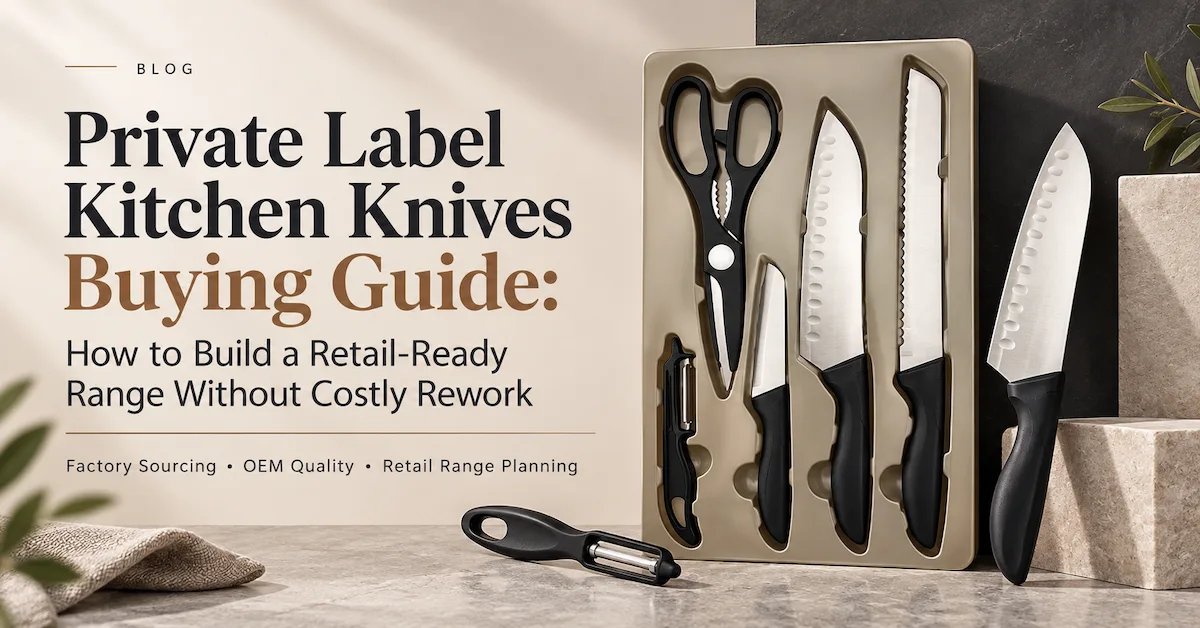
A supermarket buyer, an online seller and a gift-range manager are not solving the same problem, even when all three ask for private label kitchen knives. One worries about a five-second shelf decision. Another needs a parcel-ready pack and exact listing photographs. The third cares about the opening moment. Their knives still need to cut properly, of course, but the surrounding commercial job is different. Ignore that difference and a sound product can land in the wrong box, at the wrong price, with a muddled set of pieces.
Many sourcing projects start with incomplete questions: “Can you put our logo on this?” or “What is your price for a five-piece set?” Those questions do not identify the blade construction, handle system, exact pieces, packaging, order quantity, destination, artwork status or acceptance method. Suppliers then fill the gaps with their own assumptions. When several quotations arrive, the numbers look comparable even though the products behind them are different.
This guide changes the starting point. It treats a knife range as a small product system that moves from customer need to shelf presentation and then into repeat orders. The nine steps below help a buyer define the range, review a manufacturer, approve samples and compare offers on one basis. BONET HOUSEWARE pages are linked where they provide a relevant product or service example. Public page information is a useful reference, but project-specific specifications, MOQ, price, tooling, lead time, testing and delivery terms still require written confirmation.
What Are Private Label Kitchen Knives?
Private label kitchen knives are knives produced by a manufacturing partner and sold under the buyer's brand. The route may begin with an existing model, a modified model or a new drawing. In practice, the brand owner decides what must be on the shelf and signs off the knife, mark, box and consumer wording. The factory then has to turn that exact version into a sample it can reproduce. Some briefs concern one knife. Others combine a matched group with scissors, a peeler, guards, a block or another retail pack.
The term describes the brand relationship, not one fixed level of customization. A stock blade with a printed logo and color box is a private-label project. So is a newly developed handle family with several blade profiles and a custom gift pack. The second route creates more design, tooling and approval decisions. Buyers should therefore describe the route explicitly rather than assuming that “private label” tells the supplier how much development is expected.
Why do brands take this route? They want a range they can own without building a knife plant themselves. You will see these programs in home-kitchen shops, supermarket aisles, promotional campaigns, online marketplaces, direct-to-consumer stores, gift collections and distributor catalogs. The commercial upside depends on all the parts agreeing with one another. The blade cannot promise one thing while the box, listing and price suggest three others.
1. Name the Buyer Before You Name the Knife
Begin with the person who will buy and use the knife. “Home cook” is too broad. Picture four actual baskets: a compact starter set for a first apartment, a boxed present, a specification-led online purchase and a quick supermarket pick. They lead to different assortments. Write one short paragraph about cooking habits, experience, available storage and the buying occasion. Add the sales channel and intended retail position. Now the product discussion has edges.
The channel changes practical requirements. A hanging card needs secure product retention and a clear front panel. A color box gives more room for a brand story but hides the product. A gift box can improve presentation while increasing volume and assembly complexity. An e-commerce pack must protect the edge and point through distribution, and its online listing needs images that accurately match the delivered item. A display set may require a stable block, compact footprint and a clear piece count.
Create a one-page range brief before asking a private label kitchen knife manufacturer for options. Put the shopper and channel at the top. Below them, list how many SKUs you expect, the jobs that cannot be omitted, the visual mood, likely pack, launch window and estimated volume. Label each line “fixed,” “preferred” or “open.” That small label matters: it tells the factory where it may make a useful suggestion and where it may not improvise.
| Brief field | Buyer decision | Why it matters |
|---|---|---|
| Target customer | Skill, cooking habits, household and storage | Shapes the assortment and product message |
| Sales channel | Retail, supermarket, e-commerce, gifting or distribution | Changes pack, labeling and handling needs |
| Range role | Entry, core, premium or promotional | Prevents mismatched features and cost |
| Must-have tasks | Chopping, slicing, bread, detail work or a set solution | Gives every SKU a distinct job |
| Open decisions | Material, finish, color, storage and pack options | Focuses supplier recommendations |
Step 2: Build an Assortment Instead of Collecting Random Knives
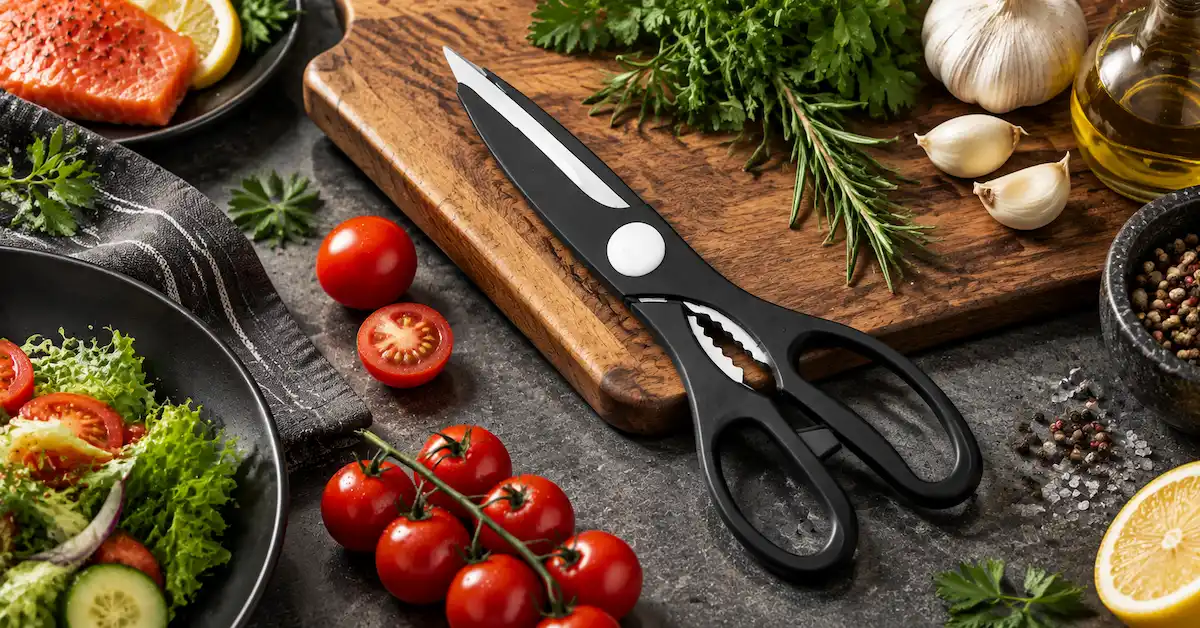
A useful assortment gives each item a recognizable task and price role. Work backward from a normal week in the customer's kitchen. Which cuts happen every day, which ones need a smaller blade, and which food defeats a plain edge? The answers usually narrow the field quickly. A chef's knife or santoku often becomes the workhorse. A paring knife earns its place through close control, while a serrated bread knife has an unmistakable separate job. Add a utility knife or accessory only when you can finish the sentence, “This belongs because...”
BONET's knife category provides several SKU-level reference points. The K102 chef knife set page lists five product dimensions, 420 stainless steel and PP. The K101 knife set page lists three product dimensions, 420 stainless steel and PP. The K107 hollow-handle knife set page identifies 430 stainless steel. These page details belong to the named models; a new private-label revision needs its own confirmation.
Build a range matrix with rows for customer task, blade type, size direction, handle family, price role and pack format. Then look for awkward twins. When two entries do the same job and occupy the same price point, either remove one or give it an honest distinction. Look for the opposite problem too. Four clever specialty blades can still feel like half a range when there is no obvious knife for Tuesday-night chopping.
| Range position | Customer question | Product decision | Approval evidence |
|---|---|---|---|
| Daily workhorse | What handles most preparation? | Chef or santoku direction | Task-based cutting sample |
| Detail tool | What gives control on small tasks? | Paring knife direction | Grip and controlled-cut review |
| Special task | What cannot the workhorse do well? | Bread or other defined profile | Media-specific result |
| Set anchor | Why buy the collection together? | Matched handles, roles and storage | Complete packed sample |
Have a target customer and range idea?
Have a target customer and range idea?
Send Your Private Label Knife BriefStep 3: Specify Blade Architecture and Ask for SKU-Level Material Evidence
Steel names attract attention because they fit neatly into a specification cell. Cutting feel does not. It comes from the whole blade: profile, thickness, edge geometry, grinding, finish, final sharpening and, where relevant, heat treatment. Write down the food and motion before debating the grade. Once the factory knows what an acceptable slice, chop or serrated cut looks like, the material discussion has a practical reference.
When evaluating a stainless steel kitchen knife manufacturer, ask which steel is proposed for each blade in the exact set. Request the material statement and any available report under the same SKU or revision. Then connect the document to physical observations: edge condition, straightness, surface appearance, alignment with the handle and cutting behavior on agreed media. Evidence from another model should not be used as proof for the new item unless the relationship is documented.
Define the finish in practical language. A mirror-like surface, brushed appearance, coated blade or decorative pattern creates different visual standards and care considerations. Record acceptable appearance under normal inspection lighting and identify critical defects such as exposed burrs, irregular grind lines, scratches outside the agreed sample standard or visible gaps at the blade-handle joint.
The cutting method should represent normal intended use. Specify the medium, preparation, number of repetitions, stroke and observation. For a bread knife, describe the loaf or test medium and whether crushing or tearing is acceptable. For a chef's knife, define representative slicing or chopping. Do not invent a laboratory claim merely to make the pack sound technical. A modest, repeatable test connected to the approved sample is more useful than a dramatic statement with no method.
Step 4: Turn the Handle, Color and Logo into One Brand System
The handle is where product identity and daily use meet. It affects grip, balance, cleaning, visual recognition and the continuity of the range. Decide whether every knife should share one handle architecture or whether different sizes need adjusted proportions. Record the construction, material direction, color reference, surface texture, seam or joint expectations and logo location. Review how the handle feels with dry hands and under the conditions reasonably associated with the intended use.
For custom logo kitchen knives, select the marking method only after reviewing the actual surface. BONET's OEM/ODM page describes logo printing and laser engraving among its customization support. The appropriate route depends on the model, finish, artwork, contrast and durability requirement. Ask for the method, position, scale and orientation to be shown on a physical sample. A digital mockup is helpful for alignment, but it cannot demonstrate how the mark looks on a curved or reflective part.
Create a brand map that links blade mark, handle color, packaging hierarchy and item code. Put the paring knife beside the chef's knife and cover the names. Do they look related? Good. Can a shopper still tell which is which? Better. Range consistency is not photocopying the same treatment onto every surface. It comes from a few repeated decisions: how the mark is made, which colors may appear, how product names are set and where the item code lives.
Keep artwork files under revision control. Name the approved file, date, color mode, dimensions and owner. When artwork changes, issue a new revision and identify what it replaces. Ask the supplier how obsolete files are kept out of production. This quiet administrative step protects the brand more effectively than relying on a message saying “use the latest logo.”
Step 5: Design Custom Packaging Around Protection, Choice and Fulfilment
Knife packaging has four jobs: retain the product, protect the edge and point, explain the choice and survive handling. Those jobs should be reviewed on the real item. A dieline can show dimensions and graphics, but it cannot prove that a knife will remain secure, that a tip will not contact a weak area or that a customer can remove the product without an awkward movement.
BONET's OEM/ODM page lists support for color boxes, gift boxes, retail packaging, barcode labels and export cartons. For custom kitchen knife packaging, begin by naming the channel. A supermarket set may prioritize shelf communication and compact case packing. An e-commerce set may prioritize internal restraint and parcel handling. A gift set may prioritize opening sequence and presentation. These are different briefs even when the knives are identical.
Plan the front panel around the buying decision. State the collection name, exact piece count and clear product roles. Avoid a large feature count that the shopper cannot verify. The back or side panels can carry item identification, material wording tied to the approved specification, care information, origin and other market-required details. The buyer or qualified adviser remains responsible for confirming legal and language requirements in the destination market.
Review the packaging as a logistics unit. Confirm individual pack dimensions, weight, inner and outer carton quantity, orientation, carton marking and any protective insert. Test how the pack behaves when lifted, stacked and moved. Record barcode placement and scannability on the finished surface. If the supplier quotation uses a preliminary packaging allowance, label it as preliminary and update the commercial record after the packed sample is approved.
| Packaging layer | Approval question | Record to retain |
|---|---|---|
| Product restraint | Can the blade, edge or point move into a weak area? | Packed sample photographs |
| Retail communication | Can the shopper identify the pieces and intended tasks? | Approved artwork revision |
| Opening experience | Can the product be removed in a controlled way? | Opening review notes |
| Shipping unit | Are quantity, orientation, labels and protection defined? | Carton specification and pack-out |
Need product and packaging reviewed as one sample?
Need product and packaging reviewed as one sample?
Request a Packaging Feasibility ReviewStep 6: Select the Right Development Route Before Requesting Price
There are three common routes for custom kitchen knives. A stock-platform route keeps the product architecture fixed and changes agreed branding or packaging. A modified-platform route changes selected elements such as color, finish, logo, set composition or package. A new-development route begins with a buyer drawing, reference sample or concept and may involve structural work, tooling and additional sample rounds.
An OEM kitchen knife manufacturer should be able to tell the buyer which route the brief represents and which decisions drive cost and timing. BONET's OEM/ODM page describes production by drawing or sample, material and color customization, logo options, packaging customization, and ODM support including concept development, structural optimization, material recommendation, feasibility assessment and sample development. These statements describe offered services; feasibility for a particular blade, handle or package must still be confirmed.
Do not choose the deepest customization route automatically. A new handle mold may create a stronger visual signature, but it also introduces more decisions than an existing handle with controlled color and branding. If the commercial goal is to test a new category quickly, a well-selected platform can be the more disciplined route. If a distinctive grip or storage solution is central to the proposition, development may be justified.
Ask for a route summary before quotation: what remains standard, what changes, what requires tooling, what requires a new sample, which files are needed and which items remain provisional. Then request project-specific MOQ, tooling charges, sample cost, sample timing, production lead time and quotation validity. These values should never be copied from another project or presented as permanent factory rules.
| Development route | Typical controlled changes | Main buyer risk |
|---|---|---|
| Stock platform | Logo, approved color option, artwork and pack | Assuming the standard model meets the intended task without testing |
| Modified platform | Finish, color, set composition, accessory or packaging structure | Treating a visible change as commercially insignificant |
| New development | Blade, handle, storage or complete product architecture | Starting tooling before performance and acceptance criteria are clear |
Step 7: Approve Samples Through Separate Function, Appearance and Pack Gates
A sample should be identifiable. Assign an ID, receive date and revision, then photograph the complete item and important details. Record the dimensions, components, blade marking, handle color and packaging status. If the next sample changes only the logo, say so. If it changes the blade or handle, issue a new revision. Without this discipline, a buyer can approve the appearance of one sample and unknowingly receive the construction of another.
Separate approval into gates. The identity gate confirms that the sample matches the current brief. The function gate checks the agreed tasks and observations. The appearance gate covers finish, molding, joints, marking and color. The packaging gate checks retention, point protection, artwork and carton assumptions. A commercial gate confirms which revision the quotation covers. Production approval should refer to the accepted result from every applicable gate.
For private label kitchen knife sets, inspect the collection both piece by piece and as one packed unit. Confirm that every knife is present, correctly positioned and visually consistent. Check that the package names the pieces accurately. Review whether the set feels balanced in value: one impressive workhorse should not be surrounded by components that do not meet the same approved standard.
A useful approval sentence is specific: “Approved for production against sample PLK-03, product specification revision B and artwork revision C, subject to the carton marking correction shown in attachment 4.” A weak approval says only “sample okay.” The first statement gives purchasing, quality and production a shared reference. The second relies on memory.
Step 8: Evaluate the Manufacturer and Normalize Every Quotation
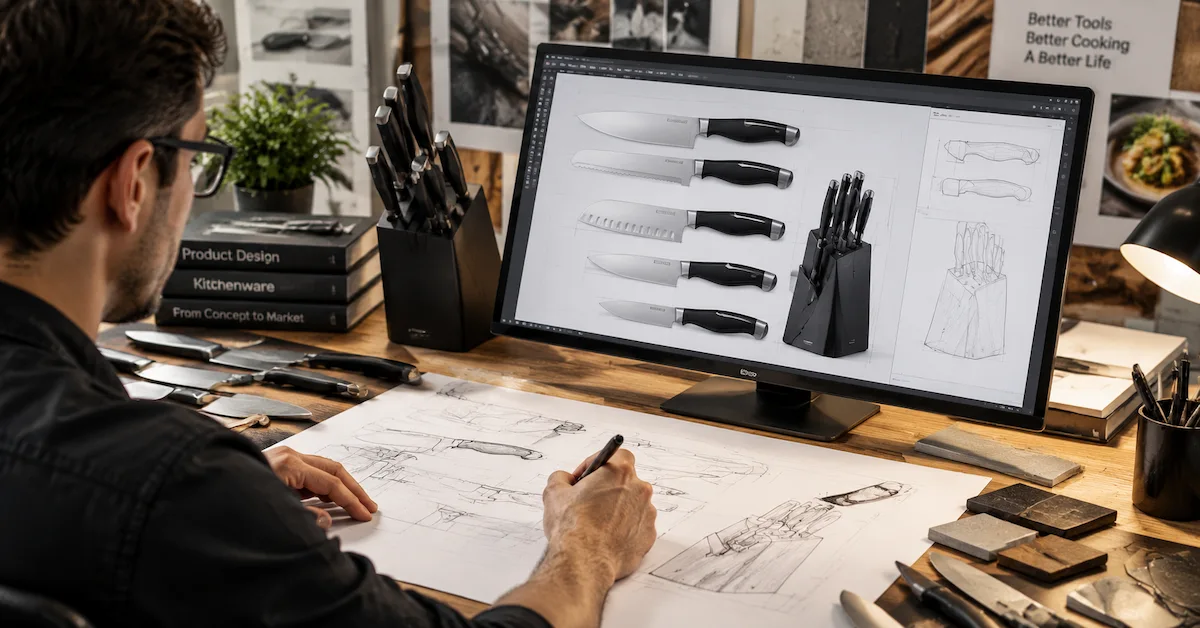
A search for a kitchen knife manufacturer China can produce many similar company descriptions. Move the discussion to evidence connected to the item. Ask the supplier to repeat the brief, identify missing inputs, explain the proposed development route and show how the sample will be controlled. Precise questions and written recaps reveal more than a broad promise of quality.
Evaluate production understanding without assuming that every model follows the same process. Ask which stages apply to the selected knife, what is checked at each important stage and how a failed part is handled. Review blade forming and straightness, edge preparation, surface appearance, handle molding or assembly, marking, final function, cleaning and packing as applicable. The goal is not to collect factory terminology. It is to identify where the product's critical characteristics are created and verified.
Normalize quotations before comparing price. Put every offer into the same table: exact model or drawing revision, blade and handle specification, finish, logo method, set contents, individual packaging, carton quantity, inspection basis, quantity, currency, trade term, destination and validity. Separate included costs, one-time charges, optional items, exclusions and provisional allowances. A lower unit price for a different pack or unconfirmed logo is not a saving; it is a different offer.
Do not rely on the scissors ISO certificate as proof for a kitchen knife project. The available ISO 9001:2015 certificate for Yangjiang Master Scissor & Knife Manufacture Co., Ltd. states a scope of production and sale of scissors. That exact scope should not be expanded to kitchen knives. For knife sourcing, request the product, process and market documents relevant to the chosen item and destination.
| Quotation line | Normalize before comparing | Written confirmation |
|---|---|---|
| Product | SKU, revision, material, finish, handle and piece count | The offer points to the approved specification |
| Branding | Method, location, colors, setup and artwork | Included and separate charges are identified |
| Packaging | Pack type, insert, labels, barcode and carton | Price uses the approved or named provisional pack |
| Development | Tooling, sample rounds and artwork changes | One-time and recurring charges are separated |
| Delivery | Quantity, currency, trade term, timing and destination | Commercial assumptions and validity are stated |
Step 9: Protect the Launch and Make Reorders Boringly Predictable
A private-label launch creates information that must remain usable after the first shipment. Build an item master for each SKU and set. Include model, dimensions, materials, finish, handle construction, color references, logo method, artwork revision, packaging dieline, barcode, pack contents, carton arrangement and approved sample ID. Store the documents where purchasing, quality, design and customer service can reach the same version.
Before a repeat order, send a change statement with two headings: “changes requested” and “items remaining as approved.” This prevents a color update from reopening the blade specification or a barcode change from silently replacing a dieline. If the supplier proposes a material, component or process change, request the reason, affected items, appearance or performance impact, sample requirement, cost effect and timing effect before approval.
Prepare customer-service facts from the approved product record. The selling team should know the exact set contents, intended tasks, material wording, care guidance and package contents. Avoid claims broader than the evidence. If an online listing shows a storage block or accessory, confirm that it is included in the delivered SKU. Consistency between page, pack and product reduces preventable returns and protects trust.
For repeat orders, compare the new production against the retained reference and current controlled documents. Investigate deviations with photographs, batch information, affected quantity and a clear observed condition. Do not guess the cause. Ask for containment, cause analysis, corrective action and verification appropriate to the issue. The best reorder system is uneventful because its decisions are already recorded.
Ready to turn a range idea into a controlled RFQ?
Ready to turn a range idea into a controlled RFQ?
Ask BONET About Your Knife ProjectPrivate Label Kitchen Knives: Buyer FAQ
How do I choose a private label kitchen knife manufacturer?
Choose against the needs of a defined product, not a generic company claim. Give candidates the same brief and compare how they handle missing information, development route, sample control, material evidence, logo execution, packaging and quotation assumptions. Review a physical sample using a written method. Confirm commercial terms for that exact revision before approving production.
What should a first inquiry include?
Include the target customer, sales channel, desired range or set composition, reference products or drawings, intended tasks, material and finish direction, handle and color direction, logo files, package concept, estimated quantity, destination market and launch timing. Mark which fields are fixed and which are open to recommendation. Ask the supplier to list unanswered questions before quoting.
Is a stock model suitable for a private-label launch?
It can be, provided the model passes the buyer's task, appearance and packaging review. A stock platform may reduce development decisions, but it does not remove the need for a controlled sample. Confirm the exact construction, available branding methods, packaging options and project-specific MOQ, price and timing.
How many knives should a starter range contain?
There is no universal number. Start with customer jobs and remove duplication. A compact range may cover daily preparation, detail work and one specialist task, while a set program may add storage and accessories. Every extra component should improve customer value enough to justify inventory, packaging space and inspection work.
What steel should I specify?
Specify the intended task and acceptance method before treating a steel grade as the answer. Review the exact grade with blade geometry, heat-treatment direction where relevant, finish, edge preparation and sample result. BONET's public pages identify 420 stainless steel for K101 and K102, and 430 stainless steel for K103, K105 and K107. Those claims are SKU-specific and should be reconfirmed for a customized version.
How should a logo be approved?
Approve the artwork file, method, size, position, orientation, color and acceptable appearance on the physical product. Review contrast and legibility on the actual finish. Link the artwork revision to the product sample and packaging revision, and identify what an updated file replaces.
What should buyers test in knife packaging?
Check product restraint, edge and point protection, component count, opening experience, printed information, barcode, pack dimensions and carton arrangement. Use a complete packed sample. For e-commerce, review the shipping configuration; for shelf retail, review presentation, hanging or standing stability and shopper comprehension.
Can a supplier provide fixed MOQ and lead-time figures on a website?
Website figures cannot replace a current project quotation. MOQ and timing can change with model, material, tooling, logo method, packaging, quantity and production schedule. Ask for written values tied to the exact product and artwork revision, along with quotation validity and delivery assumptions.
What belongs in a repeat-order file?
Keep the approved product specification, sample ID, artwork, dieline, barcode, pack contents, carton arrangement, inspection method, quotation basis and change history. Before reordering, state what changes and what stays approved. This turns the first order into a repeatable product record rather than a one-time collection of messages.
RFQ Checklist for a Private Label Knife Program
- Target customer, channel, retail position and launch objective are defined.
- Every knife or accessory has a distinct customer job and range role.
- Existing model, modified platform or new-development route is identified.
- Blade profile, material direction, finish and acceptance method are recorded by SKU.
- Handle construction, color, texture and logo location are controlled.
- Artwork files have owners and revision numbers.
- Individual packaging, inserts, labels, barcode and outer carton are included in the brief.
- Function, appearance, packaging and commercial sample gates are separate.
- Quotation lines are normalized against one product and packaging revision.
- MOQ, tooling, sample timing, production timing and delivery terms are confirmed for this project.
- Documents and market requirements are matched to the exact item and destination.
- The approved specification, sample and pack record are preserved for reorders.
Final Sourcing Decision
Successful private label kitchen knives are built by connecting ordinary decisions that are often handled separately. The customer job determines the assortment. The assortment shapes blade and handle requirements. Those requirements guide material evidence and sample tests. The brand system controls the mark, colors and item identity. Packaging protects the knife and helps the shopper choose. The quotation becomes meaningful only when it points to the same approved revision.
BONET HOUSEWARE publicly presents OEM and ODM support for kitchen knives, including production by drawing or sample, material and color customization, logo printing or laser engraving, sample development and packaging customization. Buyers can use those capabilities as a starting point, then request feasibility, samples and commercial details for the specific project. To start a useful conversation, send the customer profile, range plan, reference model or drawing, intended tasks, logo file, packaging idea, estimated quantity, destination and launch timing.
Build the RFQ around one range, one revision and one clear launch goal.
Build the RFQ around one range, one revision and one clear launch goal.
Contact BONET HOUSEWARE