




Quality Sewing Scissors: How to Choose Reliable Tailor Shears
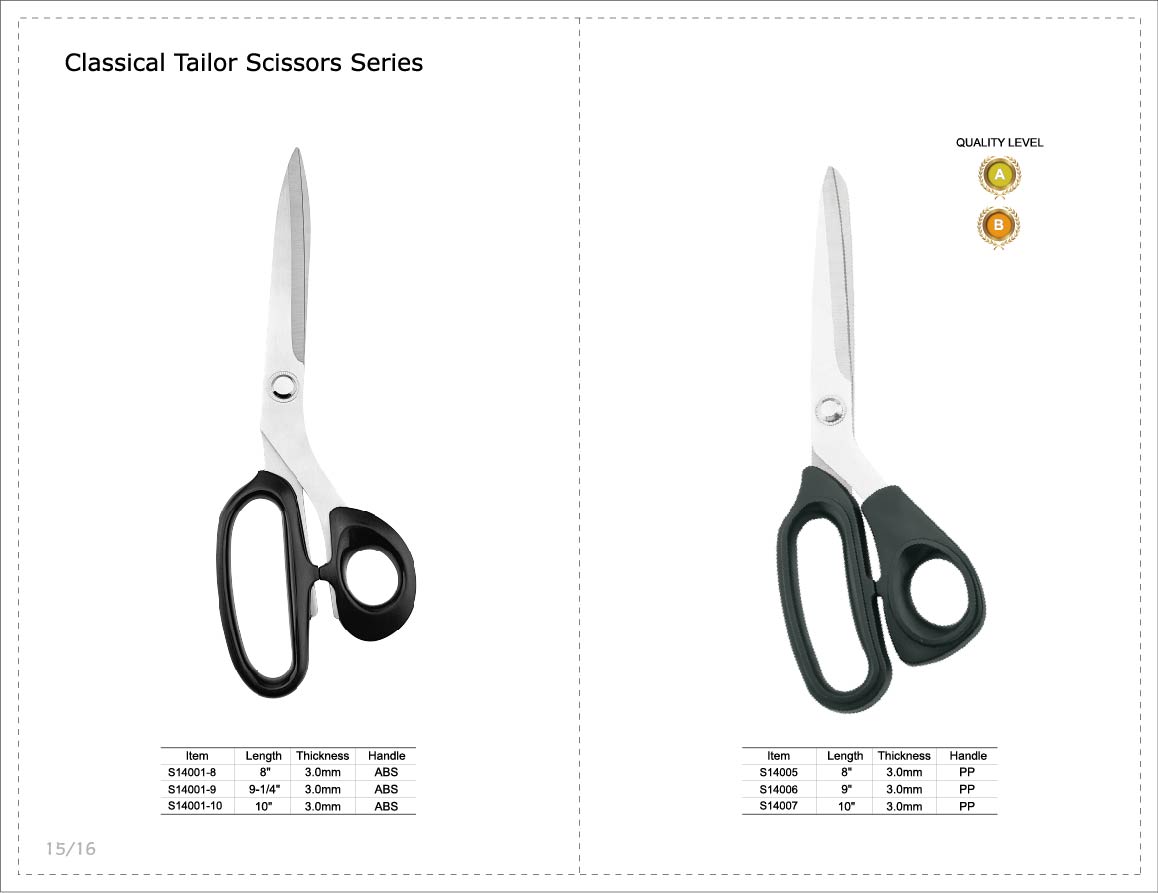
Quality sewing scissors are one of the few tools that directly affect every stage of tailoring. A clean cut helps fabric pieces match the pattern, reduces edge distortion, and saves time during assembly. For professional tailors, sewing schools, alteration shops, craft retailers, and wholesale buyers, choosing the right tailor shears is not only about sharpness. Size, blade stability, handle comfort, quality grade, packaging, and after-sales support all matter.
The Classical Tailor Scissors Series described in the original product information includes 8 inch, 9-1/4 inch, and 10 inch options, with blades listed at 3.0 mm thickness. The series also mentions A and B quality grades, plus ABS handles for item S14001 and PP handles for items S14005, S14006, and S14007. Those details give buyers a useful starting point, but they should still confirm the final specification, finish, packaging, and intended use with the supplier before placing an order.
Key Takeaways
- Choose sewing scissors by fabric type, cutting volume, hand comfort, and required blade length.
- A 3.0 mm blade thickness can indicate a focus on stability, but buyers should ask how sharpness and edge retention are controlled.
- ABS and PP handles can suit different preferences for grip, weight, and price positioning.
- Wholesale and OEM buyers should request samples and written specifications before confirming bulk orders.
Why Scissor Quality Matters in Tailoring
Fabric behaves differently from paper, plastic sheet, or cardboard. Woven cotton, denim, lining cloth, felt, and slippery synthetic fabrics can shift during cutting. If the scissors drag, twist, or chew the edge, the tailor may need to trim again, which wastes material and changes the pattern allowance. For a workshop cutting dozens of pieces a day, small inefficiencies quickly become expensive.
Good sewing scissors should open smoothly, close with consistent pressure, and cut close to the pivot as well as near the tip. The blades should meet evenly without visible gaps. The handle should allow the user to guide long cuts without forcing the wrist into an awkward angle. These details are important for both individual users and distributors building a dependable sewing tool assortment.
Choosing the Right Size: 8 Inch, 9-1/4 Inch, or 10 Inch
The Classical Tailor Scissors Series includes three common cutting lengths. An 8 inch pair is often easier to control for small pattern pieces, light fabric, classroom use, and home sewing kits. A 9-1/4 inch pair gives more reach while remaining manageable for many users. A 10 inch pair is usually selected for longer straight cuts, heavier cutting sessions, or users who prefer a larger tool.
Size should not be chosen only by the biggest number on the catalog page. Buyers should consider who will use the scissors, how long each cutting session lasts, and whether the work involves long garment panels or detailed trimming. For retail assortments, offering more than one size can help serve beginners, hobbyists, and professional users without forcing one model to fit every need.
Blade Thickness, Sharpness, and Cutting Stability
The original information states that the series has 3.0 mm thick blades. Blade thickness can contribute to a stable cutting feel, especially when cutting multiple fabric layers or heavier cloth. However, thickness alone does not prove cutting performance. The edge angle, blade alignment, pivot tension, surface finish, and final inspection process also affect the result.
Before sourcing sewing scissors in quantity, buyers should ask practical questions: What fabrics are used for sample cutting tests? Are the scissors checked for tip cutting and full-length cutting? How is pivot tightness controlled? Can the supplier provide a pre-shipment inspection standard? These questions are more useful than relying on broad claims such as “professional quality” without measurable criteria.
Handle Materials: ABS and PP Options
The original product text identifies ABS handles on S14001 and PP handles on S14005, S14006, and S14007. Both materials are commonly used in handled tools, but the best choice depends on the target market and usage pattern. A handle should feel secure, resist slipping during normal use, and provide enough finger space for the intended user group.
When evaluating samples, test the handle with dry hands and during longer cutting sessions. Check for sharp mold lines, uncomfortable pressure points, and whether the handle shape supports control near the pivot. For wholesale buyers, it is also sensible to confirm available colors, logo options, packaging style, and whether any customization changes the lead time or order requirements.
Comparison and Buying Checklist
| Selection point | What to check | Why it matters |
|---|---|---|
| Length | 8 inch, 9-1/4 inch, or 10 inch options | Matches the tool to detailed work, general cutting, or longer fabric cuts |
| Blade thickness | Confirm the stated 3.0 mm blade thickness on samples | Supports cutting stability, but should be assessed with real fabric tests |
| Handle material | ABS for S14001; PP for S14005, S14006, S14007 | Affects grip feel, weight, positioning, and user preference |
| Quality grade | Ask what A and B grades mean in written specifications | Prevents misunderstanding about finish, tolerance, or inspection level |
| Cutting test | Test cotton, lining, denim, or the buyer’s target fabric | Shows whether the scissors perform in the intended application |
| Commercial terms | Ask about MOQ, packaging, lead time, samples, and customization | Helps B2B buyers plan sourcing without assumptions |
Use and Care Tips for Longer Service
Even quality sewing scissors can perform poorly if they are misused. Keep fabric scissors separate from paper scissors, because cutting paper can dull the edge faster. Wipe the blades after cutting lint-heavy fabric, and store the scissors closed in a dry place. If the pivot becomes loose or too tight, adjust only if the design allows it and the user understands the mechanism.
- Use the scissors only for fabric and thread-related tasks.
- Do not cut pins, wire, plastic ties, or hard packaging materials.
- Clean lint from the blade and pivot area after frequent use.
- Store scissors away from moisture to reduce the risk of surface damage.
- Arrange professional sharpening when cutting performance noticeably declines.
B2B Sourcing Questions to Ask a Supplier
For importers, distributors, sewing kit brands, and retail buyers, sample approval is essential. Request the exact model number, handle material, blade thickness, size, packing method, and quality grade in writing. If the catalog lists A and B grades, ask the supplier to define the difference clearly. The distinction may relate to finishing, inspection criteria, market positioning, or another internal standard, so it should not be guessed.
Buyers should also ask whether private label packaging, barcode labels, color selection, or assortment packs are available. Do not assume MOQ, prices, compliance documents, or testing reports unless the supplier confirms them. A good purchasing process compares samples from the same production batch standard that will be used for bulk goods.
Practical FAQ
What size sewing scissors should a beginner choose?
An 8 inch pair is often easier for beginners to control, especially for home sewing and smaller fabric pieces. Users who cut long panels may prefer 9-1/4 inch or 10 inch scissors.
Are thicker blades always better?
No. The series lists 3.0 mm blade thickness, which can support stability, but sharpness, alignment, pivot tension, and edge finishing also determine cutting quality.
What is the difference between ABS and PP handles?
The original details identify ABS handles for S14001 and PP handles for S14005, S14006, and S14007. Buyers should compare samples for grip comfort, weight, and target price positioning.
How should wholesale buyers verify quality before ordering?
Request samples, test them on target fabrics, confirm written specifications, clarify A and B grade meanings, and ask about packaging, lead time, MOQ, and any customization requirements.
Can sewing scissors be used for paper?
They can physically cut paper, but it is not recommended if the scissors are reserved for fabric. Paper use may reduce cutting performance over time.
