




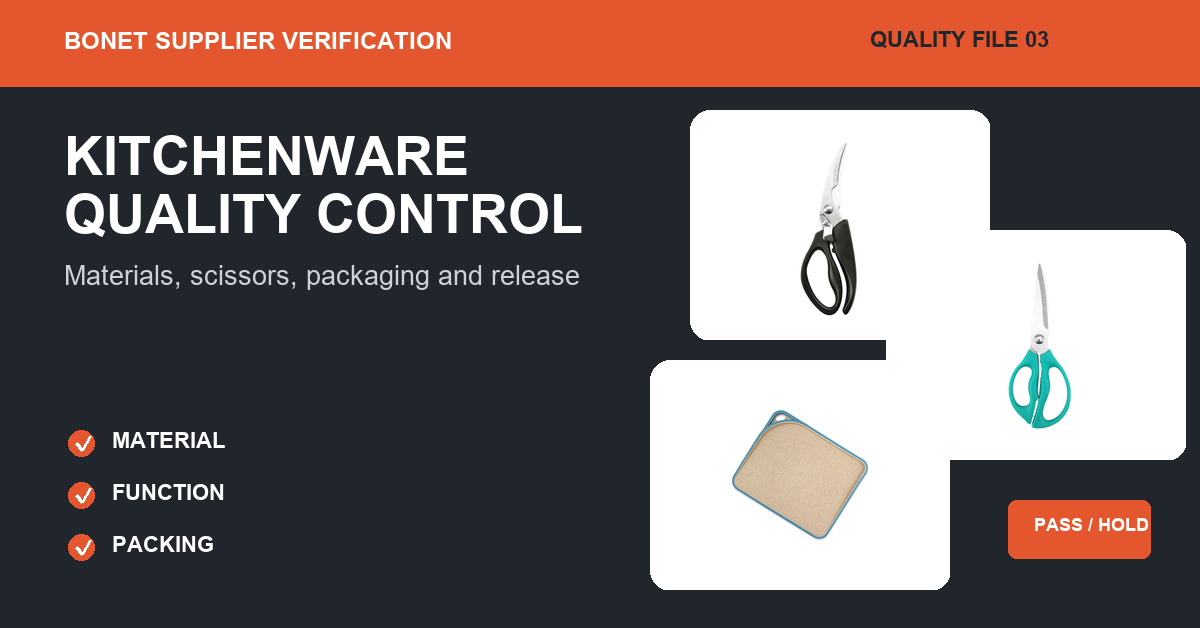
A supplier can send an excellent quotation, an attractive sample, and a confident presentation, then still ship an order that creates complaints. The gap is usually not one dramatic mistake. It is a chain of small controls that were never defined: the steel was accepted by name rather than specification, the pivot feel was judged differently by each inspector, the cutting test used whatever material happened to be nearby, or the retail pack allowed the tool to move during transport.
For buyers searching for a reliable kitchenware manufacturer China, quality control should be visible before the purchase order is released. This guide explains how to build that visibility for kitchen tools, with detailed examples from scissors and shears. It also covers incoming materials, in-process inspection, functional testing, packaging, defect classification, pre-shipment release, and corrective action. The goal is not to create paperwork for its own sake. The goal is to make the approved result repeatable and to make failures easier to contain.
Buyer takeaway: quality is controlled when the supplier and buyer agree on the product, risk, method, sample, acceptance rule, record, and response. "We inspect everything" is a promise. A usable control plan shows what that promise means.
Start quality planning with the user's task
A kitchen shear designed to cut herbs, open packaging, and trim food is not automatically suitable for poultry bones. A detachable pair may be easier to clean but introduces a separation mechanism that must fit and reconnect consistently. A magnetic sheath improves storage only when retention, cleanliness, and pack position are controlled. The intended task changes the blade, pivot, handle, added features, test media, cleaning expectations, warnings, and package.
Write a one-paragraph use statement before selecting tests. Name the user, environment, expected tasks, frequency, cleaning method, foreseeable misuse, and claims that will appear in the catalog or package. For a retail kitchen shear, the statement might cover ordinary food preparation, herbs, packaging, and the integrated opener. For a camping multi-tool, it may include outdoor storage, portability, and several functions. The supplier can then separate the supported uses from tasks that require another model.
This matters beyond scissors. A utensil used in hot cookware asks different questions from a cold-prep tool. A chopping board sold for daily family use needs a different inspection from a decorative serving board. Quality begins with a defined job. Without it, a product can pass every test in the file and still disappoint the customer.

Build the product specification around measurable characteristics
The approved sample is important, but it cannot carry the entire quality system. Samples age, become damaged, and invite subjective comparison. Convert the important features into a controlled specification. Record the model and revision, overall dimensions, blade length and thickness where relevant, materials, handle construction, pivot, tip, edge, finish, color, logo, accessory, package, and intended functions. Add drawings or photographs where words may be interpreted differently.
Not every dimension needs a tight tolerance. Control the characteristics that affect assembly, function, safety, package fit, or visible consistency. An unnecessarily tight cosmetic dimension can increase cost without helping users. A loose pivot or exposed sharp tip, by contrast, can create a serious problem even when the product looks acceptable. Risk should decide the effort.
Define the reference hierarchy. If the drawing and sample disagree, which one controls? If the specification lists one material while the artwork names another, production must stop for clarification. State how changes are approved. A supplier should not substitute a screw, resin, sheath, carton, or finish because it seems equivalent. The proposed change needs a review of function, compliance, appearance, cost, timing, and evidence.
Incoming quality control: verify what enters the process
Metal and blade material
"Stainless steel" does not describe a finished blade. The project may need a controlled grade or supplier specification, thickness, hardness or heat-treatment expectation, surface condition, and traceability to the purchased material. The verification route can include purchase documents, supplier certificates, identity testing, thickness measurement, hardness checks, or third-party analysis depending on risk and customer requirements. No single method is necessary for every order, but the method should be chosen rather than assumed.
Review the condition of incoming blanks or formed parts. Look for rust, stains, scratches, burrs, distortion, incorrect dimensions, or mixed material. Protect material during storage and handling. If the product uses two blade pieces, confirm that the intended parts are paired. A strong final inspection cannot fully correct a wrong steel lot or unstable heat-treatment result.
Polymers, elastomers, and color
Handles and accessories may use PP, ABS, TPR, nylon, silicone, or another material. Define the resin or compound, approved supplier where needed, color reference, recycled-content rule, odor expectation, surface, and intended contact or temperature environment. Check incoming color against an approved standard under agreed lighting. A verbal color name such as sage, mint, or charcoal is not a production limit.
Material declarations and test reports need a clear scope. Confirm the material, color, component, manufacturer, method, date, and market for which the evidence is being used. A report for one black resin cannot automatically support every new pigment or a different supplier. If a grip combines a hard substrate with a soft overmold, map both materials and the bond between them.
Bought-in components and packaging
Pivots, screws, springs, magnets, sheaths, openers, inserts, labels, cartons, and printed cards can all cause line failures. Create simple incoming checks for identity, dimensions, finish, fit, quantity, printing, barcode, and damage. Critical components may need a first-article approval or supplier lot record. Printed material must be controlled by artwork revision; an obsolete card can make a perfectly manufactured tool commercially unusable.
Store approved and rejected parts separately. Mark lot identity. Define what happens when incoming material fails. The supplier may return it, sort it, obtain a deviation, or replace it. "Use carefully" is not a containment plan.
In-process controls for scissors and shears
Blade formation, edge, and surface
Control the geometry that affects cutting and safety. Depending on the construction, this may include blade profile, tip, edge preparation, serration, notches, opener features, and contact between the two blades. Inspect burrs, sharp unintended edges, scratches, pits, discoloration, and finish. Cosmetic limits should be described with location, size, viewing condition, or boundary samples so inspectors do not make a new judgment for every unit.
Edge quality should be evaluated by function, not only by looking. A highly polished edge may still cut poorly if blade contact or pivot alignment is wrong. Conversely, a visible grind line may be normal for a particular construction. Connect appearance standards to the approved process and functional result.
Pivot, alignment, and opening feel
The pivot joins the product's two main systems. Check fastener presence, setting, play, alignment, opening and closing movement, full closure, and any lock or detachable feature. A pivot that is too tight makes repeated use tiring; one that is too loose can reduce blade contact and create wobble. Define a practical method. It may be a torque or force measurement for a controlled project, a validated fixture, or an approved feel range supported by boundary samples.
Look for variation across the line, not just an average. Ten acceptable pieces followed by one very loose piece may indicate an assembly or component problem. First-piece approval and regular checks help reveal drift before thousands of units are packed.
Handle molding and assembly
Inspect handle color, surface, flash, short shot, sink, deformation, sharp plastic edges, contamination, grip material, joint quality, and fit around the metal. Check that left and right components are correct and that inserts are seated. For two-material handles, examine the bond and exposed edges. The handle should remain secure during the agreed function and cleaning tests.
Ergonomics is partly subjective, so connect it to the target user and approved sample. Record hand clearance, pressure points, opening span, and slippage observations. If the project will be marketed for left-handed use or a broad range of users, test that claim rather than inferring it from the shape.

Functional testing should resemble the real claim
A test plan must say what is cut, how the material is prepared, how many actions are performed where relevant, what part of the blade is used, and what counts as pass or fail. Paper can reveal snagging or alignment on some scissors, but it does not prove poultry performance. Herbs, food packaging, meat, joints, cardboard, cord, or another medium create different loads. Select media that represent the named application and can be reproduced.
Record initial performance and condition after repeated actions when durability matters. Inspect the edge, pivot, handle, fastener, coating, detachable joint, and auxiliary functions. Note whether performance changes as residue builds or after cleaning. Use fresh or standardized media where variation could hide product differences. Keep photographs or video for failures that are difficult to describe.
Auxiliary functions need their own tests. A bottle opener should engage the intended cap. A nut-cracking section needs an agreed object and safe operating limit. An herb stripper needs defined openings and suitable stems. A magnet or sheath needs retention checks in the orientations and movements relevant to storage and packaging. One successful cut cannot validate all functions listed on the package.
Claims must remain within the evidence. Avoid turning a small internal test into a universal statement such as lifetime sharpness, professional grade, or dishwasher safe. If the buyer wants a strong claim, define the method, sample, cycle, acceptance criterion, and final configuration that support it.
Corrosion, cleaning, and condition after use
Stainless materials can still stain or corrode under unsuitable conditions. Risk depends on grade, heat treatment, surface, crevices, contact media, cleaning chemicals, drying, and storage. Agree on the exposures that matter to the market and claim. Testing may include a customer-specific method, controlled environmental exposure, or practical cleaning trials. The appropriate method should be confirmed for the product rather than copied from an unrelated tool.
After cleaning, check staining, odor, water trapped in joints, handle changes, loosening, coating damage, label condition, and ease of drying. Detachable scissors may allow better access but must reconnect safely. Non-detachable models may need cleaning instructions that reflect the pivot and any crevice. If the product is not intended for a dishwasher, the packaging and online description should not imply otherwise.
Drying and storage are part of the user environment. A magnetic or covered product can protect an edge and improve organization, but the holder itself must be cleanable and dry. Examine whether the package traps moisture during transport and whether protective oils or films are acceptable for the destination market.

Turn sampling and defect language into a release rule
Inspection quantity should follow the customer's method, order size, product risk, process history, and contractual requirements. Some buyers use recognized sampling plans; others specify fixed samples or 100 percent checks for selected characteristics. Do not insert an AQL number into a purchase order simply because it looks technical. Agree on the inspection level, lot definition, sample size, acceptance numbers, and the characteristics that require a different approach.
Classify defects by commercial and safety impact. A critical defect may create an unacceptable safety or regulatory risk. A major defect may make the product unfit for intended use, materially different from the approved specification, or difficult to sell. A minor defect may be a limited cosmetic departure that does not affect function or saleability. The definitions should be accompanied by examples relevant to the actual item.
| Area | Possible serious defect | Evidence or method |
|---|---|---|
| Blade and tip | Unintended sharp edge, broken tip, incorrect edge, severe burr | Visual boundary, dimensions, functional test |
| Pivot and assembly | Loose fastener, separation, binding, excessive play | Movement check, force or torque method, repeated operation |
| Handle | Crack, sharp flash, insecure grip, wrong material or color | Visual, fit, material record, functional load |
| Function | Cannot complete claimed task, jams, auxiliary feature fails | Defined media, procedure, cycles, pass rule |
| Surface and cleanliness | Rust, contamination, peeling finish, unacceptable odor | Visual boundary, cleaning or exposure method, odor rule |
| Packaging and marks | Exposed tip, wrong barcode, missing warning, mixed product | Pack audit, scan test, count, artwork revision |
Boundary samples help with cosmetic defects. Keep examples of acceptable and unacceptable marks, scratches, color variation, molding, printing, and package damage. Photograph them under consistent conditions and identify the revision. Boundary samples reduce arguments, but they do not replace written safety or functional requirements.
Packaging quality control is product quality control
Sharp tools need secure restraint. Check whether the blade and tip can reach the package edge, whether the tool shifts, and whether ties or inserts damage the handle or finish. A hanging card must support the weight and remain correctly oriented. A blister or box should allow the buyer to understand the product without creating unsafe access. Ecommerce packaging needs to survive parcel handling and prevent movement against other components.
Verify artwork revision, product name, model, material statements, function claims, warnings, languages, country-of-origin marking, barcode type and data, scan performance, quantity, and accessories. Inspect the actual printed pack, not only the approved PDF. Color, cut, fold, glue, print registration, coating, and board strength can change the result.
Master cartons need their own specification: unit quantity, arrangement, dimensions, weight, marks, sealing, and any pallet instruction. Perform transport or drop evaluations suited to the distribution system and customer requirement. A retail pack that survives gentle handling may fail inside a partly filled shipping carton. Test the complete arrangement.
Packing lines are vulnerable to mix-ups. Use clear model identification, line clearance, count controls, barcode checks, and a method for reconciling unused labels or components. Mixed colors and missing accessories often arise late, after product manufacture has passed. The final packing check must be strong enough to catch them.
Pre-shipment inspection: verify the order, not just the product
A pre-shipment inspection begins by confirming the lot. Record purchase order, model, revision, quantity, completed and packed percentage, carton count, sampling method, and inspection date. Compare the goods with the approved specification, sample, artwork, and packaging instruction. Include workmanship, dimensions, function, marking, barcode, assortment, quantity, accessories, unit pack, master carton, and shipping marks.
Use calibrated or otherwise verified equipment appropriate to the measurement. Photograph the lot, cartons, labels, product, tests, and defects. The report should show results, not only a pass statement. If a characteristic is not inspected, say so. If testing requires laboratory equipment or destructive work outside the inspection scope, reference the separate evidence rather than implying it was covered.
When the lot fails, the decision is not automatically "ship anyway" or "reject everything." Contain the affected goods, investigate scope, sort or rework where practical, correct the cause, and reinspect against an agreed method. Any accepted deviation needs written authority and a clear description of the affected quantity. Commercial pressure should not erase the record.
Different sales channels create different quality priorities
Supermarkets and retail chains judge the whole shelf unit. Package shape, hanging performance, barcode, visible finish, count, carton accuracy, and replenishment matter alongside function. Scissors that cut perfectly can still be refused when the card tears, the barcode will not scan, or the pack hangs sideways.
Ecommerce and direct-to-consumer brands meet quality at the front door: a courier parcel, a phone camera, then a public review. Cosmetic limits are visible online. Packaging needs to prevent movement and arrive clean. Instructions and claims must match the product because customers compare the listing with the object immediately.
Food-service and professional distributors may prioritize repeated cutting, grip, cleaning, corrosion control, and replacement consistency. Functional cycles and after-cleaning condition deserve more weight than decorative packaging.
Outdoor, camping, and promotional channels may emphasize portability, storage, corrosion exposure, multiple functions, and a fixed event date. The team should test the functions actually promoted and avoid implying that a compact multi-tool can perform every heavy-duty task.

Quality records a buyer should request before and during production
Keep the document set proportional to the project. A focused file is more useful than hundreds of unrelated certificates. At minimum, somebody should be able to open one folder and find the released product spec, the part or material map, the sample decision, current artwork, packing instruction, relevant evidence, the risk notes, and the checklist used on the order.
Production then leaves its own trail. Keep the receiving result, first-piece signoff, line checks, function results, defect tickets, rework decision, packing audit, and final report when they matter to the item. A lot number might lead back to the steel, molding batch, production date, line, or a troublesome bought-in part. The appropriate depth depends on risk and customer requirements.
Read certificates and reports rather than collecting logos. Confirm legal entity, address, scope, product or material, method, issue date, validity where applicable, and the connection to the current item. A quality-management certificate does not replace a product test. A social audit does not verify blade steel. A material report does not confirm assembly. Each document answers a different question.
Ask for records early enough to review them. Discovering during final inspection that the artwork refers to an unsupported material claim leaves few good options. Document timing belongs in the production schedule.
Corrective action: make a defect less likely to return
The first response is containment. Stop or separate suspect production, identify the affected time or lot, protect accepted goods, and notify the right people. Next, pin the failure down. Which model and revision? How many pieces, found where, under what test? Add photographs and measurements. A message that says only "quality problem" gives the investigation nowhere to start.
Look for the process cause, not only the person who touched the item. A loose pivot may involve component dimensions, driver setting, fixture wear, work instruction, check frequency, or mixed screws. A wrong card may involve artwork revision, supplier identification, warehouse segregation, or line clearance. Correct the cause and verify the correction on new output.
Update the system when needed. Revise the drawing, sample boundary, work instruction, inspection frequency, fixture, supplier control, packaging arrangement, or training. Record the effective date and affected lots. On the next order, review whether the corrective action remained in place. Closing a report is not the same as preventing recurrence.
How to assess whether a supplier's quality system is real
During an audit or video review, choose one relevant product and follow it. Start with the specification and material. Walk through incoming checks, production, first-piece approval, in-process inspection, functional testing, packing, final release, and nonconforming-product control. Compare the written process with the records and physical flow.
Ask an inspector to explain one acceptance rule. Ask how measuring equipment is checked. Review a recent defect and its correction. Look at how approved samples and artwork revisions are stored. Check whether rejected material is clearly separated. Ask what happens when a subcontracted process fails. Specific examples reveal more than a presentation full of quality slogans.
Notice communication behavior. Does the team state uncertainty? Does it identify a deviation before shipment? Can it connect a product claim to a method? Does it ask about the destination market? Be wary of the factory that promises defects cannot happen. The stronger answer is less theatrical: here is where we try to prevent them, here is where we catch them, and here is what we do when one gets through.
Common quality-control mistakes and better practice
Mistake: using the golden sample as the only standard. Better practice: pair it with dimensions, materials, artwork, functional methods, packaging instructions, and a revision record.
Mistake: choosing easy tests instead of relevant tests. Better practice: begin with the named user task and reproduce it with controlled media and acceptance rules.
Mistake: checking quality only at final inspection. Better practice: control incoming materials, first pieces, process drift, assembly, function, and packing before defects accumulate.
Mistake: treating every appearance mark as equal. Better practice: define location and severity, use boundary samples, and separate cosmetic issues from safety and function.
Mistake: approving a deviation in a private message. Better practice: identify the revision, affected quantity, risk, authority, and disposition in the project file.
Mistake: assuming the next order will be identical. Better practice: confirm materials, component suppliers, process, artwork, pack, tests, and change declarations before replenishment.
Where BONET may fit in a quality-focused shortlist
BONET HOUSEWARE CO., LTD is in Yangjiang, Guangdong, where metal kitchen tools, knives, and scissors are familiar manufacturing work. Open the BONET catalog and scissors occupy a large part of it, from kitchen and household designs to more specialized formats; multifunctional tools, knives, utensils, boards, and gadgets sit alongside them. Buyers can therefore compare several existing constructions before deciding how far a private-label project needs to move.
Product variety is only the beginning of qualification. For the selected model, ask BONET for the current specification, materials, available test evidence, sample route, process map, quality checklist, packaging options, MOQ conditions, and timing. Define the market, channel, tasks, claims, and inspection expectations in the inquiry. The final control plan should match the exact version being purchased.
When a buyer evaluates a reliable kitchenware manufacturer China shortlist, the useful evidence is specific: the supplier can explain what it controls, show how a product is inspected, identify failure risks, and preserve the approved revision through packing. That is a stronger basis for cooperation than catalog size alone.
Request a product-specific quality review
Send BONET the product or reference, intended tasks, destination market, channel, quantity, material preference, functions, claims, packaging, and inspection expectations. Ask for the closest model and the questions needed to build the sample and QC plan.
Questions buyers ask about kitchenware quality control
What belongs on the inspection sheet for kitchen scissors?
Begin with the model and revision, then work through the object in the order an inspector can follow: size, blades, edge, tip, surface, pivot, alignment, movement, handles, locks or detachable parts, and every extra function. Add the agreed cut test, cleaning observations, logo, accessories, retail pack, barcode, label, carton, quantity, and defect result. The actual claims and destination market decide what stays on the sheet.
Is 100 percent inspection always better than sampling?
No. Checking every piece makes sense for some critical or very simple characteristics. It still gives poor protection when the instruction is fuzzy, the method varies, or tired inspectors repeat the same miss all afternoon. Use risk to choose incoming, line, full, sampled, and laboratory checks. Agree on methods and responses, not only percentages.
How can a buyer verify blade material?
Connect the requirement to a controlled purchase specification and traceable lot. Depending on risk, review supplier certificates, purchase records, dimensions, hardness or heat-treatment results, identity testing, or third-party analysis. Material verification should be selected for the project; a catalog statement alone is not enough for a controlled private-label order.
Does a product test tell me the same thing as a factory audit?
No. A product test asks defined questions of a sample or production lot. An audit looks behind the item at the people, equipment, workflow, records, and controls that made it. Buyers often need both views, but for different reasons. Check the scope and date before using either report to support the current decision.
What should happen when pre-shipment inspection fails?
Contain the lot, identify scope, investigate the cause, decide on sorting, rework, replacement, or an authorized deviation, and then reinspect as agreed. Record the affected quantity and correction. Shipping pressure should not turn a failed result into an undocumented acceptance.
How can quality be protected on repeat orders?
Confirm the controlled revision, approved sample, material and component sources, process, artwork, packaging, tests, inspection method, and any change declaration. Review previous defects, complaints, and corrective actions. Repeat orders need a short release review even when the commercial product appears unchanged.
A buyer searching for a reliable kitchenware manufacturer China should ask one closing question: can the supplier show how the approved product survives contact with real materials, production variation, inspection, packaging, transport, and the next order? The answer should be visible in the process and records, not only in the sales presentation.
