




Why retail-ready kitchenware has become a sourcing category of its own
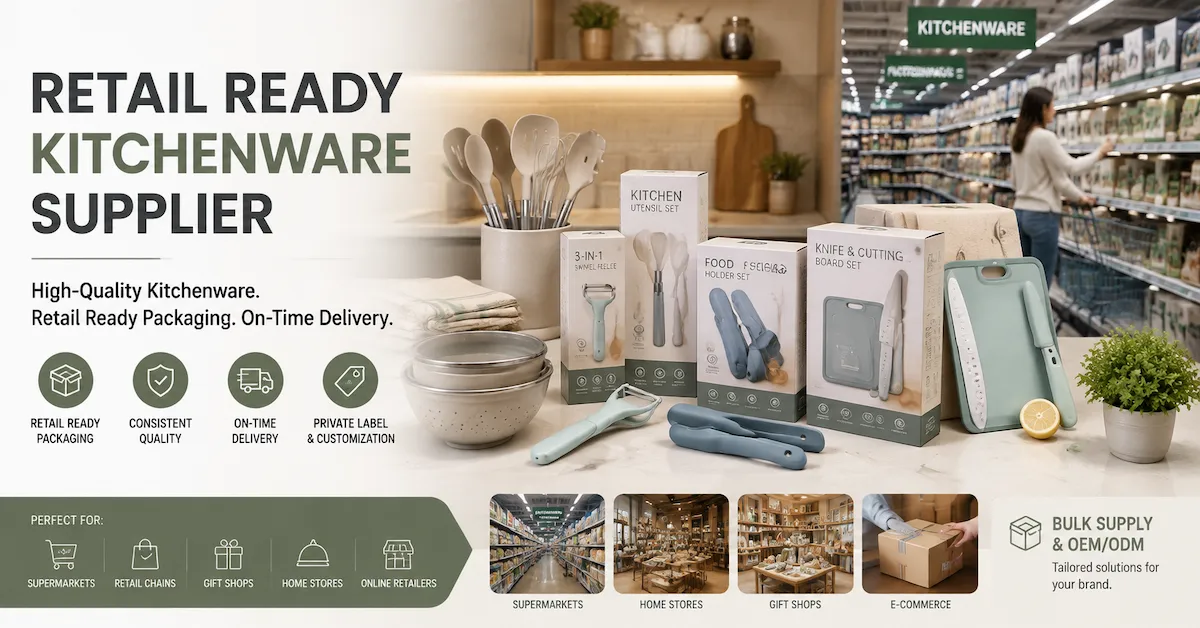
A retail ready kitchenware supplier is not just making spoons, peelers, or cutting boards. The real job is packaging kitchen basics so they can move straight from the warehouse into a supermarket aisle, a home goods chain, or an e-commerce listing without extra rework. That sounds simple until you start looking at the details: shelf appeal, set composition, pack protection, price points, and whether the product can survive handling by distributors who do not want loose parts, damaged edges, or confusing labels.
For sourcing teams, this matters because the decision is rarely about one utensil. It is about whether a supplier can deliver a complete retail presentation that matches the buyer’s channel. A set that works in a gift shop may not work in a high-volume grocery program. A knife-and-board bundle may look good in a photo, but if the packaging is awkward, the store team will hate stocking it. That is where a retail-ready supplier has real value: fewer packaging steps, cleaner merchandising, and a lower risk of ending up with inventory that is technically usable but commercially inconvenient.
What “retail-ready” usually means in practice
In kitchenware, retail-ready usually refers to products that arrive in display-friendly packaging and are suited for direct shelf placement or fast fulfillment. The visible assortment here points to that model clearly: utensil sets, a 3-in-1 swivel peeler, food scissors or a similar hand tool, a knife and cutting board set, cutting board or knife storage/holder sets, mixing bowls, and spoon-spatula bundles. Several items are boxed in printed paperboard packaging, which is a practical choice for retail programs because it supports branding, product identification, and stacking.
There is also a useful mix of materials. The tools appear to combine plastic or silicone-like handles in muted mint, blue, beige, and gray tones with metal working parts such as blades and cutting edges. That mixed-material construction is common in kitchen tools because it balances cost, grip, and function. The matte finish on some parts suggests a more modern retail presentation, which can help on shelf, though buyers should always test whether the finish holds up to scuffing during transit and stocking.
The sourcing decision buyers are really making
When a brand or retailer looks for a kitchenware partner, the conversation usually shifts among three models: standard supply, OEM kitchenware supplier support, and ODM kitchenware manufacturer capability. The differences matter.
A standard supplier is typically useful when you want established items with limited changes. You are buying what already exists, maybe with a logo or packaging update.
An OEM kitchenware supplier is closer to a manufacturing partner. You may provide the design, branding, pack structure, or product requirements, and the factory produces to spec.
An ODM kitchenware manufacturer goes one step further by offering pre-developed product concepts that can be adapted. That can shorten the development path, especially for retailers who want a private-label line without starting from zero.
The right choice depends on your channel, budget, and how much differentiation you need. If you sell into supermarkets or general merchandise chains, speed and consistency often matter more than novelty. If you are building a branded kitchen line, then packaging, product color palette, and set composition become more strategic.
Why these product types work well for retail programs
Kitchenware is a broad category, but the items shown here share one thing: they are easy to understand at a glance. That is not a small advantage. Retail shelves reward products that explain themselves quickly.
A 3-in-1 peeler signals utility immediately. A spoon and spatula bundle suggests value and giftability. A cutting board and knife set addresses a clear use case. Mixing bowls, especially if nested or stackable, support the idea of space-saving organization, which many households now expect. Even a simple food scissor can sell well if the packaging communicates the use case cleanly.
Gift-ready sets deserve special mention. They are often chosen by supermarkets, home stores, and e-commerce sellers because the buyer does not need to assemble the assortment later. The factory packages the set in a way that is ready for display, and that can reduce handling cost. The tradeoff is that the packaging must be done carefully; a good-looking box that protects poorly is not a good retail product.
What to check before you choose a supplier
The biggest mistake in this category is to judge the supplier by photos alone. A neat render or a tidy shelf image tells you almost nothing about production stability.
Start with packaging structure. Ask whether the item is designed for shelf display, hanging display, or carton-only shipment. Then check whether the packaging can survive distribution. Corners, clear windows, hang tabs, and printed inserts all affect how well the product handles in real retail conditions.
Next, look at the manufacturing mix. The visible products suggest a combination of formed plastic parts and stamped metal working components. That means the supplier needs competence in more than one process, plus decent assembly control. When a kitchen tool combines several materials, fit and finish become more important than they are for a single-material item.
You should also ask about customization depth. Can the supplier change colors, packaging graphics, set composition, and logo placement? Can they support private label programs? If the answer is vague, treat that as a warning sign. Retail buyers usually need a little flexibility, but not so much that lead-time planning becomes a guessing game.
Common mistakes buyers make with retail-ready kitchenware
One common mistake is treating the item as a commodity and ignoring the retail side. A spoon is a spoon until it lands on a shelf next to twenty others. Then package clarity, hangability, and perceived quality suddenly matter a great deal.
Another mistake is overbuilding the set. More pieces do not always mean better sell-through. A cluttered multi-piece kit can confuse shoppers and increase packaging cost. For many channels, a tight assortment with obvious use value works better than a crowded bundle.
A third mistake is assuming that all kitchenware channels want the same finish. Supermarkets may prioritize volume and price discipline. Gift shops may prefer more polished presentation. Online sellers may care most about damage resistance and photo appeal. It is worth separating those use cases early, even if the same supplier can serve all three.
And one practical aside: packaging that looks attractive under studio lighting can still be awkward on a warehouse pallet. Buyers should ask for carton dimensions and pack logic, not just a front-facing product shot.
How to evaluate quality without overcomplicating the process
For sourcing teams, a workable evaluation process is usually enough. You do not need to turn every order into a lab project, but you do need a few disciplined checks.
Inspect the handle ergonomics on hand tools such as peelers, scissors, and utensils. If the grip feels too slim, too slick, or oddly balanced, retail customers will notice. Examine cutting edges and metal interfaces for consistency. Look closely at printed packaging for alignment, color accuracy, and readability. If the set includes a cutting board holder or storage component, confirm that the parts fit together without forcing.
For nested or stackable items like bowls, verify that the stacking is stable and that the pieces do not bind. Small geometry problems can create big headaches during packing and opening. Retail buyers care about unboxing almost as much as function, because the first customer experience begins the moment the box is opened.
Questions worth asking an OEM or ODM partner
If you are comparing suppliers, keep the questions practical:
Can they support branded retail packaging?
Can they manage bulk supply for chain stores or e-commerce programs?
What customization options are available for colors, graphics, and set composition?
How do they control consistency across repeated production runs?
Can they handle mixed-material assemblies without visible fit issues?
What does their packaging workflow look like for shelf-ready sets?
Those questions are boring in the best way. They get you closer to the reality of production, which is where retail programs succeed or fail.
Who benefits most from this kind of supplier
This sourcing model fits supermarket shelf programs, retail chains, home stores, gift shops, and online sellers that need branded kitchenware in market-ready packaging. It is especially useful when the buyer wants a line that feels coordinated without commissioning every item separately.
It also fits teams that need to move quickly. If the supplier already works with pre-packaged sets and retail-ready formats, the buyer can spend less time solving box design and more time on assortment planning, pricing, and channel fit. That is often the real pressure point.
A practical buying takeaway
The best retail ready kitchenware supplier is not the one with the flashiest product shot. It is the one that can supply useful kitchen tools in a format the channel can actually sell. Look for clear packaging, sensible set construction, stable manufacturing across different materials, and enough OEM or ODM support to match your brand strategy.
If you are building a private-label line or refreshing a shelf program, start with a short list of questions around packaging, customization, and order consistency. Then request samples that reflect the real retail format, not just loose product pieces. That small discipline usually reveals more than any brochure.
Next step for sourcing teams
If you are evaluating a retail-ready kitchenware program, compare suppliers on three things first: how they package, how they customize, and how well the assortment matches your channel. From there, the rest of the decision becomes much easier. The right partner should make the product simpler to launch, not harder to explain.
