




Review of Left-Handed Children Scissors for Safety
Left-handed children often adapt to tools designed for right-handed users, but scissors are one product where that compromise can lead to frustration. When the blade orientation and handle position do not match a child’s natural cutting motion, paper can bend, lines become harder to follow, and the child may press harder than necessary. This review looks at left-handed children scissors from a practical safety and sourcing perspective, especially for parents, schools, stationery buyers, and distributors comparing options for classroom and craft use.
Key Takeaways
- True left-handed scissors should support a natural left-hand cutting angle, not simply use a universal handle shape.
- For children, safety details such as blunt-tip blades and a protective cover are important selection points.
- Soft, child-sized ergonomic handles can improve control for school and craft tasks.
- Bulk buyers should ask suppliers clear questions about materials, age suitability, packaging, testing, and customization instead of assuming details.
Why Left-Handed Scissors Matter for Children
Children learning to cut are building hand strength, coordination, and confidence. A left-handed child using right-handed scissors may have trouble seeing the cutting line because the upper blade can block the view. The child may also squeeze at an awkward angle, which can make the paper tear or fold rather than cut cleanly. Over time, this can make basic classroom activities feel unnecessarily difficult.
Left-handed children scissors are designed to work with the left hand’s natural motion. The goal is not only comfort, but also better visibility, smoother control, and less strain during repeated cutting. For a child cutting worksheets, craft paper, coloring book shapes, or simple collage pieces, the right orientation can make the activity more manageable.
Safety Features to Check First
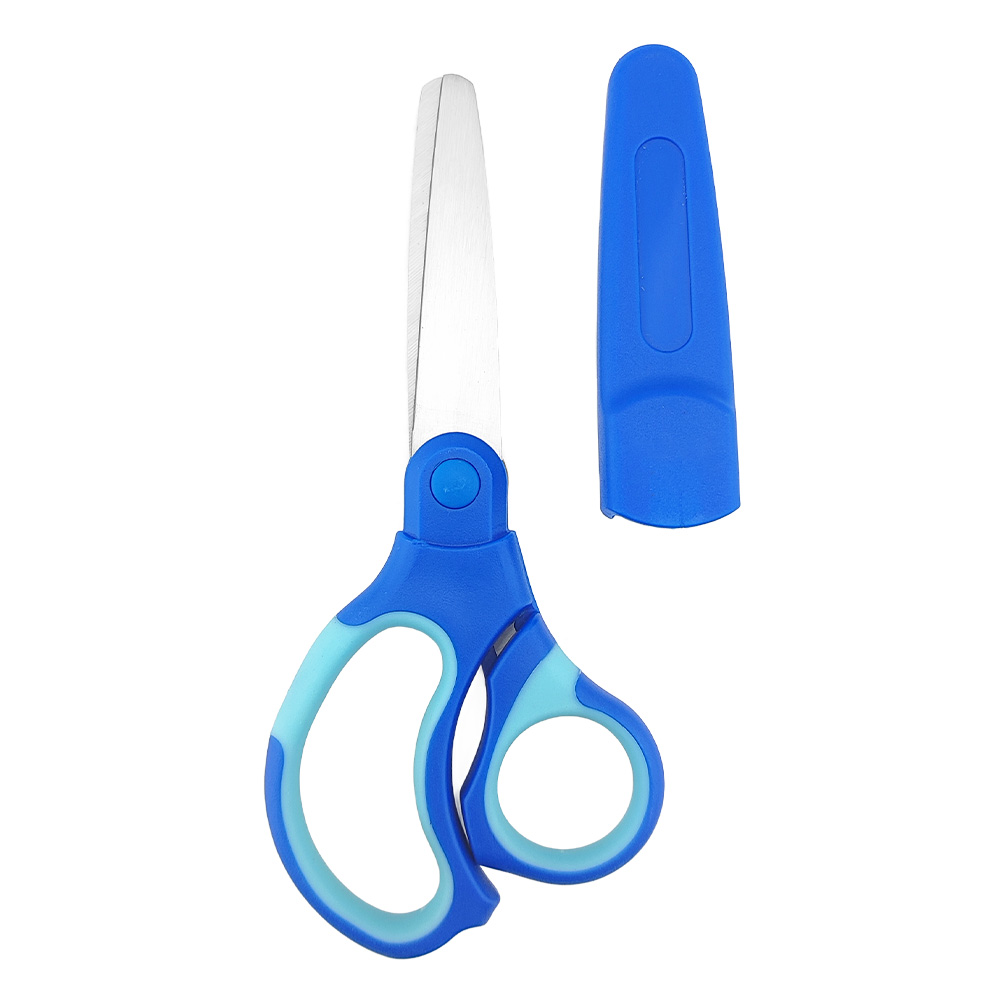
Safety is the first concern for any children’s scissor product. The original product description highlights blunt-tip blades and a safety cover. These are useful features because children may carry scissors between desks, store them in pencil cases, or use them during energetic craft sessions. A cover helps reduce exposure when the scissors are not in use, while blunt tips reduce the risk associated with accidental pokes.
However, buyers should still remember that children’s scissors are cutting tools, not toys. Adult supervision is appropriate for younger users, and schools should set clear rules for carrying, passing, and storing scissors. For bulk purchasing, buyers should ask whether the safety cover is included with every unit, how securely it fits, and whether replacement covers are available if needed.
Comfort, Grip, and Cutting Control
The original article notes soft, vibrant blue ergonomic handles. For children, handle comfort matters because small hands tire quickly. A grip that is too large, too rigid, or poorly shaped can reduce control and increase the chance of slipping. A child-sized ergonomic handle should let the user insert fingers comfortably and apply pressure without twisting the wrist.
When evaluating samples, test the scissors with typical classroom materials rather than only one sheet of paper. Ask children or teachers to try simple straight lines, curves, and basic shapes. Watch whether the child can see the cutting path and whether the paper stays flat. Good left-handed children scissors should feel predictable, not overly stiff or loose.
Comparison and Buyer Checklist
The table below can help schools, distributors, and stationery buyers compare left-handed children scissors before ordering samples or placing a bulk purchase.
| Selection Point | What to Look For | Question to Ask a Supplier |
|---|---|---|
| Left-handed design | Blade orientation and grip support natural left-hand cutting | Is this a true left-handed model or a universal-handle design? |
| Tip safety | Blunt-tip blades suitable for children’s paper craft use | What age range is the product intended for? |
| Safety cover | Cover protects blades during storage and transport | Is the cover included, and how is it packed? |
| Handle comfort | Child-sized ergonomic handle with secure grip | Can you provide samples for hand-feel evaluation? |
| Use case | Paper, worksheets, coloring pages, and light craft materials | What materials has the supplier designed the scissors to cut? |
| Bulk sourcing | Consistent packaging, labeling, and quality checks | What customization, inspection, and documentation options are available? |
Practical Use Guidance for Home and Classroom
For parents and teachers, the best result comes from matching the scissors to the child’s age, hand size, and cutting task. Start with paper strips or simple shapes before moving to detailed curves. Encourage the child to keep the thumb facing upward and to rotate the paper rather than twisting the wrist. This helps develop safer habits and cleaner cuts.
- Store the scissors with the safety cover in place when not in use.
- Use them for paper and light craft projects unless the supplier confirms other suitable materials.
- Check the hinge area regularly for looseness or debris.
- Replace scissors that no longer cut smoothly or have damaged handles or covers.
- Teach children to pass scissors handle-first and walk carefully when carrying them.
B2B Sourcing Notes for OEM and Wholesale Buyers
Because the original article references an OEM scissors factory, bulk buyers should approach the product with a sourcing checklist rather than relying on broad claims. Do not assume blade material, compliance testing, packaging format, minimum order quantity, lead time, or private-label options unless the supplier confirms them in writing. For school and children’s products, documentation and consistency are especially important.
Before placing a large order, request production samples or pre-shipment samples and compare them against your agreed specification. Confirm the exact handle color, safety cover design, blade tip shape, packaging artwork, barcode requirements, carton marks, and any market-specific labeling. If your sales channel requires particular tests or certificates, ask the supplier whether they can provide current documentation from appropriate testing bodies. The buyer should verify whether those documents match the exact product and market.
Overall Review
These left-handed children scissors address a real need: giving left-handed kids a tool that better matches their natural cutting motion. The highlighted features, including blunt-tip blades, a safety cover, and soft ergonomic blue handles, are relevant to school and craft use. The product appears best suited for controlled children’s activities such as worksheets, paper crafts, coloring book cutouts, and simple collages.
The main recommendation is to evaluate the scissors as a complete user experience. Safety is not only the blade tip or cover; it is also how well the child can grip, see the line, cut without forcing, and store the scissors after use. For families, that means choosing a product that fits the child’s hand and skill level. For wholesale buyers, it means confirming specifications, samples, and documentation before committing to volume orders.
FAQ
Are left-handed children scissors different from regular scissors?
Yes. True left-handed scissors are designed so the blade orientation and cutting view work better for left-handed users. This can help children follow lines more easily and cut with less wrist strain.
Do safety cover scissors still need supervision?
Yes. A safety cover helps protect the blades during storage, but children should still use scissors under appropriate adult guidance, especially at younger ages.
What should schools test before buying in bulk?
Schools should test sample scissors for grip comfort, left-handed cutting visibility, smooth cutting on paper, cover fit, packaging durability, and suitability for the intended age group.
Can these scissors be used for materials other than paper?
The original description mentions paper and craft materials. Buyers should ask the supplier to confirm suitable materials before using the scissors on thicker card, fabric, foam, or other craft media.
What should OEM buyers ask a scissors supplier?
Ask about confirmed specifications, available customization, packaging options, sample policy, quality inspection steps, lead time, MOQ, and any testing or compliance documents required for your target market.
