




OEM Kitchen Scissors: Practical Sourcing and Product Selection Guide
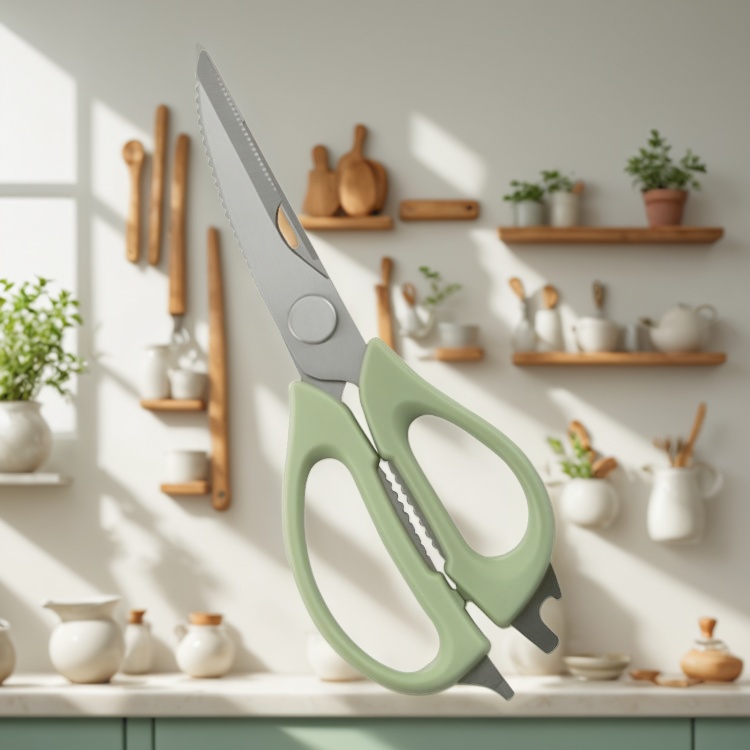
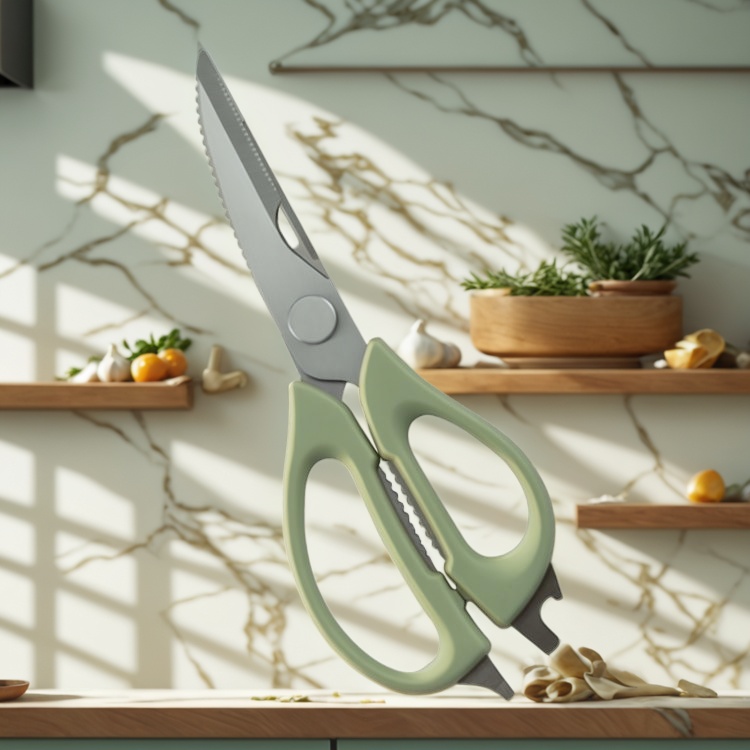
OEM kitchen scissors are a common private-label product for cookware brands, houseware distributors, supermarket programs, promotional channels, and online retail assortments. The original product description highlights a multi-function kitchen scissor design made in the Yangjiang knife and scissors manufacturing hub, with stainless steel blades, a serrated edge, pastel green coated handles, a nutcracker near the hinge, a bottle-cap notch, and a bottle opener revealed by a handle twist. Those details make the product useful for everyday cutting tasks, but buyers still need to evaluate construction, comfort, packaging, and supplier support before placing an order.
Key Takeaways
- OEM kitchen scissors should be evaluated as both a cutting tool and a private-label product.
- Useful features include stainless steel blades, a serrated edge, ergonomic handles, and integrated functions such as a nutcracker or bottle opener.
- Buyers should ask suppliers to confirm material details, surface finish, packaging options, testing process, and quality control steps.
- Samples should be checked for cutting performance, hinge stability, handle comfort, cleaning ease, and consistency across units.
What OEM Kitchen Scissors Are Designed to Do
Kitchen scissors, sometimes called kitchen shears, are designed for food preparation and light household cutting tasks. A practical pair may be used to snip herbs, trim poultry, cut lightweight packaging, portion vegetables, or open small kitchen items. The original article describes stainless steel blades intended for durability and precise cuts, along with a serrated edge that helps grip tougher materials. For product teams, that combination is important because many consumers expect kitchen scissors to handle slippery or fibrous foods more reliably than office scissors.
Multi-function designs can add value when the extra features are useful and well integrated. The built-in nutcracker near the hinge, bottle-cap notch, and twist-revealed bottle opener described in the source can reduce the number of separate small tools in a drawer. However, buyers should avoid selecting features only for appearance. Each added function should be tested for comfort, safety, and long-term usability.
Core Features to Evaluate Before Ordering
Because OEM projects often involve private label branding, packaging, and repeat production, evaluation should go beyond a single attractive sample. Buyers should confirm whether the blade material, handle coating, hinge design, and finishing process match the intended price point and retail channel. If a supplier describes blades as stainless steel, ask for the exact material specification rather than assuming a grade. If the handle is described as non-slip, request the material type and check performance with wet hands.
| Evaluation Area | What to Check | Questions to Ask a Supplier |
|---|---|---|
| Blade performance | Sharpness, edge alignment, serration grip, cutting consistency | What blade material is used, and how is sharpness inspected before shipment? |
| Handle comfort | Grip shape, coating feel, use with left and right hands | Can the handle color and surface texture be customized for an OEM order? |
| Multi-function parts | Nutcracker, bottle opener, cap notch, hinge strength | Are these functions standard in the mold, or can they be modified? |
| Cleaning and care | Food residue traps, hinge access, drying ease | What cleaning instructions should be printed on packaging or inserts? |
| Packaging | Retail display, barcode area, safety protection, brand space | What packaging formats are available, and what artwork files are required? |
Sourcing from a Kitchen Scissors Supplier
For B2B buyers, an OEM kitchen scissors project usually starts with product positioning. A discount retailer may prioritize simple packaging and cost control, while a houseware brand may need stronger visual identity, color matching, and a more detailed user card. An online seller may care about photography, compact shipping, and clear feature communication. Before discussing price, define the target customer, sales channel, expected packaging type, and any required labeling information.
Yangjiang is widely known as a knife and scissors manufacturing hub, and the original article explicitly connects the product with that region. Even so, location alone does not prove quality. Ask the supplier how they control incoming materials, blade forming, sharpening, assembly, handle coating, and final inspection. For private label work, also ask whether branding can be applied to the blade, handle, packaging, or instruction leaflet, and request physical samples before approving bulk production.
Sample Testing Checklist for Buyers
A sample should be tested in realistic conditions instead of judged only by photos. Open and close the scissors repeatedly to feel whether the hinge is smooth but not loose. Cut herbs, thin plastic packaging, paperboard, and a poultry sample if relevant to the intended market. Check whether the serrated section grips without tearing excessively. Try the nutcracker and bottle opener functions to confirm that the hand position feels stable.
- Inspect blade alignment from the tip to the hinge.
- Check for burrs, rough edges, or uncomfortable seams on the handle.
- Use the scissors with dry and slightly wet hands to evaluate grip.
- Wash and dry the sample to see whether food residue remains near the hinge.
- Compare several samples, not just one, to judge consistency.
- Confirm that packaging protects the blade tips during transport and shelf handling.
OEM Branding and Packaging Considerations
Kitchen scissors are often bought on visual trust. Packaging should show the main use cases clearly without overstating performance. If the product includes a bottle opener, nutcracker, serrated edge, and coated ergonomic handles, those points can be listed as practical features. Avoid claims such as professional grade, dishwasher safe, food-grade certified, or heavy-duty unless the supplier provides evidence and the claim matches the actual product.
For private label programs, ask for dielines, print areas, color limitations, barcode placement, and warning text options. If the handle uses a pastel green coating as described in the original article, confirm whether that color is fixed or customizable. Color consistency matters when a retailer builds a coordinated kitchen range. If the supplier offers multiple handle colors, request color samples under normal lighting before approving production artwork.
Use and Care Guidance for End Customers
Clear use-and-care instructions reduce complaints and help customers use the product correctly. Kitchen scissors should be rinsed soon after cutting food, especially when used on poultry, herbs, or sticky packaging. They should be dried thoroughly to reduce water spots and residue around the hinge. If the supplier does not clearly state dishwasher suitability, the safer packaging instruction is to recommend hand washing and immediate drying.
Customers should not use kitchen scissors for bones, frozen foods, wire, or hard non-food materials unless the product is specifically designed and tested for those tasks. Multi-function features should also be used with reasonable force. A nutcracker near the hinge can be convenient, but it should not be presented as a substitute for a heavy-duty cracking tool unless the supplier confirms the intended use.
Common Mistakes When Buying OEM Kitchen Scissors
One common mistake is selecting the lowest sample price without checking repeat-order consistency. Another is focusing on added functions while ignoring basic cutting quality. A third is approving packaging copy that makes unsupported claims. For wholesale and OEM orders, the best results usually come from a clear specification sheet, approved pre-production sample, packaging proof, and agreed inspection criteria.
Buyers should also confirm commercial details directly instead of assuming them. Minimum order quantity, lead time, logo options, carton packing, export documents, and payment terms can vary by supplier and project. Treat these as supplier questions, not fixed product facts.
FAQ
What makes OEM kitchen scissors different from standard retail scissors?
OEM kitchen scissors can be customized for a buyer's brand, packaging, color preference, and retail positioning. The base design may be similar, but the commercial project includes private-label and sourcing requirements.
Which features are most important for kitchen scissors?
Blade sharpness, alignment, comfortable handles, hinge stability, cleaning ease, and safe packaging are more important than adding many extra functions.
Can the handle color or branding be customized?
It may be possible, but buyers should ask the supplier about available molds, color matching, logo methods, artwork requirements, and any order conditions.
Should buyers request samples before ordering?
Yes. Samples help confirm cutting performance, handle comfort, finish quality, packaging fit, and whether the product matches the intended retail market.
What supplier information should be confirmed?
Ask about blade material, handle material, quality checks, packaging options, lead time, MOQ, labeling requirements, and any test reports or documentation available for the target market.
