




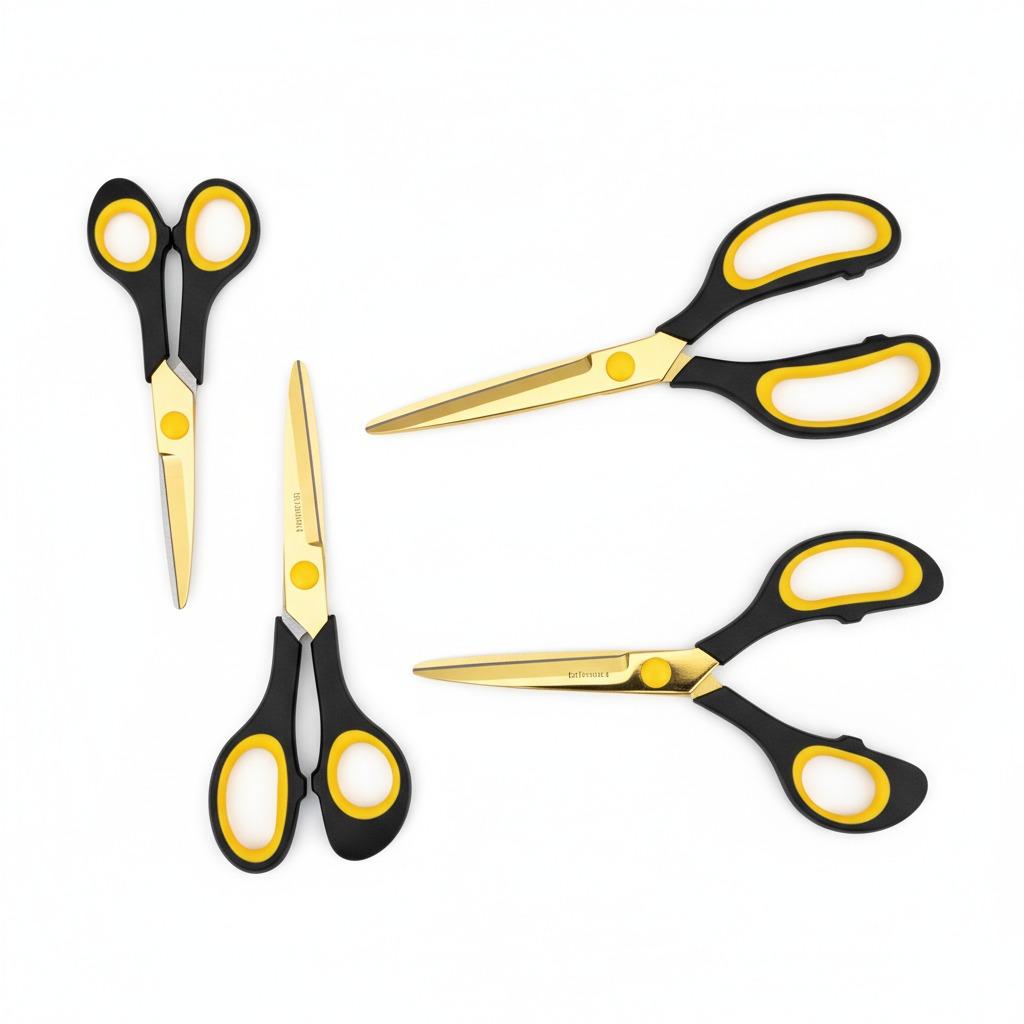
Right-Handed vs. Left-Handed Scissors: More Than Just a Mirror Image
Scissors look simple, but the difference between right-handed and left-handed models is not cosmetic. For daily cutting tasks at home, in a kitchen drawer, school kit, craft room, or office, the way the blades overlap affects comfort, control, and the neatness of the cut. If a left-handed person uses a standard right-handed pair, the blades may spread apart instead of pressing together, which can cause paper to fold, fabric to snag, or the hand to tire quickly.

This guide explains what actually changes between right- and left-handed scissors, how to identify the type you have, and what to consider when choosing household scissors for different users and tasks.
Key Takeaways
- True left-handed scissors reverse the blade orientation, not just the handle shape.
- Blade overlap matters because hand pressure pushes the cutting edges together or apart.
- Ambidextrous handles do not always mean ambidextrous cutting performance.
- Choose scissors by user hand, task, comfort, blade length, and ease of cleaning.
- For shared homes, schools, or workplaces, keeping both right- and left-handed options can reduce frustration.
Why Handedness Matters in Scissors
When you squeeze scissors, your thumb and fingers create sideways pressure. In right-handed scissors, that pressure is expected to come from the right hand, helping the blades press against each other as they close. This contact is what creates a clean shearing action.
Left-handed scissors are built so the same effect happens in the left hand. The top blade and bottom blade are reversed, so a left-handed grip keeps the cutting edges together instead of pushing them apart. This is why simply turning right-handed scissors over does not create a true left-handed tool. It may change the handle position, but it does not correct the blade overlap or line of sight.
Right-Handed vs. Left-Handed Scissors Comparison
| Feature | Right-Handed Scissors | Left-Handed Scissors | What to Check Before Buying |
|---|---|---|---|
| Blade orientation | Designed for right-hand pressure | Reversed for left-hand pressure | Hold the scissors point-forward and check which blade is on top |
| Cut visibility | Cutting line is easier to see with the right hand | Cutting line is easier to see with the left hand | Test with paper if possible |
| Handle shape | May be shaped for right thumb and fingers | May be shaped for left thumb and fingers | Look for pressure points around the thumb hole |
| Ambidextrous use | Some handles fit both hands, but blades may still be right-oriented | True left-handed models usually have reversed blades | Do not rely on handle symmetry alone |
| Best everyday users | Right-handed adults and children | Left-handed adults and children | Match the tool to the person who uses it most |
How to Identify the Scissors You Already Own
You can usually identify handedness without special tools. Hold the scissors closed with the tips pointing away from you and the handle closest to your body. Look at the blade that sits on top near the pivot. On many right-handed scissors, the upper blade is positioned so a right-handed user can see the cutting line clearly. On true left-handed scissors, the blade arrangement is reversed.
Next, cut a straight line through ordinary paper using your dominant hand. If you have to twist your wrist inward to see the line, or if the blades push the paper instead of slicing it, the scissors may not match your hand. Children often compensate by squeezing harder, which can make craft work tiring and inaccurate.
Choosing Household Scissors for Daily Tasks
For consumer use, the best choice depends on who will use the scissors and what they will cut. A general-purpose pair for mail, packaging, paper, labels, and light craft materials does not need to be complicated, but it should feel stable and predictable.
- For shared drawers: consider keeping one right-handed pair and one left-handed pair, clearly marked.
- For children: prioritize comfortable handles, appropriate blade length, and adult supervision.
- For kitchen use: choose scissors intended for food-related tasks and ask how they should be cleaned and dried.
- For crafts: match blade length to the material; shorter blades can help with curves, while longer blades suit straight cuts.
- For frequent cutting: check handle comfort and pivot smoothness before focusing on appearance.
If a product is described as ambidextrous, read carefully. Some scissors have symmetrical handles but still use a right-handed blade arrangement. That may be acceptable for occasional use, but it is not the same as a true left-handed cutting tool.
Comfort, Safety, and Use-and-Care Tips
Good scissors should close smoothly without wobbling at the pivot. If the pivot is too loose, the blades may separate and crush the material. If it is too tight, the hand works harder than necessary. For household use, comfort is also a safety issue: a user who struggles with the tool may apply too much force or cut at an awkward angle.
- Use the right scissors for the material; avoid cutting wire, hard plastic, or thick packaging unless the tool is designed for it.
- Wipe blades after use, especially after cutting tape, food packaging, or sticky labels.
- Dry scissors before storage to reduce the chance of staining or stiffness.
- Store sharp scissors away from young children and avoid leaving them open in drawers.
- Replace or service scissors when blades become loose, chipped, or difficult to close.
When Left-Handed Scissors Make the Biggest Difference
A left-handed user may manage occasional cuts with right-handed scissors, especially for simple paper tasks. The difference becomes more noticeable when cutting long lines, fabric, thin plastic, wrapping paper, or repeated shapes. The user must often push the blades together manually while also steering the cut, which increases fatigue.
Left-handed scissors are especially helpful for children learning fine motor skills. If the tool fights the user, the child may assume cutting is difficult rather than recognizing the tool is mismatched. Adults who craft, sew, prepare food, or open packaging frequently can also benefit from a dedicated left-handed pair.
Practical FAQ
Are left-handed scissors just right-handed scissors with different handles?
No. True left-handed scissors reverse the blade orientation so left-hand pressure pushes the blades together during cutting. Handle shape alone does not make scissors left-handed.
Can a right-handed person use left-handed scissors?
For a quick cut, possibly. For accurate or repeated cutting, it may feel awkward because the blade overlap and cutting visibility are designed for the opposite hand.
Are ambidextrous scissors good for everyone?
They can be useful for shared occasional use, but check whether only the handles are symmetrical. If the blades are still right-oriented, left-handed users may not get the same clean cutting action.
How many pairs should a household keep?
Many homes do well with a general-purpose pair, a kitchen pair if needed, and a left-handed pair if any regular user is left-handed. The right mix depends on your daily tasks.
What should I ask before buying scissors online?
Ask or check whether the scissors are right-handed, true left-handed, or only ambidextrous-handled. Also review blade length, intended use, cleaning instructions, and whether the handle size suits the user.
Final Thoughts
Right-handed and left-handed scissors differ in the mechanics that make cutting work: blade overlap, pressure direction, and visibility. For everyday household scissors, choosing the correct handedness can make a simple tool easier, safer, and more comfortable to use. Before buying another pair, check who will use it most, what they will cut, and whether the blade orientation truly matches their hand.
