




Scissors Factory Guide: How to Source Multifunctional Kitchen Shears
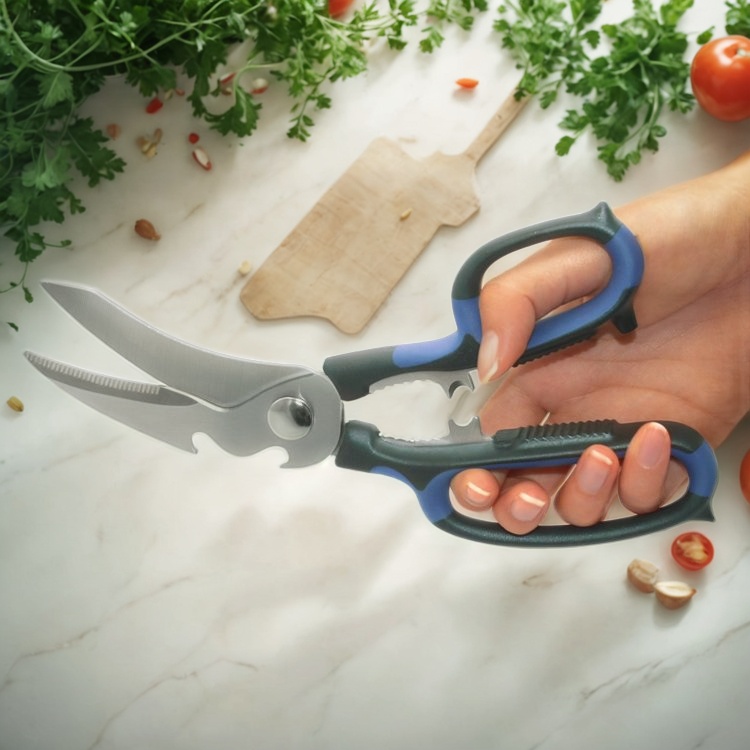
Kitchen shears are a practical category for retailers, importers, distributors, and private-label buyers because they serve everyday food-preparation tasks while offering room for differentiation in handle design, added functions, packaging, and branding. The original Bonet Houseware product article introduced multifunctional kitchen scissors with stainless steel construction, ergonomic black and blue rubber-surfaced handles, a jagged-edge secondary blade, a bottle opener, and a nutcracker. This rewritten guide turns those product points into a sourcing-focused checklist for buyers evaluating a scissors factory or OEM kitchen scissors supplier.
Key Takeaways
- Multifunctional kitchen shears should be assessed as both a cutting tool and a convenience tool.
- Ask suppliers to confirm material grade, blade hardness, coating details, packaging options, and test methods rather than assuming specifications.
- Ergonomic handles, secure grip, blade alignment, and easy cleaning are important for repeat consumer satisfaction.
- For OEM projects, clarify logo placement, color matching, sample approval, carton markings, and quality inspection criteria before production.
What Makes Multifunctional Kitchen Shears Useful?
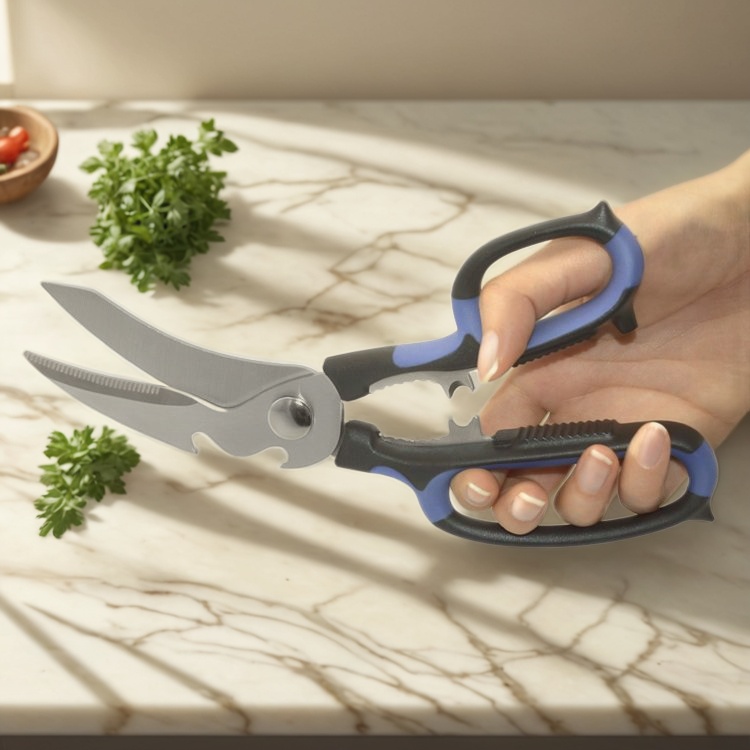
Unlike office scissors, kitchen shears are expected to cut a variety of food items and packaging materials. A multifunctional design can reduce the number of small tools stored in a kitchen drawer, but extra functions should not compromise the core cutting performance. The product described in the original article includes several everyday utility features: stainless steel blades, ergonomic handles with black and blue rubber surfaces, a jagged-edge secondary blade for added traction on tasks such as scraping fish scales, plus integrated bottle opener and nutcracker functions.
For B2B sourcing, the key question is not only whether these features exist, but whether they are practical, consistent, and clearly presented to the end customer. A buyer should request samples and test them on intended use cases: cutting herbs, trimming packaging, handling poultry preparation where appropriate, opening bottles, and cracking nuts. Any multifunction feature that feels awkward or weak during testing may create returns even if it looks attractive in a product listing.
Core Product Features to Review Before Ordering
When evaluating kitchen shears from a scissors factory, start with the basics. Blade sharpness, alignment, handle comfort, and hinge stability have a direct effect on user experience. Stainless steel is mentioned in the source article, but buyers should ask the supplier to specify the exact steel grade, finishing process, and care instructions. If the product is marketed for kitchen use, the packaging and instructions should explain safe cleaning and storage practices.
The ergonomic handle is another important detail. Rubber-surfaced black and blue handles may offer a more secure grip than hard plastic alone, but buyers should assess comfort across different hand sizes. A good sample review should include opening and closing the scissors repeatedly, checking whether the handle edges create pressure points, and confirming that the grip surface remains stable when slightly wet.
Comparison Checklist for OEM Kitchen Scissors
The table below can be used when comparing samples from a scissors factory or kitchen scissors supplier. It focuses on verifiable questions rather than assumptions.
| Evaluation Point | What to Check | Questions to Ask the Supplier |
|---|---|---|
| Blade material | Stainless steel construction is stated; confirm the exact grade and finish. | What steel grade is used, and can it be documented on the product specification sheet? |
| Cutting performance | Clean cutting, blade alignment, and smooth opening/closing. | What in-process and final inspections are used to check sharpness and alignment? |
| Handle design | Ergonomic shape and black/blue rubber-surfaced grip. | Can handle colors, materials, or logo placement be customized for OEM orders? |
| Multifunction parts | Jagged-edge secondary blade, bottle opener, and nutcracker function. | Are these functions included in the standard model, and are there usage instructions? |
| Packaging | Retail display, barcode, warning text, and care information. | What packaging formats are available, and can artwork be supplied by the buyer? |
| Quality criteria | Appearance, burrs, hinge strength, grip bonding, and carton condition. | Can the supplier agree on an inspection checklist before mass production? |
OEM and Private-Label Sourcing Questions
For buyers sourcing OEM kitchen scissors, early communication prevents misunderstandings. Product images alone are not enough. Ask for a complete specification sheet that identifies dimensions, materials, weight, finish, packaging type, and available customization options. If private labeling is required, clarify whether the logo will appear on the blade, handle, packaging, or instruction insert. Also confirm whether branding methods affect cost, lead time, or sample approval.
Commercial terms should be discussed directly with the supplier. Do not assume MOQ, price, production lead time, or export documentation from a blog post. Instead, ask: What is the minimum order quantity for standard color and custom color? How many pre-production samples are included? What is the process for approving packaging artwork? Which inspection standard will be used before shipment? Can replacement parts, spare packaging, or updated labels be supported for repeat orders?
Quality Inspection Points for a Scissors Factory Order
A consistent kitchen shears order depends on a practical inspection plan. Buyers should define acceptable and unacceptable defects before production starts. For example, cosmetic scratches, uneven handle color, loose hinges, visible burrs, poor blade contact, or packaging damage may need clear tolerance levels. If the shears include a nutcracker and bottle opener, those areas should be inspected for shape consistency and usability.
- Review golden samples and keep one approved sample with the buyer and one with the factory.
- Check blade opening, closing, alignment, sharpness, and overall balance.
- Inspect handle grip surface for secure bonding, clean edges, and color consistency.
- Confirm that multifunction areas match the approved design and are free from rough edges.
- Verify packaging artwork, barcode placement, carton markings, and inner packing quantity.
- Document inspection results with photos before shipment approval.
Packaging and Consumer Information
Packaging should do more than display the product. It should help the end user understand how to use and care for the shears. For multifunctional kitchen scissors, packaging can highlight the cutting function, fish-scale scraping assistance from the jagged edge, bottle opener, and nutcracker. However, claims should be accurate and supported by the product design. Avoid overpromising performance on materials or foods that the shears have not been tested for.
Care instructions are also important. Even when stainless steel is used, kitchen tools should be cleaned and dried properly after use. If the supplier recommends hand washing, dishwasher use, or specific drying guidance, those instructions should appear consistently across the product page, package, and insert. Buyers should ask the supplier to confirm the recommended care language.
How to Position Multifunctional Kitchen Shears in a Product Line
Multifunctional kitchen shears can fit several channels: houseware retail, supermarket kitchen aisles, online marketplace bundles, promotional gift sets, and private-label cooking tool ranges. Positioning should be based on verified features. A product with rubber-surfaced ergonomic handles may be suitable for buyers looking for comfort-oriented kitchen tools. A model with a bottle opener and nutcracker can be marketed as a space-saving kitchen accessory, provided the packaging explains the functions clearly.
For wholesale buyers, it is useful to compare this item with simpler kitchen scissors. A basic pair may compete mainly on price, while multifunctional shears compete on utility and presentation. The best choice depends on the buyer's customer base, target price point, packaging budget, and return expectations.
FAQ: Sourcing Multifunctional Kitchen Shears
What should I ask a scissors factory before placing an OEM order?
Ask for the exact material specification, available handle colors, logo options, packaging formats, sample timeline, MOQ, lead time, inspection process, and shipment documentation. Keep all agreed details in a written specification sheet.
Can the handle color and packaging be customized?
Customization may be possible, but it depends on the supplier's tooling, material availability, order quantity, and artwork requirements. Confirm these points before approving samples.
How can buyers check kitchen shears quality from samples?
Test cutting performance, hinge smoothness, handle comfort, grip security, visible burrs, and multifunction use. Compare multiple samples to see whether quality is consistent.
Should kitchen shears be marketed as stainless steel?
The original product description states stainless steel, but buyers should still ask the supplier to confirm the exact grade and include it in the official product specification if it will be used in sales materials.
What information should appear on retail packaging?
Useful packaging usually includes core functions, safe-use guidance, care instructions, barcode, country-of-origin information where required, and brand or private-label details approved by the buyer.
