




Stainless Steel Tableware Supplier Guide for Kitchen Buyers
Choosing a stainless steel tableware supplier is less about finding the lowest quote and more about building a kitchenware line that can be repeated reliably. Buyers sourcing for retail, wholesale, foodservice, private label, or catalog programs need products that look consistent, handle daily use, pack efficiently, and match the expectations of their sales channel.
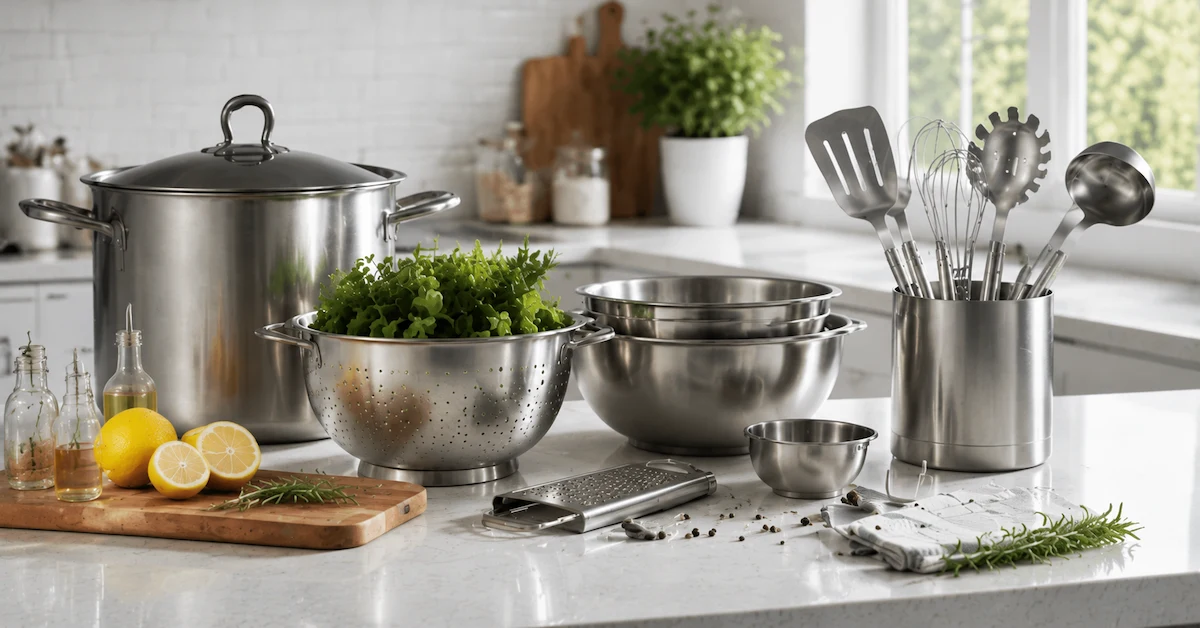
The assortment shown here includes a large stock pot with lid, nested mixing bowls, a colander, a small bowl, a utensil holder with cooking tools, and a grater. It is a practical stainless-steel kitchen houseware mix covering boiling, draining, preparation, serving, and organization. The sourcing challenge is to confirm whether every piece meets the same standard, not just whether the hero item photographs well.
Key Takeaways
- Review stainless steel tableware as a complete assortment, not as isolated items.
- Check finish, rim smoothness, nesting, lid fit, handle construction, and packing before focusing on price.
- Ask suppliers direct questions about material, production process, customization limits, documentation, and inspection procedures.
- Do not assume all stainless steel products are equal; details such as forming, polishing, and packaging affect buyer satisfaction.
Why Stainless Steel Remains a Strong Kitchenware Category
Stainless steel remains popular because it is familiar, rigid, and visually associated with cleanliness. For buyers, it also offers practical merchandising benefits. Bowls can nest, pots can stack, and multiple accessories can often be packed into compact cartons. This helps reduce storage pressure and makes assortment planning easier.
However, stainless steel is not automatically high quality. Two products may look similar in a catalog but differ greatly in edge finishing, balance, polish consistency, and forming accuracy. A supplier that understands houseware production should be able to discuss these trade-offs clearly. If a supplier only speaks in general claims, buyers should slow down and request more specific information.
Understanding the Product Mix
A kitchenware assortment like this should be evaluated by function. The stock pot with lid is the main cookware item. Visible features include side loop handles and a lid with a knob, both of which affect handling and user perception. Buyers should ask about capacity, intended use, lid fit, handle attachment, and whether the pot is positioned for household or heavier-use environments.
Nested mixing bowls are often strong volume items because they serve multiple purposes: food preparation, mixing, serving, and storage. Their value depends on smooth rims, stable bases, consistent sizing, and clean nesting. A bowl set that rattles excessively in transit may arrive with cosmetic marks even if the metal itself is sound.
The colander or strainer should be checked for hole consistency, rim strength, and stability. A poor perforation pattern can make the item feel cheap and may affect draining performance. The utensil holder, cooking tools, and grater are smaller pieces, but they still influence the customer’s impression of the whole program. Rough edges, weak handles, or uneven finishing on accessories can reduce confidence in the complete line.
Supplier Evaluation Checklist
Use a structured comparison when shortlisting a stainless steel dining ware manufacturer or trading partner. Photos are useful, but samples and written answers are more reliable.
| Checkpoint | What to Review | Questions to Ask the Supplier |
|---|---|---|
| Material details | Grade, thickness, and intended food-contact use | What stainless steel grade is used, and what documentation is available for the target market? |
| Finish quality | Polish or brushed surface, consistency across items | How is surface finishing controlled during production? |
| Edges and rims | Smoothness, rolled rims, burr removal | What deburring and edge inspection steps are used? |
| Fit and assembly | Lid fit, handle attachment, utensil strength | How are handles fixed, and what checks are made before packing? |
| Nesting and packing | Storage efficiency, scratch prevention, carton layout | Are separators or protective packing used to reduce transit marks? |
| Customization | Logo, packaging, bundling, finish changes | Which OEM or private-label options are practical for this product type? |
How Stainless-Steel Kitchenware Is Commonly Made
Many stainless-steel bowls and pots are produced through forming methods such as deep drawing or spinning. Colanders typically involve perforation and forming, while utensils and graters may be stamped and shaped before finishing. The exact process depends on the supplier and item design, so buyers should not assume construction details without confirmation.
These processes affect risk. Drawn items can have clean shapes but may show uneven rims if trimming is poorly controlled. Stamped parts can be efficient to produce but require careful deburring. Perforated products need consistent hole patterns and smooth surfaces around openings. Final polishing is also important because stainless steel shows scratches, dents, and surface inconsistency clearly under retail lighting.
Quality Checks Before Placing an Order
Before confirming a stainless steel cookware wholesale order, buyers should inspect samples under realistic conditions. Handle the pot as if it were full. Place the lid on and off several times. Stack and unstack the bowls. Run a cloth carefully around rims and utensil edges to identify burrs. Check whether the colander sits evenly. Look at the grater with special attention to edge safety and finishing.
- Confirm the exact items included in the quotation.
- Request product specifications rather than relying only on photos.
- Compare multiple samples from the same supplier when possible.
- Ask for packing details, including carton structure and scratch protection.
- Clarify inspection process, acceptable cosmetic tolerance, and replacement handling.
If your sales channel requires specific food-contact documentation or labeling, ask for it early. The original product information does not state material grade, certification status, or testing results, so these should be treated as supplier questions rather than assumptions.
Common Sourcing Mistakes to Avoid
A frequent mistake is treating stainless steel tableware as a commodity. In practice, the difference between a dependable product and a problem shipment often comes from small details: a sharp rim, a loose lid, an uneven polish line, or a carton that allows nested items to rub during transport.
Another mistake is approving a whole assortment because one item looks strong. A solid stock pot does not compensate for weak utensils, and an attractive bowl set does not fix a poorly finished grater. Buyers should evaluate the full assortment as customers will receive it.
Packaging is also easy to underestimate. Stainless steel feels durable, but polished surfaces can scratch and dent. If products are nested tightly without protection, they may arrive marked before they ever reach a shelf or end user. Ask suppliers how they balance efficient packing with surface protection.
What a Reliable Supplier Relationship Looks Like
A good stainless steel tableware supplier should respond with practical, specific answers. They should be able to explain production options, finish differences, packing methods, and customization boundaries. They should also be willing to identify cost trade-offs instead of simply agreeing to every request.
For OEM or private-label sourcing, clarify what can be customized: logo placement, packaging artwork, product bundling, finish selection, or assortment changes. Do not assume every variation is efficient or available. Ask about sample lead time, production approval process, quality inspection steps, and how changes are documented before bulk production.
Practical FAQ
Is stainless steel suitable for kitchen tableware and tools?
Yes, it is widely used for pots, bowls, colanders, utensils, and prep accessories. Suitability depends on item design, material details, finishing, and the intended sales channel.
What should buyers ask a supplier first?
Start with product specifications, sample availability, packing method, item list, material information, and any documentation required for your market.
Should the full assortment be sourced from one supplier?
It can simplify coordination and packaging, but every item still needs individual review. One weak accessory can affect the perceived value of the complete set.
How can buyers reduce quality complaints?
Inspect samples carefully, define acceptable finish standards, check edge safety, confirm nesting and packing, and document approved samples before bulk production.
Can stainless steel kitchenware be customized for private label?
Often it can, but available options vary by supplier. Buyers should ask which logo, packaging, finish, and bundling changes are practical before quoting a program.
Final Buyer Guidance
When comparing suppliers, start with function and consistency before price. Check how each item feels in hand, how the set nests, how surfaces are protected, and how clearly the supplier answers technical and commercial questions. A well-managed stainless steel tableware program should be easy to understand, repeatable in production, and appropriate for the market where it will be sold.
