





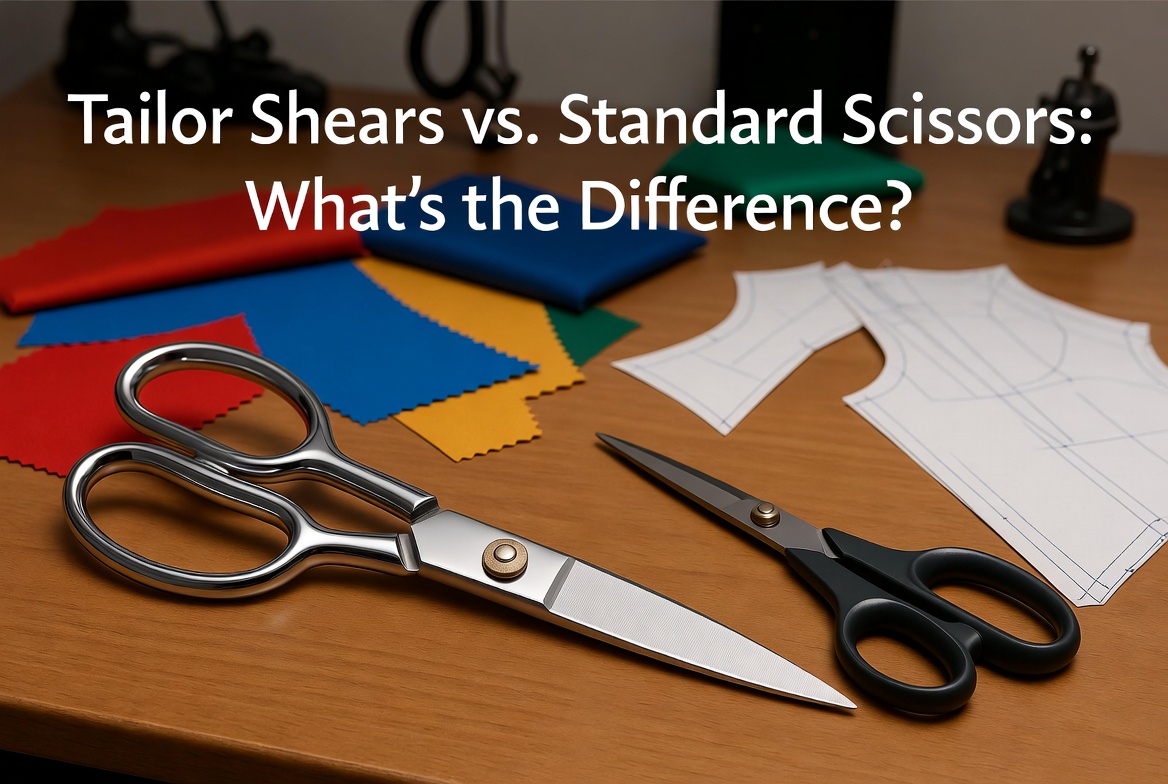
Tailor Shears vs. Standard Scissors: What’s the Difference?
If you sew, alter garments, cut patterns, or work with fabric in any regular way, the difference between tailor shears and standard scissors becomes obvious very quickly. A household pair may cut paper cleanly, yet drag, chew, or lift fabric when used on cotton, denim, lining, or layered materials. Tailor shears are designed for a different job: controlled fabric cutting on a flat surface.
This guide explains the practical differences, when each tool makes sense, and what to check before buying a pair for home sewing, school use, a tailoring studio, or a wholesale product range.
What Are Tailor Shears?
Tailor shears, also called tailoring scissors or dressmaker shears, are cutting tools made specifically for fabric work. Their most recognizable feature is the offset or bent handle. This handle shape lets the lower blade stay close to the table while your hand remains above the cutting surface. The result is less fabric lifting and a smoother cut along long pattern lines.
Tailor shears are commonly used by dressmakers, sample rooms, upholstery workers, sewing students, and crafters who need more control than everyday scissors can provide. Depending on the model, they may be longer, heavier, and more stable than general-purpose scissors. However, buyers should confirm the exact blade length, edge type, handle material, and intended fabric range with the supplier rather than assuming all tailor shears are built the same.
What Are Standard Scissors?
Standard scissors are general-purpose cutting tools used for paper, light packaging, thread, tape, ribbon, labels, and simple household tasks. They usually have a more symmetrical handle layout and a shorter cutting length. This makes them convenient for quick work but less effective for cutting long, clean lines through fabric.
The main issue is not that standard scissors cannot cut fabric at all. Many can cut a small piece of thin cloth. The problem is consistency. As fabric moves, lifts, or frays, the cut line becomes less accurate. For sewing, even a small cutting error can affect seam allowance, garment fit, or pattern matching.
Tailor Shears vs. Standard Scissors: Comparison Table
The best choice depends on the material and the task. Use this checklist-style comparison to decide which tool belongs on your worktable.
| Selection Point | Tailor Shears | Standard Scissors |
|---|---|---|
| Primary use | Cutting fabric, patterns, garment pieces, and multiple sewing tasks | Paper, packaging, labels, light crafts, and everyday cutting |
| Handle shape | Often offset or bent to keep fabric flat while cutting | Usually symmetrical or only slightly angled |
| Cutting control | Better for long, straight, and curved fabric cuts | Better for short, casual cuts where precision is less important |
| Fabric movement | Helps reduce lifting when used on a table | May lift or shift fabric, especially on longer cuts |
| Best users | Sewers, tailors, costume makers, sample rooms, textile classrooms | Office, kitchen drawer, school projects, general home use |
| Buying questions | Ask about blade length, edge finish, handle comfort, sharpening, packaging, and OEM options if sourcing in bulk | Ask about general durability, grip comfort, and intended materials |
When Should You Use Tailor Shears?
Choose tailor shears when the cut line affects the final result. In sewing, cutting is not a minor step; it sets the shape of every seam, hem, facing, and panel. A clean cut also makes fabric easier to pin, sew, and finish.
- Use tailor shears for garment pieces, quilting fabric, lining, felt, interfacing, and sewing patterns.
- Use them when cutting long straight lines, smooth curves, or repeated production shapes.
- Use them when fabric needs to remain flat on the table from the first cut to the last.
- Use them only for fabric if you want to preserve the blade edge for sewing work.
A common practice is to label one pair “fabric only.” Cutting paper with fabric shears can dull the edge faster, making the tool less pleasant to use on cloth. If you also cut paper patterns, keep a separate pair of standard scissors nearby.
When Are Standard Scissors the Better Choice?
Standard scissors still have a place in a sewing kit. They are useful for tasks where fabric accuracy is not the priority or where you do not want to risk damaging your main fabric shears.
Use standard scissors for opening mail, trimming paper templates, cutting tape, removing tags, or handling quick utility tasks around the workspace. In a studio, having both tools available prevents people from grabbing the fabric shears for cardboard, plastic strapping, or adhesive materials.
How to Choose Tailor Shears for Sewing or Sourcing
For individual buyers, comfort and cutting feel matter most. If possible, choose a size that matches your hand and the scale of your projects. Longer blades can make efficient cuts on broad fabric panels, while shorter shears may feel easier to control for small pieces.
For B2B buyers, wholesalers, or brands comparing supplier options, avoid relying only on product photos. Ask clear sourcing questions before placing an order:
- What blade lengths and handle styles are available?
- What materials are used for the blades and handles?
- Is the edge smooth, serrated, or available in more than one finish?
- Can the supplier provide samples for cutting tests on your target fabrics?
- What packaging options are available for retail, e-commerce, or bulk distribution?
- What are the available customization options for logo, color, labeling, or set configuration?
- What quality checks are performed before shipment?
These questions help buyers compare products on practical performance rather than vague claims. They also reduce the risk of ordering scissors that look suitable online but do not match the fabrics or user expectations in real use.
Care Tips to Keep Fabric Shears Cutting Cleanly
Good care extends the useful life of any cutting tool. Store tailor shears dry, avoid dropping them, and keep them away from adhesives, wire, cardboard, and thick plastic unless the tool is specifically intended for those materials. Wipe the blades after use, especially when cutting lint-heavy fabrics.
If the shears begin to push fabric instead of slicing it, the edge may need professional sharpening or adjustment. Do not keep forcing a dull pair through fabric; it can strain your hand and damage the material. Also check the pivot screw if the blades feel loose or misaligned, but only adjust it carefully and according to the product design.
Key Takeaways
- Tailor shears are designed for fabric cutting, while standard scissors are better for everyday light tasks.
- An offset handle helps fabric stay flat, improving accuracy on long cuts.
- Keep fabric shears separate from paper and packaging scissors to protect the edge.
- B2B buyers should request samples, material details, packaging options, and quality-check information before sourcing in bulk.
FAQ
Can I use standard scissors for sewing?
You can use them for small, non-critical cuts, but they are not ideal for accurate garment or pattern cutting. Tailor shears provide better control on fabric.
Why should fabric shears not be used on paper?
Paper can dull the fine cutting edge faster than fabric. Once the edge is dull, the shears may snag, push, or fray cloth instead of cutting smoothly.
What size tailor shears should I choose?
Choose based on hand comfort, cutting surface, and project type. Longer blades suit larger fabric panels, while shorter shears may be easier for detailed work.
What should wholesale buyers ask a scissors supplier?
Ask about blade and handle materials, available sizes, sample testing, packaging, customization, lead time, quality checks, and after-sales support. Confirm details in writing before ordering.
