




Tailoring Tools Manufacturer: How to Source Cutting Scissors for Fabric Work
For apparel factories, sewing tool distributors, craft retailers, and private-label buyers, tailor scissors are not a casual purchase. A pair of scissors that looks attractive but fails to cut cleanly can create fabric waste, slow production, and increase returns. When evaluating a tailoring tools manufacturer, buyers should look beyond the product photo and ask practical questions about materials, sizes, finishing, packaging, quality control, and order support.
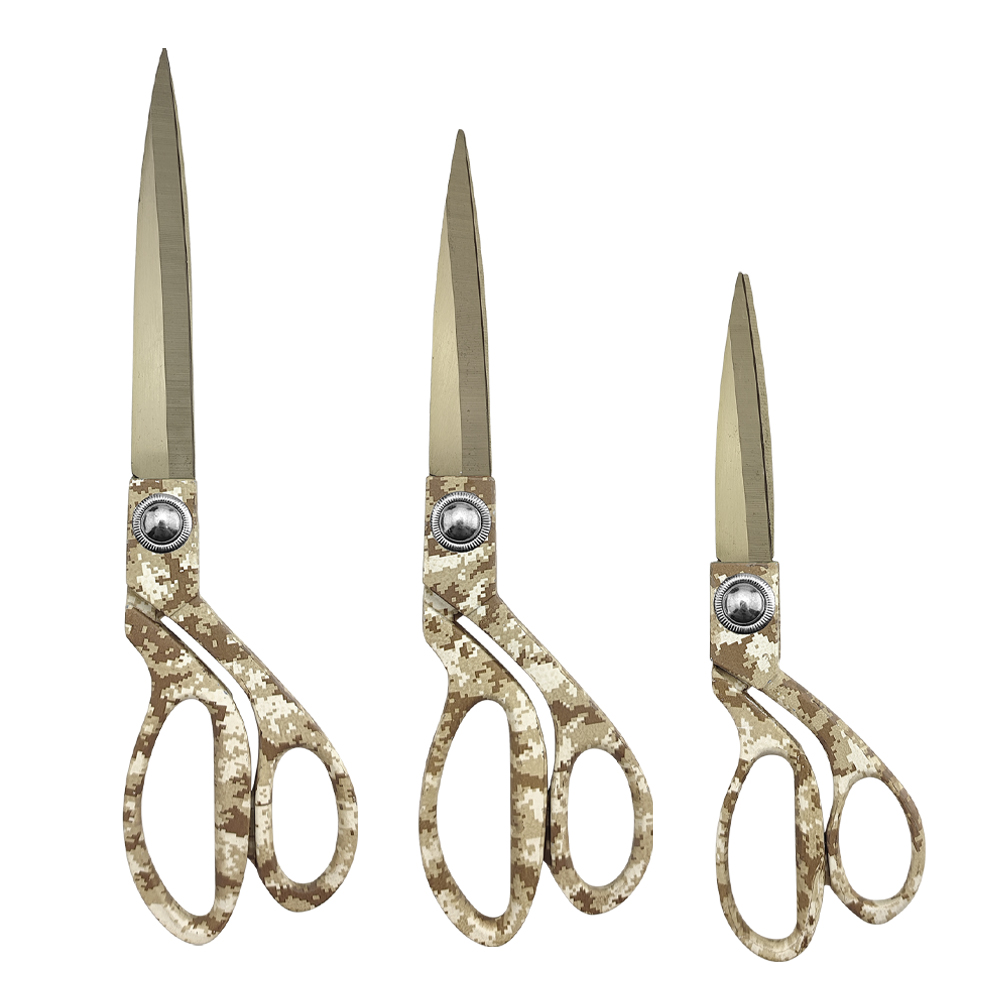
The scissors shown in the original product article feature a digital camouflage appearance, a visible metal screw at the pivot, ergonomic-style handles, and a set of three sizes for different cutting tasks. The original description also states that the scissors are made from premium stainless steel. Those details make the product relevant for fabric cutting, craft work, tailoring counters, and retail tool assortments. However, B2B buyers should still verify specifications directly with the supplier before placing a volume order.
What Makes Tailor Scissors Different from General Scissors?
Tailor scissors are designed for controlled cutting along fabric, paper patterns, interfacing, trims, and similar workshop materials. Compared with general office scissors, they typically need a sharper edge, steadier alignment, and a handle shape that can be used repeatedly during long cutting sessions. In a production or retail environment, consistency matters as much as first-cut sharpness.
When sourcing tailor cutting tools, consider how the scissors will be used. A garment workshop may require longer blades for straight fabric cuts. A craft retailer may prefer mixed-size sets for home sewing and DIY projects. A distributor may need attractive finishes, such as digital camouflage, to help the product stand out on a shelf without compromising cutting performance.
Product Features to Confirm Before Ordering
The original article highlights several useful features: stainless steel construction, ergonomic handles, a digital camouflage pattern, a robust pivot point with a visible screw, and three sizes in the set. These can be strong selling points, but each should be confirmed with measurable details during sourcing.
- Blade material: Ask the supplier to confirm the exact stainless steel type, hardness range if available, and recommended use cases.
- Blade edge: Request information on sharpening method, edge retention expectations, and whether the scissors are suitable for thick or layered fabrics.
- Handle design: Check whether the handle shape fits left-hand, right-hand, or universal use.
- Pivot construction: Ask whether the screw can be adjusted and how pivot tension is controlled during inspection.
- Set composition: Confirm the exact lengths, weights, and packaging arrangement for the three sizes.
Comparison Checklist for B2B Buyers
A structured checklist makes supplier comparison easier, especially when several tailoring tools manufacturers offer similar designs. Use the table below before confirming samples or bulk production.
| Evaluation Item | What to Check | Why It Matters |
|---|---|---|
| Cutting performance | Test on cotton, denim, felt, and pattern paper if relevant | Confirms whether the scissors match your customers' real use |
| Blade alignment | Open and close the blades slowly to check contact and smoothness | Poor alignment causes snagging and uneven cuts |
| Handle comfort | Review grip size, finger space, and pressure points | Comfort affects repeat use in tailoring and craft work |
| Finish quality | Inspect camouflage print, surface coating, burrs, and scratches | Appearance influences retail acceptance and brand perception |
| Packaging | Ask for blister card, box, sleeve, or custom packaging options | Packaging affects shelf display, shipping protection, and labeling |
| Supplier support | Clarify sample lead time, inspection method, MOQ, and after-sales process | Prevents confusion before scaling to wholesale orders |
How to Evaluate Samples from a Tailoring Tools Manufacturer
Sample testing should be practical and repeatable. Do not judge scissors only by opening the package and making one cut. Instead, create a small testing routine that mirrors your market. If your customers are tailors, test long straight cuts and curved cuts on fabric. If your buyers are craft stores, test the scissors on mixed household materials while clearly avoiding uses outside the supplier's recommendation.
Inspect each sample for sharp points, blade symmetry, screw tightness, handle finishing, and print consistency. Open and close the scissors at least 30 to 50 times to check whether the pivot remains stable. If the product will be sold as a three-size set, test all three sizes separately because small scissors and large scissors often perform differently.
For wholesale or OEM projects, ask the manufacturer which tolerances are inspected during production. If no formal data is available, request a simple pre-shipment inspection checklist covering appearance, cutting test, quantity, packaging, and carton marks. Avoid assuming any certification, compliance result, or material grade unless the supplier provides documentation.
OEM, Wholesale, and Private-Label Questions to Ask
Buyers planning OEM or wholesale orders should discuss commercial details early. The goal is not only to obtain a low unit price, but to reduce risk across the full order process. A supplier may be able to offer custom packaging, logo placement, or color options, but the feasibility depends on tooling, order quantity, production schedule, and material availability.
- What are the available scissor sizes and can the set composition be changed?
- Can the digital camouflage finish be customized, and what artwork format is required?
- What is the minimum order quantity for standard packaging and for custom packaging?
- How are blade sharpness, pivot tension, and appearance inspected before shipment?
- Can the supplier provide carton dimensions, gross weight, and packing details for freight planning?
- What sample cost, sample lead time, and production lead time should buyers expect?
- Are spare samples or reference samples retained for order comparison?
Positioning Digital Camouflage Scissors in the Market
The digital camouflage pattern gives these tailor scissors a distinctive look compared with plain metal or basic black-handle scissors. For retailers, that visual difference can help build a themed sewing-tool display or attract hobby users who prefer tools with personality. For distributors, the design may be useful in catalogs where many scissors otherwise appear similar.
Still, appearance should support the product, not replace performance. Marketing copy should avoid exaggerated claims and focus on what can be verified: the set includes multiple sizes, the scissors are intended for fabric cutting and craft use, the design has a digital camouflage style, and the pivot uses a visible metal screw. If additional performance claims are needed, request test data or supplier confirmation first.
Care and Handling Guidance for End Users
Clear user guidance can reduce complaints after purchase. Fabric scissors should be kept clean, dry, and separate from heavy-duty cutting tasks unless the supplier confirms that use. Cutting wire, hard plastic, or abrasive materials may damage the edge. Users should wipe blades after use, store scissors closed, and avoid dropping them on hard floors because the blade tips or pivot alignment can be affected.
If the screw is adjustable, end users should be told how to handle minor tension changes. If it is not intended for adjustment, that should also be stated. Good instructions are especially important for private-label packaging, where the customer may not know the limitations of tailor cutting tools.
Key Takeaways
- Tailor scissors should be evaluated by cutting performance, alignment, handle comfort, finish, and packaging.
- The featured product includes a digital camouflage appearance, stainless steel description, three sizes, and a visible screw pivot according to the original article.
- B2B buyers should verify exact specifications, MOQ, packaging options, and inspection standards directly with the supplier.
- Sample testing should reflect real fabric, craft, or retail use before wholesale ordering.
FAQ: Sourcing Tailor Cutting Scissors
Are these scissors suitable for all fabrics?
They are presented as tailor scissors for fabric cutting, but buyers should test the intended fabrics before bulk ordering. Thick, layered, or specialty materials may require separate confirmation.
Can I request custom branding or packaging?
Possibly, but this depends on the supplier's OEM capability, order quantity, artwork requirements, and production schedule. Ask for confirmed options before designing retail packaging.
What should a sample test include?
Test straight cuts, curved cuts, tip cutting, opening smoothness, handle comfort, blade alignment, and visible finish quality across all sizes in the set.
What information should I ask for before placing a wholesale order?
Request exact sizes, materials, packaging details, carton information, sample lead time, production lead time, MOQ, inspection process, and any available documentation supporting product claims.
