




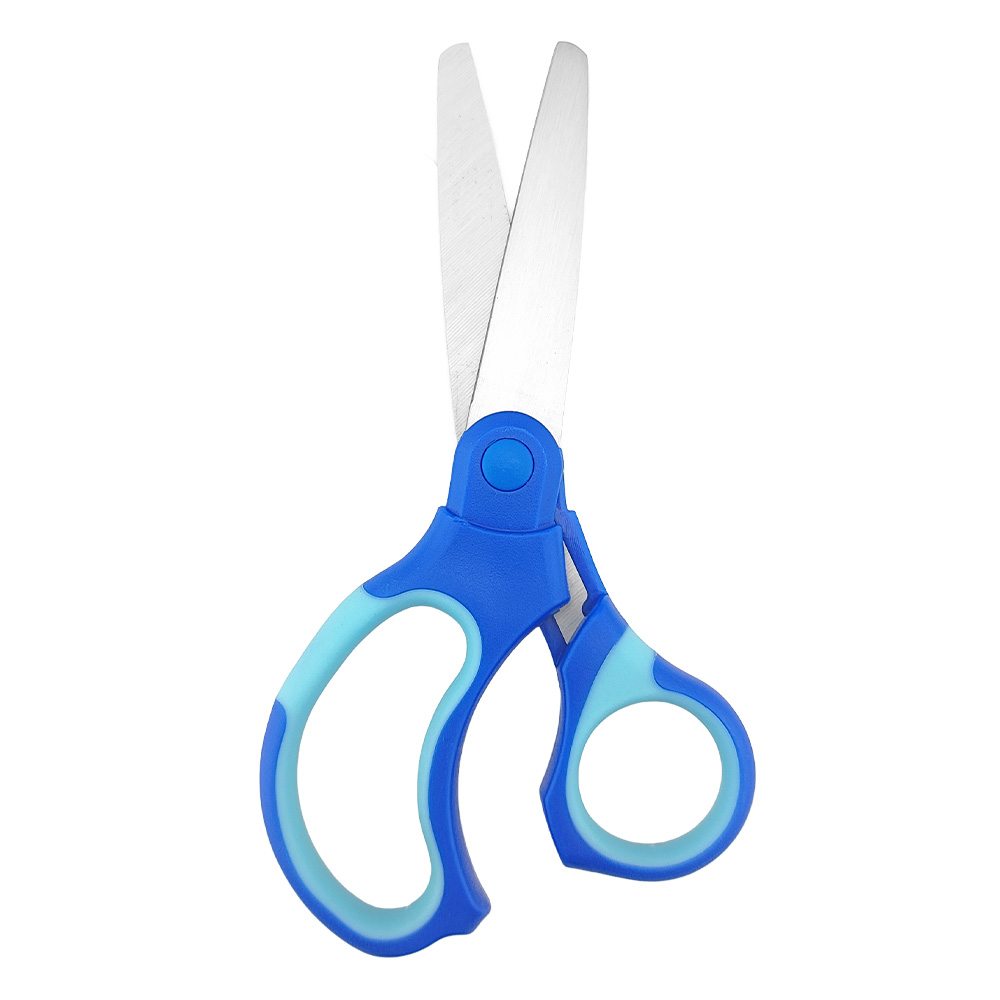
The Best Left-Handed Children Scissors for Safety and Comfort
Left-handed children often struggle with standard classroom scissors because the blade orientation and handle shape are usually designed for right-handed cutting. The result can be torn paper, uncomfortable wrist angles, and frustration during basic school or craft tasks. Choosing left-handed children scissors is not only about convenience; it is about helping young learners cut with better control, confidence, and safety.
For retailers, school-supply distributors, and OEM buyers, the decision should go beyond color and packaging. A good sourcing review should consider child-safe blade design, handle comfort, protective storage, durability, age suitability, and clear supplier communication. The product shown below is presented as a school scissors option with a safety cover, contoured handles, stainless steel blades, and a blue and teal appearance. Buyers should still confirm all commercial and technical details directly with the supplier before placing an order.

Key Takeaways
- Left-handed children scissors help reduce awkward hand positioning for left-handed users.
- A safety cover is useful for storage, school bags, and classroom organization.
- Comfortable handles matter because children are still developing fine motor control.
- OEM and wholesale buyers should ask suppliers to confirm materials, age grading, packaging, and quality checks.
- Do not rely on appearance alone; request samples and test cutting performance before bulk purchasing.
Why Left-Handed Children Need Dedicated Scissors
Many right-handed scissors place the top blade in a position that gives right-handed users a clear cutting line. When a left-handed child uses those scissors, the blade can block the view of the line, and the natural squeezing motion may push the blades apart rather than together. This can make paper bend or tear instead of cutting cleanly.
Dedicated left-handed children scissors are intended to match the way a left-handed child naturally holds and controls the tool. This supports better visibility, a more relaxed wrist position, and smoother cutting during activities such as worksheets, paper crafts, collage projects, and basic classroom tasks. For teachers and parents, that can mean fewer interruptions and less discouragement for left-handed learners.
Safety Features to Review Before Buying
Children's scissors should be evaluated carefully because they are used in busy environments: classrooms, art rooms, homes, and school bags. The original product information highlights a safety cover feature, which is valuable because it helps keep blades covered when the scissors are not in use. This is especially practical for transport and shared storage bins.
Other safety details should be confirmed with the supplier rather than assumed. Buyers can ask whether blade tips are rounded, what age range the product is intended for, and whether the handle size is suitable for the target users. If the scissors will be sold in a regulated market or supplied to schools, ask what documentation, labeling, or test reports are available for review.
Comfort and Ergonomics for Small Hands
Comfort is not a luxury feature for children's scissors. Young users may not yet have strong grip control, so handle design can influence both safety and cutting accuracy. The source article mentions soft, contoured handles, which can support a steadier hold and reduce pressure during longer craft sessions.
When checking samples, observe how a child positions the thumb and fingers. The handle openings should not force the hand into an unnatural angle. Edges should feel smooth, and the scissors should open and close without requiring excessive force. For wholesale buyers, it is also worth checking whether the same design works across the intended age group or whether different sizes are needed.
Comparison Checklist for Sourcing Left-Handed School Scissors
| Check Item | Why It Matters | Questions to Ask the Supplier |
|---|---|---|
| Left-handed usability | Supports correct blade visibility and natural cutting motion. | Is the blade orientation designed for left-handed users, or is it a universal model? |
| Safety cover | Helps protect blades during storage and transport. | Is the cover included as standard, and how securely does it fit? |
| Blade material | Affects cutting performance and durability. | The source mentions stainless steel blades; can the supplier confirm the material specification? |
| Handle comfort | Reduces strain for children during repeated cutting. | What handle material is used, and are samples available for grip testing? |
| Packaging | Important for retail, school kits, and safe shipping. | What packaging options are available for OEM, wholesale, or classroom supply? |
| Quality control | Reduces inconsistent cutting and loose assembly. | What inspections are performed before shipment? |
OEM and Wholesale Buying Guidance
If you are sourcing from an OEM scissors factory or supplier, treat the product page as a starting point, not a final specification sheet. The original description refers to OEM scissors factory sourcing and highlights durable stainless steel blades, a safety cover, and blue and teal styling. These details are useful, but procurement teams should request written confirmation for any specification that affects performance, labeling, or compliance.
Before placing a bulk order, prepare a short supplier checklist:
- Request physical samples and test them with paper commonly used in schools.
- Confirm whether the scissors are left-handed only or suitable for both left- and right-handed users, as the original description references inclusive use.
- Ask for exact blade material, handle material, dimensions, and recommended age range.
- Review packaging options, barcode needs, private-label artwork requirements, and carton information.
- Ask what quality control steps are used for blade alignment, handle finish, cover fit, and opening-closing smoothness.
- Clarify lead time, minimum order quantity, payment terms, and after-sales handling directly with the supplier.
This approach helps avoid misunderstandings and makes it easier to compare quotations from different factories or trading partners.
Use Cases: Classroom, Home, and Craft Kits
Left-handed children scissors are most useful where children cut frequently: school art classes, homework activities, paper crafts, scrapbooking, and beginner DIY projects. A protective cover also helps when scissors are packed into pencil cases or craft kits. For retailers, this makes the product relevant to back-to-school assortments, children's stationery ranges, and family craft sections.
For schools and institutional buyers, consistency matters. If a classroom includes left-handed students, stocking a small number of left-handed scissors can improve accessibility. Teachers should label or separate them clearly so students can quickly find the correct tool. If the product is promoted as usable by both left- and right-handed children, test that claim with real users before adopting it as a shared classroom option.
Care, Storage, and Everyday Use Tips
Good scissors last longer when they are stored and used correctly. Children should be taught to use scissors only on suitable craft materials unless an adult confirms otherwise. Cutting hard plastics, wire, or thick materials can damage blades and reduce cutting quality.
- Place the safety cover on after each use.
- Keep scissors dry before storage to help maintain the blades.
- Store them in a pencil case, classroom tray, or craft box with the cover attached.
- Check regularly for loose parts, rough handle edges, or damaged covers.
- Replace scissors that no longer cut smoothly or cannot be safely stored.
Practical FAQ
Are left-handed children scissors different from regular scissors?
Yes. True left-handed scissors are designed so left-handed users can see the cutting line more clearly and apply pressure in a natural direction. This can make cutting smoother and less frustrating.
Is a safety cover necessary?
A safety cover is strongly recommended for school bags, shared classroom storage, and craft kits. It helps keep the blades covered when the scissors are not being used.
Can one pair work for both left- and right-handed children?
Some products are described as suitable for both users, but buyers should verify this with samples. A universal design may not perform the same as a dedicated left-handed model.
What should OEM buyers confirm before ordering?
Confirm blade material, handle material, age range, packaging, quality checks, lead time, minimum order quantity, and any documentation needed for the target market.
How should parents choose scissors for a left-handed child?
Look for left-handed usability, a comfortable handle, manageable opening and closing force, a safety cover, and smooth cutting on ordinary paper. Supervise young children during use.
