




The Evolution of Powder Metallurgy in Modern Knives
Powder metallurgy has become one of the most discussed steelmaking methods in the premium knife market. For kitchen knives, the appeal is easy to understand: buyers want blades that hold an edge, sharpen predictably, resist staining when appropriate, and perform consistently from one batch to the next. Powder metallurgy, often shortened to PM, does not automatically make every knife better. It is a manufacturing route for steel, and its value depends on the alloy, heat treatment, blade geometry, grinding quality, handle construction, and the supplier’s quality control.
This guide explains how PM changed modern knives and how wholesalers, OEM buyers, and kitchenware retailers can evaluate PM kitchen knives without relying on marketing terms alone.
Key Takeaways
- Powder metallurgy creates a more uniform steel structure than many conventional ingot processes, which can support balanced edge retention and toughness.
- PM steel is not one single material; CPM-S30V, CPM-S35VN, CPM MagnaCut, M390, CPM-20CV, Elmax, R2/SG2, and HAP-series steels are different options with different trade-offs.
- For B2B sourcing, buyers should ask for steel identity, heat-treatment targets, sample testing, packaging options, lead times, and after-sales support instead of assuming performance from the PM label.
- The right knife depends on the customer segment: professional kitchens, home cooks, gift sets, and specialty culinary users may need different steel, blade shape, and price positioning.
From Conventional Steel to Powder Metallurgy
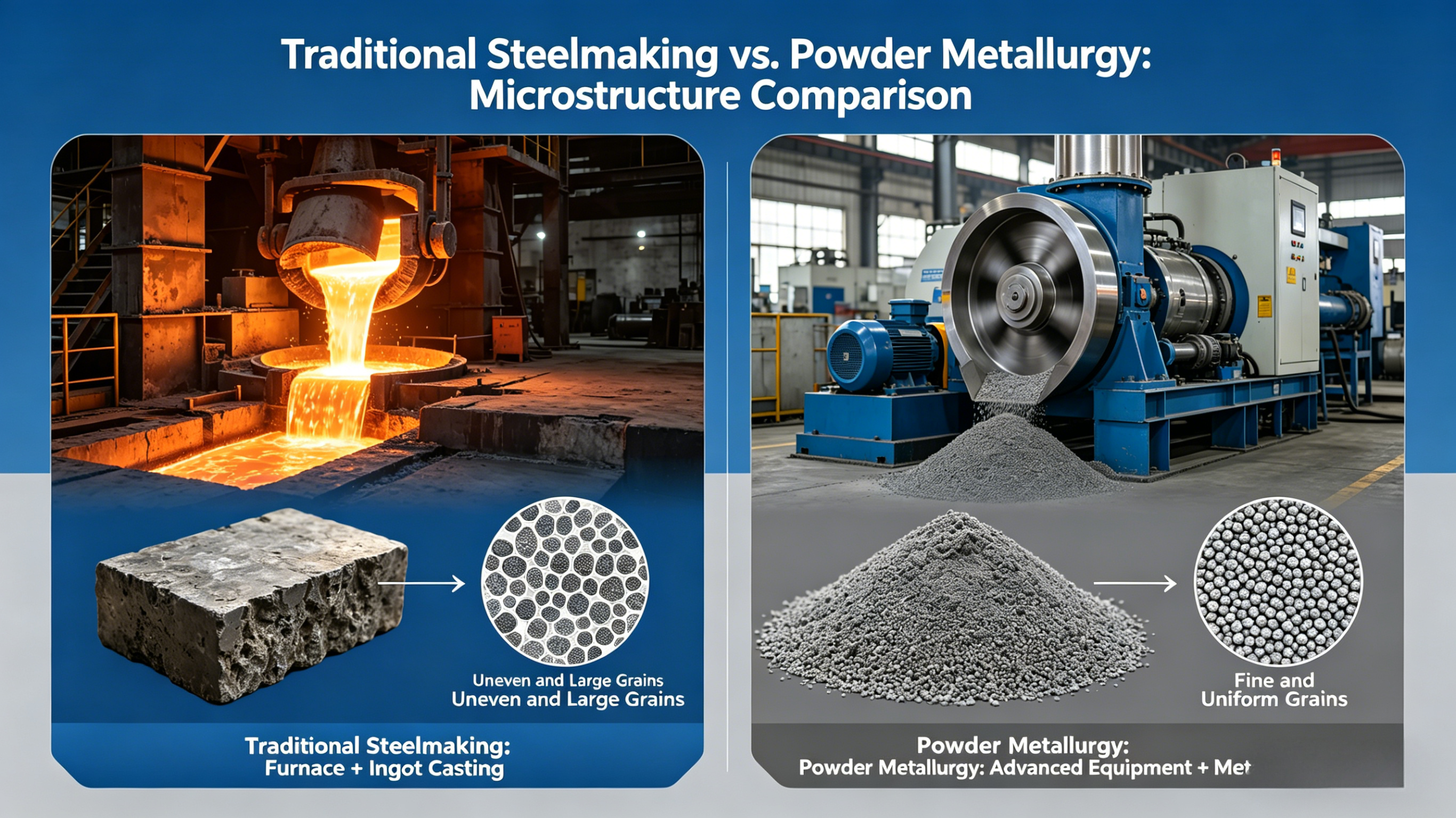
Traditional knife steels are commonly produced by melting alloying elements, casting the metal into ingots, and then rolling or forging it into usable stock. This approach has made many reliable knives for decades. However, conventional processing can create larger carbides and less uniform distribution of alloying elements, depending on the steel and process control. In a kitchen knife, those factors may influence how the edge wears, how it responds to sharpening, and how consistent performance feels across production batches.
Powder metallurgy takes a different route. Molten steel is atomized into fine particles that solidify quickly. Those particles are then consolidated under heat and pressure, often through processes such as hot isostatic pressing or related methods, before being rolled or forged into bar stock. The result is generally a finer, more uniform carbide structure. In practical terms, this can help modern knife steels combine wear resistance with usable toughness more effectively than some conventional versions.
Why PM Steel Matters in Kitchen Knives
Kitchen knives face a different environment from outdoor or industrial cutting tools. They may contact acidic foods, moisture, cutting boards, bones, frozen ingredients, and repeated washing. A chef’s knife, santoku, gyuto, utility knife, or slicer must also feel comfortable and controllable during long prep sessions. PM steel can be attractive because it may support:
- Longer working sharpness between touch-ups, depending on alloy and heat treatment.
- Fine edge stability for precise slicing and vegetable preparation.
- More consistent properties across the blade when steel production and knife manufacturing are well controlled.
- Balanced performance in premium stainless and semi-stainless knife categories.
Still, PM is only one part of the finished tool. A poorly ground PM blade can cut worse than a well-made conventional steel knife. Buyers should evaluate the complete knife, not only the steel name printed on the blade.
Common PM Steels and How Buyers Compare Them
The original discussion of PM kitchen knives often mentions steels such as CPM-S30V, CPM-S35VN, CPM MagnaCut, M390, CPM-20CV, Elmax, R2/SG2, and HAP-series steels. These names appear in premium knife categories, but they are not interchangeable. The table below gives a practical sourcing view rather than a laboratory ranking.
| Steel family | Typical market position | Buyer questions to ask | Common kitchen use fit |
|---|---|---|---|
| CPM-S30V | Premium stainless PM option | What heat treatment range is used, and how is chipping risk managed? | Everyday chef knives and utility knives |
| CPM-S35VN | Premium stainless PM option with broad knife use | Can the supplier provide consistent batches and sharpening guidance? | All-purpose kitchen knives |
| CPM MagnaCut | Modern high-performance stainless PM steel | Is the steel authentic, and what hardness target is planned for kitchen use? | Premium chef knives and specialty ranges |
| M390 / CPM-20CV | High-end wear-resistant stainless PM category | Will sharpening difficulty match the end customer’s expectations? | Slicers, presentation knives, premium retail lines |
| Elmax | Premium stainless PM steel used in knife applications | What blade geometry is recommended for kitchen cutting tasks? | Gyuto, santoku, and professional-style knives |
| R2/SG2 or HAP-series | Often seen in Japanese-style premium knives | What care instructions should be supplied to customers? | Gyuto, santoku, petty knives, and fine slicing |
B2B Sourcing Checklist for PM Kitchen Knives
For importers, wholesalers, and OEM kitchenware brands, PM steel can help create a differentiated product line. It can also increase complexity. Before approving a sample or placing a wholesale order, use a structured checklist:
- Confirm the exact steel identity. Ask whether the supplier can identify the steel grade and provide documentation from the material source where available.
- Discuss heat treatment. Ask for the target hardness range, tempering approach, and how the supplier balances edge retention against toughness.
- Review blade geometry. Edge angle, spine thickness, grind symmetry, and distal taper often affect cutting performance as much as the steel grade.
- Test real kitchen tasks. Compare samples on vegetables, proteins, herbs, and cutting boards similar to the target customer’s use.
- Check finishing consistency. Inspect edge finish, handle fit, blade straightness, packaging, labeling, and corrosion-prone areas.
- Clarify commercial details. Ask about MOQ, lead time, sample policy, customization options, packaging formats, and replacement handling rather than assuming standard terms.
- Prepare care instructions. Even stainless PM knives should be washed and dried promptly, and most premium knives should not be treated as dishwasher-safe unless the supplier can support that claim.
Product Selection for Different Customer Segments
A PM steel knife line should match the needs of the buyer’s market. A professional cook may accept more careful maintenance in exchange for edge performance. A general home user may prefer easier sharpening and simple care. A gift-set buyer may focus on presentation, handle feel, and clear instructions. For wholesale programs, it is often wise to offer a small, focused range first: an 8-inch chef knife, a santoku, a petty or utility knife, and perhaps a slicing knife. This keeps inventory manageable while allowing buyers to compare feedback across common blade shapes.
Retailers should also avoid overpromising. PM steel can be excellent, but no kitchen knife is chip-proof, rust-proof in every environment, or maintenance-free. Clear care guidance reduces returns and helps end users get better service life from the product.
Care and Sharpening Considerations
PM knives often reward proper maintenance. Users should cut on wood or appropriate synthetic boards, avoid twisting the edge through hard foods, wash by hand, dry quickly, and store the knife in a block, saya, rack, or edge guard. Sharpening needs depend on the alloy and hardness. Some wear-resistant PM steels may take longer to sharpen on basic stones, so buyers should ask suppliers which sharpening tools and grit progression they recommend for the finished knife.
FAQ
Is every powder metallurgy knife better than a conventional steel knife?
No. PM steel can offer advantages, but the final result depends on heat treatment, blade geometry, grinding, finishing, and quality control.
What should OEM buyers ask a knife supplier first?
Start with the steel grade, heat-treatment target, sample availability, customization scope, MOQ, lead time, packaging options, and quality inspection process.
Are PM kitchen knives difficult to sharpen?
Some wear-resistant PM steels can take more time to sharpen than simpler steels. Ask the supplier for sharpening recommendations and test samples with your intended tools.
Can PM stainless knives rust?
Stainless does not mean stain-proof under all conditions. Food acids, salt, humidity, and poor drying can still cause staining or corrosion, so hand washing and prompt drying are recommended.
Conclusion
The evolution of powder metallurgy has given modern knife makers more ways to balance edge retention, toughness, corrosion resistance, and consistency. For B2B buyers, the opportunity is not simply to buy a knife labeled “PM steel,” but to specify the right steel, geometry, finish, packaging, and care information for the target market. With careful sampling and supplier questions, PM kitchen knives can become a strong addition to a premium kitchenware range.
