




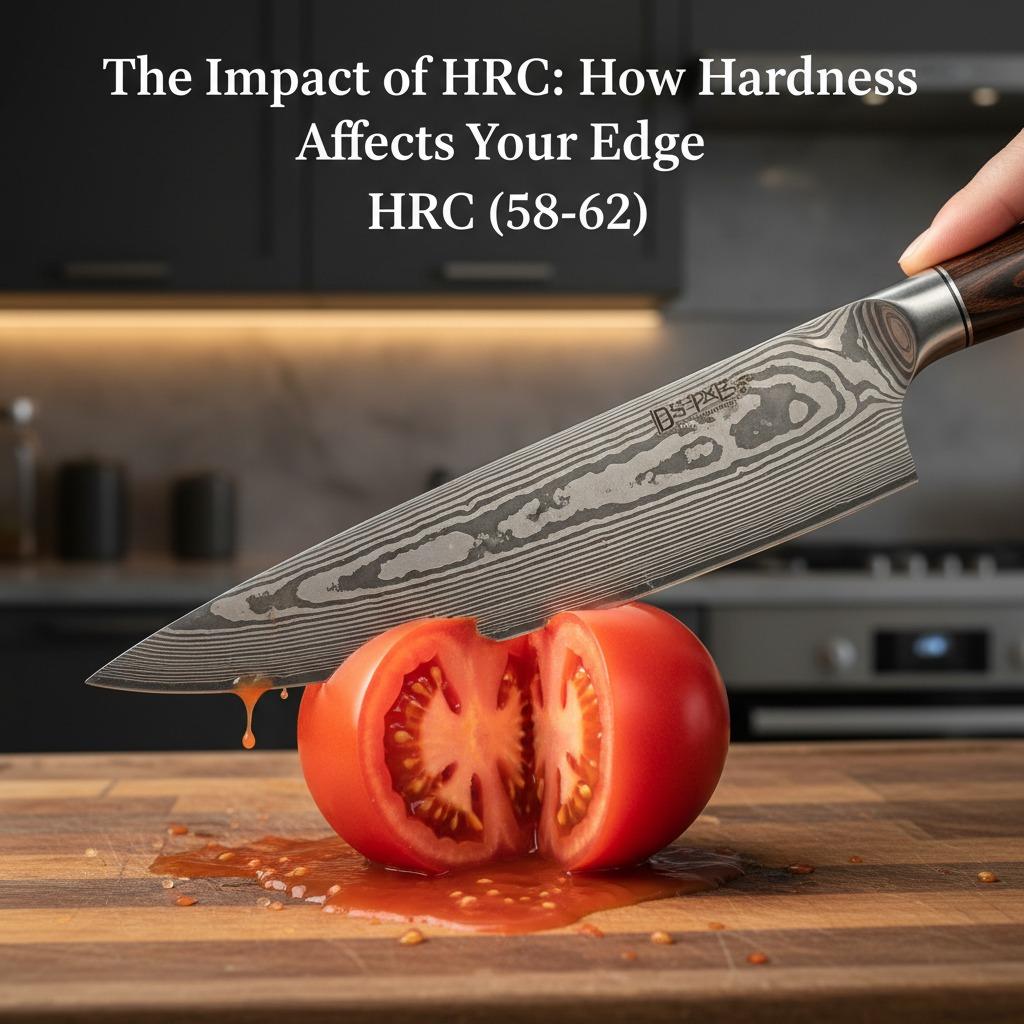
The Impact of HRC: How Hardness Affects Your Edge
When people compare a kitchen knife, they often focus on visible details: blade shape, handle comfort, weight, and how sharp the edge feels out of the box. One less visible number can be just as important: HRC. Short for Rockwell Hardness C scale, HRC helps explain how a knife edge behaves after weeks of chopping, slicing, washing, sharpening, and everyday use.
Hardness is not the same as quality. A higher HRC number does not automatically mean a better knife, and a lower number does not mean a poor knife. It is a trade-off. Understanding that trade-off helps home cooks, chefs, retailers, and sourcing teams choose knives that match real kitchen tasks instead of relying on generic claims about sharpness.
What HRC Means on a Kitchen Knife
The Rockwell Hardness C scale measures a material's resistance to permanent indentation. In simple terms, it indicates how hard the blade steel is after heat treatment. For kitchen knives, the original article noted a typical range of about 54 to 65 HRC. Within that range, small differences can change how a knife feels and how it should be maintained.
A hard blade can support a fine, acute edge, which may cut cleanly and hold sharpness for longer under appropriate use. A softer blade is usually tougher and more forgiving when the edge is twisted, hits a dense cutting board, or contacts harder food. The right choice depends on what the knife is expected to do.
How Hardness Changes Edge Retention
Edge retention is the ability of a blade to stay sharp during use. A higher-HRC kitchen knife often resists edge rolling better, so it may keep a crisp cutting feel through repeated vegetable prep, boneless protein slicing, or fine herb work. This is why cooks who value precise slices often pay attention to hardness.
However, hardness is only one part of edge retention. Edge geometry, steel composition, heat treatment consistency, sharpening angle, cutting board material, and user technique all matter. If a supplier advertises a certain HRC, buyers should ask how it is measured and whether the stated range applies to the finished blade, not only to raw steel.
The Trade-Off: Toughness, Chipping, and Sharpening
Harder steel can hold a thin edge, but it may also be less tolerant of abuse. A very hard knife is usually not the best tool for frozen food, bones, hard shells, or forceful twisting cuts. In those situations, a tougher and slightly softer blade may be more practical.
Sharpening effort also changes with hardness. Lower-HRC knives are generally easier to refresh with a whetstone or honing routine, while harder knives may require more patience and suitable sharpening stones. Honing rods should also be chosen carefully: a steel rod that works on a softer knife may be less useful on a harder blade.
HRC Range Comparison for Everyday Selection
The table below is a practical selection guide. It describes common performance tendencies, not a guarantee for every knife. Always check the supplier's actual product information before making a purchasing decision.
| HRC Range | Typical Behavior | Advantages | Limitations | Best Use Case |
|---|---|---|---|---|
| 54-57 | Softer and tougher | Forgiving, easier to sharpen, lower chipping risk | Edge may dull faster | Heavy prep, dense vegetables, general busy kitchens |
| 58-60 | Balanced everyday hardness | Good edge retention with manageable care | Still needs regular maintenance | All-purpose home and professional prep |
| 61-63 | Harder, finer edge potential | Strong sharpness retention for precise cutting | More care needed to avoid chips | Fine slicing, boneless proteins, herbs, controlled work |
| 64+ | Very hard specialty range | Long-lasting fine edge when used correctly | More difficult sharpening and higher brittleness risk | Experienced users and specialized precision tasks |
Choosing the Right HRC for Your Kitchen
For many home cooks, a mid-range hardness around the balanced category is the easiest starting point. It gives useful sharpness without demanding overly delicate handling. Professional kitchens may prefer a mix: a tougher workhorse for high-volume prep and a harder slicing knife for controlled, precise tasks.
Use this checklist before choosing a knife by HRC:
- Match the knife to the task. Do not use a fine slicing knife as a cleaver or bone knife.
- Ask about the stated hardness range. A single number may not reflect normal manufacturing tolerance.
- Consider sharpening access. If users cannot sharpen regularly, edge retention becomes more important.
- Review the cutting environment. Hard boards, stainless prep surfaces, and rushed technique can damage edges.
- Check care instructions. Hand washing, drying, and safe storage are important for any quality blade.
Care Tips That Protect the Edge
HRC only helps if the knife is used correctly. Avoid dishwashers, because high heat, detergent, and movement against other utensils can damage the edge and handle. Wash by hand, dry promptly, and store the knife in a block, sheath, magnetic strip, or tray that prevents edge contact.
Use wood or suitable synthetic cutting boards rather than glass, stone, ceramic plates, or metal surfaces. Cut straight down and forward instead of twisting the edge through food. For harder knives, avoid lateral pressure and never scrape the cutting board with the sharpened edge; use the spine of the blade instead.
Questions to Ask When Sourcing Kitchen Knives
If you are buying for retail, hospitality, private label, or wholesale programs, HRC should be part of a broader specification discussion. Do not rely on hardness alone. Ask the supplier practical questions such as:
- What HRC range is targeted for the finished blade?
- How is hardness checked, and at what stage of production?
- What blade style, edge angle, and intended use does the knife support?
- What sharpening and care guidance should be provided to end users?
- Are sample knives available for cutting, washing, and sharpening evaluation before bulk ordering?
These questions help buyers compare products fairly without assuming performance details that have not been verified.
Key Takeaways
- HRC measures blade hardness, but it does not measure overall knife quality by itself.
- Higher HRC can improve edge retention, but it may require more careful use and sharpening.
- Lower HRC can be more forgiving for heavy kitchen work, though it may need more frequent sharpening.
- The best kitchen knife hardness depends on the user, cutting task, maintenance routine, and sourcing requirements.
FAQ
Is a higher HRC always better for a kitchen knife?
No. A higher HRC can help a knife hold a fine edge, but it can also make the edge less forgiving if used roughly. For many kitchens, balance matters more than the highest number.
What HRC is easiest for beginners?
A moderate range is usually easiest because it balances sharpness, durability, and sharpening effort. Beginners should prioritize proper cutting technique and care as much as hardness.
Can I use a high-HRC knife for bones or frozen food?
It is better not to. Hard, fine-edged knives are generally intended for controlled slicing and prep, not impact or twisting against very hard materials. Use a suitable heavy-duty knife for those tasks.
How often should I sharpen a kitchen knife?
It depends on use, board material, edge hardness, and cutting technique. Sharpen when the knife begins to crush food, slip on skins, or require extra pressure. Regular light maintenance is better than waiting until the edge is very dull.
What should buyers confirm with a supplier?
Confirm the finished-blade HRC range, intended use, edge geometry, care instructions, sample availability, and any documentation the supplier can provide. Avoid assuming specifications that are not clearly stated.
