




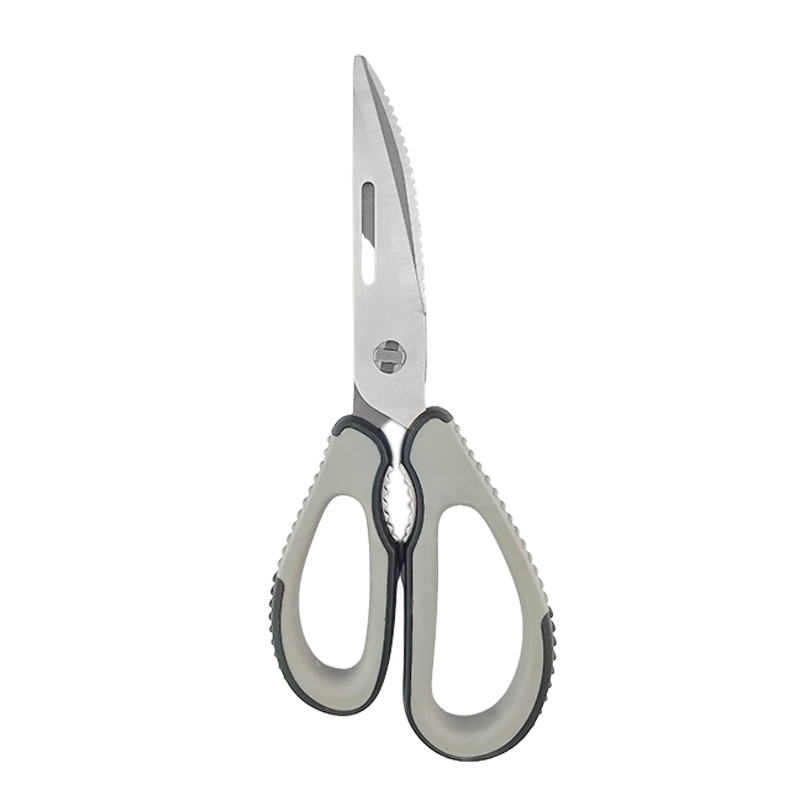
Multi-Functional Kitchen Scissors: Practical Sourcing and Selection Guide

Multi-functional kitchen scissors are often promoted as a simple way to cut herbs, open packaging, trim food, crack nuts, or open bottles. For home users, the appeal is convenience. For distributors, retailers, importers, and private-label buyers, the question is more practical: which features are genuinely useful, which claims need verification, and what should be confirmed before placing a wholesale or OEM order?
The original product information highlights several visible or stated features: stainless steel construction, razor-sharp blades, a serrated edge, a built-in nutcracker and bottle opener, rubberized slip-resistant handles, and a grey-and-black dual-tone design. Those details are useful starting points, but a responsible buying decision should go further. Buyers should ask how the scissors are made, how they are tested, what customization is available, and how the supplier controls consistency across batches.
Key Takeaways
- Multi-functional kitchen scissors should be evaluated as both a cutting tool and a safety-sensitive kitchen item.
- Visible features such as serrated blades, bottle openers, nutcrackers, and rubberized handles are useful, but buyers should request specifications and samples.
- Wholesale and OEM buyers should confirm material details, packaging options, inspection standards, lead time, MOQ, and after-sales process directly with the supplier.
- For consumer use, cleaning, drying, and safe storage are important for long-term performance.
What Multi-Functional Kitchen Scissors Are Designed to Do
Kitchen scissors are different from office scissors because they are expected to handle food preparation and tough household tasks. A multi-functional pair may be used to trim herbs, cut meat into smaller portions, slice food packaging, open sealed bags, grip bottle caps, or crack small nuts. The stated model also includes a built-in bottle opener and nutcracker, which can reduce the need for separate tools in a compact kitchen or travel cooking kit.
However, multi-function design should not mean unclear purpose. A good pair of kitchen scissors still needs to cut cleanly and feel stable in the hand. Extra functions should support the main cutting task rather than interfere with it. If a tool is being sourced for retail shelves or online listings, the most important question is whether the final user can understand and use each function safely without confusion.
Product Features Buyers Should Evaluate
The original description refers to stainless steel blades, a serrated edge, rubberized slip-resistant handles, and a grey-and-black design. These are relevant selling points, but B2B buyers should treat them as points for verification. Ask the supplier which stainless steel is used, how blade sharpness is checked, whether the handle material has a specification sheet, and whether the product is intended to be detachable or fixed if that matters for your market.
Ergonomics deserve particular attention. A handle that feels comfortable for one user may not suit another, especially when used repeatedly in a food-service environment or during batch preparation. If you are buying for retail, request samples and test them with several hand sizes. Check whether the grip remains stable when hands are wet, whether the blades align properly, and whether the serrated section cuts without tearing too much.
Comparison Checklist for Sourcing Kitchen Scissors
| Evaluation Point | Why It Matters | Questions to Ask a Supplier |
|---|---|---|
| Blade material | Affects cutting performance, corrosion resistance, and perceived quality. | What stainless steel is used, and can the material be documented? |
| Blade edge and serration | Determines how well the scissors handle food, packaging, and tougher cuts. | How is sharpness checked during production? |
| Handle design | Influences comfort, grip, and control during repeated use. | What is the handle material, and is a sample available for testing? |
| Extra functions | Nutcracker and bottle opener features can add value if they are easy to use. | Are these functions tested separately during inspection? |
| Packaging | Important for retail display, e-commerce shipping, and private label programs. | What packaging formats and artwork requirements are supported? |
| Quality control | Reduces inconsistent products in wholesale shipments. | What inspections are performed before shipment? |
Guidance for OEM and Wholesale Buyers
If your search intent is related to an OEM scissors manufacturer, scissors factory, or kitchen scissors wholesale supplier, the buying process should be structured. Start with the product brief: target market, retail price range, expected packaging, blade and handle preferences, and any local compliance requirements you need to meet. Do not assume that a supplier's standard model automatically fits your market.
Next, request samples from the exact production route you are considering. Test cutting performance on common kitchen materials such as herbs, poultry packaging, food bags, and thin cardboard. If the product includes a nutcracker or bottle opener, test those features with realistic items rather than relying only on photos. For bulk orders, ask whether pre-shipment inspection, carton drop testing, barcode labeling, or private label packaging can be arranged.
Commercial terms should also be clarified early. Ask about MOQ, lead time, customization fees, packaging costs, payment terms, spare sample availability, and how defective units are handled. These details should be confirmed in writing before production. A professional sourcing conversation is not only about the lowest unit price; it is about reducing uncertainty before goods move into your sales channel.
Selection Tips for Home and Retail Customers
For consumer-facing buyers, the best kitchen scissors are the ones that match daily habits. If you mostly cut herbs and open packaging, comfort and blade control may matter more than heavy-duty functions. If you often prepare poultry or tougher ingredients, look for strong blade alignment and a handle that gives enough leverage. If you want one compact tool for several tasks, a model with a bottle opener and nutcracker can be useful, provided those functions feel safe and intuitive.
- Hold the scissors and check whether the handle fits your hand comfortably.
- Open and close the blades to feel whether the movement is smooth and controlled.
- Look for a stable grip, especially if the handles are described as slip-resistant.
- Check whether the extra functions are placed where they will not interfere with cutting.
- Choose packaging or product information that clearly explains cleaning and safe use.
Use, Cleaning, and Care
Kitchen scissors come into contact with food, packaging, and sometimes raw ingredients, so care is not optional. Clean the blades after use, especially after cutting meat, fish, or sticky packaging. Dry the scissors before storage to reduce moisture exposure. If the product is detachable, follow the supplier's instructions for separating and reassembling the blades. If it is not detachable, clean carefully around the hinge area where residue can collect.
Storage also affects safety and product life. Keep the scissors away from children, avoid tossing them loosely into a crowded drawer, and consider a sheath or dedicated storage slot if available. Do not use kitchen scissors for tasks far outside their intended purpose, such as cutting wire or hard industrial materials, unless the supplier specifically confirms that use.
FAQ
Are multi-functional kitchen scissors suitable for wholesale programs?
Yes, they can be suitable for wholesale if the supplier can provide consistent quality, clear packaging options, and commercial terms that match your sales channel. Always confirm MOQ, lead time, inspection process, and sample approval steps.
What should I ask an OEM scissors manufacturer before ordering?
Ask about blade material, handle material, customization options, packaging, production lead time, quality checks, sample cost, MOQ, and how product defects are managed. If your market has specific compliance requirements, raise them before sampling.
Can one pair of kitchen scissors replace several tools?
It can reduce the need for separate tools for simple jobs such as cutting food, opening packaging, cracking small nuts, or opening bottles. It should not replace specialized tools for tasks beyond its design limits.
How do I judge quality from a sample?
Check blade alignment, cutting smoothness, handle comfort, grip stability, hinge movement, and the usability of extra functions. Test more than one sample if you are planning a bulk order.
Should kitchen scissors be washed in a dishwasher?
Follow the supplier's care instructions. If dishwasher suitability is not clearly stated, hand washing and thorough drying are the safer default approach.
Final Buying Perspective
Multi-functional kitchen scissors can be practical for both home kitchens and B2B product ranges, but the best choice depends on verified details rather than broad marketing language. For buyers sourcing from a scissors factory or OEM scissors manufacturer, the strongest approach is to combine sample testing, clear specification questions, and written commercial confirmation. For end users, focus on safe handling, comfortable grip, and realistic daily tasks. A well-chosen pair should make preparation easier without creating uncertainty about quality, cleaning, or use.
