




Understanding the Different Anatomy of Kitchen Shears
Kitchen shears look simple at first glance, but they are built differently from ordinary desk scissors. A good pair is designed to cut food cleanly, give the hand more leverage, and make cleaning easier after contact with raw ingredients. Understanding the anatomy of kitchen shears helps you choose the right pair, use each section correctly, and avoid damaging the tool during daily cooking.
This guide explains the main parts of kitchen scissors, what they do, and the practical details to check before buying. It is written for home cooks, cooking enthusiasts, and anyone comparing kitchen shears for regular food preparation.
Key Takeaways
- Kitchen shears are not the same as paper scissors; their blade shape, pivot, handle design, and add-on features are intended for food tasks.
- The pivot area is one of the most important parts because it affects cutting smoothness, tension, and cleaning access.
- Serrated edges, bone notches, bottle opener grooves, and locking clasps are useful only when they match your cooking habits.
- For hygiene, choose shears that are easy to open, rinse, dry, and inspect after use.
Main Parts of Kitchen Shears and What They Do
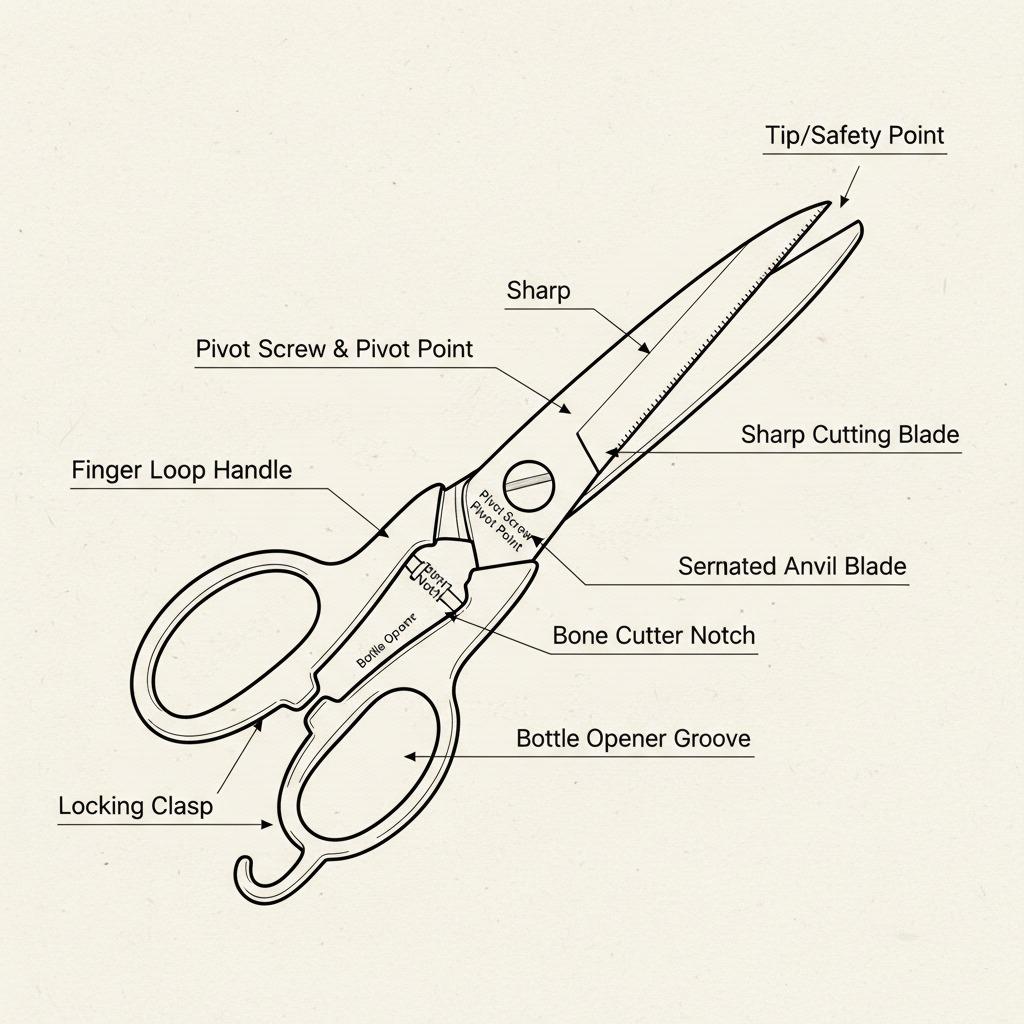
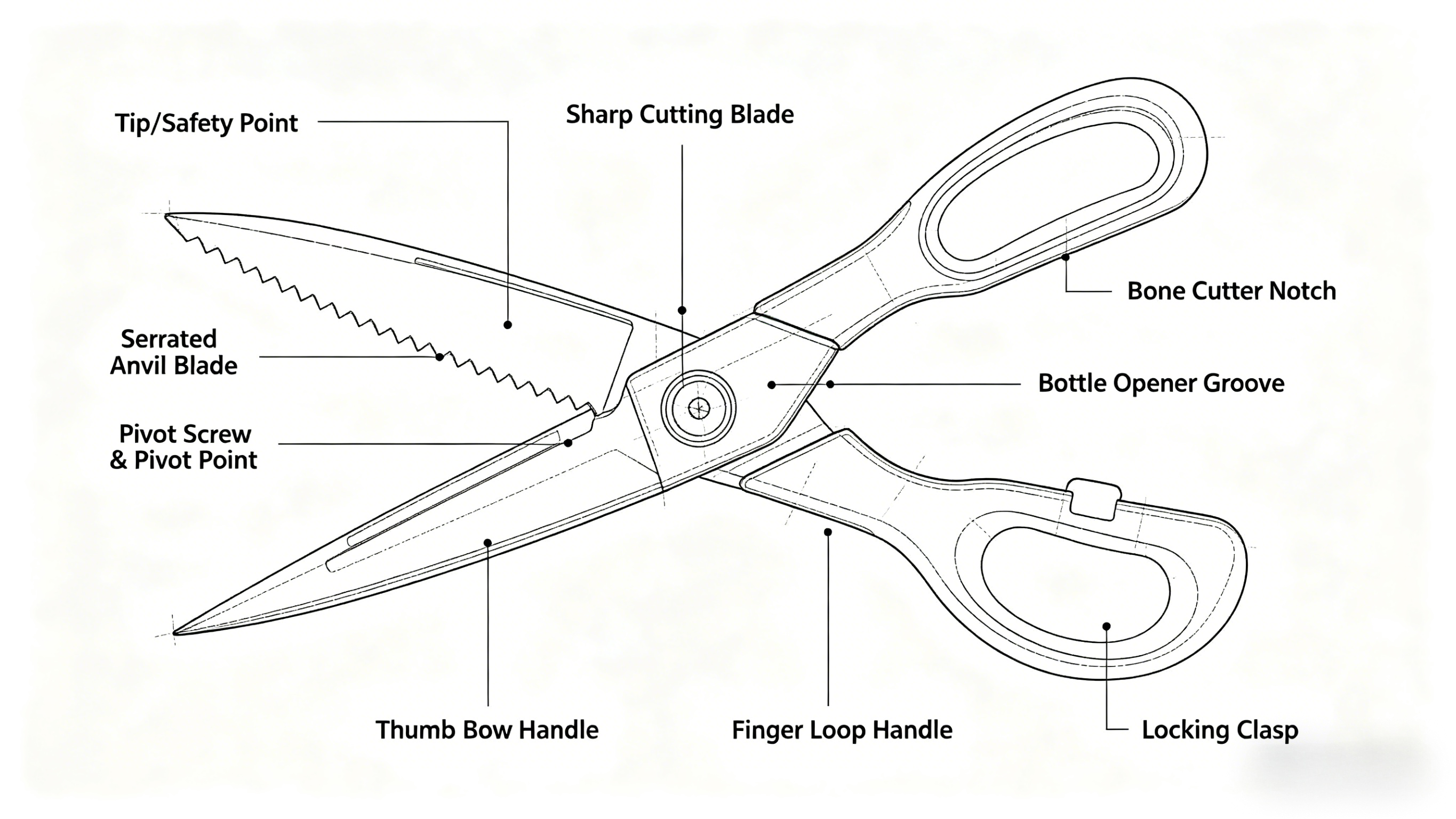
The anatomy of kitchen shears can vary by model, but most multi-purpose designs share several recognizable parts. The table below explains common components and how each one affects performance in real kitchen tasks.
| Part | What It Is | Why It Matters | What to Check |
|---|---|---|---|
| Blade tip | The pointed or rounded end of each blade | Useful for small snips, trimming herbs, and starting a cut | Choose pointed tips for precision or rounded tips when safety is a priority |
| Smooth cutting blade | A sharpened straight edge | Makes clean cuts through herbs, vegetables, dough, packaging, or cooked food | Look for an even edge without visible chips or rough spots |
| Serrated blade | A toothed edge on one blade | Helps grip slippery foods such as poultry skin or fish | Check that the teeth are consistent and not overly aggressive for your needs |
| Pivot point | The joint where the two blades cross | Controls leverage, opening movement, and cutting tension | Open and close the shears to feel for wobble, grinding, or stiffness |
| Bone cutter notch | A curved cutout near the pivot | Adds leverage for small bones or cartilage when the model is designed for that use | Ask whether the notch is intended for poultry bones, seafood, or light trimming only |
| Handle loops | The finger and thumb openings | Affect comfort, grip stability, and control during longer tasks | Confirm the loops fit your hand and do not pinch |
| Locking clasp | A closure that keeps blades shut | Improves drawer safety and storage control | Make sure it locks firmly but is easy to release with dry hands |
| Opener or grip groove | A built-in groove in the handle area | May help open bottles, loosen lids, or grip small items | Decide whether this feature is useful or unnecessary bulk |
How Kitchen Shears Differ from Regular Scissors
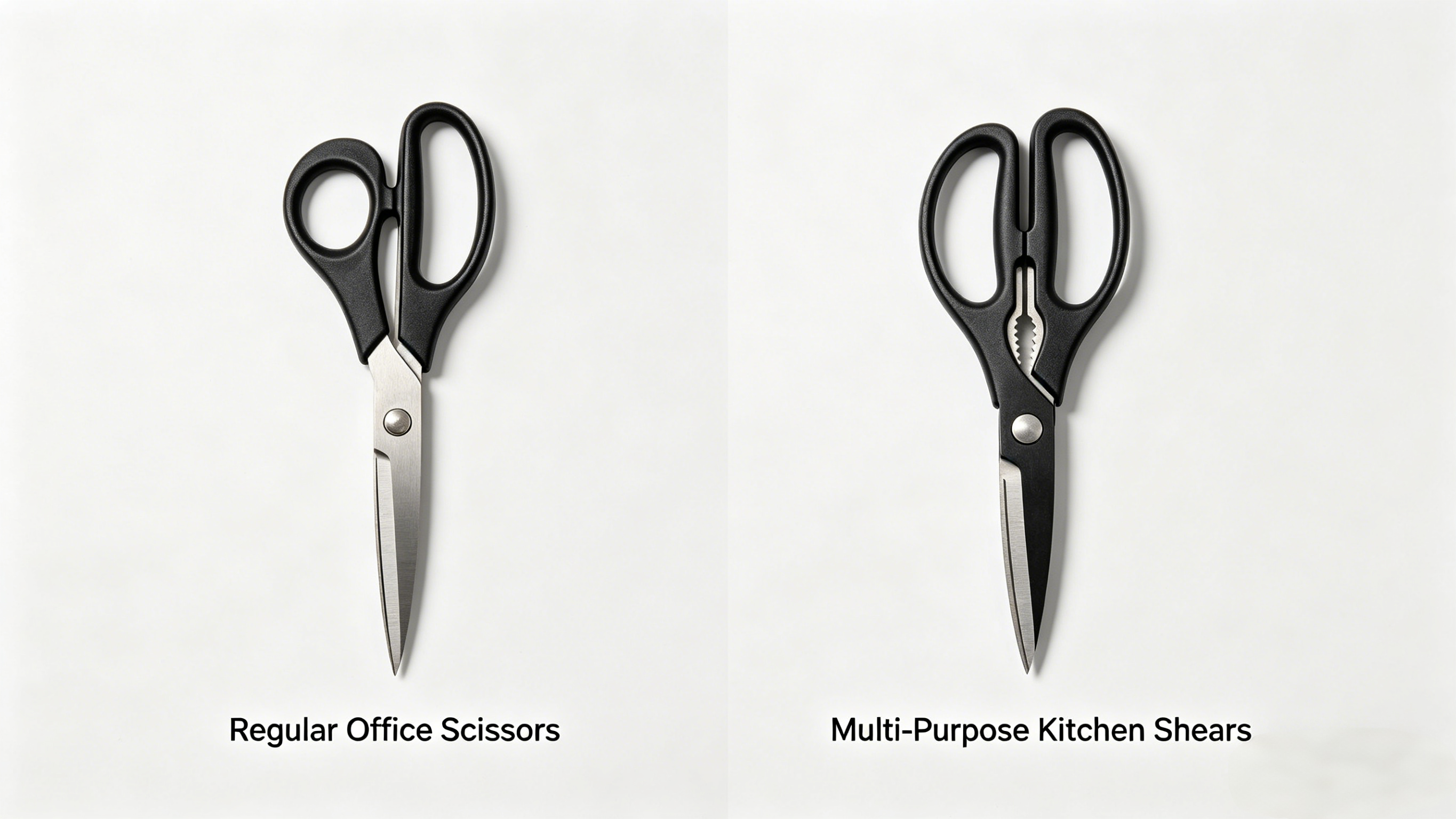
Regular scissors are usually made for paper, thread, packaging, or craft materials. Kitchen shears are shaped for food, where moisture, oils, bones, skin, and uneven textures are common. The difference is not only the sharpness of the blades; it is the way the whole tool distributes force.
- Blade geometry: Kitchen shears often use one smooth edge and one gripping edge so food is less likely to slide forward while cutting.
- Stronger leverage near the pivot: The area close to the joint gives more cutting power than the tip, which is why tougher tasks should be positioned near the pivot.
- Food-contact cleaning needs: Kitchen scissors may touch raw poultry, herbs, seafood, or sauces, so seams and joints must be cleaned carefully.
- Handle shape: Larger handle loops help the user apply controlled force, especially when hands are wet or when trimming meat.
Choosing Kitchen Shears for Your Cooking Habits
The best kitchen shears are the ones that match the tasks you actually perform. If you mostly cut herbs, parchment, noodles, or cooked food, a lightweight pair with fine tips may be more comfortable than a heavy-duty model. If you frequently break down poultry, trim fish fins, or cut through thicker food, pay closer attention to the pivot, handle grip, and rear cutting notch.
Before purchasing, ask practical questions instead of relying on feature lists alone. Do the blades open smoothly? Can the shears be taken apart for cleaning, or is the pivot fixed? Is the locking mechanism stable? Are the handle loops comfortable for left-handed and right-handed users, if that matters in your kitchen? If buying for a shared kitchen, consider whether the design is intuitive enough for multiple users.
Using Each Part Correctly
Using the right section of the blade helps protect both the food and the tool. The tip is best for delicate trimming, such as cutting herbs, snipping green onions, or opening thin packaging. The middle of the blade is useful for general cutting because it balances control and force. The area near the pivot provides the most leverage and should be used for tougher foods when the shears are designed for that purpose.
Avoid twisting the blades sideways while cutting. Twisting can loosen the pivot or damage the cutting edges. Do not use kitchen shears on wire, cans, frozen blocks, or other hard non-food materials unless the manufacturer specifically states they are suitable. Even strong shears can lose alignment when used outside their intended purpose.
Cleaning and Care After Food Preparation
Kitchen shears need more careful cleaning than office scissors because food residue can collect around the pivot, serrations, handle grooves, and locking clasp. After cutting raw meat or seafood, wash the shears promptly with warm water and dish soap. Pay special attention to the joint and any textured areas where residue can hide.
- Open the blades fully before washing so water can reach the pivot area.
- If the design separates into two pieces, clean both blade faces and the joint surfaces.
- Dry immediately after washing to reduce water spots and keep the pivot moving smoothly.
- Store the shears locked closed, preferably away from loose utensils that can nick the edges.
- Check the tension occasionally; if the blades feel loose or misaligned, follow the maker’s care instructions.
Dishwasher use depends on the product’s stated care guidance. If no clear instruction is available, hand washing is the safer routine because it limits harsh detergent exposure and reduces impact with other utensils.
Common Selection Mistakes to Avoid
One common mistake is choosing the heaviest pair available and assuming it will perform better. Weight can help with leverage, but it can also cause fatigue during small repetitive tasks. Another mistake is buying every possible add-on feature. Bottle openers, nutcracker-style grips, and bone notches can be useful, but they should not make the handle uncomfortable or harder to clean.
Also check balance. A pair of kitchen shears should feel stable when opened and closed, not blade-heavy or awkward at the handle. If you are comparing products online, look for clear photos of the pivot, blade edges, handle loops, and locking clasp. If details are missing, ask the supplier or seller for close-up images and care instructions before deciding.
Practical FAQ
Are kitchen shears the same as kitchen scissors?
The terms are often used interchangeably. In practice, “kitchen shears” usually refers to sturdier food-preparation scissors with features such as a stronger pivot, gripping blade, or handle tools.
Do I need a detachable pivot?
It is helpful if you cut raw meat, herbs, or sticky foods often because it makes deep cleaning easier. If the pivot is fixed, inspect and wash that area carefully after each use.
What part should I use for cutting chicken?
Use the section close to the pivot for better leverage, and only use a bone notch if the shears are intended for that task. Avoid forcing the tip through hard bone.
How do I know when kitchen shears need sharpening or replacement?
If food slips, herbs bruise instead of cutting cleanly, or the blades fold material rather than snip it, the edge may be dull or the pivot may be loose. Check alignment and care instructions first.
Can kitchen shears go in a dishwasher?
Follow the product’s care instructions. When guidance is unclear, hand wash and dry promptly, especially after contact with salty, acidic, or protein-rich foods.
Final Thoughts
Kitchen shears are useful because each part has a purpose: the tip handles precision, the blade edges control cutting, the pivot supplies leverage, and the handle affects comfort and safety. By understanding this anatomy, you can choose shears that match your cooking habits, use the correct cutting zone, and keep the tool cleaner for everyday food preparation.
