





Upgrade Your Kitchen with OEM Kitchen Scissors
OEM kitchen scissors are a useful category for retailers, distributors, private-label brands, and hospitality buyers that need practical cutting tools for everyday food preparation. Unlike general-purpose scissors, kitchen scissors are designed for tasks such as snipping herbs, trimming ingredients, opening packaging, and handling tougher kitchen jobs where a knife may be less convenient.
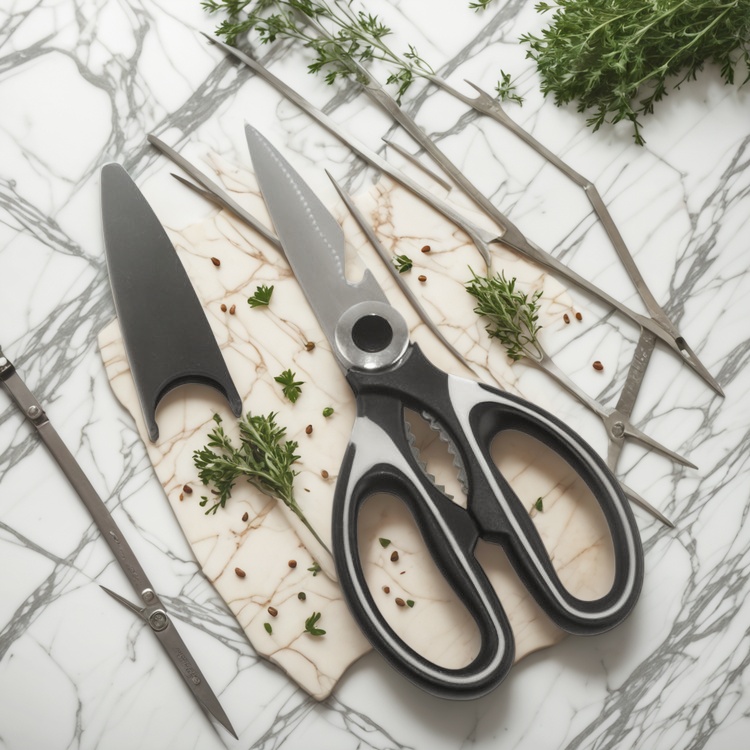
The original product presentation highlights several design details: stainless steel blades, finely serrated edges, an ergonomic dual-color grip, a protective cover, and a curved notch that can be used as a nut cracker or bottle opener. These are useful starting points for evaluating a kitchen scissors factory or kitchen shears manufacturing partner, but B2B buyers should still confirm all commercial and technical details before placing an order.
Key Takeaways
- OEM kitchen scissors should be evaluated by blade performance, handle comfort, safety storage, and multifunction use.
- Finely serrated stainless steel blades can help reduce slipping during common kitchen cutting tasks.
- A scissors with cover design supports safer storage and helps protect the blade edge between uses.
- B2B buyers should ask suppliers about materials, packaging, quality checks, customization, MOQ, and lead times rather than assuming them.
What Makes OEM Kitchen Scissors Different?
OEM kitchen scissors are produced for a buyer's brand, packaging concept, or channel requirements. For a wholesaler, this can mean consistent styling across a product line. For a retailer, it may mean packaging that fits shelf display needs. For a private-label brand, it may involve logo placement, color selection, user instructions, and carton labeling.
The important point is that OEM does not automatically guarantee a specific quality level. A buyer still needs to define the product brief clearly. That brief should describe the blade material required, handle color, cover design, packing method, barcode or label requirements, and any market-specific documentation the buyer needs to review. If a supplier has not stated a specification in writing, it should be treated as unconfirmed.
Blade Design and Cutting Performance
The source article describes the scissors as having stainless steel blades with finely serrated edges. In kitchen use, serrations can help grip food surfaces and reduce sliding, especially when cutting herbs, meat skin, or packaging. Stainless steel is commonly chosen for kitchen tools because buyers usually expect corrosion resistance and cleanability, although the exact grade should always be confirmed with the supplier.
When comparing samples, B2B buyers should test cutting performance on realistic materials. Do the scissors cut herbs cleanly without crushing them? Do they handle kitchen packaging without bending or twisting? Does the serrated edge feel even along the cutting length? A simple sample test can reveal differences that are not obvious from product photos.
Handle Comfort, Grip, and Safety Cover
The original description notes an ergonomically shaped handle with a dual-color grip. Handle comfort matters because kitchen scissors are often used repeatedly during food preparation. A grip that feels acceptable for one quick cut may feel uncomfortable when trimming multiple ingredients or preparing bulk orders in a catering environment.
The protective cover is also important. A scissors with cover format can reduce accidental contact with the blades in drawers, cartons, sample kits, or retail packaging. It can also help protect the cutting edge during storage and transportation. Buyers should ask whether the cover is included as standard, whether it locks securely, and whether it can be matched to the handle color or packaging concept.
Multifunction Details: Useful, But Verify Them
The product description mentions a curved notch that can serve as a nut cracker or bottle opener. Multifunction details can improve consumer appeal and make a product more competitive in a crowded kitchen tools category. However, buyers should avoid relying only on marketing claims. If a feature will be promoted on packaging or online listings, ask the supplier to show how it is intended to be used and confirm any limitations.
For wholesale and OEM programs, multifunction features should be simple, durable, and easy for end users to understand. A feature that looks interesting but is difficult to use may create returns or negative reviews. During sample evaluation, test each claimed function and decide whether it should be emphasized, mentioned briefly, or left out of your own product copy.
OEM Kitchen Scissors Sourcing Checklist
| Evaluation Area | What to Check | Questions to Ask the Supplier |
|---|---|---|
| Blade | Stainless steel blades and serrated cutting edge | What steel grade is used, and can it be documented? |
| Handle | Ergonomic shape and dual-color grip | Can handle colors be customized for OEM orders? |
| Safety | Protective cover fit and stability | Is the cover included, and how is it packed? |
| Function | Cutting, nut-cracker notch, bottle-opener use | Which functions are tested before shipment? |
| Packaging | Retail pack, bulk pack, label, instructions | What packaging options and artwork files are required? |
| Commercial Terms | MOQ, lead time, payment, inspection | What are the confirmed terms for this exact model? |
How B2B Buyers Should Compare Suppliers
A kitchen scissors factory should be evaluated on communication, sample consistency, production control, and willingness to answer detailed questions. Fast replies are useful, but they do not replace clear specifications. Ask for a written quotation that identifies the model, materials, accessories, packaging, customization scope, order quantity, and delivery assumptions.
For OEM kitchen scissors, buyers should also request pre-production samples before mass production. Compare the sample against your brief and keep an approved sample as a reference. If you require third-party inspection, labeling rules, or destination-market documentation, discuss those requirements early. Do not assume certifications, test reports, or compliance coverage unless the supplier provides current documents for the relevant product and market.
Use Cases for Retail, Wholesale, and Food Service
For retail buyers, the product image, cover, handle color, and packaging story may influence shelf appeal. The black and white color scheme mentioned in the source can work for a clean, neutral kitchen tools range, but color suitability depends on the buyer's assortment and brand direction.
For distributors and wholesalers, the main concerns are repeatable quality, carton handling, practical packaging, and a product description that does not overpromise. For food service or hospitality procurement, durability, easy cleaning, and safe storage may matter more than decorative appearance. In every channel, the product should be positioned around real kitchen utility rather than vague lifestyle claims.
Practical FAQ
What should I confirm before ordering OEM kitchen scissors?
Confirm blade material, handle material, cover inclusion, color options, packaging, logo method, MOQ, lead time, inspection process, and any documents required for your sales market.
Are serrated kitchen scissors better than smooth blades?
Serrated edges can help grip certain foods and packaging, reducing slippage during cutting. Buyers should still test samples because performance depends on blade geometry, assembly, and overall build quality.
Can scissors with cover be used for private-label products?
Often yes, but the exact customization options depend on the supplier. Ask whether the cover, handle, packaging, and printed materials can be customized for your brand.
Should I advertise the nut cracker and bottle opener functions?
Only if you have tested those functions and the supplier confirms them for the exact model you are purchasing. Clear, accurate product copy helps reduce customer complaints.
How can I reduce sourcing risk?
Use a written specification, approve samples before production, define packaging requirements, ask about quality checks, and consider shipment inspection for larger orders.
Final Buying Guidance
OEM kitchen scissors can be a practical addition to a kitchenware assortment when the product brief is clear and the supplier relationship is managed carefully. The stainless steel blades, finely serrated edge, ergonomic dual-color handle, protective cover, and multifunction notch described in the source are useful features to evaluate. For serious sourcing, the next step is not simply choosing a photo; it is confirming specifications, testing samples, and documenting every requirement before production begins.
