




A vegetable peeler looks uncomplicated until a retailer receives complaints about torn skins, wasted produce, uncomfortable handles, loose blades, or difficult cleaning. For importers, kitchenware brands, and wholesale buyers, selecting a vegetable peeler manufacturer requires more than collecting product photographs and factory prices. The key is making product performance measurable before the first bulk order and repeatable after the approved sample is stored away.
This article approaches procurement through a produce-to-blade qualification framework: test what a peeler actually removes, how much usable food remains, how comfortably the user controls it, and what happens when the tool is washed and used again. BONET HOUSEWARE's published M054 3-in-1 Vegetable Peeler and M042 Rotary Cylinder Peeler provide real product references, while unpublished certifications, minimum quantities, production schedules, and performance results remain matters for direct confirmation.
Quick Answer: Choose a vegetable peeler manufacturer by agreeing on the intended ingredients, exact blade configuration, component materials, sample tests, and inspection criteria. Compare controlled peeling performance, food waste, grip comfort, cleaning access, and retail packaging—not unit price alone. Approve a physical reference sample and written specifications before OEM production, and use the same controls to inspect subsequent shipments.
1. Why a Produce-Test Approach Matters to B2B Peeler Buyers
The practical value of a peeler is not merely that a blade touches a vegetable. It must engage skin reliably, follow an irregular surface, avoid excessive cutting into edible flesh, and allow the user to complete the job without repeated slips or difficult cleaning. A good retail sample should deliver the intended result in ordinary use, not only in an ideal demonstration recorded by an experienced salesperson.
Different purchasing teams care about different failures. A supermarket category manager needs a product that shoppers understand and can use safely. An importer needs consistency between samples and delivered cartons. A private-label brand needs evidence supporting its product claims and care instructions. An e-commerce seller needs compact, protective packaging and an accurate listing of included accessories. A foodservice-oriented distributor may need additional performance and cleaning evidence for the environments it serves.
This guide is designed for those professional buyers, not for purchasing a single household peeler. It is also not a substitute for evaluating industrial peeling equipment, nor a declaration that a household model is suitable for every commercial food-preparation setting. When use conditions become more demanding, the test plan must change accordingly.
An important distinction is peeling capability versus peeling efficiency. Two devices may both remove potato skin, but one may need more strokes, leave more waste, or cause the user to grip the vegetable awkwardly. Those differences cannot be resolved with a catalog photograph. Establish the tasks first, test the actual product, and then compare quotations against an identical specification.
2. Published BONET Peeler References: What Is Actually Known
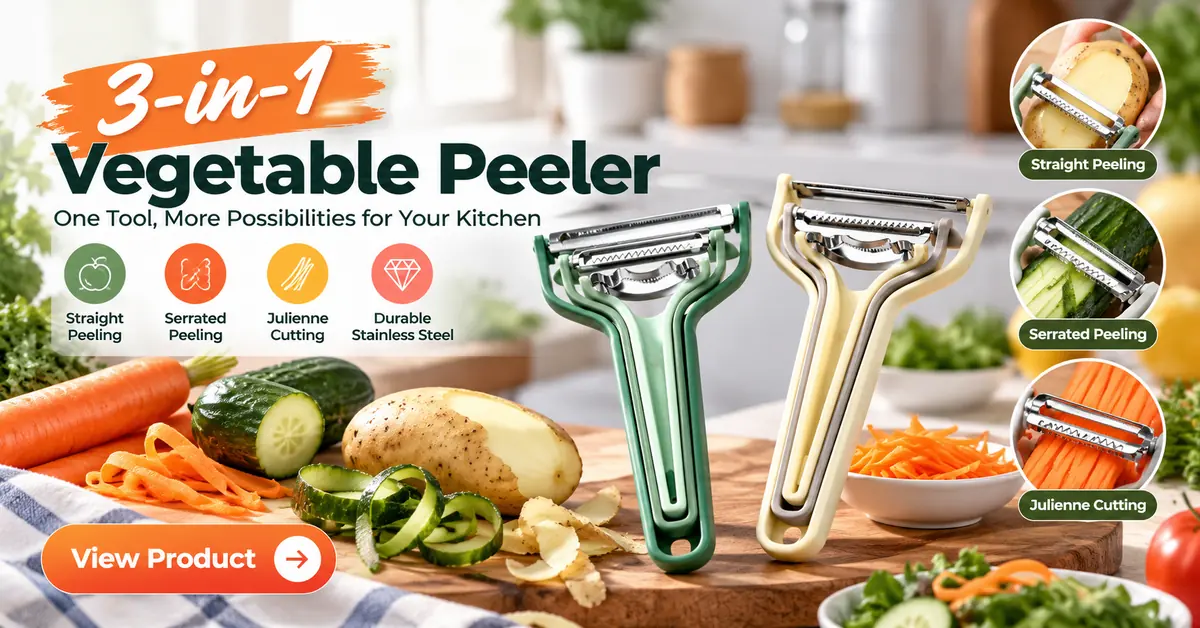
BONET HOUSEWARE operates in Yangjiang, China, and presents kitchenware manufacturing and OEM/ODM support on its website. Two useful public references are the M054 3-in-1 Vegetable Peeler and the M042 Rotary Cylinder Peeler. These are different product formats rather than two directly interchangeable sizes of the same tool.
| Published item | BONET M054 | BONET M042 |
|---|---|---|
| Public product name | 3-in-1 Vegetable Peeler | Rotary Cylinder Peeler |
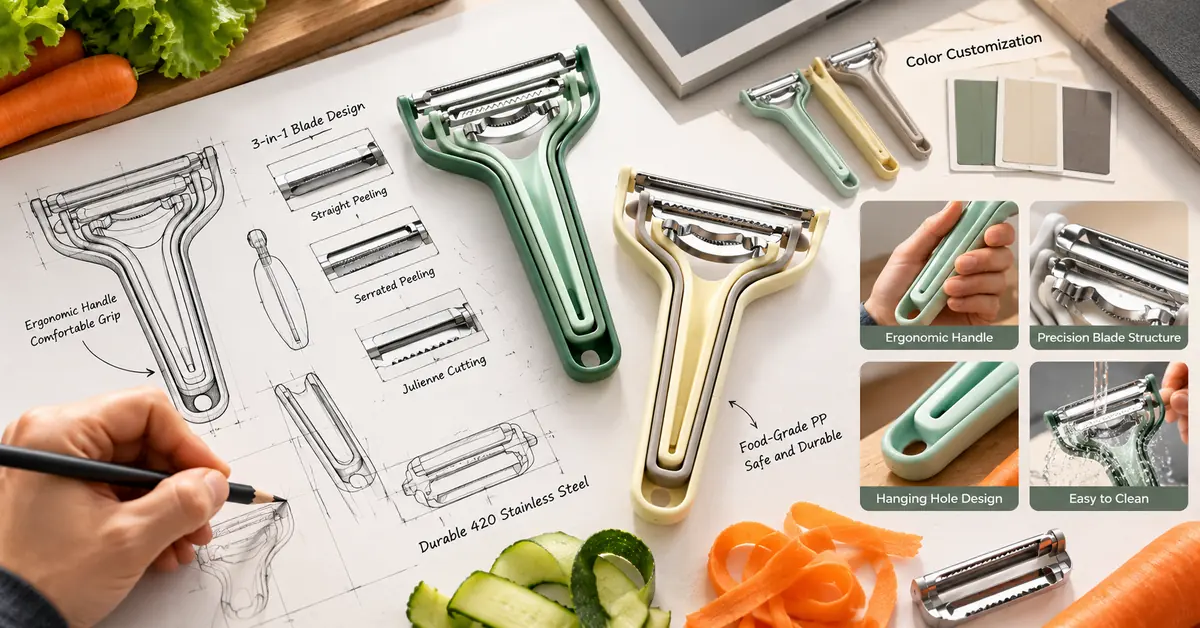
| Metal material | 420 stainless steel | 420 stainless steel |
| Plastic material | PP | PP |
| Listed dimensions | Large: 18 × 10.8 × 2.5 cm; medium: 15.1 × 9.2 × 2 cm; small: 13 × 6 × 2 cm | 20 × 8.5 cm |
| Listed weight | L: 32.6 g; M: 23 g; S: 16.5 g | 220 g |
| Public functional description | Straight, serrated and julienne roles | Modular cutting inserts with collection concept |
| Procurement clarification | Confirm size, exact blade selection and pack contents | Confirm inserts, collection assembly and intended tasks |
These figures are manufacturer-published descriptions, not independent performance test results. A model's listing does not establish its present MOQ, wholesale price, lead time, available private-label colors, certificates, or exact packing configuration. The M054 page mentions multiple sizes and blade roles; request the SKU-specific combination that would actually be supplied. For M042, check the complete container and insert package rather than assuming it is a conventional handheld peeler.
This disciplined starting point makes a manufacturer conversation more efficient. Instead of saying “send any vegetable peeler,” buyers can identify one documented reference, request a sample, specify their target tasks, and ask for a quotation against a precise configuration. The Multi Functional product category can support broader sourcing discussions, but the approved product page and sample should control the final specification.
3. Convert Consumer Tasks Into a Clear Peeler Specification
A sourcing brief should start with the intended task. Is the customer peeling firm potatoes, preparing long carrot strips, removing delicate tomato skin, making julienne garnish, or combining several jobs in a compact kitchen? A tool designed for one task may be less convenient for another. This is especially relevant to multi-blade products that are easy to overpromote by feature count alone.
Write down the primary ingredients, ideal peel result, expected user group, handling direction, storage arrangement, washing procedure and retail sales channel. Then separate requirements into essential, preferred, and optional. A normal household peeler may need a consistent straight-edge peel and safe storage. A salad-preparation device may prioritize uniform strips and cleaning access around multiple small cutting points. A branded gift product may require coordinated colors and packaging while still passing the basic cutting test.
The specification should also identify the exact blade, the plastic and metal components, any moving or replaceable parts, included guards, the material/appearance reference, the approved care instructions, and the retail package. Do not let the sales label “three functions” substitute for a component list. If a proposed design changes edge exposure, retention, handle profile or washing procedure, those changes need separate review before mass production.
An effective RFQ can then ask a potential vegetable peeler manufacturer to distinguish what is already available from what needs new development. This prevents buyers from treating a color change and a redesigned blade mechanism as the same level of OEM customization.
4. Blade Geometry: Why Straight, Serrated and Julienne Results Differ
Peeler behavior depends on edge shape, exposure, support, engagement angle and the way the edge follows the ingredient. The word “sharp” alone does not describe those characteristics. A blade can be sharp enough to cut yet difficult to control, prone to digging into food or ineffective on a soft surface. A supplier should be able to explain the intended function of the actual supplied edge and discuss how that function is checked.
A straight blade is generally evaluated on ordinary firm produce such as carrots and potatoes: clean engagement, manageable resistance, peel continuity and a reasonable removal depth. A serrated edge can provide different bite behavior on delicate or slippery skins; the buyer should look for clean engagement without tearing or crushing. A julienne edge produces multiple narrow strips, so its evaluation should consider strand formation, even spacing, safe handling and trapped residue. Treat julienne as its own preparation task, not a better straight-peeling score.
The M054 product description assigns straight, serrated and julienne roles to its multifunctional concept. This is useful information for a trial plan, but it does not provide measured cutting force, thickness, service-life or yield data. Buyers should not manufacture those figures for sales copy. The material designation “420 stainless steel” is also not proof by itself of final hardness, edge retention or performance after repeated cleaning.
If the design includes a rotating, detachable or stackable assembly, inspect the mechanism as carefully as the blade. Changes in blade position or attachment fit can alter cutting behavior even where the cutting edge appears identical. Make the approved physical sample, not a generic blade type, the reference for inspection.
5. A Produce-to-Blade Test Matrix for Supplier Qualification
For a vegetable peeler manufacturer, a practical qualification protocol makes different suppliers comparable. Select representative foods, prepare them under reasonably consistent conditions and record the procedure. Ripeness, size, moisture, skin thickness, and operator experience all influence test results. One especially favorable carrot or tomato is not enough to establish a bulk-order standard.
| Ingredient or task | What buyers should observe | Typical concern | Recommended record |
|---|---|---|---|
| Potato, firm skin | Edge engagement, remaining skin, gouging | Repeated strokes or excessive waste | Before/after photos, strokes, usable mass |
| Carrot, long strokes | Smoothness, strip continuity, hand stability | Jerking and unwanted cuts | Strip images, effort observations |
| Cucumber ribbons | Strip formation and relative consistency | Tearing or peel trapped near blade | Output photos, cleaning observations |
| Ripe tomato | Control on a soft surface | Slipping, damaged flesh | Operator notes and endpoint photo |
| Apple, rounded shape | Ability to follow changing curvature | Awkward angle or missed patches | Strokes, handling notes |
| Carrot or zucchini julienne | Strand separation and release | Uneven strands, clogged teeth | Strand sample, residue and wash notes |
This is a proposed buyer test matrix, not a report of completed BONET experiments. The acceptance criteria should be chosen after the target market and sample requirements have been agreed. A retailer selling an entry-level everyday peeler may emphasize potatoes and carrots. A specialty brand may choose tomato or julienne performance as the differentiator. Record different tasks separately rather than combining all functions into one subjective rating.
Ask the supplier to make available multiple representative samples when practical. It may be useful to rotate trained operators, blind the model identity during evaluation if feasible and record which ingredient batches were used. A short written protocol is more valuable than a long, unrepeatable demonstration video, because it can be applied to a later production sample.
6. How to Measure Peeling Yield and Waste Responsibly
Peeling yield addresses how much of the useful ingredient remains after completing an agreed task. A simple internal study can weigh a prepared piece of produce before and after peeling, photograph the endpoint and collect the removed skin and edible material. The result depends on the food and person performing the task, so treat it as comparative in-house evidence, not a universal laboratory certification of a peeler model.
A working formula is usable produce retention (%) = usable mass after the approved peeling task ÷ starting prepared mass × 100. For illustration, a buyer could compare two samples using matched potatoes and the same endpoint, then assess whether variation appears linked to blade angle or operator technique. This article does not claim any yield figure for M054, M042 or other BONET products. Any pass limit must be negotiated from actual pilot observations before commercial inspection.
Also record stroke count, interrupted strokes, visible gouges, peel fragments, clogging, and time to finish. For a julienne blade, the more relevant output may be the percentage of usable strips and how easily they separate—not “skin removed.” If effort matters, a buyer may use a defined tester rating or appropriate measurement equipment, but the chosen method and its limitations should be documented.
Make sure the comparison uses enough samples for a useful decision. One neat photograph cannot establish performance distribution across a shipment. The point is not to invent highly precise metrics; it is to turn “peels well” into observations that engineers, sourcing managers and suppliers can repeat and discuss. Actual requirements should reflect the consumer task, not an arbitrary number inserted to make the report look scientific.
7. Handle Grip and Ergonomics Across Repeated Tasks
Even an effective blade may disappoint when users cannot comfortably control it. A handle should support ordinary hand positions without encouraging unsafe contact with the edge. A smooth surface may feel pleasant with dry hands but behave differently when damp. Small handles may work well for compact storage yet be harder for some users to grip during repetitive preparation.
Check grip comfort, wrist angle, thumb location and clearance near the blade under safe test conditions. Consider right- and left-handed use where the planned market requires it. Record whether the product slips, twists or demands unusual pressure on potatoes, carrots and curved fruits. A household peeler need not meet an invented professional endurance target, but claims about ergonomic comfort should have a reasonable basis.
M054's product page lists several sizes and weights, which helps buyers define candidates. It does not by itself prove which size will be most comfortable for every user. M042 is a different modular format; its weight and collection structure should be evaluated with the appropriate operating sequence. Avoid presenting their listed dimensions as a direct ergonomic ranking.
For an OEM buyer, ask whether a handle-color change alters the material or surface feel, and whether a redesign changes tooling or blade alignment. Preserve the exact sample used for grip approval. A seemingly minor structural change can affect the way the peeler engages food and should not be released solely on appearance.
8. Materials, Food Contact, and Evidence Buyers Should Request
BONET identifies 420 stainless steel and PP plastic for M054 and M042. Those public materials are a starting point for technical review; they do not identify the full component bill of materials or independently establish food-contact conformity under every market and use condition. Ask which resin grade, colorants, metal components, coatings, adhesives or other accessories form the approved finished article.
For European Union sourcing, the European Commission identifies Regulation (EC) No 1935/2004 as the framework for food-contact materials, Regulation (EC) No 2023/2006 for relevant good manufacturing practices and Regulation (EU) No 10/2011 for plastic food-contact materials, as amended. For the United States, the FDA addresses authorization of relevant food-contact substances according to their identity and intended conditions of use. Appropriate evidence depends on the finished product, actual materials, contact conditions and destination market.
These references are procurement context, not a claim that BONET M054 or M042 carries a particular certificate or approval. Request current supporting documentation for the actual SKU, including scope, tested or declared formulation, issuer, date and any use limitations. A blanket phrase such as “FDA approved,” “LFGB certified,” “BPA-free,” or “dishwasher safe” should not be printed without checking the supporting evidence for the particular assertion.
Material identification also needs to be connected to workmanship. Look for molding flash, rough metal edges, exposed joints, crevices retaining food residues and loose components. Ask how blade and handle materials are identified on the manufacturing record, and what procedure addresses unauthorized substitutions on a repeat order. A steel designation alone cannot demonstrate edge service life or performance after cleaning.
9. Manufacturing Route: Follow the Critical Features, Not a Machine Count
A useful factory review follows the approved product through the steps that can affect performance. Depending on the peeler design, those steps may include incoming metal and resin checks, blade forming or processing, edge finishing, plastic molding or component sourcing, assembly, functional verification, cleaning and packing. The specific route must be confirmed for the quoted SKU; a generic manufacturing list does not mean every operation occurs in the same facility.
Ask the vegetable peeler manufacturer to identify the responsible process owner for the blade geometry, handle dimensions, retention mechanism and final functional test. Which characteristics are checked before assembly, and which can only be checked after the complete tool is built? How are nonconforming blades or handles separated from acceptable parts? If components come from specialist partners, what acceptance standards apply when they arrive?
A concise process-control map can have five gates: incoming components, critical cutting-edge operation, handle/assembly fit, functional test, and packed-unit release. Each gate should have a defined sample or record and an escalation procedure. That makes quality traceable without pretending all suppliers have identical equipment or automation.
BONET's OEM/ODM page describes requirement communication, design and sampling, quotation confirmation, mass production, inspection, and delivery. Buyers can use this six-stage collaboration structure to assign ownership to each peeler-specific approval. The useful evidence is the actual sample and process record, not a general claim that a factory produces thousands of products.
10. Blade Retention, Sharp-Edge Protection, and Cleaning Access
A vegetable peeler places sharp metal close to a user's hand. Buyers should therefore inspect edge retention and protection as part of normal product qualification. For fixed-blade formats, examine visible looseness, misalignment, rough joints, exposed points and the way the edge sits in its holder. For rotating, removable or modular designs, test the locking or fitting action through the intended use and cleaning cycle.
The most meaningful retention test depends on the exact configuration. Do not invent universal pull-force thresholds or lifetime cycles. Agree on a practical test method with the supplier, have the sample handled by trained personnel, and record any unapproved movement or failure. If the tool has protective accessories, confirm that the purchase specification includes them and that they remain secure during the agreed packing and handling conditions.
Cleaning matters because vegetable fibers can become trapped at pivots, serrations, julienne teeth and plastic seams. Ask testers to peel the relevant produce, clean according to the proposed care directions, inspect hard-to-reach surfaces and reassemble any detachable parts. Observe residue, awkward hand positions and parts that are easy to misplace. The test ends only when the tool is ready for another use, not immediately after the initial peeling demonstration.
The public M054 page discusses storage and cleaning, and the M042 page describes modular parts. Buyers should verify these descriptions against the current supplied version and its approved care instructions before making unqualified claims about machine washing, cleaning time, or everyday durability. A compelling demonstration can highlight actual tested features without claiming performance that has not been established.
11. Set Inspection Rules for Repeatable Wholesale Shipments
A vegetable peeler manufacturer cannot use one successful sample to prove that every production unit will behave the same way. A buyer needs an inspection plan covering materials, cutting function, assembly and packaging. Such a plan should define how the factory checks products during production and what the importer can review before shipment. It should also distinguish potentially hazardous defects from cosmetic flaws and minor packaging issues.
| Control stage | Check to specify | Recommended evidence | Buyer purpose |
|---|---|---|---|
| Incoming material | Approved blade and handle component identity | Material or supplier records | Avoid unauthorized substitutions |
| Assembly | Blade fit, retention and visible finish | Assembly check sheet | Limit loose or misaligned parts |
| Functional review | Specified produce test and intended blade functions | Sample-linked test record | Match the approved product experience |
| Cleanability | Residue, access, disassembly or reassembly | Observation sheet | Confirm practical care instructions |
| Appearance | Finish, colors, marking and molding condition | Golden sample comparison | Maintain retail consistency |
| Pack-out | Included accessories, edge guard, barcode, instructions | Packed sample and carton checklist | Reduce claims and picking errors |
| Shipment release | Lot identification and agreed sampling approach | Final inspection report | Support traceability and decisions |
Where statistical acceptance sampling is appropriate, buyer and manufacturer should agree on the applicable plan, sample size, inspection level, defect classes, and remedies. This article does not assert that BONET currently uses any specified AQL or that a given defect rate has been achieved. A high internal SEO/GEO content score should never replace hard product evidence.
For multiple blade sizes, colors or retail pack variants, identify which checks apply to each SKU. An incorrect variant in the right box is a packing problem; a correctly labeled product with poor blade retention is a more serious technical issue. Both require corrective action, but they should not be hidden inside one averaged “quality score.”
12. Compare M054 and M042 Without Making a False Ranking
The M054 and M042 references address different shopping and preparation ideas. M054 is described as a 3-in-1 peeling system, while M042 is a modular cylinder-style tool with a collection concept. A supplier comparison is useful only after the buyer decides whether the target consumer wants a simple handheld peeler or a multifunction preparation device with additional components.
| Comparison issue | M054 sourcing question | M042 sourcing question |
|---|---|---|
| Consumer task | Which of the straight, serrated and julienne functions is essential? | Which cutting insert and collection functions are included? |
| Hand operation | Which published size fits the target user and pack? | How is the modular tool held and operated? |
| Cleaning | Are cutting areas and stacked parts accessible? | Can containers and inserts be cleaned and reassembled? |
| Component security | Is each blade securely mounted in the approved form? | Are inserts properly retained and correctly identified? |
| Retail pack | Does packaging protect the right blade/variant? | Does every quoted insert appear in the BOM and carton? |
| Commercial comparison | Confirm SKU-specific MOQ, price and schedule | Confirm full-system cost, included pieces and schedule |
No published comparative peeling-yield results, service-life data or retail margin estimates are established by these pages. A brand can still make a strong decision by treating each as a candidate for its own defined consumer task. Where the expected product is a simple peeler, avoid paying for features the audience will not use. Where the added functions support a credible retail proposition, ensure the supplier can document the complete kit and its quality controls.
13. OEM/ODM: Separate Logo Changes From Blade Development
BONET describes OEM support for production by drawing or sample, material and color customization, branding and packaging, plus ODM support for concept development, structural optimization, samples and manufacturing coordination. These capabilities provide a process for discussing an inquiry, not a blanket guarantee that every modification is possible on every existing model.
For private-label vegetable peelers, packaging and approved color or logo changes may be less complex than altering blade exposure, handle mechanics or insert retention. A structural redesign can involve new engineering review, possible tooling, different testing, and revised documentation. Ask the supplier to identify the distinction before accepting a price or promised launch date.
Confirm who controls drawings, artwork, mold or tooling ownership if relevant, approved material sources, and change authorization. Request a physical sample bearing the actual branding and packed in the intended retail presentation. A cutting tool should not be released on a graphic proof alone: printed descriptions, color, accessory count, product geometry and safe packaging must all agree.
An effective OEM project also respects intellectual property and confidentiality. Keep proprietary drawings and development requirements within approved communications; determine which marketing images and testing records may be used publicly. A buyer can request an exclusivity discussion where relevant, but no exclusivity right should be implied without an agreement.
14. Lead Time, MOQ and Landed Cost: What a Quotation Must Include
A peeler's factory price is not the entire procurement cost. Blade style, insert count, plastic color, logo method, retail pack, protective components, carton dimensions, sampling, inspection and freight all affect the economics. A compact single-item household peeler and a modular preparation set should be costed differently. Compare quotations only when they refer to the same approved configuration, quantity and trade term.
The public M054 and M042 information does not establish a standard wholesale MOQ, universal sampling charge, fixed production lead time or current export price for a custom order. Ask BONET to quote the exact SKU and distinguish standard stock, custom color, packaging print runs and structural development if relevant. Identify which charges are one-time and which recur per unit. Record quote currency, named delivery location, Incoterms rule and validity period.
A simple hypothetical example illustrates why packaging cannot be ignored: a peeler priced at $1.00 with $0.30 of allocated packing and transport has a $1.30 subtotal, while one at $1.08 with $0.15 in those costs has a $1.23 subtotal. These figures are invented for calculation only, not BONET prices or market benchmarks. A real landed-cost model must also account for duties, inspection, expected losses, local handling and channel fees without double counting.
Avoid expanding order quantity simply to receive a lower quote if the additional stock may become obsolete. A small approved pilot can be useful when a brand is testing a new blade format, provided the manufacturer confirms that such an order is feasible. Reorder planning should incorporate total replenishment time, packaging inventory and documented product revisions.
15. Retail Packaging and the End-Customer Promise
The package must tell the truth about the shipped product. If a listing advertises three blade functions, the physical item, accessories and instructions must match that description. For a supermarket display, evaluate hanging presentation, barcode position, shelf footprint and protection against accidental blade contact. For e-commerce, test the packed product against the expected parcel-handling environment and verify that the listing photography reflects the actual color and configuration.
A useful approval file includes a final packed sample, artwork revision, component count, care instructions, any necessary safety notices and master-carton specifications. Avoid unsupported declarations of certification, dishwasher compatibility, exclusive materials or unusual durability. For food-contact-related claims, the retailer should review the documents applicable to the intended market and finished item.
Packaging affects consumer understanding as well as freight costs. A clear illustration of the intended blade purpose may reduce confusion when a peeler has multiple modes. Conversely, a box with impressive feature numbers but unclear operating steps can create unnecessary frustration. Make the functional message specific: which blade is for what ingredient, how to change or handle it, and how to clean it according to the approved instructions.
For brand programs, the article's main commercial lesson remains constant: a vegetable peeler manufacturer should provide the approved product and packaging as one controlled commercial unit, rather than treating a loose sample and a future print file as unrelated promises.
16. A Peeler RFQ Buyers Can Send to BONET HOUSEWARE
A useful quotation request to a vegetable peeler manufacturer should distinguish what is already available from what requires technical review. Begin with the M054 product, the M042 product, or your own reference drawing. Then send a concise brief covering the intended use, target country, estimated quantities, selected material and blade configuration, branding and packaging requirements, testing documents and target schedule.
| RFQ topic | What the buyer provides | What to request back |
|---|---|---|
| Product reference | M054, M042 or drawing and intended tasks | Available design and precise variant |
| Functions | Straight, serrated, julienne or modular requirements | Included components and feasibility |
| Material evidence | Destination market and required claims | Applicable product-specific documentation |
| Quantities | Trial estimate and reorder range | MOQ by option and volume price breaks |
| Branding | Logo, color sample, artwork and pack format | Methods, approvals and setup charges |
| Quality | Produce-test matrix and acceptance concerns | Sample plan and inspection arrangement |
| Delivery | Destination, target arrival and desired term | Lead-time breakdown and shipping basis |
Ask the supplier to classify its response as available as listed, possible subject to design or sampling review, or not currently confirmed. That makes the first inquiry far more actionable than “What is your best price?” It also provides a clean record for the purchaser's engineering, regulatory, sales and logistics colleagues.
Use BONET's contact page to request samples and discuss the exact product. Buyers can also review the OEM/ODM collaboration process and the complete kitchenware catalog when planning a coordinated retail product range.
Frequently Asked Questions About Vegetable Peeler Manufacturing
1. What should I ask a vegetable peeler manufacturer before ordering?
Ask for the exact model, included blade types, published dimensions, component materials, intended food-preparation tasks, available samples and current quotation basis. Define the tests that matter to your customer, and require an approved packed sample and inspection plan before releasing a wholesale order.
2. Does BONET offer a 3-in-1 vegetable peeler?
Yes. BONET publicly lists M054 with 420 stainless steel, PP plastic and multiple size/weight options. Its description identifies straight, serrated and julienne uses. The buyer should confirm which size, blades and retail accessories are included in the specific quotation.
3. How does M042 differ from M054?
M042 is marketed as a rotary cylinder-style modular preparation tool with interchangeable inserts and a collection concept. M054 is presented as a 3-in-1 peeler. Their suitability depends on the planned tasks, consumer expectations, cleaning routine, package and approved configuration; they should not be ranked without a common test brief.
4. How can importers test peeler sharpness and waste?
Use representative ingredients, a consistent endpoint and a recorded procedure. Check edge engagement, strokes, peeling continuity, gouging and retained usable mass. For a julienne attachment, assess strip output rather than skin waste. If numerical criteria are required, establish them from actual pilot tests rather than inventing manufacturer results.
5. What is the benefit of 420 stainless steel?
It is a useful published material designation for the listed BONET products, but does not independently prove a particular edge life, final hardness, corrosion result or cleaning performance. Those properties also depend on geometry, processing, assembly and operating conditions. Request relevant evidence for the specific tool rather than relying on the grade name alone.
6. Are the peelers certified for European or US food contact?
No product-specific certificate for M054 or M042 has been independently established in this guide. Importers should verify applicable regulations, the finished product composition and supporting documents for their market. Regulatory citations in a buying guide are not substitutes for test reports or declarations covering the actual supplied configuration.
7. Can BONET customize the peeler's color, logo and packaging?
BONET publicly describes OEM/ODM options including colors, branding, material discussions and packaging support. Availability for a particular model, logo method, quantity and finish requires project confirmation. Any material or blade-structure change should trigger a proportionate technical and sample review.
8. What is BONET's MOQ for M054 or M042?
The reviewed product information does not establish a single confirmed wholesale MOQ for every variant or custom package. Provide the proposed quantities, color, artwork, pack type and expected future order range to obtain a specific answer. Do not assume a minimum stated for another kitchenware category applies to peelers.
9. Which packaging should I choose for retail?
Choose based on the sales channel and approved product structure. A hanging retail pack needs clear function labels, safe blade protection and barcode placement. An e-commerce pack needs protection during delivery and an accurate component list. Evaluate real packed samples and confirm carton dimensions before final approval.
10. How do I keep the next shipment consistent with the approved sample?
Keep a version-controlled product specification, physical reference, material records, performance test matrix, final artwork, accessory list, pack-out instructions and inspection agreement. Require notification before changes to blade geometry, retention parts, plastics, colorants or packaging claims. Apply the same approved checks to repeat orders.
Conclusion
A reliable vegetable peeler manufacturer should help a B2B buyer turn a simple-looking kitchen tool into a clearly specified, testable and repeatable product. Peeling yield, edge engagement, handle comfort, secure blade construction, material evidence, cleaning access and quality inspections all contribute to the user experience and the economics of a wholesale program. The strongest purchasing decision is based on a documented sample and task-specific tests rather than generic claims or price alone.
BONET HOUSEWARE offers published references including the M054 3-in-1 Vegetable Peeler and M042 Rotary Cylinder Peeler, alongside an OEM/ODM collaboration process. Those sources provide a foundation for a sourcing discussion, while the exact sample, documents, MOQ, schedule and quotation must be agreed for each purchase. Contact BONET HOUSEWARE with your selected model, market, intended ingredients, order range and branding brief to begin a technically informed inquiry.
