




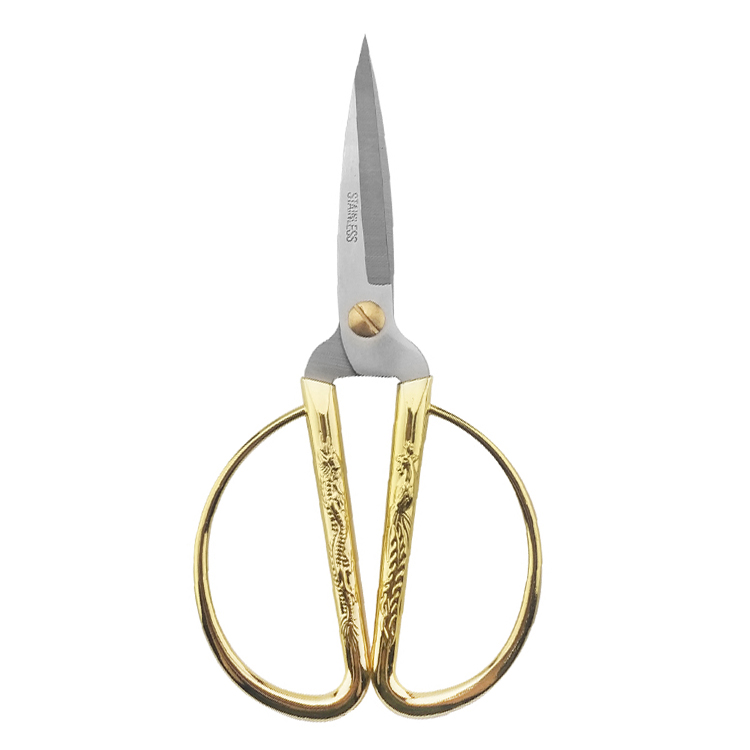
Vintage Tai Chi Household Scissors: Practical Buying and Care Guide
Household scissors are simple tools, but the right pair can make everyday cutting tasks cleaner, safer, and more comfortable. Vintage-style Tai Chi household scissors are designed for people who want a useful cutting tool with a decorative Chinese-inspired appearance. The original product description highlights stainless steel blades, ornate gold-tone handles, an engraved wheat pattern, and ergonomic handle loops intended to support precise control during use.

This guide explains what to look for before choosing decorative household scissors, how to use them appropriately, and what questions retailers, giftware buyers, and sourcing teams should ask when evaluating a supplier.
Key Takeaways
- Vintage Tai Chi household scissors combine a decorative Chinese-style handle design with everyday cutting utility.
- The source description states that the blades are made from high-quality stainless steel and are suitable for materials such as paper and delicate fabrics.
- Ornate gold-tone handles with an engraved wheat pattern make the scissors suitable for visible storage, craft desks, sewing kits, and gift sets.
- Buyers should verify blade material, handle material, finish durability, packaging, inspection standards, and after-sales terms before placing wholesale or OEM orders.
What Makes Tai Chi Household Scissors Different?
Many household scissors are purely functional, with plain plastic handles and basic blades. Tai Chi household scissors are positioned differently: they are intended to be both a cutting tool and a decorative object. The vintage styling, gold-tone handle finish, and engraved wheat pattern create a more traditional visual character than standard office or kitchen scissors.
The Tai Chi reference suggests balance and symmetry, which fits the product’s combination of utility and ornamentation. For home users, that means the scissors can sit on a sewing table or craft station without looking out of place. For retailers, the design may appeal to shoppers looking for gifts, sewing accessories, stationery add-ons, or distinctive household tools.
Blade Performance and Suitable Uses
The original article states that these scissors use stainless steel blades and are intended to cut materials such as delicate fabrics and paper. Stainless steel is commonly used in household cutting tools because it can offer corrosion resistance and dependable sharpness when properly maintained. However, the exact steel grade, hardness, blade thickness, and edge angle are not provided in the source, so buyers should request those details from the supplier if they affect the intended application.
Typical suitable uses may include:
- Cutting paper for home, office, or craft projects
- Trimming thread, ribbon, and light sewing materials
- Handling delicate fabric cuts where control matters
- General household tasks that do not involve hard wire, thick plastic, or food preparation
To maintain edge life, users should avoid cutting abrasive, sticky, or very hard materials unless the supplier confirms that the blade is designed for those tasks. A decorative household scissor should not automatically be treated as a heavy-duty workshop tool.
Handle Design, Comfort, and Control
The scissors are described as having ornate gold-tone handles with engraved wheat detailing. The handle loops are also described as ergonomic and intended to reduce hand fatigue during extended use. This is important because comfort affects cutting accuracy, especially for crafting, tailoring, and repeated trimming tasks.
When assessing comfort, look beyond appearance. A well-designed handle should allow the fingers to settle naturally into the loops without sharp pressure points. The inner edges should feel smooth, and the handle should not twist or flex during normal use. If the scissors will be sold to craft users or sewing enthusiasts, a sample test is worthwhile: cut multiple sheets of paper, trim a fabric edge, and make several small curved cuts to evaluate control.
Comparison Checklist for Buyers
Use the following checklist when comparing vintage-style household scissors with standard household or craft scissors. It can help both consumers and B2B buyers judge whether the product fits the intended use.
| Selection Point | What to Check | Why It Matters |
|---|---|---|
| Blade material | Confirm stainless steel details and ask for the specific grade if needed | Material affects corrosion resistance, edge retention, and care requirements |
| Cutting purpose | Test paper, ribbon, thread, and delicate fabric | Ensures the scissors match everyday household or craft use |
| Handle comfort | Check loop size, inner smoothness, and grip stability | Comfort improves control and reduces fatigue during repeated cuts |
| Decorative finish | Inspect the gold-tone surface and engraved wheat pattern | Finish quality matters for gift, retail, and display value |
| Packaging | Ask whether retail packaging, protective sleeves, or custom packaging are available | Packaging protects the blade and supports retail presentation |
| Quality checks | Ask how sharpness, alignment, pivot tension, and appearance are inspected | Consistent inspection reduces returns and buyer complaints |
Use and Care Tips for Longer Service
Even attractive household scissors need basic maintenance. Good care keeps the blades cleaner, helps preserve cutting performance, and reduces the chance of stains or stiffness at the pivot.
- Wipe the blades after use, especially after cutting tape, adhesive labels, or coated paper.
- Keep the scissors dry. If they become wet, dry the blades and pivot area before storage.
- Store them in a drawer, case, or upright holder where the edges are protected.
- Do not use them as a screwdriver, pry tool, wire cutter, or package opener for hard plastic strapping.
- If the pivot becomes stiff, ask the supplier whether light lubrication is recommended for this model.
- Keep scissors away from children unless supervised, because decorative tools can still have sharp blades.
If the scissors begin pulling fabric instead of cutting cleanly, the issue may be blade dullness, pivot looseness, or material mismatch. Do not force the cut; inspect the blades and consider professional sharpening if appropriate.
B2B Sourcing Questions for Wholesale and OEM Buyers
For retailers, distributors, and private-label buyers, the visual design is only one part of the decision. Before confirming an order, ask the supplier clear questions rather than assuming details that are not listed.
- What is the exact blade material and surface treatment?
- What is the handle material, and how is the gold-tone finish applied?
- Can the supplier provide samples for cutting, finish, and packaging review?
- What inspection steps are used for blade alignment, sharpness, handle finish, and pivot tension?
- Are custom packaging, logo placement, or labeling options available?
- What are the minimum order quantity, lead time, payment terms, and replacement policy?
- Are there any market-specific compliance documents required for the buyer’s destination?
These questions are especially important for decorative scissors because customer satisfaction depends on both appearance and cutting quality. A product that looks attractive in photos must still perform reliably in the hand.
FAQ
Are these scissors only for decoration?
No. The source describes them as household scissors with stainless steel blades for cutting materials such as paper and delicate fabrics. Their decorative handle design adds visual appeal, but they are still intended to be used as scissors.
Can they be used for sewing projects?
They may be suitable for light sewing tasks such as trimming thread, ribbon, and delicate fabric. For thick fabric layers or professional tailoring work, buyers should test samples and confirm blade specifications with the supplier.
Do the scissors have stainless steel blades?
Yes, the original article explicitly states that the blades are made from high-quality stainless steel. It does not state the exact stainless steel grade, so that should be confirmed when sourcing.
How should I clean them?
Wipe the blades with a dry or slightly damp cloth, remove adhesive residue promptly, and dry them before storage. Avoid soaking the scissors unless the supplier confirms that it is safe.
What should wholesale buyers verify before ordering?
Wholesale buyers should verify blade material, handle material, finish durability, sample quality, packaging options, inspection procedures, lead time, MOQ, and any documentation needed for the target market.
