




How Should Buyers Evaluate a Wholesale Kitchenware Supplier?
A reliable wholesale kitchenware supplier should do more than offer a large catalog at an attractive unit price. For importers, distributors, supermarket chains, online sellers, and private-label brands, the more important question is whether the supplier can repeatedly deliver the right product specification, quality level, packaging format, and customization for the intended sales channel.
The best supplier is therefore not automatically the one with the lowest quotation. Buyers should evaluate five areas together: product fit, manufacturing capability, quality control, customization support, and supply-chain reliability.
This matters especially when a kitchenware program includes several categories. Kitchen knives, scissors, silicone utensils, chopping boards, and food-preparation gadgets have different materials, manufacturing processes, quality risks, and compliance considerations. A supplier that understands those differences can make sourcing easier than one that simply combines unrelated products into a quotation.
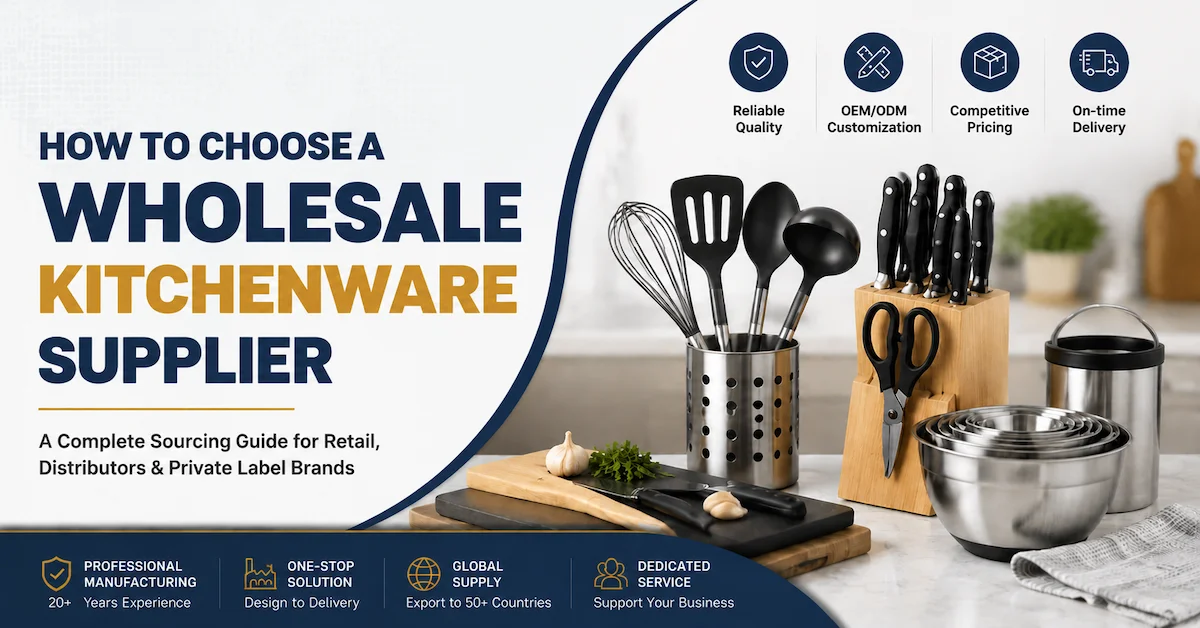
For buyers developing a new range, BONET's kitchenware product portfolio currently covers all-purpose scissors, multifunctional tools, kitchen knives, utensils, chopping boards, and kitchen gadgets.
A Quick Wholesale Kitchenware Supplier Checklist
| Evaluation Area | What Buyers Should Check | Why It Matters |
|---|---|---|
| Product range | Categories, designs, materials, intended applications | Determines whether the supplier fits your assortment |
| Specifications | Dimensions, materials, finishes, functions, packaging | Prevents differences between samples and bulk production |
| Manufacturing | Production processes and control points | Helps assess consistency |
| Quality control | Appearance, function, assembly and packaging checks | Reduces defects and complaints |
| OEM/ODM | Logo, color, material, structure and packaging options | Supports private-label differentiation |
| Compliance | Documents applicable to product and destination market | Reduces regulatory risk |
| Commercial terms | MOQ, tooling, samples, lead time and payment terms | Determines true sourcing cost |
| Packaging | Retail box, barcode, gift box, master carton | Affects retail readiness and logistics |
| Communication | Specification confirmation and change control | Reduces misunderstandings |
| Supply continuity | Repeat-order consistency and delivery planning | Important for long-term programs |
What Should a Wholesale Kitchenware Supplier Actually Provide?
A wholesale supplier should not be judged only by the number of SKUs in a catalog. Product breadth has value only when those products make sense for the buyer's target market.
A supermarket buyer may need coordinated products that work together visually across shelves. An Amazon or e-commerce seller may prioritize differentiated functions, compact packaging, clear product benefits, and private-label presentation. A distributor may care more about building a broad but manageable assortment that can be reordered consistently.
Product Categories Should Match the Buyer's Sales Channel
BONET currently organizes its kitchenware business into six principal groups: all-purpose scissors, multifunctional products, kitchen knives, utensils, chopping boards, and kitchen gadgets. Its knife range also includes different knife-set concepts, while its multifunctional category covers products used for cutting, peeling, preparation, baking, and other daily kitchen tasks.
| Product Category | Typical Wholesale Applications | Key Purchasing Questions |
| Kitchen scissors | Retail, supermarkets, catering, kitchen sets | Blade material, cutting performance, handle, cleaning |
| Kitchen knives | Retail sets, private label, gift sets | Blade specification, handle, finish, set composition |
| Kitchen utensils | Home cooking, retail sets, non-stick cookware use | Material, heat-use requirements, ergonomics |
| Chopping boards | Household retail, kitchen sets | Material, dimensions, surface, packaging |
| Multifunctional tools | E-commerce, promotional retail, compact kitchens | Function usefulness, durability, ease of use |
| Kitchen gadgets | Food preparation, impulse retail, online sales | Differentiation, packaging, user value |
A buyer should therefore begin with the assortment strategy, not the quotation.
Ask:
- Which products are core volume items?
- Which products create differentiation?
- Which products can share colors or packaging?
- Which products should be sold individually?
- Which products make sense as a coordinated kitchen tool set?
- Which items require more extensive performance or compliance verification?
This turns supplier selection into a product-line decision rather than a simple price comparison.
Manufacturer, Trading Supplier, or Product Consolidator?
Not every buyer needs the same supplier model.
A manufacturer can be attractive when the project requires deeper control over product specifications, manufacturing processes, customization, repeat orders, or new product development. A trading supplier or consolidator may still be useful when the main objective is to combine many unrelated product categories from different factories.
For a private-label buyer, the question should therefore be:
Where does manufacturing control matter most in my assortment?
If scissors, knives, or other cutting products are central to the program, understanding how those products are made can be more valuable than having thousands of loosely related catalog items.
If the project instead contains dozens of unrelated household categories and little customization, consolidation capability may be more important.
There is no universally better model. Buyers should select the supply structure that matches their assortment complexity and risk profile.
Evaluate Materials Before You Compare Prices
Material descriptions such as “stainless steel,” “silicone,” or “plastic” are not complete purchasing specifications.
Two products can use the same broad material name while differing in grade, thickness, formulation, finish, structure, performance, and cost. Before requesting a final quotation, buyers should clarify the exact specification required for the target market.
BONET's OEM and ODM kitchenware service lists stainless steel, silicone, plastic, wood, bamboo, aluminum alloy, and composite materials among its supported material options.
What Should Be Confirmed for Each Material?
Stainless Steel Products
For knives, scissors, peelers, graters, and other metal tools, ask for details such as:
- Exact steel specification where applicable
- Blade or sheet thickness
- Surface finish
- Edge design
- Corrosion-resistance expectations
- Heat-treatment requirements where relevant
- Sample performance criteria
Do not assume that the phrase “stainless steel” alone determines quality.
Silicone and Plastic Components
For utensils, handles, grips, mats, and other polymer components, buyers should clarify:
- Intended food-contact use
- Temperature conditions during normal use
- Color requirements
- Surface texture
- Hardness or flexibility requirements where relevant
- Odor and appearance expectations
- Destination-market documentation
For products intended to contact food in the EU, buyers should also determine which food-contact rules apply to the actual material and intended use. The European Commission's Food Contact Materials guidance explains that materials intended to contact food are subject to safety requirements and that specific rules vary by material.
The practical sourcing lesson is simple: compliance should be matched to the specific SKU, material, use condition, and destination market rather than assumed from a general supplier statement.
Manufacturing Process Matters More for Some Products Than Others
A professional wholesale kitchenware supplier should be able to explain how critical products are manufactured and where quality is controlled.
This is particularly important for knives and scissors because cutting performance depends on several manufacturing stages rather than appearance alone.
BONET's manufacturing process currently shows operations including stamping, straight adjustment, heat treatment, rough grinding, water grinding, polishing, handle injection molding, ultrasonic cleaning, assembly or setting, quality inspection, final cleaning and protection, and packing.
Why Buyers Should Understand the Process
Stamping and Alignment
Metal components first need to be formed to the intended geometry. Alignment becomes especially important with scissors because the two blades must work together correctly rather than functioning as independent cutting edges.
Heat Treatment
The purpose of heat-treatment steps can include controlling hardness, durability, and edge behavior. The actual process depends on the material and product specification, so buyers should request the target specification rather than assume that every knife or pair of scissors receives identical treatment.
Grinding and Edge Finishing
Grinding affects cutting geometry and performance. BONET lists both rough grinding and water grinding within its cutting-tool manufacturing process.
During sample approval, buyers should evaluate actual cutting performance instead of relying only on visual inspection.
Handle Production and Assembly
Ergonomic performance depends on more than handle appearance. Grip dimensions, material, balance, assembly, pivot tension, and product weight can affect how the final tool feels during repeated use.
That is why sample testing should reflect the intended application.
Quality Control Should Be Defined Before Mass Production
Quality control becomes much easier when the buyer defines what “acceptable” means before the order starts.
A vague requirement such as “good quality” cannot function as an inspection standard.
Instead, develop a product specification and approval checklist covering measurable or observable criteria.
A Practical Kitchenware QC Framework
| QC Area | Example Checks |
| Appearance | Color, scratches, stains, finish consistency |
| Dimensions | Length, width, thickness, component fit |
| Function | Cutting, peeling, opening, gripping or intended use |
| Assembly | Alignment, joints, handles, moving parts |
| Materials | Confirm agreed material specification |
| Branding | Logo location, size and appearance |
| Packaging | Box, insert, barcode, labels, carton |
| Quantity | SKU and packing quantity |
| Consistency | Compare production units with approved sample |
| Documentation | Required reports or records for target market |
BONET states that its production process includes inspections during manufacturing and that its OEM/ODM workflow includes a dedicated quality-inspection stage covering appearance, function, assembly, packaging, and overall consistency before shipment.
Its About page also lists ISO 9001, BSCI, and Sedex among company certifications. Buyers should still verify the current certificate, issuing body, validity, scope, and relevance to their own sourcing program rather than relying on a logo alone.
For context, ISO explains ISO 9001 as a quality-management-system standard designed around consistent processes and meeting customer requirements.
OEM, ODM, and Private Label: Know What Level of Customization You Need
“Custom kitchenware” can mean very different things.
Changing the logo on an existing product is very different from redesigning a handle, changing materials, developing a new structure, or creating an entirely new product.
A capable wholesale kitchenware supplier should make that distinction clear early in the project.
OEM Is Suitable When the Product Direction Is Already Defined
OEM projects often begin with:
- Existing buyer specifications
- Drawings
- Reference samples
- Standard products requiring branding
- Color customization
- Logo printing or laser engraving
- Custom retail packaging
BONET states that its OEM services can include production by drawing or sample, material and color customization, logo printing or laser engraving, packaging customization, export packaging, mass-production management, and quality-inspection support.
ODM Is More Appropriate for New Product Development
ODM becomes more relevant when buyers need help turning an idea into a manufacturable product.
BONET lists concept development, structural optimization, material recommendations, sample development, packaging development, surface-treatment advice, feasibility assessment, and mass-production support within its ODM service scope.
The buyer should identify which development stage is actually required before requesting a price.
Otherwise, suppliers may quote completely different scopes of work.
A Clear Development Process Reduces Sourcing Risk
A structured process helps avoid misunderstandings between quotation and production.
BONET presents its OEM/ODM collaboration in six stages:
- Requirement communication
- Design and sampling
- Quotation and confirmation
- Mass production
- Quality inspection
- Packaging and delivery
This sequence is useful because the commercial quotation comes after the product requirements and sample direction become clearer, rather than being treated as the first and only decision.
What Buyers Should Confirm During Requirement Communication
Provide as much information as possible about:
- Product type
- Target sales market
- Intended customer
- Materials
- Dimensions
- Functions
- Color
- Logo
- Packaging
- Expected quantity
- Compliance requirements
- Quality expectations
The more complete the RFQ, the easier it is to compare suppliers fairly.
Packaging Should Be Designed Around the Sales Channel
Packaging is not simply the final step after product manufacturing.
For wholesale buyers, it is part of the product specification.
A supermarket program may require shelf-ready presentation, clear labeling, barcodes, and consistent carton configuration. E-commerce sellers may be more sensitive to parcel dimensions, product protection, visual presentation, and customer unboxing experience. Gift or promotional programs may prioritize presentation over space efficiency.
BONET lists color boxes, gift boxes, retail packaging, barcode labels, and export carton packaging within its customization capabilities.
Packaging Questions to Ask Before Ordering
- Is the product sold individually or as a set?
- Does the package need a window?
- Is an insert required?
- Where will the barcode appear?
- Is multilingual information required?
- What product warnings or instructions are needed?
- How many retail units go into each master carton?
- How will the product be protected during export transportation?
Changing packaging after production begins can create unnecessary cost and delays, so it should be confirmed with the product rather than treated as an afterthought.
How Different Buyers Should Select Kitchenware
There is no single “best” wholesale assortment.
Importers and Distributors
These buyers generally need repeatable supply and a product range that can support several customer accounts.
Priorities often include:
- Assortment breadth
- Repeat-order consistency
- Competitive landed cost
- Stable packaging
- Clear specifications
- Quality inspection
- Long-term product availability
Supermarkets and Chain Retailers
Retail programs often require stronger control over:
- Shelf presentation
- Color consistency
- Barcode labeling
- Packaging dimensions
- Series coordination
- Reliable replenishment
- Product documentation
A coordinated line of knives, scissors, utensils, boards, and food-preparation tools can make more commercial sense than buying unrelated standalone products.
Amazon and E-Commerce Sellers
Online products need a clear reason for customers to choose them.
That may come from:
- Useful multifunctionality
- Better storage
- Easier cleaning
- Improved handling
- Attractive design
- Private-label packaging
- A differentiated bundle
But added functions should solve real user problems. A product with many features is not automatically better if those functions make it bulky, difficult to clean, or hard to explain.
Private-Label Brands
Brand owners should focus heavily on consistency.
Customers will associate the product with the brand printed on the packaging, not with the factory.
Private-label sourcing should therefore control:
- Product specifications
- Brand colors
- Logo placement
- Packaging
- User instructions
- Inspection criteria
- Repeat-order consistency
What Determines Wholesale Kitchenware Cost?
Unit price is only one part of total sourcing cost.
A meaningful quotation depends on the product configuration.
| Cost Driver | Why It Changes the Quote |
| Material | Different grades and formulations have different costs |
| Product size | Changes material consumption and packaging |
| Structure | More components can increase manufacturing complexity |
| Surface finish | Additional treatment adds processing |
| Tooling | New designs may require molds or tooling |
| Logo process | Printing, engraving and other methods differ |
| Packaging | Gift boxes and retail packaging add cost |
| Order quantity | Affects production and packaging efficiency |
| Testing | Market-specific testing may add project cost |
| Inspection | Additional inspection requirements add work |
| Freight | Carton volume and weight affect landed cost |
This is why professional buyers should avoid asking only:
“What is your best price?”
A more useful question is:
“What product specification and order configuration does this price cover?”
MOQ and Lead Time Should Be Quoted for the Actual Project
MOQ and lead time are important, but they should not be guessed from a generic blog post.
They can change based on:
- Standard versus customized product
- Material
- Color
- Logo process
- Packaging
- Tooling
- Sample development
- Order quantity
- Production schedule
BONET's OEM/ODM process specifically places cost, MOQ, lead time, specifications, and project schedule within the quotation-and-confirmation stage.
For that reason, buyers should request project-specific figures after defining the product rather than treating a generic MOQ as applicable to every SKU.
Common Mistakes When Choosing a Wholesale Kitchenware Supplier
Choosing on Unit Price Alone
The cheapest quotation can become expensive if it leads to inconsistent quality, repacking, returns, delayed launches, or repeated supplier changes.
Compare the entire sourcing package.
Approving Appearance Without Testing Function
A kitchen product can look good but perform poorly.
Scissors should be tested by cutting. Peelers should be tested on relevant foods. Multifunctional tools should be checked function by function.
Using Vague Material Descriptions
“Stainless steel” or “silicone” is not enough when the material specification matters.
Ask for the specific information needed for the product and destination market.
Leaving Packaging Until the End
Packaging changes can affect product dimensions, shipping cartons, cost, production timing, and labeling.
Confirm packaging during development.
Assuming One Certificate Covers Every Product
Company certifications, factory audits, test reports, and product-specific compliance documents are different things.
Always verify what a document covers.
Ordering Before Establishing an Approved Reference
Where practical, keep an approved sample or agreed specification as the production reference.
This gives both buyer and supplier a clearer basis for inspection.
When Is BONET a Suitable Wholesale Kitchenware Supplier?
BONET is particularly relevant to buyers sourcing kitchen knives, scissors, utensils, chopping boards, multifunctional kitchen tools, and related kitchen gadgets under wholesale, OEM, ODM, or private-label programs. Its current website describes support for brands, wholesalers, distributors, retailers, supermarket chains, and e-commerce sellers.
The company's About BONET page describes a 5,000 m² manufacturing facility in Yangjiang and a 6S management system, while the manufacturing section provides a visible production workflow for knives and scissors.
That makes BONET more relevant when buyers need a combination of:
- Kitchenware and cutting-tool sourcing
- OEM or private-label development
- ODM product development
- Material and color customization
- Logo customization
- Retail packaging
- Manufacturing-process visibility
- Quality-control coordination
Buyers sourcing categories outside the company's stated kitchenware and scissors portfolio should first confirm whether BONET has the relevant manufacturing or sourcing capability rather than assuming every household product is supported.
FAQ
What is a wholesale kitchenware supplier?
A wholesale kitchenware supplier provides kitchen products in commercial quantities to importers, distributors, retailers, supermarket chains, e-commerce sellers, hospitality suppliers, or other business buyers. Some suppliers also provide OEM, ODM, and private-label services.
How do I choose a reliable wholesale kitchenware supplier?
Evaluate product range, material specifications, sample quality, manufacturing processes, quality control, customization capabilities, packaging, compliance documentation, communication, commercial terms, and repeat-order consistency. Do not compare price alone.
What products can BONET supply?
BONET's current product range includes all-purpose scissors, multifunctional kitchen tools, kitchen knives, utensils, chopping boards, and kitchen gadgets. Buyers can explore the current range on the BONET Products page.
Does BONET provide OEM kitchenware?
Yes. BONET states that its OEM services include production based on drawings or samples, material and color customization, logo printing or laser engraving, packaging customization, mass-production management, and quality-inspection support.
What is the difference between OEM and ODM kitchenware?
OEM generally starts from an existing buyer design, specification, sample, or established product requiring customization. ODM involves more development support, which may include concept development, structural optimization, material selection, sampling, and packaging development.
Can kitchenware packaging be customized?
Yes, depending on the product and project. BONET lists color boxes, gift boxes, retail packaging, barcode labels, and export cartons among its packaging customization options.
What is the MOQ for wholesale kitchenware?
There is no single MOQ that should be assumed for every product. MOQ can depend on the SKU, customization level, material, color, logo, packaging, and production requirements. Buyers should obtain a project-specific quotation.
How long does a wholesale kitchenware order take?
Lead time varies according to the product, sampling requirements, customization, packaging, order quantity, and production schedule. Confirm the actual timeline during quotation and project planning rather than relying on a general estimate.
What quality checks should kitchenware buyers request?
Typical areas include dimensions, appearance, material conformity, functionality, assembly, logo, packaging, quantity, and consistency with the approved specification or sample. Product-specific tests should be added according to the intended use and target market.
How can I request a quotation from BONET?
Prepare the product type, target market, quantity, materials, customization requirements, logo, packaging, and quality requirements before contacting the supplier. You can submit the project through the BONET Contact Us page, allowing the team to evaluate the actual requirements before confirming commercial details.
Conclusion
Choosing a wholesale kitchenware supplier is ultimately a supply-chain decision rather than a catalog-shopping exercise. The strongest sourcing programs begin by defining the buyer, sales channel, product specification, material requirements, quality criteria, packaging, and customization before comparing quotations.
Importers and retailers should pay particular attention to whether a supplier can explain how products are made, how specifications are controlled, how samples move into mass production, and how problems are prevented before shipment.
BONET combines kitchenware and cutting-tool categories with OEM, ODM, private-label customization, manufacturing processes, and packaging support for B2B buyers. Companies developing a new wholesale range can review BONET's products, learn more about its OEM/ODM capabilities, review its manufacturing process, or contact BONET with product specifications for a project-specific discussion.
