




What buyers really need from a wholesale kitchenware supplier
If you are looking for a wholesale kitchenware supplier, you are usually not shopping for a single utensil. You are trying to solve a purchasing problem: how to source kitchen tools that look coherent on shelf, hold up in daily use, and leave enough margin for retail, gifting, or foodservice resale. That sounds simple until the samples arrive and you discover the handles feel flimsy, the finish looks cheap under store lighting, or the set is difficult to pack into an e-commerce box without wasting space.
For sourcing teams, the real decision is not just who can quote the lowest unit cost. It is who can supply a kitchenware assortment that matches your channel, your target customer, and your brand promise. A restaurant kitchenware supplier may prioritize function and repeat ordering. A retail buyer may care more about presentation, bundle value, and private label flexibility. In both cases, the supplier has to deliver consistency, not just product.
Why kitchenware sets are a different sourcing category
Kitchenware sits in an awkward middle ground. It is not as simple as a single commodity item, because the buyer is often evaluating a set: spatulas, spoons, ladles, tongs, serving tools, measuring spoons, and sometimes matching storage containers. Yet it is not a fully engineered industrial product either. That means visual quality, ergonomics, and material feel matter almost as much as the functional basics.
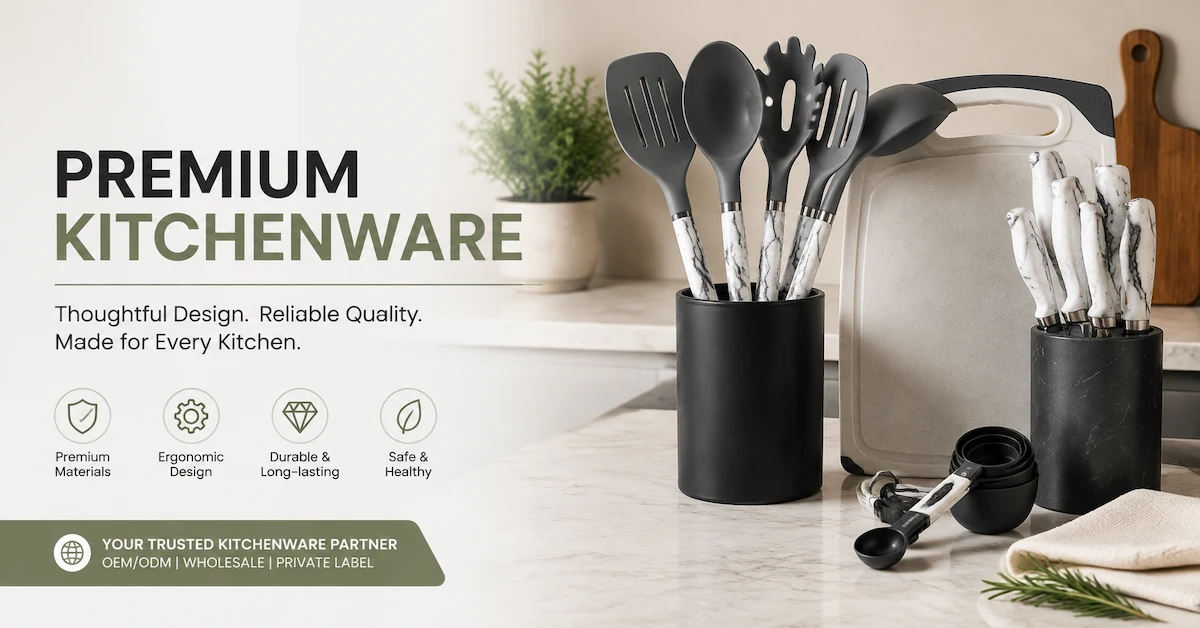
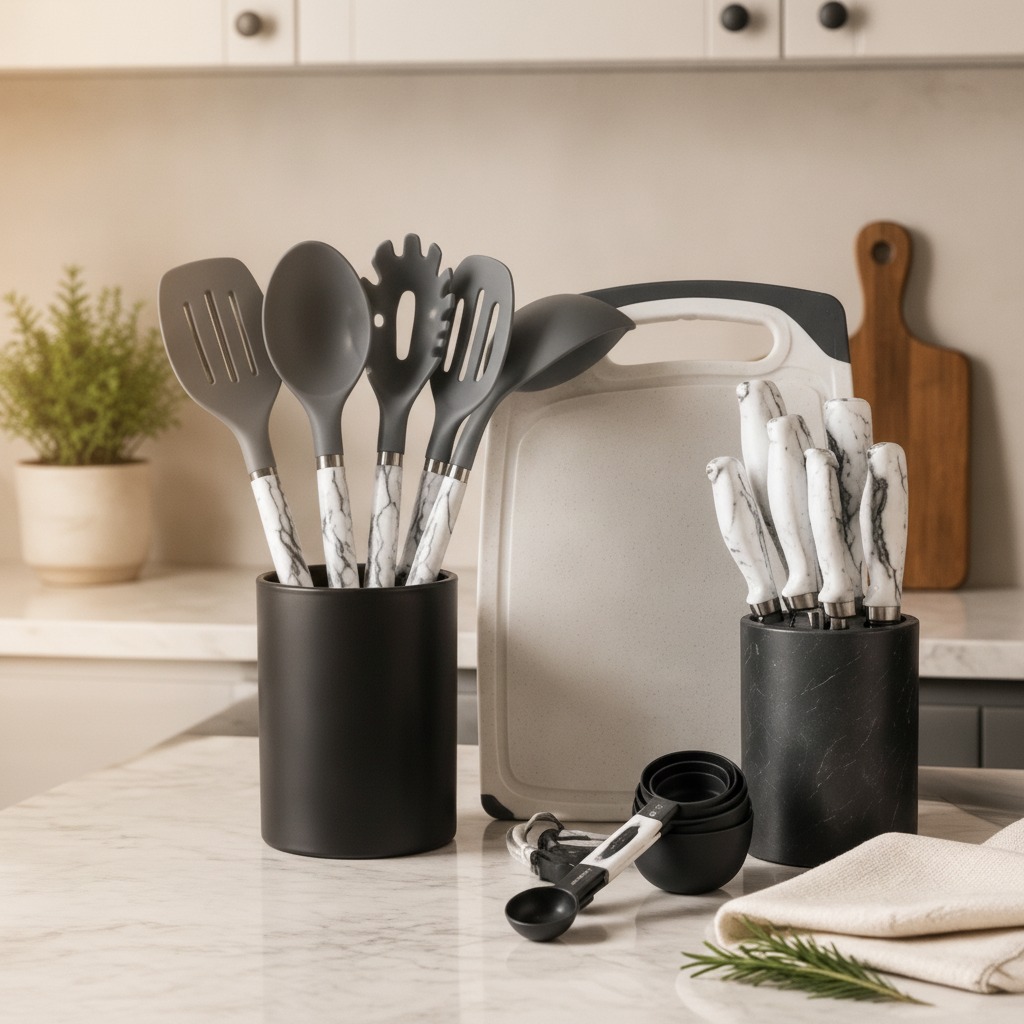
The product style referenced here is a coordinated utensil collection with matte black working heads, marble-look handles, and upright holders. That kind of presentation is useful in retail because it looks complete without being overly busy. It also fits private label strategies, where the buyer wants a polished look before adding branding. The “OEM/ODM | WHOLESALE | PRIVATE LABEL” positioning is a clue that the supplier is set up for that type of program, which matters if you need packaging or branding changes rather than an off-the-shelf carton.
Quick takeaways for sourcing managers
A good kitchenware supplier should help you answer four questions quickly:
Can the tools support the cooking tasks your customers actually perform?
Does the visual design fit your channel, whether that is retail, gifting, or bulk kitchenware supply?
Can the supplier handle repeat orders with the same look and quality expectations?
Is the product line flexible enough for private label, bundling, or promotional use?
The answer is often clearer once you separate function from merchandising. A spoon that stirs well is necessary. A spoon set that photographs well, packs efficiently, and feels durable in hand is what sells the repeat order.
What to look for in the product itself
The visible utensil set described here combines several common kitchen functions: stirring, flipping, serving, scooping, and measuring. That is useful because buyers rarely want a collection made up of only one utensil family. A cooking tools collection should support everyday prep without forcing the user to reach for another product line.
Material and finish
The working heads appear to be matte black silicone or a nylon-like material, while the handles have a marble-patterned white and gray finish. That combination is popular because it balances utility with décor-friendly styling. In practical terms, the buyer should still ask how the materials are made, what the handle coating is, and how the finish behaves after repeated washing. Decorative surfaces can be a selling point, but only if they stay attractive.
A small caution here: the words “Premium Materials,” “Durable & Long-lasting,” and “Safe & Healthy” are marketing claims shown in the image. They are not a substitute for written product specifications. If you need a confirmed food-contact statement, heat resistance data, or cleaning guidance, request it directly. Do not assume a premium-looking set has the same performance as a professionally rated commercial tool.
Ergonomics and handling
The long handles and rounded grips suggest an everyday, user-friendly design. That matters more than many buyers admit. If the grip is awkward, users do not just dislike it; they stop using the set. For retail, that means fewer positive reviews and more returns. For foodservice, it means slower prep and more tool replacement.
Ergonomic design is not just a slogan. It is a practical test. Ask whether the handle stays comfortable when wet, whether the utensil balances properly in the hand, and whether the set includes the right head shapes for the type of cooking your customers do most often. A pasta server looks good in a bundle, but if your audience mostly makes soups and sauces, a ladle and spoon set may be more useful.
Wholesale kitchenware is sold on assortment logic, not single-item appeal
One common mistake is buying a nice-looking utensil set without thinking about assortment logic. In wholesale kitchenware, the question is not whether each piece is acceptable on its own. The question is whether the set creates a complete, defensible offer.
A retail buyer may want a coordinated bundle that looks like a gift-ready kitchen starter kit. A café or catering buyer may want backup pieces in bulk kitchenware format to reduce breakage risk and simplify ordering. A private label seller may want a visually distinctive group that can be photographed once and sold across several channels. These are different problems, even if they use the same base product.
The black-and-marble palette works because it is neutral enough to fit modern kitchens, but still distinctive enough to separate the product from plain commodity utensils. That makes it more suitable for shelf display and online listing images. It is less about trendiness and more about shelf discipline.
Choosing between a general supplier and a restaurant kitchenware supplier
The phrase restaurant kitchenware supplier usually implies a focus on durability, repeat supply, and practical utility. That is a useful fit if you are buying for foodservice, school kitchens, or institutional use. A general wholesale kitchenware supplier may offer a broader catalog, including giftable sets and styled home products.
The right choice depends on the use case.
If the product is meant for restaurants or prep environments, prioritize tool function, handle comfort, and replenishment consistency.
If the product is meant for retail or gifting, prioritize appearance, bundle completeness, and packaging options.
If the product is meant for both, ask the supplier how they separate product lines. Sometimes a visually polished set is marketed as premium but is still best treated as consumer-grade rather than heavy commercial equipment. That is not a flaw; it is simply a sourcing reality.
Questions buyers should ask before placing an order
You do not need a long technical checklist, but you do need the basics.
What are the exact materials used in the heads and handles?
Is the set designed for OEM or ODM customization, and what can be changed?
How are the items packed for wholesale and retail distribution?
Are the holders included, and if so, what is their function in shipping and display?
What design elements are fixed, and which ones can be branded or recolored?
How does the supplier handle sample approval versus mass production?
These are not just paperwork questions. They determine whether the supplier can actually support your program after the first order. A set that looks good in a sample photo may be difficult to scale if the decorative handle finish is inconsistent or the packaging is fragile.
Private label and OEM/ODM considerations
The visible OEM/ODM and private label positioning is important because many buyers now want more than a generic stock product. They want a product family that can be branded for a store chain, promotional campaign, or marketplace storefront.
If that is your goal, pay attention to the parts of the set that are easiest to customize: packaging, printed branding, color combinations, and holder style. The marble-look handles may already be part of the product identity, so changing them could alter the entire appeal. In some cases, that is exactly what you want. In others, the smartest move is to preserve the core visual design and adjust the brand presentation around it.
This is also where discount kitchenware wholesale can become misleading. A low quote is not much use if the product cannot be packaged consistently or if the visual details vary from sample to shipment. Buyers should think in terms of landed presentation, not just factory price.
Common sourcing mistakes
The first mistake is assuming all kitchen utensils are interchangeable. They are not. A serving spoon, a slotted turner, and a ladle each solve different problems, and customers notice when the bundle feels incomplete.
The second mistake is ignoring how the set looks in a real kitchen. The black, white, and marble-look design is strong because it photographs well and blends with modern interiors. But if your customer base prefers rustic or professional stainless-steel styles, that same look may feel too decorative.
The third mistake is failing to separate marketing claims from verified product data. “Safe & Healthy” sounds reassuring, but the buyer still needs the underlying specifications. That is especially true if the set will be sold through regulated channels or to commercial users who ask direct questions.
A practical buying approach
Start with the channel, not the catalog. If you need retail-ready bundles, look for a supplier that can support consistent styling, private label, and presentable storage. If you need foodservice replacement stock, focus on reliability and repeatability. If you need both, ask for a program that can be adapted by packaging rather than forcing one item to do everything.
Then compare the sample against the use case. Hold the utensils. Check the balance. Look at the holder. Think about how the bundle will appear on a shelf, in a carton, or in a kitchen drawer. Those small realities usually decide whether a kitchenware line succeeds.
FAQ for wholesale buyers
Is this type of utensil set better for home use or foodservice?
It can serve both, but the styling suggests it is especially suitable for home kitchens, gifting, retail bundles, and general prep use.
Can I use it as a private label product?
The OEM/ODM and private label positioning suggests that customization is part of the offering, but the exact options should be confirmed with the supplier.
What should I confirm before ordering in bulk?
Confirm materials, packaging, included pieces, branding options, and any care or performance details that matter to your channel.
Next step for buyers
If you are evaluating a wholesale kitchenware supplier for a new assortment, start by requesting a sample breakdown and a customization discussion, not just a price quote. That saves time later and helps you judge whether the set fits your market.
For sourcing teams building a private label range, a coordinated utensil collection like this can be a sensible base product. For restaurants and institutional buyers, the real test is whether the supplier can keep supply stable and the tool mix practical. Either way, the best purchase is the one that fits the job, not just the photo.
