




Choosing a wholesale kitchenware supplier without buying the wrong mix

For buyers who source for restaurants, catering operations, retail shelves, or private-label bundles, choosing a wholesale kitchenware supplier is rarely just a price exercise. The real problem is assortment fit: you need a supplier that can cover prep, cooking, baking, serving, and storage without leaving gaps in the range or flooding you with slow-moving pieces. That is where kitchenware wholesale decisions tend to go wrong. A catalog can look broad on paper and still fail the practical test of a busy kitchen or a retail planogram.
What makes this category tricky is that kitchenware is not one product family. It is a stack of very different items with different material demands, manufacturing methods, and buyer expectations. A wooden cutting board, a stainless steel whisk, a glass storage jar, and a set of tongs do not behave the same way in production or in use. A good bulk kitchenware buying decision starts with understanding those differences, then matching them to your channel.
What a strong wholesale kitchenware assortment should cover
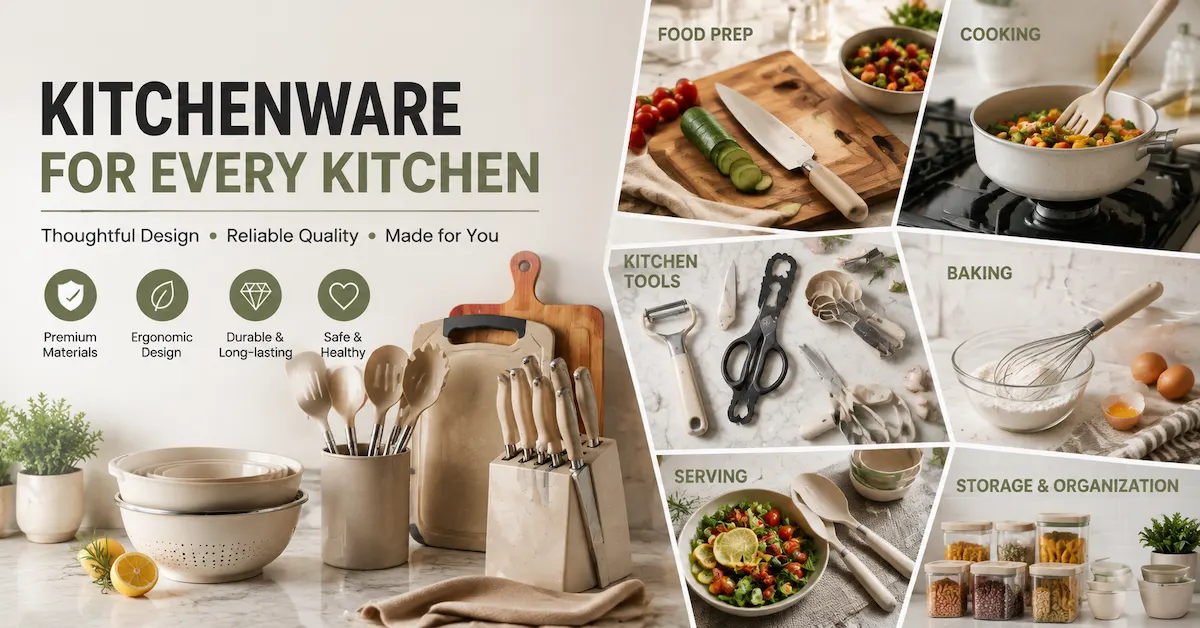
A cohesive kitchen collection usually spans several working zones in the kitchen. The most useful assortments cover food prep, cooking, baking, serving, and storage. That is the practical appeal of a multi-category line: it lets a sourcing team build larger orders around one family of goods instead of piecing together unrelated SKUs from multiple vendors.
In the product information provided, the visible assortment includes a cutting board with handle, chef’s knife or kitchen knife, slotted or solid spatulas and spoons, tongs, peeler, scissors, whisk, mixing bowl, cookware shown in use, nested bowls or colanders, and storage jars or containers with lids. Some items appear to be wood or bamboo, especially the spoons and cutting board. Others appear to be metal or stainless steel, particularly the knife, whisk, peeler, and tongs. The containers appear to be glass with metal or plastic lids. That kind of material mix is common in kitchenware wholesale because each material plays a different role.
Why material variety matters
Wood and bamboo are often chosen for a natural look and a softer touch on cookware surfaces. Stainless steel is usually preferred where strength, edge retention, or spring action matters. Glass containers are attractive for storage because contents are visible at a glance, which helps both retail presentation and kitchen organization. Buyers should still be careful here: a polished visual concept does not tell you anything about food-contact compliance, coating quality, or long-term wear. Those points need to be confirmed separately.
The problem buyers are really trying to solve
Most sourcing teams are not simply looking for “kitchen tools.” They are trying to solve one of three business problems.
The first is operational supply. Foodservice buyers need dependable tools that can be replenished in volume, with enough consistency to keep back-of-house standards stable. The second is merchandising. Retail buyers want a range that looks coherent, photographs well, and gives the shopper a reason to buy a bundle instead of one item. The third is margin protection. A wholesale kitchenware supplier should offer enough breadth that you can build a product family, not just a one-off purchase.
That is why a general catalog is not enough. If the supplier can only provide a knife here, a bowl there, and a storage jar from somewhere else, the sourcing process becomes fragmented. Time is lost, color and finish drift, and packaging is harder to standardize. A better supplier simplifies category management.
What to look for in a wholesale kitchenware supplier
The obvious starting point is range, but range alone does not tell you whether the supplier is reliable. Look at the assortment through a buyer’s lens.
1. Category breadth with practical use-case coverage
A useful supplier should cover the main kitchen motions: cutting, stirring, flipping, mixing, straining, measuring, serving, and storing. If the line only includes showpiece items, it may look good in a catalog and fall apart in a real order. A stronger range includes both the visible hero products and the quieter support items that round out a kitchen setup.
2. Material pairing that makes sense
Not every material should be used everywhere. Metal makes sense for tools that need stiffness or sharpness. Wood and bamboo can be appropriate for boards and utensils where surface gentleness and a warm look matter. Glass works well for display-friendly storage. If a supplier mixes materials well, it usually signals a more mature sourcing structure.
3. Consistency across finishes and design language
The provided product concept leans toward natural, matte, neutral-toned finishes. That can work well for modern retail presentations and clean kitchen merchandising. But consistency matters more than style alone. Handles, lid finishes, edge profiles, and visual tone should feel like they belong in one collection. Small mismatches become obvious when products are displayed together.
4. Packaging and bundle readiness
For retail and gifting channels, the real issue is not just the product. It is how the product ships, displays, and resells. A wholesale kitchenware supplier should be able to support carton logic, labeling, and assortment planning, even if those details vary by item type. Buyers often underestimate this until they are trying to build a cohesive shelf or ship mixed cartons.
Common manufacturing realities behind kitchenware wholesale
Because the assortment spans multiple product types, manufacturing is likely to vary by item. Exact production methods are not identifiable from the provided material, and it would be unsafe to guess too specifically. Still, buyers should expect different process families across the range. Wooden and bamboo pieces may involve turning, shaping, sanding, and assembly. Metal tools may be stamped, forged, bent, or formed depending on the function. Glass containers are typically made through glass production and then assembled with lids. This mix is normal in wholesale kitchenware, but it means quality control has to be managed by item family rather than by the collection as a whole.
A practical warning: do not assume a visually coordinated set has the same durability across every piece. A knife and a storage jar can sit in the same brand story while having very different failure points.
Selection criteria that save money later
When comparing bulk kitchenware options, buyers should ask a few unglamorous questions.
Will the assortment support the intended channel, or only decorate it?
Does the supplier offer enough depth to replace fast-moving SKUs when demand spikes?
Can the line be scaled into multiple formats, such as starter bundles, retail multipacks, or foodservice replacement items?
Do the materials and finishes fit the brand position you are trying to build?
And perhaps most important, are the product claims being kept separate from the evidence? The graphic language provided includes claims such as premium materials, ergonomic design, durable and long-lasting, and safe and healthy. Those may be useful for marketing, but they should not be treated as verified product specifications. A sourcing manager needs the underlying documentation, not the slogan.
Where buyers make avoidable mistakes
One common mistake is overbuying novelty pieces and underbuying the everyday tools that drive replenishment. Another is mixing too many styles in one order, which makes the collection look cheap even if the products themselves are fine. A third is ignoring the storage side of the category. Jars, nested bowls, and colanders may not look as exciting as knives or cookware, but they often drive day-to-day utility and visual order in both homes and commercial kitchens.
There is also the packaging problem. Glass jars need different protection than bamboo utensils. Metal tools can scratch. Knife packaging has its own safety and display concerns. If your wholesale kitchenware supplier treats all products as if they ship the same way, you should be cautious.
Practical advice for sourcing teams
If you are building a new assortment, start by defining the end use. A restaurant buyer may prioritize durability, stackability, and easy replacement. A retail buyer may care more about presentation and collection coherence. A catering buyer may need a broad but not overly complex mix of tools that supports event prep and service.
From there, map the assortment by task rather than by item type. For example: prep tools, cooking tools, baking tools, serving tools, and storage. That approach exposes gaps faster than scanning a random catalog. It also helps when you negotiate with a supplier, because you can talk in terms of functional coverage instead of isolated SKUs.
If the supplier can support multiple categories from one kitchenware wholesale program, that usually makes procurement simpler. It also reduces the risk of style drift across separate purchases.
FAQ for bulk kitchenware buyers
Is one supplier enough for a full kitchen range?
Sometimes yes, if the supplier has a genuinely broad assortment and can keep the design language coherent. For very specialized items, many buyers still split sourcing across categories.
Should I prioritize material over appearance?
For foodservice, usually yes. For retail, both matter, but material suitability still comes first. A nice-looking tool that performs poorly will not stay in the line for long.
Are natural-looking kitchen tools always better?
Not automatically. Wood and bamboo can suit many applications, but the right choice depends on use, care expectations, and the rest of the assortment.
Next step for buyers
If you are evaluating a wholesale kitchenware supplier, start with a sample assortment map and compare it against your real use case. Ask which items are intended for prep, cooking, baking, serving, and storage. Then confirm materials, packaging, and quality documentation item by item. That is the fastest way to separate a useful supplier from a merely attractive catalog.
For sourcing teams and product managers, the best outcome is not just a lower unit cost. It is a kitchenware range that is easy to reorder, easy to present, and hard to break in the wrong place.
