




Bottle Opener Kitchen Scissors Supplier Guide for Buyers
Choosing a bottle opener kitchen scissors supplier is not only about finding a tool with an extra feature. For retailers, wholesalers, promotional buyers, and foodservice sourcing teams, the real question is whether the product works reliably in everyday use. A pair of kitchen scissors may cut packaging, trim herbs, open food bags, and help with light prep. When a bottle opener or cap-gripping feature is added, the tool becomes more versatile, but it also becomes easier to overpromise.
Good sourcing starts with realistic expectations. These scissors can be useful where drawer space is limited and users prefer one compact tool for several small jobs. However, the cutting action, pivot stability, handle comfort, and opener performance still need to be checked through samples. A clever design does not compensate for loose blades or an opener that slips under pressure.
Key Takeaways
- Start by testing the scissors as cutting tools before judging the opener function.
- Do not assume the blade steel grade, handle material, or opener capacity unless the supplier confirms them.
- Ask for production samples, not only display samples or catalog photos.
- Check pivot tightness, blade alignment, grip comfort, and opener usability with real packaging and caps.
- For OEM or wholesale orders, clarify packaging, branding, inspection standards, and replacement handling before purchase.
What Bottle Opener Kitchen Scissors Are Designed to Do
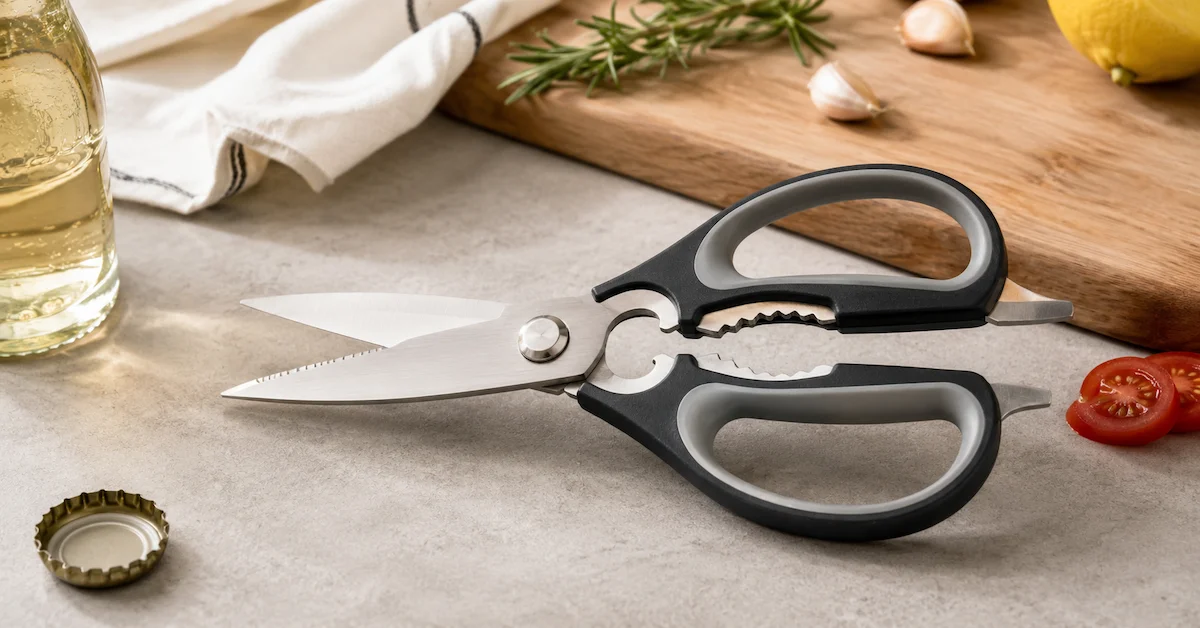
This product combines standard kitchen scissor blades with an integrated opening feature. Based on the visible design, it has metal blades with a brushed or satin appearance, two-tone black and light gray handles, a central pivot, and a small metal element near the handle area that appears intended for opening or prying. The exact function should be verified with the supplier because different models may be designed for bottle caps, jar assistance, or general cap gripping.
In practical use, the product fits small kitchen tasks: cutting food packaging, snipping herbs, trimming light ingredients, opening sealed bags, and dealing with capped containers. It is not automatically a substitute for heavy-duty poultry shears or a dedicated bar bottle opener. Buyers should position it as a compact multi-function kitchen tool unless testing proves a more demanding use case.
Best-Fit Buying Scenarios
Multi-function kitchen scissors are especially relevant for product lines where utility is more important than novelty. For home kitchen retail, the appeal is simple: one drawer tool can handle several common tasks. For wholesale and promotional programs, the product is easy to explain and can be bundled with other kitchen accessories. For catering or food prep teams, the benefit is reduced tool switching during light tasks.
The right market position depends on confirmed performance. If the scissors cut cleanly and the opener works smoothly, they can be sold as a useful everyday kitchen tool. If cutting performance is only moderate, the product may still suit light household use but should not be promoted for demanding professional prep.
Supplier Evaluation Checklist
| What to Check | Why It Matters | Questions to Ask |
|---|---|---|
| Blade alignment | Poor alignment causes tearing, slipping, or uneven cutting. | How is blade alignment checked during production? |
| Pivot assembly | The pivot controls cutting smoothness and long-term feel. | Is the pivot adjustable, riveted, or fixed by another method? |
| Opener performance | The opener feature must match buyer expectations. | Is it designed for bottle caps, jars, caps, or general prying? |
| Handle comfort | Grip shape affects repeat use and customer satisfaction. | What material is used for the handle and grip area? |
| Packaging and branding | Important for retail, private label, and wholesale programs. | What packaging options and artwork requirements are available? |
Materials and Construction Points to Confirm
The visible blade finish suggests stainless steel, but the exact grade is not stated in the source information. Buyers should not assume corrosion resistance, hardness, or dishwasher suitability without supplier confirmation. Ask what blade material is used, how the edges are sharpened, and whether the product is intended for light kitchen prep or broader household utility.
The handles appear to be plastic or coated polymer in a black and light gray design. This can be suitable for a comfortable, cost-effective kitchen tool, but details matter. Ask whether the grip is molded as one piece or overmolded, whether color matching is available, and how the handle performs after repeated washing or exposure to kitchen moisture. If the product will be sold in a market with specific safety or labeling requirements, ask the supplier what documentation can be provided rather than assuming compliance.
How to Test Samples Before Ordering
Sample testing should be practical and repeatable. Do not only open and close the scissors once. Use them the way a customer would. Cut paper packaging, thin plastic wrapping, herb stems, food bags, and light cardboard if that matches your intended use. Then test the opener on the actual cap types your market commonly uses.
- Check whether the blades meet evenly from pivot to tip.
- Open and close the scissors repeatedly to feel for grinding, wobble, or stiffness.
- Cut several materials and note whether the tool cuts cleanly or pushes material away.
- Use the opener feature on real caps and observe slipping, bending, or awkward leverage.
- Wash and dry the sample, then check for trapped moisture, loosened grips, or visible marks.
If possible, test more than one sample. A single good sample does not prove production consistency. For larger sourcing programs, ask how the supplier controls inspection during mass production and what defects are considered unacceptable.
Common Buyer Mistakes to Avoid
One mistake is treating every multi-purpose kitchen scissor as the same product. Small differences in pivot position, handle size, opener angle, and blade thickness can change the user experience. Another mistake is focusing on the opener feature while ignoring cutting quality. Customers will usually judge scissors first by how they cut.
Buyers also need to avoid unsupported claims. Unless the supplier confirms a steel grade, coating, food-contact suitability, dishwasher use, or certification, do not build those claims into product listings. This is especially important for private label and marketplace sales, where inaccurate specifications can create returns or compliance issues.
OEM, Wholesale, and Private Label Questions
For OEM and wholesale purchasing, commercial details should be clarified early. Ask whether the supplier can support your target packaging format, barcode needs, instruction language, carton labeling, and brand artwork. If color customization is required, ask about available colors, sample approval steps, and color tolerance. Do not assume minimum order quantities, lead times, or tooling requirements; request current terms directly from the supplier.
Buyers sourcing through kitchen tool product ranges may also ask whether related items can be matched in handle color or finish. This can matter for retail sets, seasonal promotions, and coordinated private label assortments.
Practical FAQ for Sourcing Teams
Are bottle opener kitchen scissors suitable for professional kitchens?
They may be useful for light prep, packaging, and convenience tasks, but buyers should test them under expected working conditions before positioning them for professional use.
Can this tool replace a dedicated bottle opener?
It depends on the opener design. It may be convenient for casual use, but repeated bar-style opening should be tested carefully before making that claim.
What is the most important quality point?
Blade alignment and pivot stability are usually the first priorities. If the scissors do not cut smoothly, the added opener feature has limited value.
Should buyers request samples before a wholesale order?
Yes. Samples help verify cutting feel, handle comfort, opener performance, packaging quality, and whether the supplied product matches the catalog description.
Next Step for Buyers
If you are comparing a bottle opener kitchen scissors supplier, build your decision around testing and clear questions. Confirm materials, intended use, packaging options, inspection methods, and branding support. Then evaluate samples with real kitchen tasks rather than relying on photos. A well-made multi-function scissor can be a practical addition to a kitchenware line, but only when the basic scissor performance and opener function are both proven.
