




Chef Knife Manufacturer Guide for Buyers and Sourcing Teams
Choosing a chef knife manufacturer is not only a catalog decision. For importers, private label brands, wholesalers, and food-service buyers, the real question is whether a supplier can make a chef knife that feels controlled in the hand, cuts predictably, and remains consistent from sample approval to repeat orders. A chef knife is a general-purpose kitchen tool, but it has to perform many jobs: slicing vegetables, mincing herbs, trimming proteins, and handling repetitive prep work without creating user fatigue.
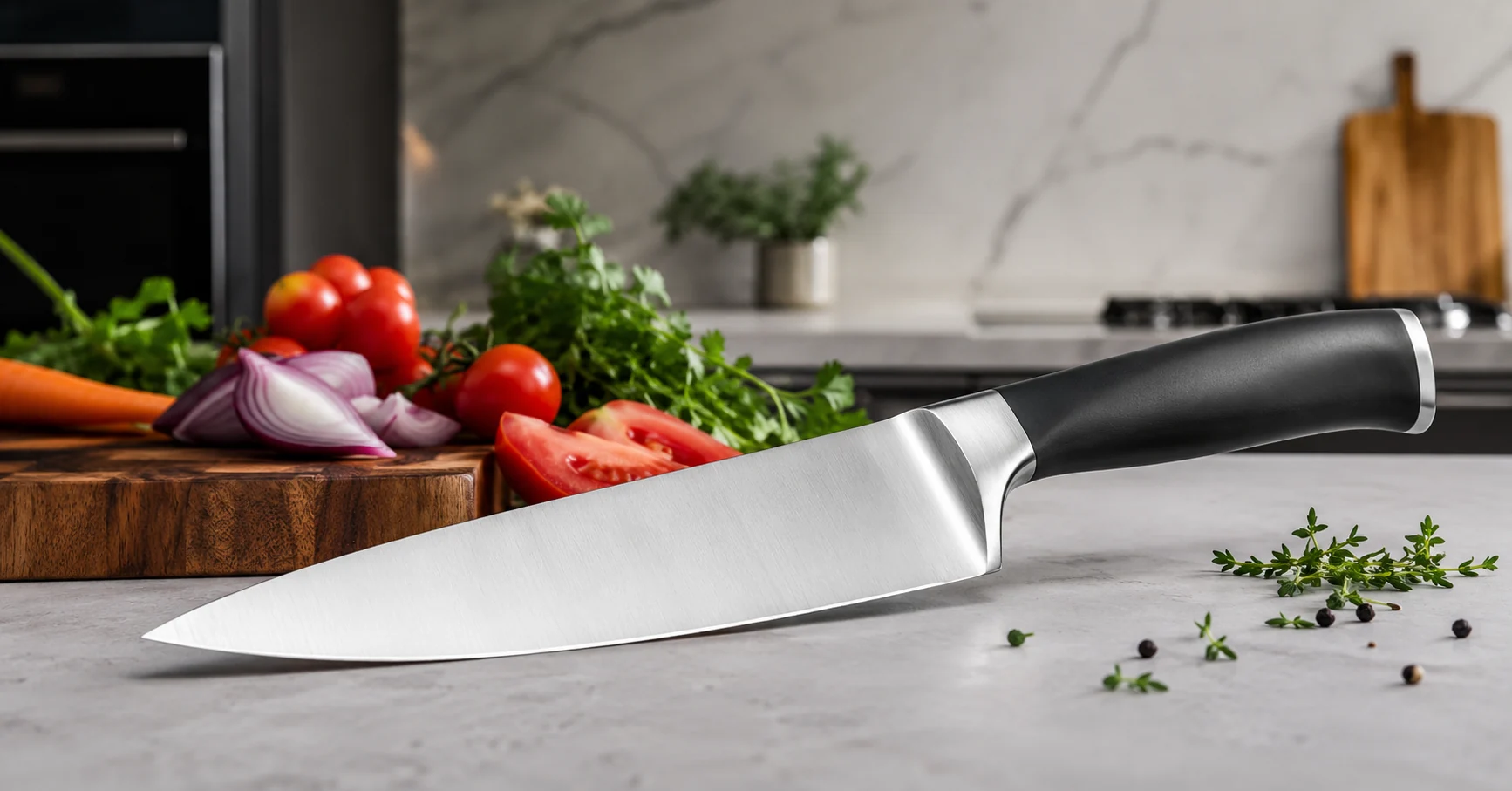
The product image associated with this topic shows a classic chef knife profile with a broad blade, straight spine, gently curved cutting edge, and black contoured handle. Those visual cues suggest an everyday prep knife format, but sourcing teams should not assume hidden specifications from appearance alone. Steel grade, hardness, heat treatment, handle material, process type, and compliance documentation must be confirmed directly with the supplier.
Key Takeaways
- Start with the intended user: professional prep kitchen, retail consumer, hospitality supply, or private label range.
- Evaluate blade geometry and handle comfort before focusing only on steel claims.
- Ask whether the knife is stamped or forged, but judge the sample by consistency, balance, grinding, and finish.
- Do not assume certifications, material grades, or production capacity unless the supplier documents them.
- Use physical samples and a written technical questionnaire before placing a larger order.
Define the Chef Knife You Need to Source
A chef knife for a restaurant prep station may need different priorities from a knife sold in a domestic retail set. Professional users often care about control, edge maintenance, handle security, and fatigue over long shifts. Home users may place more emphasis on weight, comfort, appearance, and simple care instructions. The same overall silhouette can serve both channels, but the sourcing brief should be different.
Before contacting factories, define the target market, blade length range, expected packaging type, handle preference, price positioning, and whether OEM or private label customization is required. If these points are vague, suppliers may quote products that look similar but are difficult to compare technically.
Stamped or Forged: Ask, Then Verify
Buyers often ask whether a chef knife is stamped or forged. Stamped blades are typically cut from sheet steel, then ground and finished. Forged knives are generally shaped from heated steel and may feel more substantial. However, process labels do not automatically prove quality. A well-made stamped knife can outperform a poorly controlled forged one, depending on heat treatment, edge geometry, grinding accuracy, and assembly.
Because the original product information does not confirm the manufacturing process, buyers should ask the supplier directly. Request a process description, cross-section details if available, and production sample photos. More importantly, compare several samples from the same batch. Look for consistent blade profile, even edge grinding, straight alignment, and a clean transition between blade and handle.
Blade Geometry Users Notice First
Many sourcing discussions begin with steel grade, but users often feel geometry first. A broad chef knife blade can help with chopping and moving cut ingredients. A gently curved cutting edge supports rocking cuts for herbs and aromatics. A pointed tip helps with trimming and more precise work. These features are visible in the product image, but their actual performance depends on thickness, taper, balance, and edge finish.
Ask the manufacturer how the blade thickness changes from spine to edge and from heel to tip. A thicker blade may feel stable through dense ingredients, but it can create drag. A thin edge may cut cleanly, but it may be less forgiving if the user twists the knife on hard foods. Buyers should test the knife on real ingredients rather than judging sharpness only by a quick paper cut.
Handle Design Is a Safety and Comfort Issue
The image shows a black, contoured handle with an ergonomic shape. This type of handle can be suitable for repetitive prep work, but the actual material and construction should be confirmed. Sourcing teams should ask whether the handle is molded, assembled with scales, overmolded, or attached by another method. They should also check whether there are gaps at the blade-handle transition where moisture or food residue could collect.
Comfort testing should include different hand sizes and grip styles. A handle that feels secure for one user may create pressure points for another. If the knife is intended for food-service channels, wet-hand grip confidence and ease of cleaning are especially important. If it is for retail consumers, packaging and instructions should make maintenance expectations clear.
Material Questions Buyers Should Ask
The available source does not identify the blade steel, hardness, handle composition, or heat treatment. Those details should become part of the supplier questionnaire. Do not accept vague terms such as premium steel or professional quality without supporting information. Ask what steel family is used, how the blade is hardened, how the edge is ground, and what finish is applied.
For handle materials, ask about heat tolerance, moisture resistance, cleaning limitations, and attachment method. For packaging, ask how the edge is protected during shipping. For documentation, ask what material traceability, inspection records, or market-specific compliance documents the supplier can provide, without assuming any certification exists until it is verified.
Comparison Checklist for Supplier Evaluation
| Evaluation Area | What to Check | Questions to Ask |
|---|---|---|
| Blade profile | Shape, curvature, straightness, heel finish | Can the same profile be held across production batches? |
| Edge quality | Sharpness, grind symmetry, burr removal | How is the final edge inspected before packing? |
| Handle assembly | Alignment, gaps, grip comfort, transition area | What material and attachment method are used? |
| Finish | Surface consistency, scratches, cleaning practicality | What finish options are available and how are they controlled? |
| Commercial support | Samples, drawings, packaging, repeat order control | What MOQ, lead time, customization, and QC records can be provided? |
Common Sourcing Mistakes to Avoid
One common mistake is choosing the most attractive catalog photo without testing the knife in real prep tasks. Another is assuming that a heavier knife is automatically better. Weight can feel reassuring at first, but balance and cutting control matter more over time. Buyers also make mistakes when they focus only on initial sharpness. A knife can arrive sharp but still have inconsistent grinding, weak edge stability, or an uncomfortable handle.
Price-only comparison can also create problems. If two quotes are far apart, compare the steel description, process, handle construction, packaging, inspection method, customization requirements, and after-sales support. The lowest unit cost may not be the lowest total sourcing cost if returns, replacements, or user complaints increase.
Sample Testing Before Purchase Orders
Before placing a larger order, request samples that represent intended production rather than hand-selected display pieces. Test several units for cutting feel, balance, edge consistency, washing behavior, and packaging protection. Photograph and document any issues, then ask the supplier how they would control those points in mass production.
- Inspect visual finish and blade straightness under good lighting.
- Check the handle for gaps, looseness, sharp edges, and comfort.
- Use the knife on common ingredients such as onions, herbs, carrots, and proteins.
- Clean and dry the knife according to the supplier guidance.
- Compare all samples for consistency rather than judging only the best one.
Practical FAQ
What should I ask a chef knife manufacturer first?
Start with intended use, blade material, handle material, manufacturing process, sample availability, customization options, MOQ, lead time, packaging, and inspection method. Ask for documentation rather than relying on marketing terms.
Is a forged chef knife always better than a stamped knife?
No. Forged and stamped describe process routes, not guaranteed performance. Heat treatment, blade geometry, grinding consistency, handle construction, and quality control all affect the final knife.
Can I judge quality from photos?
Photos help identify general design, but they cannot confirm steel grade, hardness, edge consistency, balance, or assembly strength. Physical samples are necessary for serious sourcing decisions.
What details matter for private label chef knives?
Private label buyers should confirm logo method, packaging structure, care instructions, barcode or labeling needs, carton protection, repeat-order color matching, and the supplier process for approving pre-production samples.
Next Step for Sourcing Teams
If you are shortlisting a chef knife manufacturer, build your decision around samples, written specifications, and supplier answers. A good sourcing process compares how the knife performs, how consistently it can be produced, and how clearly the supplier can explain materials and controls. That approach reduces risk and helps buyers select a chef knife that is suitable for the market it is meant to serve.
