




Chef Knife Set Supplier Guide for Buyers and Sourcing Teams
Choosing a chef knife set supplier is not only about finding a factory that can ship knives. For retail, hospitality, gifting, and private-label programs, the better question is whether the supplier can deliver a repeatable knife set that looks consistent, performs for everyday prep, and arrives in packaging suitable for your sales channel.
A chef knife set with block storage is a multi-component product. Buyers must evaluate the blades, handles, storage block, packaging, finish consistency, and the usefulness of the assortment. Small problems become visible quickly: uneven polishing, mismatched handles, loose block slots, unclear accessory descriptions, or a set composition that looks large but does not support real kitchen tasks.
Key Takeaways
- Evaluate the full set, not only the main chef knife or total knife count.
- Confirm blade material, handle construction, block material, packaging, and exact set composition with the supplier.
- Ask for real sample photos and physical samples before approving a program.
- For OEM or private label, provide a clear brief covering channel, target user, assortment, packaging, and branding needs.
What a Chef Knife Set Should Solve
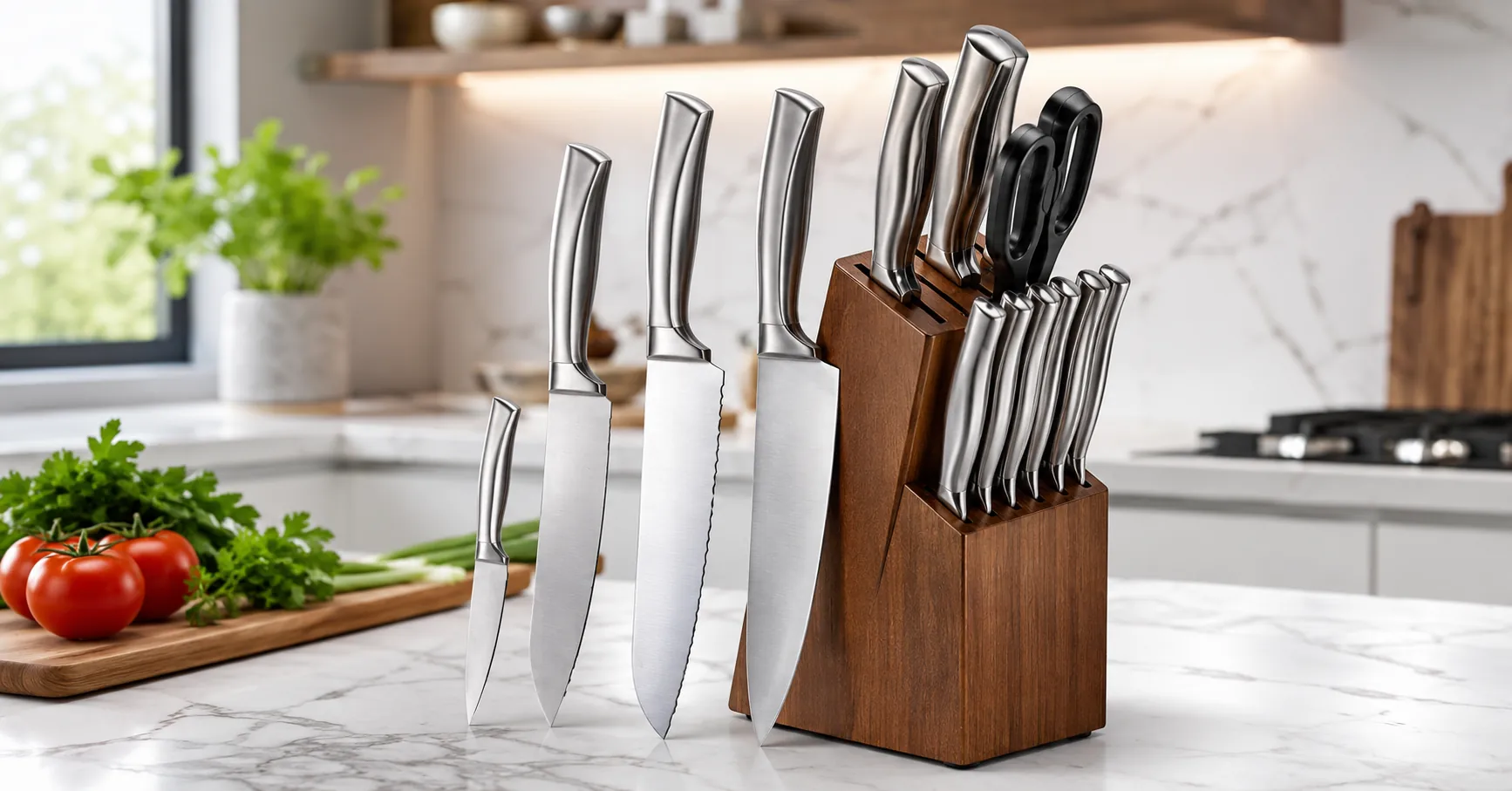
A practical chef knife set should reduce friction in daily food preparation. The product shown includes multiple stainless-steel knives in different shapes and sizes, stored in a vertical block. Visible pieces include long chef or utility-style blades, a serrated blade, a smaller paring-style knife, and several shorter knives. This kind of assortment can support common kitchen tasks such as chopping vegetables, slicing bread or cooked meats, utility cutting, and quick prep work.
For retail buyers, the set also needs to work as a complete countertop presentation. Matching metallic handles and a wood-toned storage block create a coordinated appearance, which can be important for gifting and home kitchen channels. For hospitality or food-service buyers, the value is more operational: organized storage, fast access, and a clear place for each knife.
How to Evaluate a Chef Knife Set Supplier
Start with consistency. A knife block set contains several visible parts, so inconsistent finishing is easier to notice than it would be on a single loose knife. Compare the blade finish across the set. Check whether the handles align cleanly, whether each knife sits securely in the block, and whether the product looks intentional when viewed from the front, side, and top.
Buyers should also ask how the supplier describes the product technically. Do not rely only on broad catalog language such as “stainless steel” or “premium finish.” Ask what blade material description will appear on packaging, whether the knives are stamped or forged if that matters for your range, how the handle is constructed, and what material is used for the block. If the supplier cannot confirm a detail, avoid placing it in your sales copy.
Product Details to Verify Before Ordering
Visible presentation matters, but sourcing decisions should be based on confirmed specifications. The photographed set appears to use stainless-steel blades, metallic handles, and a wood-toned block with angled slots. Those are useful observable details, but buyers should still confirm the exact commercial specification before sampling, costing, or creating listings.
| Area to Check | Why It Matters | Questions to Ask the Supplier |
|---|---|---|
| Set composition | A balanced assortment is easier to sell and use. | Which knife types and sizes are included? Are any tools at the back shears, honing tools, or other accessories? |
| Blade material | Material wording affects performance expectations and marketing accuracy. | What is the exact blade material description? Can it be printed on packaging? |
| Handle finish | Mismatched handles reduce perceived quality. | How is finish consistency controlled across all knives in a set? |
| Block design | The block is part of the product, not just storage. | What is the block material? Are the slots secure and practical for daily use? |
| Packaging | Knife sets can be scuffed or misaligned in transit. | How are blades, handles, and the block protected during shipping? |
| OEM support | Private-label programs require clear boundaries. | Which elements can be customized, and which are fixed? |
Set Composition: More Knives Is Not Always Better
A common sourcing mistake is judging a knife set by the number of pieces alone. A larger count may look attractive in a listing, but overlapping knives can confuse users and reduce perceived value. A smaller set with a chef knife, serrated knife, utility knife, paring knife, and useful short prep knives may be stronger than a larger set filled with near-duplicates.
When comparing suppliers, map each knife to a likely kitchen task. If two or three pieces perform the same job, ask whether a different blade profile would improve the assortment. Also check whether accessories are included and clearly identified. If a catalog photo shows black-handled tools at the rear of the block, confirm whether they are kitchen shears, a sharpening or honing tool, or another item before writing product descriptions.
Block Design, Countertop Fit, and Merchandising
The storage block is central to the customer experience. A wood-toned vertical block with angled slots can make the set look organized and compact, but the design still needs to be stable, practical, and suitable for the intended kitchen. Ask for dimensions, packed size, slot layout, and photos from multiple angles. If countertop footprint is important for your market, do not approve the product from a front-facing image alone.
For retail merchandising, the block should help shoppers understand the set quickly. The knives should be easy to see, and the packaging should explain the assortment without overstating unconfirmed features. For hospitality buyers, ease of removal, secure storage, and simple cleaning around the block area may matter more than shelf presentation.
Private Label and Wholesale Sourcing Guidance
For OEM, wholesale, or private-label sourcing, prepare a specification brief before requesting a quote. A useful brief should define the sales channel, expected user, target price position, preferred knife count, packaging format, labeling needs, and any market-specific documentation you require. Avoid asking only for “best quality” or “popular design,” because those phrases do not create a measurable standard.
- Request a current sample that matches the quoted specification.
- Review finish consistency across every knife in the set.
- Test how each knife fits into and removes from the block.
- Confirm packaging protection for blades, handles, and block corners.
- Ask which customization options are available for branding, packaging, or assortment.
- Clarify reorder consistency, lead-time expectations, and inspection procedures before committing.
Common Mistakes When Comparing Suppliers
The first mistake is treating all knife block sets as interchangeable. Two sets with similar photos can differ in blade finish, handle alignment, block stability, packaging quality, and actual usefulness. The second mistake is assuming that a polished stainless-steel appearance tells you the steel grade, hardness, corrosion resistance, or edge performance. Those details must be confirmed by the supplier if they are relevant to your market.
Another mistake is writing product copy before specifications are verified. If you describe unconfirmed materials, accessories, certifications, or performance claims, you may create avoidable customer-service and compliance risks. Good sourcing teams keep marketing language aligned with confirmed supplier information.
Practical FAQ for Sourcing Teams
Is a knife set with block better for retail than loose knives?
Often, yes. A block set presents as a complete product, is easier to merchandise, and can work well for gifting. However, the assortment and packaging still need to match the retail channel.
Should buyers assume the steel grade from the appearance?
No. A stainless-steel appearance does not confirm the exact steel grade or performance level. Ask the supplier for the exact material description and use only confirmed wording.
What matters most in a sample review?
Check finish consistency, handle alignment, blade edges, block slot fit, product stability, packaging protection, and whether the received sample matches the quoted set composition.
Can a chef knife set be customized for private label?
Possibly, but customization depends on the supplier. Ask which elements can be changed, such as packaging, logo placement, assortment, block style, or handle finish, and confirm any limitations early.
How should buyers compare quotations?
Compare quotes against the same confirmed specification. A lower price may reflect different materials, fewer pieces, simpler packaging, or less customization, so request a line-by-line comparison.
Where to Go Next
If your team is evaluating a chef knife set supplier, use the sample as a test of supplier discipline. Ask clear questions, document confirmed specifications, and compare the full set rather than a single hero image. A strong sourcing process should confirm how the product works as a kitchen tool, how it presents as a retail item, and how reliably it can be repeated in future orders.
