




Citrus Juicer Supplier Guide: What Buyers Should Check
A manual citrus press may look like a simple kitchen tool, but choosing the right citrus juicer supplier is a practical sourcing decision. Buyers for cafés, restaurants, hotel breakfast stations, catering teams, retail assortments, and private-label programs need more than an attractive product photo. They need to know whether the juicer will stay stable, press consistently, clean quickly, and withstand repeated handling.
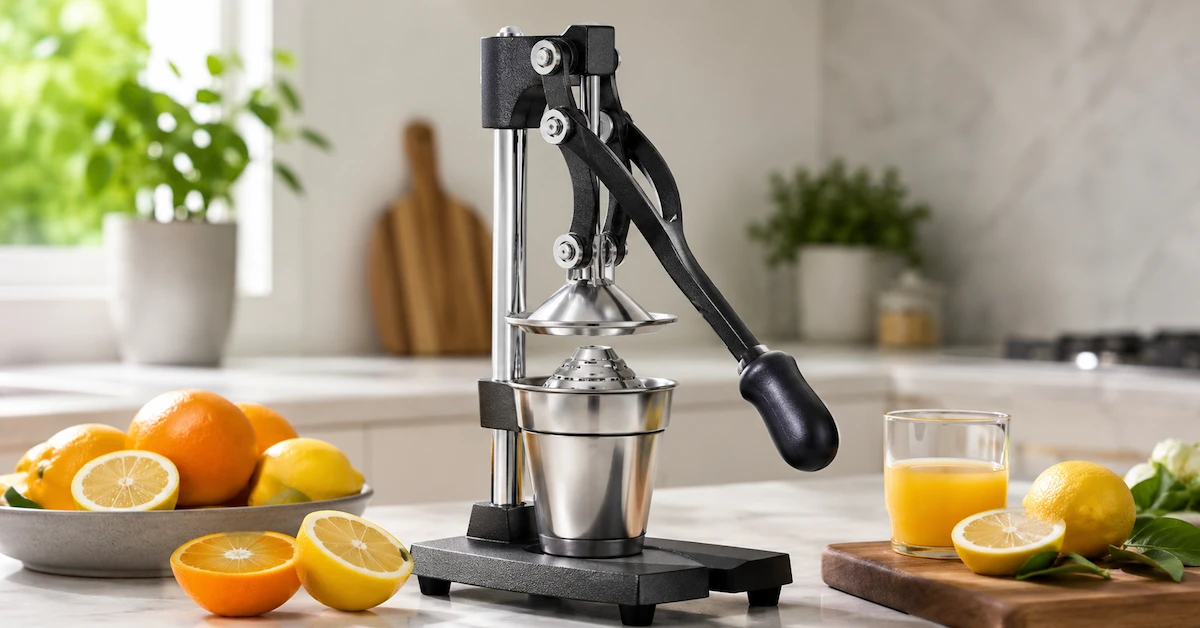
The product shown is a lever-style manual countertop citrus juicer. It appears to use a heavy base, upright support posts, a jointed lever, a metal pressing area, and a black handle grip. Those visible details are useful starting points, but they are not a substitute for supplier confirmation. In B2B sourcing, buyers should ask clear questions about structure, food-contact parts, finish durability, cleaning access, packaging, and quality control before placing a wholesale or OEM order.
Key Takeaways
- Stability is one of the most important checks for a manual countertop citrus press.
- Buyers should confirm which parts contact juice and what materials are used.
- A smooth lever, comfortable grip, and aligned pressing head affect daily usability.
- Cleanability matters because citrus pulp and juice residue can collect around the cup and cone.
- Wholesale buyers should request samples, close-up photos, and written product details before committing to larger orders.
What This Manual Citrus Juicer Is Designed to Do
A lever-style citrus juicer is built to press halved lemons, oranges, and similar fruits without electricity. The user places the fruit on the reamer or cone, pulls the handle down, and the pressing head applies force so juice drains into a cup or container below. This makes the tool suitable for locations where powered equipment is unnecessary, noisy, or inconvenient.
For moderate-use environments, a manual press can be a practical choice because it is quiet, compact, and mechanically straightforward. It can support drink preparation, breakfast service, kitchen prep, and small-batch juicing. However, buyers should not assume every manual press is suitable for the same workload. Two products can look similar online but differ in weight distribution, joint quality, coating, alignment, and ease of cleaning.
Buyer Checklist: What to Compare Before Ordering
| Check Point | Why It Matters | Questions to Ask the Supplier |
|---|---|---|
| Base stability | A stable base reduces tipping and movement during pressing. | What is the base construction? Can you provide weight and stability details? |
| Food-contact parts | Citrus juice is acidic, so wet-contact surfaces need suitable material and finish. | Which parts contact juice? What material grade is used for each part? |
| Lever mechanism | The lever carries repeated force and affects user comfort. | How are the joints assembled? Is there a sample video showing operation? |
| Cleaning access | Pulp and juice residue can create complaints if cleaning is difficult. | Which parts are removable? How should the unit be cleaned after use? |
| Finish quality | Coatings and polished areas should tolerate regular handling and washing routines. | How is the frame finished? What care instructions are provided? |
| Packaging | Heavy tools can be damaged in transit if not packed well. | Can you share inner box, carton, and drop-protection details? |
Material and Structure Points to Inspect
With this category, buyers often focus on the visible metal finish and overlook the load-bearing structure. That is risky. The frame, posts, lever, and pivot points take the force every time fruit is pressed. If these parts flex, loosen, or feel misaligned, the product may disappoint even if the cup and cone look polished.
The image shows a matte black base and metallic working components. The black surface may be painted or powder-coated, but buyers should confirm the actual finish with the supplier. A coating that chips easily can reduce the product’s perceived quality and may expose the underlying material to moisture. Likewise, the supplier should identify the food-contact components separately from cosmetic or structural components.
For procurement teams, it is reasonable to ask for material declarations, close-up images, care instructions, and sample inspection reports if available. Do not assume stainless steel grade, coating thickness, corrosion performance, or dishwasher suitability unless the supplier confirms it in writing.
Why Buyers Choose Manual Presses Instead of Electric Juicers
Manual citrus presses remain popular because they solve a specific problem: quick citrus extraction without power. They are quiet, do not require countertop outlets, and have fewer operating steps than many powered machines. This can be useful for mobile catering, small cafés, buffet counters, bar prep, or food-service locations where staff only need citrus juice in limited batches.
That does not mean a manual press is the best answer for every operation. If a business juices large volumes all day, an electric citrus juicer may reduce staff fatigue and improve throughput. A manual countertop model is best evaluated as a controlled, compact, and low-noise tool for moderate use. A responsible citrus juicer manufacturer should help buyers understand the intended use case rather than describe the product as suitable for every possible application.
How to Evaluate a Citrus Juicer Supplier
A good supplier should be able to explain the product clearly from both the user’s perspective and the buyer’s perspective. For users, the main concerns are stability, pressing comfort, speed, and cleanup. For buyers, the concerns include material confirmation, assembly consistency, packaging protection, defect handling, private-label options, and documentation.
Before placing a wholesale order, consider the following steps:
- Request a physical sample and test it with different citrus sizes.
- Check whether the base shifts when the handle is pressed with normal force.
- Inspect pivot points for looseness, rough movement, or uneven alignment.
- Wash and dry the product according to the supplier’s instructions to see whether residue remains in hard-to-reach areas.
- Ask the supplier to confirm material details for juice-contact parts and structural parts.
- Review packaging by simulating handling or requesting transit-test information if available.
If the supplier only provides general phrases such as “high quality” or “commercial grade” without explaining construction, buyers should ask for more precise information. Clear answers are especially important for OEM, private-label, and retail programs where customer returns can quickly reduce margin.
Common Sourcing Mistakes to Avoid
The most common mistake is buying on appearance alone. A polished cup and dark base can look professional in a product listing, but performance depends on balance, leverage, finish quality, and assembly accuracy. Another mistake is ignoring cleaning workflow. Citrus pulp can collect around perforated inserts, cup edges, and pressing surfaces. If staff cannot rinse or wipe the tool efficiently, the product may be used less often than expected.
Buyers should also avoid assuming that heavier always means better. A stable base is valuable, but excessive weight may create handling and shipping concerns. The goal is balanced construction: stable during pressing, practical to move, and protected well enough for transport. Finally, do not skip sample testing. A manual press is a tactile product. The lever feel, grip comfort, and counter stability are difficult to judge from photos alone.
Practical FAQ for Procurement Teams
Is this type of citrus press only for home use?
No. A manual countertop citrus press can be suitable for cafés, restaurants, catering setups, hotels, bars, retail customers, and home kitchens. The correct fit depends on expected volume, cleaning routine, and staff preference.
What material details should buyers request?
Ask which components contact juice, which materials are used for those components, and how the frame is finished. Do not assume exact metal grades or coating processes unless the supplier confirms them.
Should buyers choose manual or electric juicers?
Choose manual models for quiet operation, compact placement, and moderate use without electricity. Consider electric models for high-volume, continuous juicing where labor efficiency is the main priority.
What should be checked in a sample?
Check base stability, lever smoothness, pressing alignment, grip comfort, removable parts, ease of cleaning, surface finish, packaging, and whether the delivered sample matches the supplier’s listing.
Can this product be sourced for OEM or private label?
Possibly, but buyers should ask the supplier directly about branding options, packaging customization, minimum order requirements, lead time, sample policy, and artwork requirements. These details should not be assumed.
Final Sourcing Advice
When comparing citrus juicer suppliers, start with practical use rather than decoration. A dependable manual press should feel stable on the counter, operate smoothly, allow reasonable cleaning access, and be described with clear material and construction information. For wholesale and OEM buyers, the strongest supplier is not the one using the most dramatic claims, but the one that can answer specific questions consistently.
Ask for samples, close-up photos, material confirmation, packaging details, and care instructions before scaling an order. In this category, small details such as lever alignment, coating quality, and pulp cleanup can decide whether the product performs well in daily service or becomes a source of complaints.
