




Cutting Board Manufacturer Guide for Buyers and Sourcing Teams
Choosing a cutting board manufacturer is not only a product design decision. For retailers, hospitality buyers, giftware brands, and private-label sourcing teams, the real issue is whether the supplier can deliver boards that are consistent, well finished, suitable for the intended use, and accurately described in sales materials. A board may look appealing in a catalog image, but buyers still need to verify surface quality, edge treatment, packaging protection, and production repeatability.
Wooden cutting boards sit between kitchen utility and table presentation. Some customers want a practical board for slicing and chopping, while others want a serving board for bread, cheese, fruit, or charcuterie. A capable supplier should understand those differences and help buyers match board shape, thickness, finish, and handling features to the correct channel.
Key Takeaways
- Evaluate the factory process before focusing on branding or packaging.
- Match board format to the end use: prep, serving, retail display, restaurant use, or gifting.
- Do not assume material grade, finish type, food-contact claims, or dishwasher suitability unless the supplier documents them.
- Use samples to inspect sanding, edge rounding, groove quality, flatness, and consistency between units.
What the Product Range Reveals
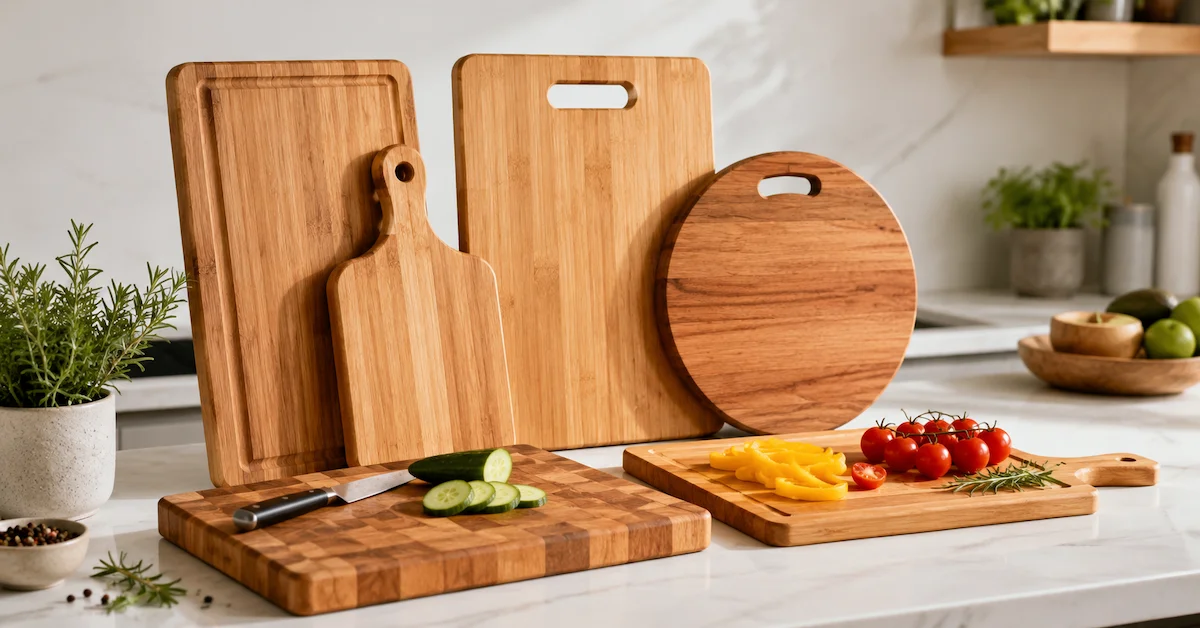
The original product set includes several visible board formats: rectangular prep boards, boards with juice grooves, paddle-style boards with handle slots, round handled boards, smaller presentation boards, and an end-grain style block board. This range matters because it suggests more than one merchandising route. A rectangular grooved board can fit everyday food preparation, while handled and round boards often suit serving or gift programs.
Buyers should not treat all wooden boards as interchangeable. A board with a juice groove may be useful for ingredients that release liquid, but the groove must be cleanly cut and sanded. A handled board may be convenient to carry, but the handle slot should feel smooth and secure. An end-grain style board can provide a more substantial look, yet it also requires buyers to ask more detailed questions about assembly, flattening, and long-term consistency.
Manufacturing Details Buyers Should Verify
Most board programs involve cutting, shaping, slotting, sanding, edge rounding, and finishing. The visible boards show rounded profiles and smooth-looking surfaces, but sourcing teams should confirm these details through physical samples rather than photos. The underside, handle cutouts, groove corners, and board edges often reveal more about factory discipline than the top surface does.
If a supplier uses routing or CNC processes for repeated shapes, ask how profiles are controlled across batches. If end-grain style boards are offered, ask whether the glue-up and flattening steps are handled in-house or outsourced. If a finish is applied, request the finish description and care instructions in writing. Do not describe the finish as food-safe, certified, or washable in a specific way unless the supplier provides supporting information suitable for your market.
Comparison Table: Board Formats and Sourcing Checks
| Board format | Typical buyer use | What to inspect in samples | Questions to ask the supplier |
|---|---|---|---|
| Rectangular board with groove | Everyday prep, retail kitchenware | Groove smoothness, flatness, edge rounding | How is the groove cut and sanded? |
| Paddle board with handle slot | Serving, gifting, display lines | Handle comfort, slot finish, balance | Can the handle shape be customized? |
| Round handled board | Presentation, cheese, bread, casual serving | Round profile consistency, surface finish | How is dimensional consistency controlled? |
| Smaller board | Compact kitchens, add-on retail items | Weight, storage convenience, edge feel | Can sizes be grouped as a coordinated set? |
| End-grain style block | Premium lines, gift programs | Assembly quality, flatness, visual uniformity | Is the end-grain construction produced in-house? |
Procurement Criteria That Matter
A sourcing decision should go beyond appearance and unit price. Ask for clear material descriptions, product drawings, sample approval standards, packaging methods, and finish details. If the supplier offers several board types, confirm whether they are made from the same stated material or from different constructions. This helps avoid confusion in listings, packaging copy, and customer service responses.
Sample inspection should include practical handling tests. Place the board on a flat surface and check for rocking. Run a hand around the edges and handle slot to detect rough areas. Inspect the juice groove for splinters or uneven routing. Compare several samples side by side to see whether dimensions, color tone, and finish are reasonably consistent. For B2B programs, consistency is often more valuable than a single perfect sample.
OEM and Private-Label Questions to Ask
When discussing OEM or wholesale cutting boards, keep the conversation specific. Useful questions include:
- Which board shapes are standard, and which require custom tooling or setup?
- What tolerances can be maintained for length, width, thickness, and handle placement?
- What sanding process is used before finishing and packaging?
- What finish is applied, and what care instructions should be provided to end users?
- How are boards packed to reduce abrasion, corner damage, or moisture exposure during transit?
- What documentation can the supplier provide for material descriptions, labeling, and market requirements?
A reliable cutting board manufacturer should answer with process detail, not only broad assurances. If the answers are vague during sampling, they may become more difficult during production.
Common Overstatements to Avoid
Cutting board listings often contain broad claims that buyers should verify before using them. Do not assume a natural-looking board has a specific finish, a specific wood species, antibacterial properties, or dishwasher compatibility. Do not claim certification, testing, or compliance unless documentation is available and relevant to the selling market.
It is also risky to assume that a board suitable for serving is automatically suitable for heavy prep. Serving boards may prioritize appearance and handling, while prep boards need stable surfaces, practical sizes, and durable edge treatment. Define the product role first, then approve the design language.
Use Cases: Retail, Restaurants, and Gifts
Retail buyers usually benefit from a coordinated range: a practical grooved board for daily use, a handled board for serving, and a smaller board for entry-level pricing or compact kitchens. Restaurants and catering buyers may focus more on grip, cleaning routines, storage, and repeated handling. Gift programs often emphasize shape, grain appearance, and presentation, but the board still needs to function well after purchase.
For every channel, care guidance matters. Wooden boards generally require more user education than plastic boards, so buyers should ask the supplier what care language is appropriate for the exact finish and construction being supplied.
FAQ for Sourcing Teams
Is an end-grain style cutting board always the best option?
No. It may offer a premium visual impression and a heavier feel, but it can also involve higher complexity. Choose it only if the price point, packaging, and end customer expectations support it.
Can one cutting board design work for prep and serving?
Sometimes, but buyers should test the board for both uses. A serving board needs comfortable handling and presentation value, while a prep board needs stability, smooth edges, and practical working space.
What should buyers request before approving production?
Request approved samples, written material descriptions, finish information, packaging details, product dimensions, and any documentation needed for your sales market. Avoid adding claims that the supplier has not supported.
How should a buyer compare two suppliers?
Compare sample consistency, response quality, process transparency, packaging method, customization limits, and willingness to document specifications. The lowest quote is not always the lowest-risk option.
