




Cutting Board Supplier Guide: What Buyers Should Check Before Ordering
Choosing a cutting board supplier is not only a price comparison. For retailers, hospitality buyers, distributors, and private-label kitchenware teams, the decision affects product consistency, packaging, customer feedback, and repeat ordering. A board can look acceptable in a catalog image but still disappoint when the surface feels rough, the handle cutout is uncomfortable, or the juice groove is too shallow to serve a real purpose.
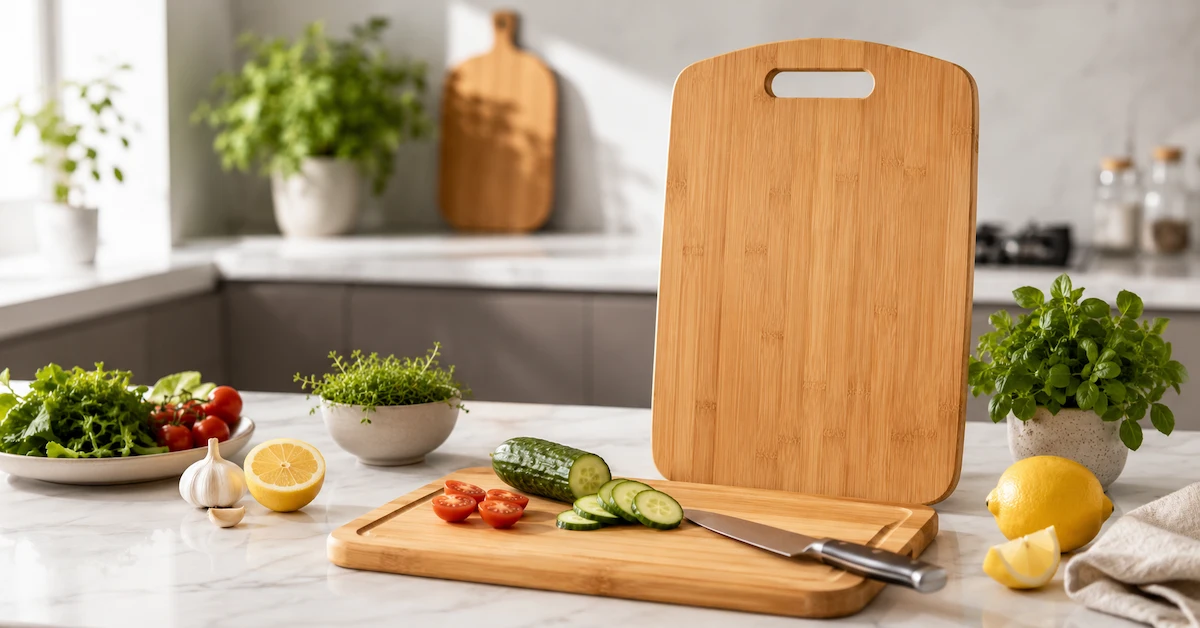
The product style shown is a light bamboo or wood chopping board with rounded corners, an integrated oval handle cutout, a natural matte appearance, and, on one visible board, a shallow perimeter groove. Those details are common in retail-friendly boards because they support both food preparation and presentation. Before placing an order, buyers should turn those visible details into a written sourcing checklist.
Key Takeaways
- Do not approve a cutting board supplier based on staged photos alone; request actual sample images and physical samples where possible.
- Check tactile details such as edge rounding, handle smoothness, surface sanding, and groove depth.
- Ask how the board is constructed and finished, especially when buying bamboo or engineered wood products.
- Match the board design to the sales channel: retail, gift, hospitality, food service, or private label.
- Avoid accepting claims about durability, dishwasher suitability, stain resistance, or food-contact compliance unless the supplier can provide relevant documentation.
Why Supplier Choice Matters for Cutting Boards
Cutting boards seem simple, but they are used in a high-contact environment. Customers touch the surface, wash the product, carry it by the handle, and may use it for slicing fruit, vegetables, bread, herbs, or serving food. Small production differences can become visible quickly.
For B2B buyers, the most common problems are not dramatic failures. They are subtler issues: inconsistent color across a batch, rough fibers inside the handle cutout, uneven sanding, weak-looking edges, or packaging that does not protect corners during shipping. These problems increase returns, slow down replenishment, and create extra work for quality teams.
What Buyers Usually Need from a Board Supplier
A practical sourcing brief should describe more than size and material. For the board style shown, buyers may need a clean natural appearance, rounded corners, a comfortable oval handle, a smooth matte surface, and a groove if the board is intended for juicy ingredients or serving use.
Before requesting a quotation, clarify the following points:
- Primary use: chopping, serving, gift set, retail shelf product, or hospitality supply.
- Preferred construction: ask whether it is bamboo, laminated bamboo, wood, or another engineered material.
- Handle requirement: hanging, carrying, display, or decorative purpose.
- Groove requirement: no groove, shallow rim, or deeper liquid-catching groove.
- Packaging expectation: bulk pack, retail sleeve, gift box, hang tag, or private-label packaging.
This level of detail helps suppliers quote on the same basis and reduces misunderstandings when comparing samples.
Bamboo Boards: Useful, but Not All the Same
Bamboo boards appear often in buyer briefs because they offer a natural look, moderate weight, and strong shelf appeal. They can fit home kitchen lines, promotional bundles, and branded kitchenware ranges. However, buyers should not assume that every bamboo board is built the same way.
Depending on the supplier and design, a board may use strips, layers, lamination, or another construction method. The image alone does not confirm the exact build, thickness, adhesive system, surface treatment, or long-term behavior in use. These are commercial and technical questions to ask the supplier directly.
For OEM or private-label sourcing, request a clear explanation of the material structure, machining process, sanding process, and finish. If the supplier cannot explain how the board is made, it becomes harder to control repeat orders.
Sample Approval Checklist
When comparing suppliers, use the same inspection points for each sample. The table below gives a practical framework for B2B evaluation.
| Check Point | What to Inspect | Why It Matters |
|---|---|---|
| Surface finish | Feel the board by hand; check for rough patches, sticky coating, or uneven sheen. | A smooth, consistent surface affects perceived quality and customer trust. |
| Edge treatment | Inspect corners and side edges for rounding, sanding marks, or splinters. | Softened edges make the board safer and more comfortable to handle. |
| Handle cutout | Check the inside of the oval opening for clean machining and enough finger space. | The handle is a daily-use feature, not only a visual detail. |
| Juice groove | Confirm whether the groove is decorative or deep enough for the intended use. | A shallow groove may look good but offer limited function. |
| Batch consistency | Compare several units, not one perfect sample. | Retail and wholesale buyers need repeatable appearance and dimensions. |
| Packaging fit | Check whether corners, handles, and surfaces are protected during transport. | Damage in transit can erase savings from a lower unit price. |
Questions to Ask Before Placing an Order
A reliable cutting board supplier should be able to answer practical production and quality questions. Buyers do not need to demand confidential factory details, but they should understand enough to reduce risk.
- What material construction is used for this board?
- Are the handle and groove CNC-cut, routed, or formed another way?
- What sanding steps are used after machining?
- What surface finish is applied, and what care instructions should be provided?
- Can groove depth, board profile, or handle position be adjusted?
- Will bulk production follow the same process as the approved sample?
- What packaging options are available for retail or private-label orders?
- What documents can you provide for any claims related to food contact, testing, or compliance?
Be cautious with unsupported claims. If a supplier says a board is dishwasher-safe, antimicrobial, stain-resistant, or certified for a particular market, ask for the relevant documentation before using that claim in your sales materials.
Matching Board Design to Sales Channel
For retail, the board needs to look clean in packaging and photography. Rounded corners, a natural finish, and a handle cutout can make the product easier to display. For gift sets, visual consistency across multiple boards or accessories becomes especially important.
For hospitality or food service, buyers may care more about handling, cleaning routines, board size, and replacement cycles. A groove can be useful for juicy foods, while a flat board may be easier for fast prep tasks. One design does not suit every use case.
For private-label programs, confirm where branding will go before production. Logo placement can be affected by handle position, groove layout, board dimensions, and packaging format. Ask for a pre-production sample with the intended branding method before approving bulk production.
Common Sourcing Mistakes to Avoid
The first mistake is treating the product photo as a full specification. A photo does not confirm thickness, construction, finish type, groove depth, packaging, or batch consistency. The second mistake is overvaluing appearance while ignoring feel. Customers notice rough edges and uncomfortable handles as soon as they pick up the board.
A third mistake is assuming a serving board and a chopping board can always be marketed the same way. If the board is mainly for presentation, say so. If it is intended for regular food preparation, inspect the working surface and care instructions carefully. Clear positioning helps prevent customer misuse and unrealistic expectations.
Practical FAQ
What should I check first in a cutting board sample?
Start with surface smoothness, edge finishing, handle comfort, groove function, and overall consistency. These are the details customers notice immediately.
Is bamboo always the best material for cutting boards?
Not always. Bamboo is popular for its natural look and retail appeal, but suitability depends on construction, finish, intended use, and care requirements. Ask the supplier for exact material and process details.
Should I request one sample or several?
Several samples are better. One sample may not show normal batch variation. Comparing multiple units helps reveal color differences, machining consistency, and packaging protection.
Can I add private-label branding to this type of board?
Often, private-label branding may be possible, but buyers should ask the supplier about available methods, logo placement limits, sample approval, packaging options, and any effect on lead time or cost.
Final Buyer Advice
Before shortlisting a cutting board supplier, define the board style, use case, finish expectation, handle design, groove requirement, and packaging format. Then compare suppliers against that written brief rather than relying on first impressions.
The right supplier is not simply the one that can make a board. It is the one that can reproduce the approved board consistently, answer sourcing questions clearly, and support the channel you sell into. In this category, the details you feel by hand often matter as much as the details you see in a photo.
