




What Should Buyers Know About an Ergonomic Kitchen Tools Manufacturer?
An ergonomic kitchen tools manufacturer focuses on designing and producing kitchen products that improve user comfort, control, and efficiency. For brands, retailers, importers, and private-label companies, ergonomic design is no longer only a product feature; it is a way to create differentiation in competitive kitchenware markets.
Modern consumers expect kitchen products to be easy to hold, comfortable to use, and suitable for repeated daily tasks. A well-designed kitchen tool should consider how users interact with the product, from grip comfort and weight balance to overall functionality.
For B2B buyers, selecting the right manufacturer requires evaluating more than product appearance. Important factors include:
- Ergonomic design capability
- Product development experience
- Material selection
- Manufacturing processes
- Quality control systems
- OEM and private-label support
- Packaging solutions
BONET provides kitchenware manufacturing solutions covering kitchen scissors, kitchen knives, utensils, chopping boards, multifunctional kitchen tools, and related products for global brands, retailers, distributors, and e-commerce businesses. BONET Products
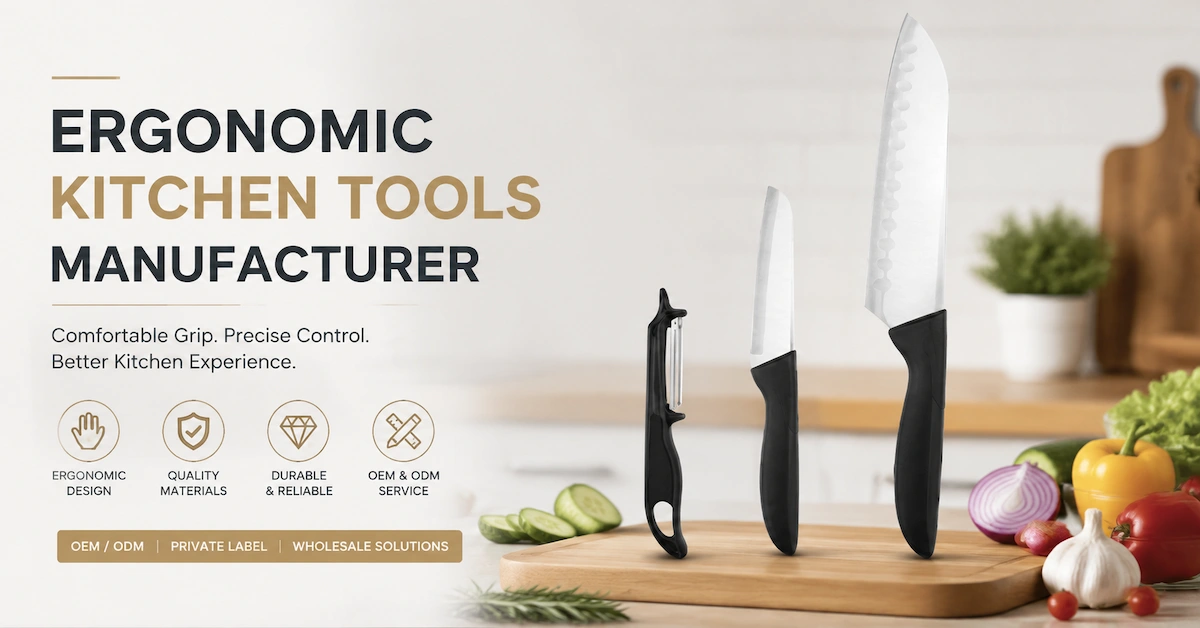
What Are Ergonomic Kitchen Tools?
Ergonomic kitchen tools are products designed around the relationship between the user and the tool.
Instead of focusing only on appearance, ergonomic design considers:
- How users hold the product
- How much force is required
- How comfortable the product feels during repeated use
- Whether the tool improves efficiency
- Whether the design reduces unnecessary strain
Examples include:
- Kitchen scissors with comfortable handles
- Knives with balanced weight distribution
- Utensils designed for easier gripping
- Multifunctional tools that simplify kitchen tasks
For manufacturers, ergonomic design involves balancing user experience, production feasibility, material selection, and cost requirements.
Why Ergonomic Design Matters for Kitchenware Brands
Kitchen tools are frequently used products. Small improvements in comfort and usability can significantly influence customer satisfaction.
For retail brands and product developers, ergonomic design provides several advantages:
| Benefit | Business Value |
|---|---|
| Better user comfort | Improves customer experience |
| Easier operation | Increases product appeal |
| Product differentiation | Helps brands compete |
| Premium positioning | Supports higher-value collections |
| Better reviews | Encourages customer satisfaction |
A basic kitchen tool may solve a functional problem, but an ergonomic kitchen tool can create a better user experience.
This difference is especially important for:
- Premium kitchenware brands
- Private-label products
- Online retailers
- Lifestyle product companies
Types of Ergonomic Kitchen Tools
Different kitchen products require different ergonomic considerations.
Ergonomic Kitchen Scissors
Kitchen scissors depend heavily on handle design and cutting control.
Important design factors include:
- Comfortable grip
- Smooth opening and closing
- Stable blade alignment
- Suitable hand positioning
For retail buyers, ergonomic scissors can create differentiation from basic household scissors.
Ergonomic Kitchen Knives
Kitchen knives require careful attention to:
- Handle comfort
- Weight balance
- User control
- Cutting experience
A knife should feel stable during use rather than simply looking attractive.
Ergonomic Kitchen Utensils
Utensils such as spatulas, spoons, and cooking tools often focus on:
- Comfortable holding
- Practical shape
- Ease of cleaning
- Daily usability
Multifunctional Kitchen Tools
Multifunctional products should simplify tasks rather than create unnecessary complexity.
Buyers should evaluate:
- Whether functions are practical
- Whether the product remains easy to use
- Whether storage is convenient
BONET's kitchenware categories include multifunctional products, kitchen knives, utensils, scissors, chopping boards, and kitchen gadgets suitable for different retail applications. BONET Kitchenware Categories
Key Ergonomic Features Buyers Should Evaluate
When sourcing ergonomic kitchen products, buyers should focus on several design elements.
Handle Design and Grip Comfort
The handle is one of the most important ergonomic components.
Manufacturers should consider:
- Shape
- Size
- Surface texture
- Grip stability
- User comfort
A poorly designed handle can reduce product usability even if the main function works correctly.
Weight Balance
Weight affects:
- Control
- User fatigue
- Product feeling
For products such as knives and scissors, balanced weight distribution can improve handling.
Functional Efficiency
Ergonomic design should make tasks easier.
Buyers should ask:
- Does the product solve a real user problem?
- Is the operation intuitive?
- Does the design improve daily usage?
Product Safety and User Experience
Kitchen products should also consider:
- Smooth edges
- Secure assembly
- Comfortable operation
- Appropriate product structure
Materials Used in Ergonomic Kitchen Tools
Material selection influences:
- Product performance
- Comfort
- Appearance
- Durability
- Cost positioning
BONET's OEM/ODM capabilities include support for materials such as stainless steel, silicone, plastic, wood, bamboo, aluminum alloy, and composite materials depending on project requirements. BONET OEM ODM Service
Stainless Steel Components
Common applications:
- Kitchen knives
- Scissors
- Metal kitchen tools
Buyers should evaluate:
- Product specifications
- Surface finish
- Intended application
- Manufacturing requirements
Silicone Components
Silicone is often used where comfort and grip are important.
Applications include:
- Handles
- Cooking utensils
- Kitchen accessories
Important considerations:
- Feel
- Flexibility
- Color consistency
- Design requirements
Plastic and Composite Materials
Used for:
- Lightweight structures
- Handles
- Functional components
The correct material depends on product positioning and target customers.
Manufacturing Process Behind Ergonomic Kitchen Tools
Ergonomic design must be supported by reliable manufacturing.
A product may have a good concept, but production accuracy determines whether the final product matches the design intention.
Important manufacturing stages may include:
- Component forming
- Surface treatment
- Grinding
- Polishing
- Handle production
- Assembly
- Quality inspection
BONET's manufacturing information describes processes including stamping, straight adjustment, heat treatment, grinding, polishing, injection molding, ultrasonic cleaning, assembly, quality inspection, final cleaning, protection, and packing for related cutting-tool products. BONET Manufacturing Process
Why Manufacturing Capability Matters
For brands and retailers, manufacturing capability affects:
- Product consistency
- Sample-to-production accuracy
- Customization ability
- Repeat-order stability
A supplier with manufacturing experience can better support product improvements and customization requests.
OEM and Private Label Ergonomic Kitchen Tools
Many brands develop ergonomic kitchen products to create unique market positioning.
An experienced manufacturer should support different customization levels.
Common Customization Options
Buyers may require:
- Custom handle design
- Product colors
- Logo printing
- Laser engraving
- Packaging customization
- Product combinations
- New product development
BONET's OEM/ODM services include production based on drawings or samples, material and color customization, logo printing or laser engraving, packaging customization, and product development support. BONET OEM ODM Solutions
OEM vs ODM Ergonomic Kitchen Tools
| Service | Suitable For |
|---|---|
| OEM | Buyers with existing product requirements |
| Private Label | Brands creating their own collections |
| ODM | Companies developing new concepts |
The right service depends on whether the buyer needs branding only or deeper product development support.
Quality Control for Ergonomic Kitchen Products
Quality control is especially important because ergonomic products depend on both function and user experience.
A product may meet visual expectations but fail during daily use.
Ergonomic Kitchen Tool QC Checklist
| QC Area | What Buyers Should Check |
|---|---|
| Grip | Comfort and consistency |
| Function | Product performance |
| Assembly | Stability of components |
| Appearance | Surface quality |
| Dimensions | Product specification accuracy |
| Packaging | Retail presentation |
| Consistency | Match with approved samples |
BONET states that its OEM/ODM workflow includes quality inspection covering appearance, function, assembly, packaging, and overall consistency before delivery. BONET OEM ODM Process
Applications and Buyer Markets for Ergonomic Kitchen Tools
Different buyers use ergonomic kitchen products for different purposes.
Kitchenware Brands
Need:
- Product differentiation
- Better user experience
- Brand value
Retailers and Home Stores
Need:
- Attractive products
- Reliable quality
- Retail-ready packaging
Supermarket Buyers
Need:
- Practical products
- Stable supply
- Competitive positioning
E-Commerce Sellers
Need:
- Unique product features
- Customer satisfaction
- Strong product presentation
Private Label Companies
Need:
- Custom designs
- Branding support
- Long-term cooperation
How to Select the Right Ergonomic Kitchen Tools Manufacturer?
Before choosing a supplier, buyers should evaluate several areas.
Supplier Selection Checklist
| Question | Why It Matters |
|---|---|
| Does the supplier understand ergonomic design? | Improves product usability |
| Can the supplier customize products? | Supports brand differentiation |
| Does the supplier control manufacturing? | Improves consistency |
| Can the supplier support packaging? | Improves retail readiness |
| Does the supplier provide quality control? | Reduces sourcing risk |
| Can the supplier support repeat orders? | Enables long-term cooperation |
The best manufacturer is not only a production partner but also a product development partner.
Common Mistakes When Sourcing Ergonomic Kitchen Tools
Focusing Only on Appearance
A visually attractive product may still perform poorly if comfort and usability are ignored.
Ignoring User Testing
Ergonomic products should be evaluated through actual use scenarios.
Choosing Materials Without Considering Application
Different products require different material solutions.
Not Defining Specifications Clearly
Buyers should confirm:
- Dimensions
- Materials
- Colors
- Functions
- Packaging
- Quality expectations
Skipping Sample Approval
Samples help verify whether the final product matches expectations before mass production.
FAQ
What is an ergonomic kitchen tools manufacturer?
An ergonomic kitchen tools manufacturer designs and produces kitchen products focused on comfort, usability, control, and user experience.
Why are ergonomic kitchen tools important?
Ergonomic kitchen tools improve comfort, handling, and efficiency, helping brands create products with stronger market differentiation.
What products can be designed ergonomically?
Examples include kitchen scissors, knives, utensils, multifunctional kitchen tools, and other daily kitchen products.
Can ergonomic kitchen tools be customized?
Yes. Manufacturers may support custom designs, colors, logos, packaging, and product development depending on project requirements.
What materials are used for ergonomic kitchen tools?
Common materials include stainless steel, silicone, plastic, wood, bamboo, aluminum alloy, and composite materials.
How do manufacturers improve kitchen tool comfort?
Manufacturers consider handle design, weight balance, material selection, product structure, and user interaction.
What should brands check before choosing a manufacturer?
Brands should evaluate design capability, manufacturing experience, quality control, customization support, and communication.
Can ergonomic kitchen tools be private labeled?
Yes. Private-label programs can include branding, packaging customization, and product adjustments.
Why work with an ergonomic kitchen tools manufacturer instead of a trader?
Manufacturers may provide better control over production, customization, quality consistency, and product development.
Does BONET provide custom ergonomic kitchen tool solutions?
BONET provides OEM/ODM kitchenware manufacturing solutions including customization, product development support, packaging solutions, and manufacturing services for global business buyers. BONET Contact Us
Conclusion
Choosing the right ergonomic kitchen tools manufacturer requires evaluating design capability, manufacturing expertise, material knowledge, customization options, and quality management.
For brands and retailers, ergonomic kitchen tools provide an opportunity to create products that combine practical function with better user experience.
A professional manufacturer can help transform product ideas into reliable kitchenware solutions through product development, manufacturing control, OEM support, and quality management.
BONET supports global buyers with kitchen scissors, knives, utensils, chopping boards, multifunctional kitchen tools, and customized kitchenware solutions.
Brands developing ergonomic kitchen products can explore BONET's product range, OEM/ODM services, manufacturing capabilities, or contact the team to discuss product requirements. BONET Products BONET Contact Us
